
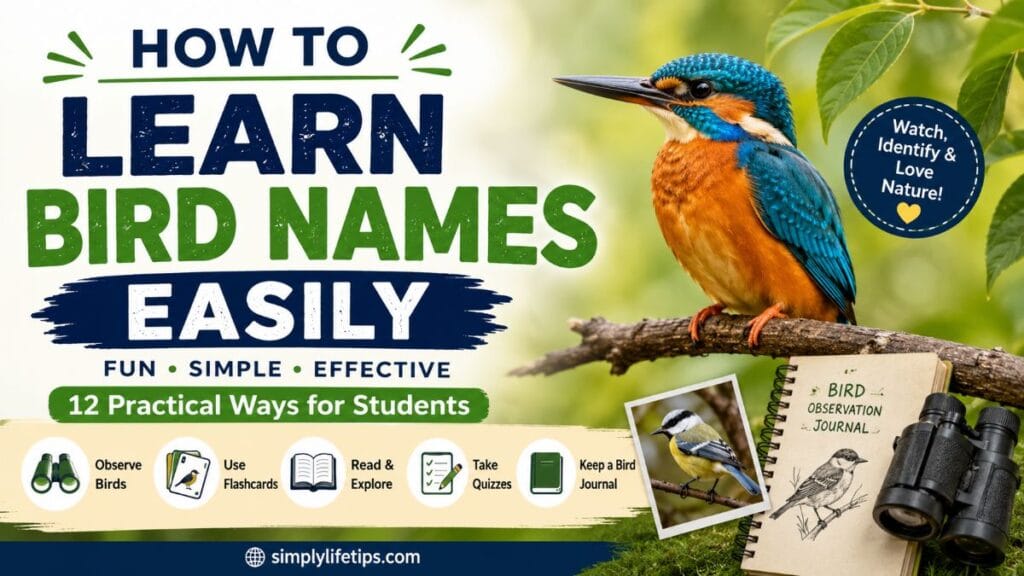
Have you ever wondered how to learn bird names easily while making the experience enjoyable and memorable? Learning bird names does not have to involve memorizing long lists from textbooks. By combining outdoor observation, interactive activities, creative projects, and educational resources, students can recognize different bird species with confidence. Understanding how to learn bird names easily also improves vocabulary, observation skills, scientific knowledge, and appreciation for wildlife. Whether you are a student, teacher, or parent, these practical methods will help make bird identification an exciting part of everyday learning.
If you’re new to bird identification, start with our comprehensive Bird Names in English guide to learn the names and pictures of common bird species before exploring how to learn bird names easily.
Key Takeaways
- Learning how to learn bird names easily is more effective when students combine outdoor observation with interactive learning methods.
- Watching birds in parks, gardens, forests, and backyards helps students identify species by their appearance, behavior, and habitat.
- Educational flashcards, field guides, and bird identification apps improve memory and make learning more engaging.
- Wildlife documentaries and bird-watching programs allow students to observe birds in their natural environments and understand their behaviors.
- Drawing, coloring, storytelling, and educational games make bird learning enjoyable, especially for younger children.
- Keeping a bird observation journal helps students record their discoveries and strengthens long-term retention.
- Group discussions, presentations, and quizzes reinforce knowledge while improving communication and critical thinking skills.
- Practical bird-learning activities enhance vocabulary, observation, concentration, and environmental awareness.
- Making bird identification a daily habit helps students recognize common bird species more quickly and confidently.
- Learning bird names encourages curiosity about wildlife, fosters respect for biodiversity, and inspires lifelong appreciation for nature.
Learn Bird Names Easily: Infographic
Looking for a quick and engaging way to remember bird names? This infographic summarizes the 12 practical methods discussed in this guide, making it easy for students, parents, and teachers to review the key techniques at a glance. Save or pin it for future reference and use it as a handy visual guide during bird-watching trips, classroom activities, or outdoor learning sessions.
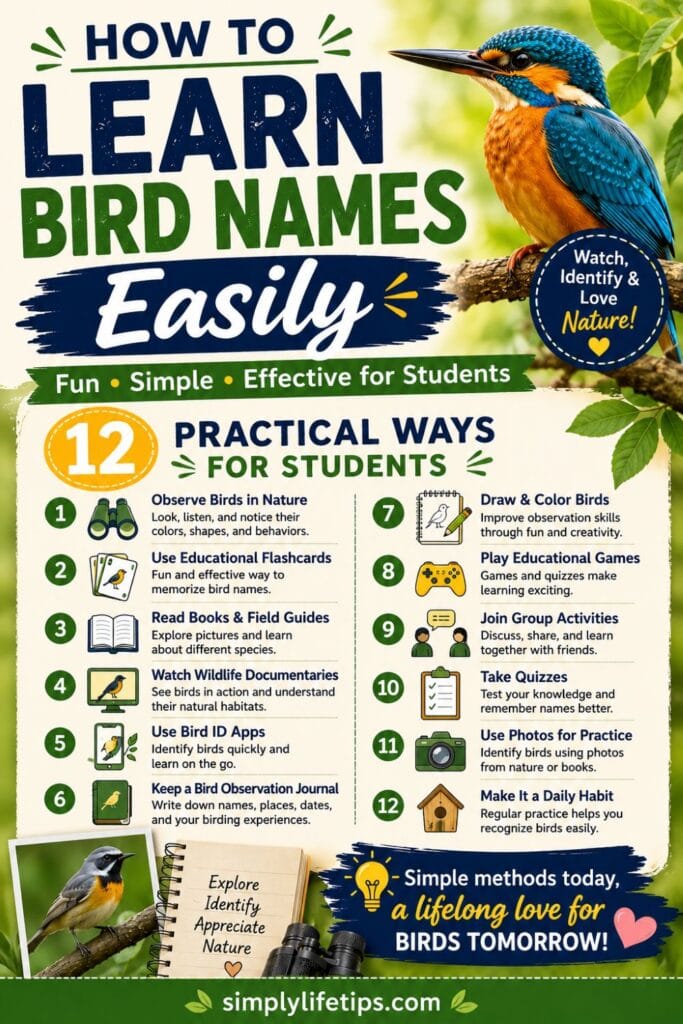
The infographic provides a simple overview of how to learn bird names easily, but the detailed explanations in this article will help you apply each method more effectively. By combining bird watching, educational games, flashcards, field guides, and regular practice, you’ll develop stronger bird identification skills and a deeper appreciation for wildlife. Don’t forget to bookmark this guide and share the infographic with fellow students, teachers, and nature enthusiasts.
How to Learn Bird Names Easily?
Observe Birds in Nature
One of the most effective ways to understand how to learn bird names easily is by observing birds in their natural habitats. Students can visit parks, gardens, forests, wetlands, rivers, lakes, or even watch birds from their own backyards. Seeing birds in real life helps learners connect their names with their appearance, size, colors, and behavior.
For example, students may notice a sparrow hopping around searching for seeds, a kingfisher patiently waiting beside a pond before diving for fish, or a crow collecting food in an urban environment. Watching birds fly, build nests, care for their chicks, and interact with their surroundings creates lasting memories that make identification much easier. Carrying binoculars, a bird field guide, or a bird identification app during outdoor visits can further improve the learning experience.
Use Educational Flashcards
Educational flashcards are one of the simplest ways to learn bird names easily. Each flashcard can display a bird’s photograph or illustration on one side and its name, habitat, diet, or interesting facts on the other.
Students can make their own flashcards using drawings, printed images, or photographs, making the activity even more engaging. For example, one flashcard may feature a peacock with information about its colorful feathers, while another shows a pelican explaining its large throat pouch used for catching fish. Reviewing flashcards regularly improves memory retention and helps students recognize birds more quickly during outdoor observations.
Watch Wildlife Documentaries
Wildlife documentaries provide an exciting opportunity to learn about birds from different regions of the world. High-quality nature programs allow students to observe birds in forests, mountains, deserts, wetlands, oceans, and polar regions without leaving home.
Students can watch eagles hunting from the sky, flamingos living together in large colonies, hummingbirds hovering while feeding on flowers, or penguins protecting their chicks in icy environments. Watching these documentaries helps students recognize birds visually while learning about their habitats, migration, feeding habits, and ecological importance.
Take Bird Identification Quizzes
If you want to know how to learn bird names easily, regular quizzes are an excellent way to reinforce knowledge. Bird identification quizzes usually present pictures, silhouettes, or bird calls and ask students to choose the correct species.
Teachers can organize classroom competitions, parents can create simple quizzes at home, and students can use online educational platforms that offer interactive bird games. Frequent practice helps improve memory, builds confidence, and makes bird identification much faster.
Maintain a Bird Observation Journal
Keeping a bird observation journal is one of the most rewarding learning habits for students. Every time they observe a bird, they can record its name, location, color, size, feeding behavior, habitat, weather conditions, and any interesting observations.
Students may also include sketches, photographs, or notes about bird calls. For example, they might record seeing a robin collecting worms in a garden after rain or watching an egret searching for fish in a wetland. Over time, the journal becomes a valuable personal reference that strengthens both observation and identification skills.
Create Bird Drawing and Coloring Activities
Drawing and coloring birds helps students focus on important physical characteristics that distinguish one species from another. Carefully studying a bird while drawing encourages learners to notice feather patterns, beak shapes, eye colors, wing structures, and tail designs.
For example, coloring the brilliant blue feathers of a kingfisher or the colorful plumage of a macaw helps students remember these birds much more effectively than simply reading about them. Artistic activities also improve creativity and fine motor skills while making bird learning enjoyable.
Learn Through Educational Games
Educational games make learning bird names exciting rather than stressful. Students can participate in matching games, crossword puzzles, word searches, memory cards, and digital learning apps that focus on bird identification.
For example, students can match bird photographs with their correct names, solve puzzles based on habitats, or identify birds using descriptive clues. Interactive games encourage active participation and improve long-term memory while keeping students motivated.
Join Bird Watching Programs
Many schools, wildlife organizations, and environmental clubs organize bird-watching programs that provide excellent opportunities for practical learning. These guided excursions allow students to observe birds alongside experienced birdwatchers and naturalists.
Experts teach participants how to identify birds using body shape, feather colors, flight patterns, bird songs, nesting behavior, and preferred habitats. Bird-watching programs also develop patience, concentration, teamwork, and a greater appreciation for biodiversity.
Use Bird Books and Field Guides
Bird books and field guides remain some of the most valuable resources for students learning bird identification. These books contain detailed photographs, illustrations, identification tips, habitat descriptions, migration maps, and interesting facts about various bird species.
Students can compare similar-looking birds, learn scientific names, understand migration routes, and study bird calls. Carrying a field guide during nature walks allows learners to identify unfamiliar birds quickly and accurately.
Learn Bird Names Through Stories and Poems
Stories, poems, rhymes, and children’s books make learning bird names enjoyable, especially for younger students. Many educational stories feature birds as main characters, helping children associate each species with memorable behaviors and personalities.
For example, reading stories about clever crows, singing nightingales, hardworking woodpeckers, or majestic eagles helps students remember bird names naturally while improving reading comprehension and language skills.
Practice Group Discussions and Presentations
Classroom discussions and presentations encourage students to research different bird species and share their knowledge with classmates. Each student can choose a bird and explain its habitat, diet, behavior, physical characteristics, and interesting facts.
For example, one student may discuss the migration of swallows, another may explain the hunting skills of hawks, while someone else presents information about parrots or owls. These activities strengthen communication skills while reinforcing bird identification knowledge.
Connect Learning with Daily Life
A simple but powerful answer to how to learn bird names easily is to make bird identification part of everyday life. Birds are present almost everywhere, providing countless opportunities for regular practice.
Students can identify pigeons in city squares, sparrows around homes, crows on rooftops, kingfishers near rivers, mynas in gardens, and egrets in agricultural fields. Making bird observation a daily habit helps learners remember bird names naturally while becoming more aware of the wildlife around them.
Benefits of Learning Bird Names
Learning how to learn bird names easily through practical activities offers far more than the ability to identify different bird species. It supports academic learning, improves life skills, and encourages students to develop a meaningful connection with nature. Here are the major benefits in detail.
Improves Vocabulary and Language Skills
Learning bird names introduces students to a wide range of new words, helping them expand their vocabulary naturally. They become familiar with common bird names such as sparrow, eagle, robin, kingfisher, flamingo, and woodpecker, as well as descriptive terms related to feathers, beaks, wings, habitats, and migration.
Reading bird guides, writing observation notes, and discussing bird species with teachers or classmates also improve spelling, pronunciation, reading comprehension, and communication skills. These language skills benefit students across multiple academic subjects.
Strengthens Observation and Concentration Skills
Bird identification requires students to pay close attention to details. They learn to observe a bird’s size, feather colors, beak shape, tail length, flight pattern, feeding habits, and behavior before identifying the species.
For example, students may notice that a kingfisher has a long, pointed beak for catching fish, while a woodpecker has a strong beak designed for drilling into tree trunks. Regular observation improves concentration, attention to detail, and patience—valuable skills that also enhance classroom learning and problem-solving abilities.
Enhances Memory and Recall
Practical learning activities help students remember information more effectively than simple memorization. Observing birds in nature, drawing pictures, playing educational games, or maintaining a bird journal creates memorable experiences that strengthen long-term memory.
For instance, a student who watches a peacock displaying its colorful feathers in a park is more likely to remember its name than someone who only reads about it in a textbook. Repeated real-life experiences reinforce learning and improve recall during quizzes and examinations.
Encourages Environmental Awareness
Learning bird names helps students understand that birds are an important part of healthy ecosystems. They discover how birds pollinate flowers, disperse seeds, control insect populations, and contribute to maintaining ecological balance.
As students observe changes in bird populations or habitats, they also become more aware of environmental issues such as pollution, deforestation, climate change, and habitat loss. This awareness encourages responsible attitudes toward protecting wildlife and conserving natural resources.
Develops Curiosity and Scientific Thinking
Bird watching naturally inspires curiosity. Students begin asking questions such as why some birds migrate, how birds build nests, what different species eat, and why certain birds live only in specific habitats.
Searching for answers encourages research, critical thinking, and scientific inquiry. Students learn to compare observations, collect information, analyze patterns, and draw conclusions, which strengthens their overall scientific learning.
Makes Learning Fun and Interactive
One of the biggest advantages of learning bird names through practical methods is that it transforms education into an enjoyable experience. Activities such as bird watching, flashcards, quizzes, drawing, coloring, storytelling, and educational games keep students actively involved in the learning process.
Instead of memorizing long lists of names, students learn by exploring nature, solving puzzles, participating in competitions, and sharing discoveries with friends. This interactive approach increases motivation and reduces boredom.
Builds Creativity and Artistic Skills
Bird-related creative activities, such as sketching, painting, coloring, and crafting, encourage students to express themselves artistically while studying bird species. Carefully observing feather patterns, wing shapes, and color combinations improves visual observation and artistic accuracy.
For example, drawing a colorful macaw or painting the elegant feathers of a flamingo allows students to combine creativity with scientific observation, making learning both educational and enjoyable.
Improves Communication and Teamwork
Group discussions, classroom presentations, and bird-watching excursions encourage students to work together while sharing their knowledge. Explaining the characteristics of a bird or presenting research about its habitat helps improve public speaking and communication skills.
Team activities also teach students how to cooperate, exchange ideas, listen to others, and solve problems collectively, preparing them for collaborative learning in other subjects.
Promotes Healthy Outdoor Activities
Learning bird names often encourages students to spend more time outdoors in parks, gardens, forests, wetlands, and nature reserves. Outdoor learning reduces screen time while promoting physical activity through walking, hiking, and exploring natural environments.
Fresh air and regular contact with nature also support mental well-being, reduce stress, and improve overall concentration and mood.
Develops Respect for Wildlife and Biodiversity
As students become familiar with different bird species, they begin to appreciate the diversity of life on Earth. They understand that every bird plays an important role in maintaining healthy ecosystems, whether by controlling pests, spreading seeds, or pollinating plants.
This understanding fosters empathy toward animals and encourages students to support wildlife conservation, habitat protection, and environmentally responsible behavior throughout their lives.
Supports Academic Success
Bird identification combines knowledge from science, geography, environmental studies, language arts, and even mathematics through observation and data recording. Students learn to classify birds, understand ecosystems, read field guides, maintain journals, and interpret maps.
These interdisciplinary activities strengthen analytical thinking, research skills, and academic performance while making classroom lessons more meaningful and engaging.
Creates a Lifelong Interest in Nature
Perhaps the greatest benefit of learning how to learn bird names easily is that it encourages a lifelong appreciation for nature. Students who begin identifying birds at a young age often develop lasting hobbies such as bird watching, wildlife photography, nature journaling, and environmental conservation.
A simple habit of observing birds during daily walks can grow into a lifelong passion for protecting biodiversity and exploring the natural world.
Frequently Asked Questions (FAQs)
How can students learn bird names easily?
Students can learn bird names easily by combining practical activities such as bird watching, using flashcards, reading field guides, watching wildlife documentaries, taking bird identification quizzes, and maintaining a bird observation journal. Regular practice and real-life observation help improve memory and make learning more enjoyable.
Why is learning bird names important for students?
Learning bird names helps students improve their vocabulary, observation skills, environmental awareness, and scientific knowledge. It also encourages curiosity about wildlife and helps children understand the importance of biodiversity and nature conservation.
What are the best resources for learning bird names?
Some of the best resources include bird field guides, educational books, bird identification apps, wildlife documentaries, flashcards, online quizzes, and bird-watching programs. These tools provide pictures, descriptions, habitats, and interesting facts that make bird identification easier.
At what age can children start learning bird names?
Children can begin learning bird names as early as preschool through picture books, coloring activities, and simple bird-watching sessions. As they grow older, they can use field guides, nature journals, and educational apps to identify more bird species and learn about their habitats and behaviors.
What is the easiest way to remember bird names?
The easiest way to remember bird names is to observe birds regularly in nature and associate each bird with its unique features, such as feather colors, beak shape, size, habitat, or behavior. Repeating this process through flashcards, games, quizzes, and journaling strengthens long-term memory and makes bird identification much easier.
Conclusion
Knowing how to learn bird names easily opens the door to a fascinating world of nature and wildlife. By combining outdoor observation, educational games, flashcards, documentaries, journals, drawing activities, field guides, and classroom discussions, students can recognize bird species with confidence while developing valuable life skills. Learning bird names becomes much more meaningful when it is connected with real experiences, making every visit to a park, garden, or forest an opportunity to discover something new. With regular practice and curiosity, students can build a lifelong appreciation for birds and the natural world.
Related Articles
- Pirate Birds: Sky Explorers With A Taste For Adventure!
- Amazing Birds With The Longest Beaks: Names And Sounds
If this resonated with you, share it with someone who needs it.
PVM

Mathukutty P V is a Blogger, YouTuber, and Content Writer and the founder of Simply Life Tips. After taking voluntary retirement in 2017, he embraced a free lifestyle focused on learning, personal growth, and sharing practical wisdom to help others live with more purpose and positivity.



