
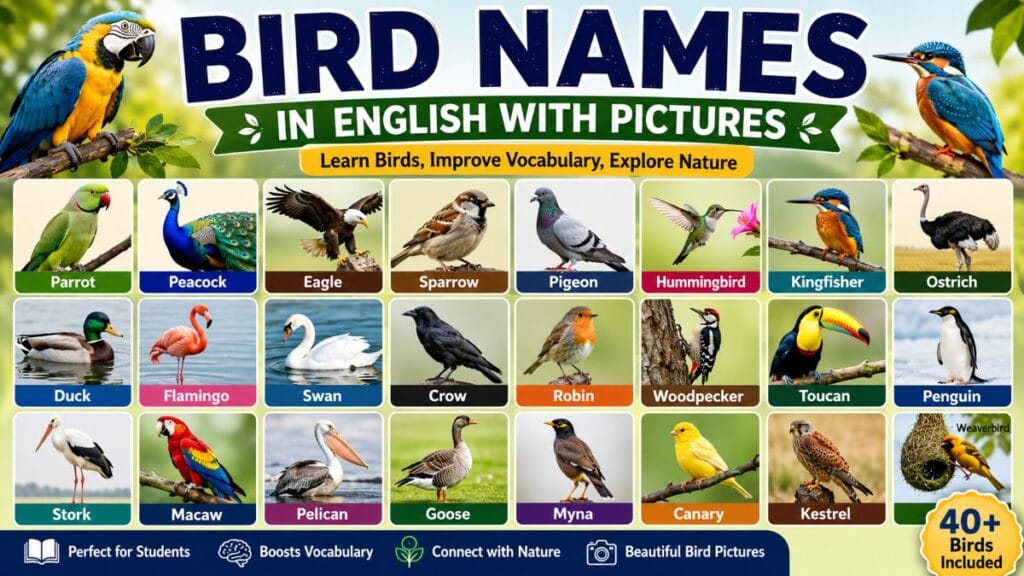
Bird names in English are essential vocabulary words that help students improve language skills while learning about the fascinating world of nature. Birds are found in almost every habitat on Earth, from dense forests and grasslands to deserts, mountains, wetlands, and oceans. They come in a wide variety of colors, sizes, and behaviors, making them one of the most interesting groups of animals to study. Learning bird names in English not only enhances vocabulary but also develops awareness of wildlife, biodiversity, and environmental conservation.
What Are Birds?
Birds are warm-blooded vertebrate animals belonging to the class Aves. They are characterized by feathers, wings, beaks, and the ability to lay eggs. Most birds can fly, although some species, such as ostriches and penguins, are flightless. Birds play important roles in ecosystems by pollinating plants, dispersing seeds, controlling pests, and maintaining ecological balance.
Scientists have identified more than 10,000 bird species worldwide. Some birds migrate thousands of kilometers every year, while others spend their entire lives in a single region.
Importance of Learning Bird Names in English
Learning bird names provides many educational benefits.
- Expands English vocabulary.
- Improves observation and identification skills.
- Encourages interest in science and nature.
- Helps students understand biodiversity.
- Supports environmental awareness.
- Enhances communication and general knowledge.
Students often encounter bird names in textbooks, stories, quizzes, and competitive examinations, making this topic valuable for academic learning.
Common Bird Names in English
Learning bird names in English becomes easier when learners can connect each name with a picture. The infographic below features more than 40 common bird names, helping students improve their vocabulary and recognize different birds.
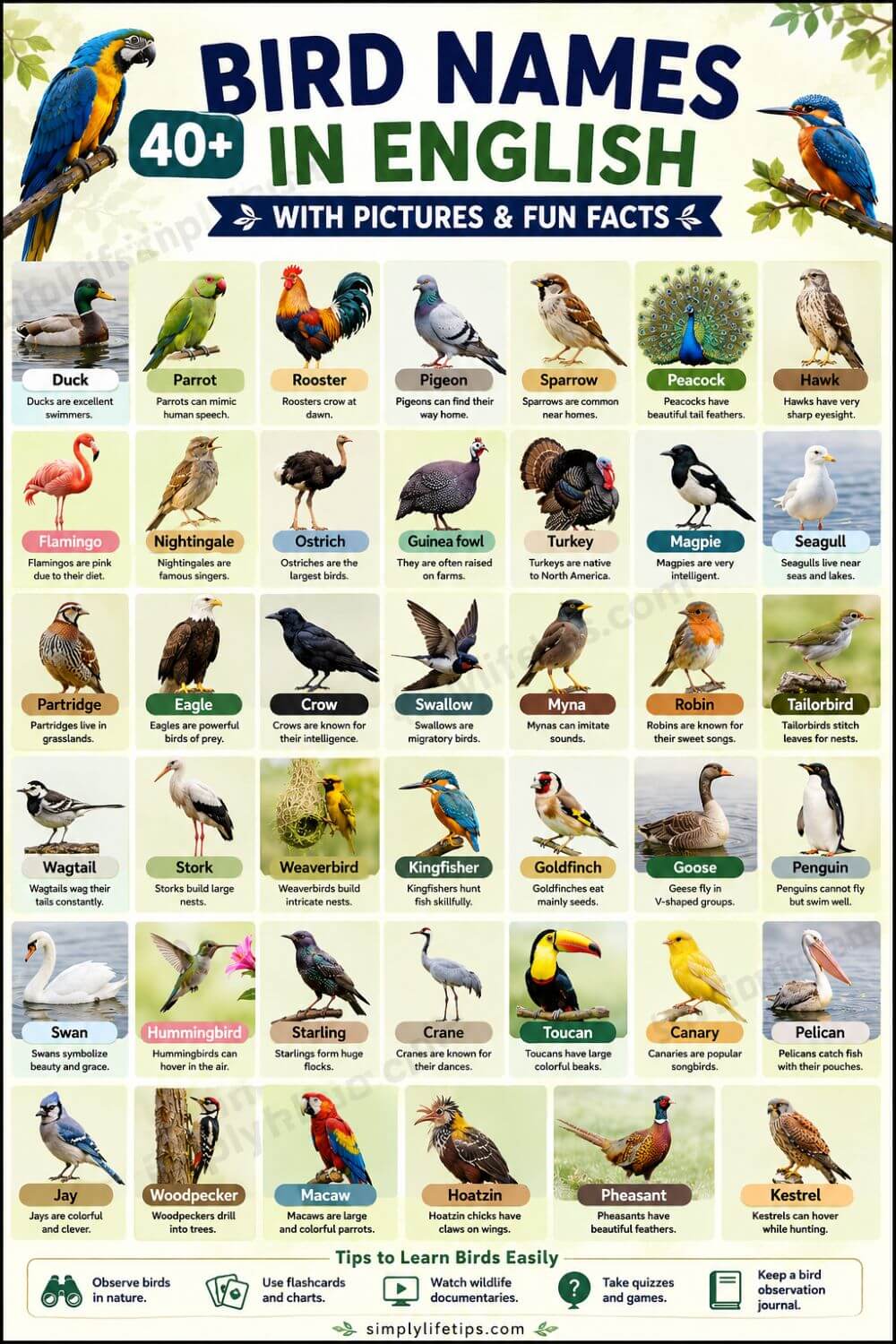
From colorful parrots and majestic eagles to graceful swans and tiny hummingbirds, birds display remarkable diversity. Save this visual guide for revision and explore the bird profiles below to learn more about their characteristics, habitats, and interesting facts.
Duck
Ducks are water birds commonly found in ponds, lakes, rivers, and marshes. They have broad bodies, short legs, and webbed feet that help them swim efficiently. Their waterproof feathers help keep them dry while floating on water.
Ducks feed on aquatic plants, insects, worms, and small fish. Domestic ducks are raised for eggs and meat, while wild ducks inhabit a variety of wetland environments.
Parrot
Parrots are colorful and intelligent birds known for their strong, curved beaks and ability to imitate sounds. Their beaks help them crack nuts and seeds, while some species also feed on fruits and flowers.
Parrots live mainly in tropical and subtropical regions of South America, Africa, Asia, and Australia. Popular types include macaws, cockatoos, and African grey parrots.
Rooster
A rooster is an adult male chicken, known for its colorful feathers, prominent comb, and loud crowing. Roosters may help protect their flock and alert other chickens to potential danger.
They are commonly found on farms and in domestic poultry flocks.
Pigeon
Pigeons are adaptable birds found in cities, towns, and rural areas around the world. Many have strong navigation abilities and can find their way back to familiar locations over long distances.
Historically, trained pigeons carried messages before modern communication systems became widespread. Today, pigeons are commonly seen in parks, streets, and public squares.
Sparrow
Sparrows are small birds commonly found near human settlements. They are known for their cheerful chirping and lively behavior. Many sparrows feed on grains, seeds, and insects.
Although sparrows remain common in many places, some populations have declined in certain cities because of habitat changes and other environmental pressures.
Peacock
The peacock is the male of the peafowl and is famous for its colorful display of elongated feathers, often called a train. These feathers feature striking eye-like patterns that become especially noticeable when the bird displays them.
Indian peafowl are native to South Asia, and the Indian peafowl is the national bird of India. Their impressive appearance has made them symbols of beauty and pride in many cultures.
Hawk
Hawks are birds of prey with strong talons, hooked beaks, and excellent eyesight. They hunt animals such as small mammals, reptiles, and other birds, depending on the species.
As predators, hawks help maintain ecological balance by influencing the populations of the animals they hunt.
Flamingo
Flamingos are distinctive birds with long legs, curved necks, and pink or reddish plumage. Their coloration comes from pigments in the algae and small aquatic organisms they eat.
They often gather in large colonies around lakes, lagoons, and wetlands, where they feed on algae and small aquatic organisms.
Nightingale
The nightingale is a songbird renowned for its rich and melodious singing. Its beautiful voice has inspired writers, musicians, and poets for centuries.
Nightingales inhabit woodland edges, shrublands, and other areas with dense vegetation, depending on the species.
Ostrich
The ostrich is the largest living bird in the world. Native to Africa, it can grow to over nine feet (2.7 metres) tall and weigh more than 150 kilograms.
Although ostriches cannot fly, their powerful legs make them exceptional runners. They also lay the largest eggs of any living bird species.
Guinea Fowl
Guinea fowl are medium-sized birds recognized by their spotted feathers and distinctive calls. They are raised on farms for meat and can help control insects by feeding on them.
These birds are native to Africa, although domesticated guinea fowl are now kept in many other parts of the world.
Turkey
Turkeys are large, ground-dwelling birds native to North America. They have broad bodies, strong legs, and distinctive fan-shaped tails.
Turkeys are widely raised for meat and are closely associated with Thanksgiving celebrations in the United States.
Magpie
Magpies are intelligent birds belonging to the crow family. Many species have distinctive black-and-white plumage and are known for their curiosity, adaptability, and problem-solving abilities.
Research has investigated whether magpies can recognize themselves in mirrors, but the interpretation of such findings remains debated. Their behavior provides other examples of the complex learning abilities found among corvids.
Seagull
Seagulls, commonly called gulls, are often seen near beaches, harbors, lakes, and coastal waters. Their strong wings allow many species to travel considerable distances.
Gulls are opportunistic feeders that eat a variety of foods, including fish, insects, crustaceans, and food scraps.
Partridge
Partridges are ground-dwelling birds often found in grasslands, scrublands, and agricultural areas. Their plumage can help them blend into their surroundings and avoid predators.
They generally feed on seeds, plants, and small invertebrates. When threatened, they may run for cover or fly away over short distances.
Eagle
Eagles are powerful birds of prey known for their strong talons, hooked beaks, and excellent eyesight. Their keen vision helps them detect potential prey from considerable distances.
Across many cultures, eagles symbolize courage, strength, leadership, and freedom.
Crow
Crows are highly intelligent birds known for their ability to solve problems, recognize familiar human faces, and use tools in some species.
They adapt well to many environments, including cities, farms, forests, and open countryside. Their varied diet helps them survive in changing conditions.
Swallow
Swallows are agile birds with long, pointed wings and streamlined bodies. They feed mainly on flying insects, often catching them while moving swiftly through the air.
Many swallow species migrate over long distances between their breeding and wintering grounds.
Myna
Mynas are social birds known for their varied calls and vocal abilities. Some species can imitate human speech and other sounds.
They are commonly found in gardens, parks, farmland, and urban areas, where they feed on insects, fruits, and other available foods.
Robin
Robins are small songbirds known for their melodious calls and distinctive plumage. The appearance of a robin varies by species; for example, the European robin has an orange-red breast, while the American robin has a reddish-orange breast.
Robins often visit gardens and feed on insects, worms, and fruits.
Tailorbird
The tailorbird is named for its distinctive nesting behavior. It joins leaves together using plant fibers, spider silk, or other fine materials to form a nest.
This remarkable technique helps create a sheltered place for its eggs and demonstrates the variety of nesting strategies found among birds.
Wagtail
Wagtails are slender birds recognized by their frequent tail-wagging movements. They are often found near rivers, wetlands, grasslands, and open areas.
Most wagtails feed mainly on insects and other small invertebrates, which they pick up from the ground or shallow water.
Stork
Storks are large wading birds with long legs, long bills, and broad wings. Depending on the species, they may build large nests in trees, on buildings, or on other elevated structures.
Some stork species undertake long seasonal migrations, travelling between breeding and feeding areas.
Weaverbird
Weaverbirds are famous for constructing intricate nests woven from grass, leaves, and other plant materials. Many species create hanging nests with carefully woven entrances.
In several species, males build or begin building nests as part of their courtship displays to attract females.
Kingfisher
Kingfishers are often brightly colored birds known for their ability to catch fish and other small prey. Many species perch near water before diving quickly to capture food.
Their sharp eyesight helps them locate prey, although hunting methods and diets vary among species.
Goldfinch
Goldfinches are small birds admired for their colorful plumage and lively calls. Some species, such as the European goldfinch, have distinctive yellow wing markings and facial patterns.
Goldfinches mainly eat seeds and may visit gardens and bird feeders where suitable food is available.
Goose
Geese are large water birds known for their social behavior and seasonal migrations. Many migratory geese travel in V-shaped formations, which can help reduce the energy required for flight.
They communicate through honking calls and commonly feed on grasses, aquatic plants, seeds, and other vegetation.
Penguin
Penguins are flightless birds adapted for swimming and diving. Their streamlined bodies, flipper-like wings, and dense feathers help them move efficiently through the water.
Penguins live mainly in the Southern Hemisphere, from Antarctica to warmer coastal regions. Depending on the species, they feed on fish, krill, squid, and other marine animals.
Swan
Swans are large water birds known for their long necks, graceful appearance, and often white plumage. Many species form long-lasting pair bonds, although mating behavior varies.
They commonly inhabit lakes, rivers, ponds, and wetlands, feeding on aquatic plants and other vegetation.
Hummingbird
Hummingbirds are small birds known for their ability to hover while feeding on nectar. Their wings beat rapidly, allowing them to remain in place as they reach flowers with their slender bills.
The bee hummingbird is the smallest living bird species. Hummingbirds also help pollinate many flowering plants as they move between flowers.
Starling
Starlings are social birds that often gather in large flocks. Some species form spectacular coordinated aerial displays known as murmurations.
They feed on a variety of foods, including insects, fruits, and seeds. Their adaptability allows many species to live in different habitats.
Crane
Cranes are tall birds with long legs and necks, known for their elaborate courtship displays and distinctive calls. Many species inhabit wetlands, grasslands, and open landscapes.
In various cultures, cranes symbolize peace, longevity, and good fortune.
Toucan
Toucans are tropical birds recognized by their large, colorful bills. Despite their size, these bills are relatively lightweight and help the birds reach and handle food.
Toucans mainly eat fruit, although some species also consume insects, eggs, and small animals.
Canary
Canaries are small songbirds known for their melodic calls and, in some varieties, bright yellow plumage. Their colors vary depending on the species and domestic variety.
They are popular pet birds. Historically, canaries were also used in mines as early warning indicators of dangerous gases, including carbon monoxide.
Pelican
Pelicans are large water birds with long bills and expandable throat pouches that help them catch and hold fish.
Some species forage cooperatively, working together to herd fish into suitable feeding areas. Their diets mainly consist of fish and other aquatic prey.
Jay
Jays are intelligent members of the crow family, often recognized by their colorful plumage and loud calls. Many species store food, such as nuts and seeds, for later use.
By carrying and burying seeds, some jays help disperse plants and contribute to forest regeneration.
Woodpecker
Woodpeckers use their strong bills to drill into tree trunks and branches while searching for insects or creating nesting cavities.
Their skulls, neck muscles, and other anatomical features help them withstand the repeated forces associated with pecking. Many species also use their bills to communicate by drumming on wood.
Macaw
Macaws are large, colorful parrots native to Central and South American regions. They are known for their strong curved beaks, intelligence, and social behavior.
Their powerful beaks help them crack hard nuts and seeds. Depending on the species and conditions, some macaws can live for several decades.
Hoatzin
The hoatzin is an unusual bird native to the Amazon and other parts of northern South America. Young hoatzins have claws on their wings that can help them climb through vegetation.
It is sometimes called the “stinkbird” because fermentation in its digestive system produces a distinctive odor. Hoatzins mainly feed on leaves and other plant material.
Pheasant
Pheasants are ground-dwelling birds, many of which have colorful plumage and long tails. They inhabit a variety of environments, including forests, grasslands, and agricultural areas.
Their diets often include seeds, berries, leaves, and insects. When disturbed, they may run for cover or take flight.
Kestrel
Kestrels are small falcons known for their ability to hover while scanning the ground for prey. This hunting technique helps them locate animals in open habitats.
Depending on the species, kestrels feed on insects, rodents, reptiles, and small birds.
Classification of Birds
Birds can be grouped into different categories based on their habitats, feeding habits, and physical characteristics. The following groups provide a simple introduction to some common types of birds.
Water Birds
Water birds live in or around water bodies such as lakes, rivers, ponds, and wetlands. Many have adaptations that help them swim, wade, or find food in aquatic environments.
Examples include:
- Duck
- Goose
- Swan
- Pelican
- Stork
Birds of Prey
Birds of prey hunt other animals for food. They often have sharp talons, hooked beaks, and keen eyesight to help them locate and capture prey.
Examples include:
- Eagle
- Hawk
- Kestrel
Songbirds
Songbirds are known for their vocal abilities. Many produce complex songs used for communication, attracting mates, or defending territories.
Examples include:
- Nightingale
- Robin
- Canary
- Sparrow
Flightless Birds
Flightless birds cannot fly, but they have adapted to their environments in other ways. Some are excellent runners, while others are powerful swimmers.
Examples include:
- Ostrich
- Penguin
Amazing Facts About Birds
- Birds are the only living animals that have feathers.
- Ostriches have exceptionally large eyes, among the largest of any land animal.
- Hummingbirds can fly backward, a rare ability among birds.
- Eagles have excellent eyesight that helps them detect prey from a distance.
- Penguins are flightless birds but are highly adapted for swimming underwater.
- Some parrots can learn to imitate many words and sounds.
- Many swallow species migrate thousands of kilometers between breeding and wintering grounds.
- Weaverbirds are known for building intricate nests woven from grass and other plant materials.
Why Are Birds Important to the Environment?
Birds play important roles in maintaining healthy ecosystems and supporting biodiversity.
- Seed dispersal: Many birds spread seeds, helping plants grow and forests regenerate.
- Pollination: Some birds transfer pollen between flowers as they feed on nectar.
- Natural pest control: Insect-eating birds help control insect populations.
- Ecosystem balance: Birds contribute to food webs as predators, prey, scavengers, and seed dispersers.
- Environmental indicators: Changes in bird populations can provide clues about habitat quality and environmental health.
Protecting birds and their habitats helps support biodiversity and the long-term health of natural ecosystems.
Exploring bird names in English is also a useful way to build vocabulary while learning about birds, their characteristics, and their habitats.
If you want to remember bird names more easily, explore these 12 practical ways to learn bird names easily, including bird watching, flashcards, educational games, and observation journals.
Conclusion
Birds are among the most fascinating creatures on Earth. From tiny hummingbirds and cheerful sparrows to majestic eagles and colorful peacocks, different bird species have distinctive features and behaviors. Learning bird names in English helps students expand their vocabulary, improve their general knowledge, and develop a greater appreciation for nature.
Understanding the importance of birds can also encourage environmental awareness and wildlife conservation. By learning about birds and protecting their habitats, we can help preserve the biodiversity that makes our natural world so remarkable.
Related Articles
- Pirate Birds: Sky Explorers With A Taste For Adventure
- Amazing Birds With The Longest Beaks: Names And Sounds
FAQs About Bird Names in English
What is the largest bird in the world?
The ostrich is the largest living bird in the world. It can grow to over 9 feet (2.7 metres) tall.
Which bird can imitate human speech?
Parrots are well known for their ability to mimic human speech and other sounds. Some species, such as African grey parrots, are particularly skilled at vocal imitation.
Which bird is the national bird of India?
The Indian peafowl, commonly known as the peacock, is the national bird of India.
Which bird is the smallest in the world?
The bee hummingbird is the smallest living bird species in the world.
Which birds are considered birds of prey?
Eagles, hawks, and kestrels are examples of birds of prey. These birds hunt other animals for food and typically have sharp talons and hooked beaks.
References: Wikipedia – IOC World Bird List

Mathukutty P. V. is the founder of Simply Life Tips. He shares practical advice and useful insights on personal growth, health, well-being, technology, and everyday living. His goal is to help readers build positive habits and make informed decisions. He believes in continuous learning and sharing knowledge to help people live healthier, happier, and more meaningful lives.