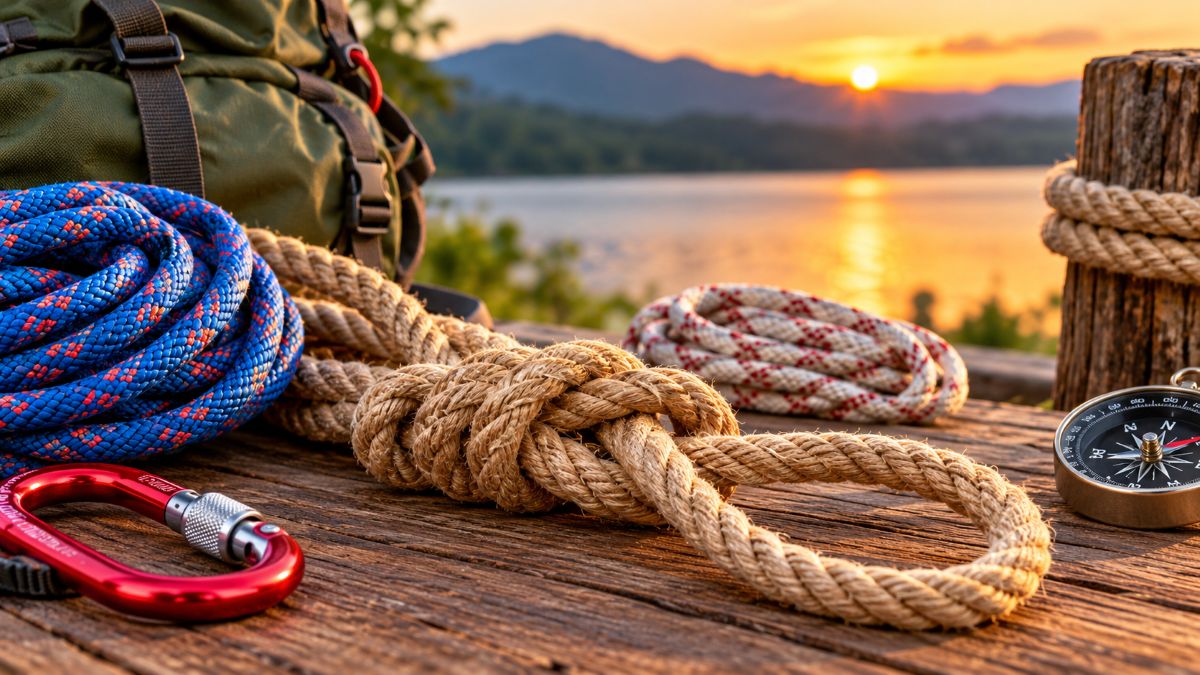
Have you ever wondered why sailors, campers, climbers, and fishermen use different types of knots instead of relying on just one? Each knot serves a particular purpose. Some create fixed loops, others join two ropes, while some attach ropes to objects or help adjust tension. Learning the different types of knots is a useful practical skill that can make everyday tasks and outdoor activities easier.
Whether you’re preparing for a camping trip, learning basic outdoor skills, securing everyday items, or expanding your practical knowledge, understanding different types of knots can help you choose an appropriate knot for the task. In this guide, you’ll learn about 15 common knots, how they are used, and the advantages and limitations of each.
What Are the Different Types of Knots?
Different types of knots are methods of tying rope, cord, or string for specific purposes. Some create fixed loops, others join two ropes, while some attach ropes to objects or help adjust tension. Each knot has its own characteristics and limitations, so choosing the right knot depends on the task.
Knots have been used for centuries in sailing, fishing, camping, and other practical activities. Today, they remain useful for boating, gardening, household tasks, and outdoor pursuits.
Importance of Learning Different Types of Knots
Learning different types of knots helps you handle ropes more effectively in everyday situations and outdoor activities. Choosing an appropriate knot and tying it correctly can help keep equipment secure and reduce the risk of ropes slipping or coming loose.
Campers use knots to pitch tents and secure gear. Sailors use them to attach lines and manage equipment on boats. Fishermen use suitable knots to connect fishing lines and tackle. At home, knots are useful for tying packages, securing items during transport, and hanging decorations.
Understanding the purpose and limitations of each knot helps you choose the right one for the task. For climbing, rescue, heavy lifting, and other safety-critical activities, follow approved procedures and seek qualified training.
Different Types of Knots
Bowline Knot
The Bowline Knot is one of the most widely recognized types of knots. It creates a fixed loop at the end of a rope that does not tighten like a slip knot. It is traditionally used in sailing and general rope work when a fixed loop is needed.
The Bowline can often be untied more easily than some other knots after loading, but its security depends on correct tying, rope characteristics, and loading conditions. It should not be assumed suitable for every application.
Common Uses
- Suitable sailing and boating tasks
- General camping tasks
- Creating a fixed loop for non-critical purposes
- General-purpose rope work where appropriate
Safety note: Do not rely on a basic Bowline for climbing, rescue, or other life-safety applications unless it is part of an approved system and you have the required training.
Square Knot (Reef Knot)
The Square Knot, also called the Reef Knot, is one of the easiest types of knots to learn. It is commonly used to tie together the ends of a single rope or cord around a bundle, making it useful for simple binding tasks.
Although the Square Knot is easy to tie, it can slip or capsize under certain loading conditions. It is not suitable for joining ropes when the connection must withstand significant or unpredictable loads. For this reason, it is best reserved for appropriate light-duty tasks, such as tying packages and securing bundles.
Because it is simple to learn, the Square Knot is often introduced in scouting, crafts, and basic rope-tying lessons.
Common Uses
- Tying packages and gifts
- Securing suitable bundles
- Simple household tasks
- Crafts and decorative rope work
Clove Hitch
The Clove Hitch is one of the quickest types of knots for attaching a rope to a pole, post, or other suitable support. It is relatively easy to tie and adjust, making it useful for temporary fastening during camping and general rope work.
One advantage of the Clove Hitch is its simplicity. However, it can slip or loosen under some loading conditions, particularly when the load changes or the rope is smooth. Depending on the application, an additional securing method may be necessary.
The Clove Hitch is useful for temporary attachments when its limitations are understood. It should not be relied on as the sole securing method for safety-critical loads or situations where failure could cause injury.
Common Uses
- Temporary camping attachments
- Attaching ropes to suitable poles
- Securing lines for general-purpose tasks
- Temporary positioning of ropes
- Outdoor rope work
Slip Knot
The Slip Knot is one of the different types of knots that creates a loop that can tighten when the standing part of the rope is pulled. Unlike a fixed loop, its size can change, making it useful for certain temporary fastening and craft applications.
The Slip Knot is commonly used in knitting, crochet, decorative rope work, and other tasks where an adjustable loop is helpful. Its suitability for gardening, camping, or other practical uses depends on the specific task and the type of cord being used.
Because the loop can tighten under tension, a Slip Knot should not be used where an uncontrolled tightening could cause injury. It is not suitable for climbing, rescue, or other life-safety applications.
Common Uses
- Knitting and crochet
- Crafts and decorative rope work
- Temporary fastening for suitable tasks
- Adjustable loops in cord work
- Other non-safety-critical applications
Figure Eight Knot
The Figure Eight Knot is one of the different types of knots commonly used as a stopper knot. Its shape helps prevent a rope from passing through an opening, depending on the rope and the application. Other figure-eight variations serve different purposes, including certain applications in climbing.
The knot is valued because its structure is relatively easy to recognize and inspect when tied correctly. However, a stopper knot and a climbing tie-in knot are not interchangeable. The correct configuration, proper tying technique, and intended application are essential.
For climbing, mountaineering, and rope-rescue work, use only knots and securing methods approved for the specific system, and learn them through qualified instruction. Do not assume that a Figure Eight Knot is automatically safe for every heavy load or safety-critical task.
For additional guidance on climbing knots and their applications, see REI’s guide to climbing knots.
Common Uses
- General-purpose stopper applications
- Preventing a rope end from passing through a suitable opening
- Basic rope-tying practice
- Certain climbing applications when the correct figure-eight variation is used
- Outdoor rope work appropriate to the knot’s limitations
Overhand Knot
The Overhand Knot is one of the simplest types of knots to learn. Although basic, it forms part of many more complex knots and is useful for understanding fundamental rope-tying techniques.
The Overhand Knot is commonly used as a simple stopper knot to help prevent a rope end from passing through an opening, provided the knot is appropriately sized for the rope and opening. It is also used in decorative rope work and as a component of other knot structures.
Because it is easy to tie and remember, the Overhand Knot is a good starting point for beginners learning basic knot-tying skills. However, it can be difficult to untie after being tightened, and it should not be treated as a suitable knot for every application.
Common Uses
- Simple stopper knots
- Decorative rope work
- Basic rope-tying practice
- Learning fundamental knot techniques
Sheet Bend
The Sheet Bend is one of the different types of knots used to join two ropes, particularly when they have different diameters. It is a useful joining knot, but its holding performance depends on factors such as rope construction, relative thickness, and loading conditions.
The Sheet Bend is commonly associated with traditional rope work, including sailing and camping. Before using it, ensure that the knot is tied correctly and suited to the task. Do not assume that it will hold securely with every combination of rope materials or under every loading condition.
The Sheet Bend remains a useful knot to learn for general rope work, especially when connecting ropes of different sizes. However, safety-critical applications require a knot and connection method specifically approved for the intended purpose.
Common Uses
- Joining suitable ropes of different diameters
- General camping tasks
- Traditional sailing and rope work
- Non-critical rope repairs
- Outdoor activities where the knot is appropriate
Fisherman’s Knot
The Fisherman’s Knot is one of the different types of knots used to join two lines or cords. The name is commonly associated with a joining knot formed by tying two overhand knots around the standing part of the opposite line. Its suitability depends on the line material, diameter, and intended use.
When tied correctly, the two knots are drawn together to form a connection. However, holding performance can vary with the type of line being used, particularly with smooth or slippery synthetic materials. Always check that the knot is appropriate for the line and task before relying on it.
The Fisherman’s Knot is useful to learn for basic line-joining applications, but it should not be confused with the Double Fisherman’s Knot, which uses additional wraps. Neither should be assumed suitable for every climbing, rescue, or other life-safety application without following qualified technical guidance.
Common Uses
- Joining suitable fishing lines
- Connecting compatible cords
- Basic line-joining practice
- General-purpose rope work where appropriate
- Learning traditional fishing knots
Timber Hitch
The Timber Hitch is one of the different types of knots traditionally used to attach a rope to a log, pole, or other cylindrical object for pulling. It is designed to grip the object when tied correctly, making it useful in certain hauling and timber-handling tasks.
One advantage of the Timber Hitch is that it can generally be untied easily after the pulling force is released. However, its performance depends on the rope, the surface and shape of the object, and the direction and consistency of the pull. It should not be assumed to remain secure under every loading condition.
The Timber Hitch is useful for learning traditional hauling techniques, but it is not automatically suitable for lifting heavy objects. Follow appropriate rigging procedures and use equipment approved for the intended load.
Common Uses
- Attaching ropes to logs for pulling
- Traditional timber handling
- Moving suitable poles and cylindrical objects
- General outdoor rope work
- Learning basic hauling knots
Anchor Bend
The Anchor Bend, also known as the Anchor Hitch, is one of the different types of knots used to attach a rope to an anchor ring or another suitable attachment point. Although commonly called a bend, it is technically a hitch because it secures a rope to an object rather than joining two ropes together.
Traditionally used in boating and sailing, the Anchor Bend is designed to provide a secure attachment when correctly tied. Its performance depends on the rope material, the attachment point, the loading conditions, and the way the knot is secured. It should not be assumed to resist slipping in every situation, particularly when conditions change or the rope is exposed to repeated movement.
The Anchor Bend is useful for learning traditional marine rope work. For anchoring a boat or securing safety-critical equipment, follow the manufacturer’s instructions and appropriate marine safety guidance.
Common Uses
- Attaching suitable ropes to anchor rings
- Traditional boating and sailing
- Securing ropes to appropriate rings or attachment points
- General marine rope work
- Learning basic nautical knots
Prusik Knot
The Prusik Knot is one of the different types of knots known as friction hitches. When tied with a compatible cord around a rope, it can grip under certain loading conditions and may slide along the rope when unloaded. Its performance depends on the cord and rope materials, diameters, knot configuration, and condition.
The Prusik is used in some climbing, mountaineering, and rope-rescue systems for rope progression or positioning. However, it must be tied correctly and tested according to the relevant procedures. It should not be assumed to provide a reliable backup or to hold securely in every situation.
Although the Prusik may look simple, learning its correct configuration and limitations is essential. For climbing, tree work, or rescue applications, follow approved technical guidance and obtain instruction from a qualified professional.
For a step-by-step explanation, see the Prusik Knot guide from Animated Knots.
Common Uses
- Rope-progression systems where approved
- Certain mountaineering applications
- Rope positioning in suitable systems
- Some rope-rescue techniques when properly trained
- Learning about friction hitches
Rolling Hitch
The Rolling Hitch is one of the different types of knots used to attach a rope to another rope or a suitable pole while helping resist movement in a particular direction. It is useful when a line needs to grip an object under an appropriate pulling force.
In traditional sailing, the Rolling Hitch can be used to secure a line to another rope and help adjust tension. Campers may also use it for suitable tent or tarp lines. However, its holding ability depends on the materials, the direction of the pull, and how the knot is tied. It should not be assumed to hold securely under every loading condition.
The Rolling Hitch is a useful knot to learn for general rope work, but safety-critical applications require appropriate equipment and verified techniques.
Common Uses
- Adjusting suitable tent and tarp lines
- Attaching a rope to another rope
- Traditional sailing and rigging
- Adjusting rope tension in appropriate situations
- General-purpose rope work
Double Fisherman’s Knot
The Double Fisherman’s Knot is one of the different types of knots used to join two ropes or cord ends. It is formed by tying two double overhand knots around the opposite standing parts and drawing them together. This creates a compact connection that can be difficult to untie after being loaded.
The Double Fisherman’s Knot is commonly used to join the ends of accessory cord to form closed loops, including Prusik loops used in certain climbing systems. However, its suitability depends on the rope or cord material, diameter, knot configuration, and intended application. It should not be assumed to provide the same performance with every type of rope or under every loading condition.
Because the knot can tighten significantly under load, untying it may be difficult. For climbing, mountaineering, and rescue applications, use only approved techniques and equipment, and obtain appropriate instruction.
Common Uses
- Joining compatible cord ends
- Forming closed accessory-cord loops
- Making Prusik loops for suitable climbing systems
- Traditional mountaineering rope work where approved
- General-purpose cord joining when appropriate
Taut-Line Hitch
The Taut-Line Hitch is one of the different types of knots used to create an adjustable loop in a rope. It can be moved along the standing part of the rope to adjust tension when the knot is not heavily loaded. Its ability to hold depends on the cord material, the way it is tied, and the conditions in which it is used.
Campers commonly learn the Taut-Line Hitch for adjusting tent guy lines and tarp supports. It can also be useful for suitable clotheslines and other general outdoor tasks where occasional tension adjustments are needed.
Although this knot is convenient because it can be adjusted without completely untying it, it should not be assumed to lock securely under every condition. Check the knot regularly and use an appropriate alternative when failure could cause injury or damage.
Common Uses
- Adjusting tent guy lines
- Tensioning suitable tarp supports
- Clotheslines
- Adjustable lines for camping
- General outdoor rope work
Carrick Bend
The Carrick Bend is one of the different types of knots traditionally used to join two ropes, particularly in maritime rope work. Its interwoven structure makes it distinctive, and when tied correctly, it forms a joining knot that can be secured appropriately for the intended task.
The Carrick Bend has a long history in sailing and traditional rope work. However, its suitability depends on the rope material, diameter, loading conditions, and how the knot is tied and secured. It should not be assumed to be stronger than other joining knots or suitable for heavy lifting simply because of its appearance.
For general learning, the Carrick Bend is a useful example of a traditional rope-joining knot. For rescue operations, industrial lifting, or other safety-critical tasks, use only approved connections and follow the relevant technical guidance.
Common Uses
- Joining suitable ropes
- Traditional maritime rope work
- Learning traditional rope-joining techniques
- General-purpose applications where the knot is appropriate
How to Choose the Right Types of Knots
Choosing among the different types of knots depends on the task, the rope material, and the conditions in which the knot will be used. A Bowline creates a fixed loop, while a Sheet Bend is designed to join two ropes. Understanding the purpose and limitations of each knot helps you make a more appropriate choice.
For camping, the Taut-Line Hitch can help adjust tent guy lines. In traditional sailing, the Anchor Bend is used to attach a rope to a suitable ring or anchor point. The Timber Hitch is traditionally used to attach a rope to a log or pole for pulling, while a Slip Knot creates a loop that can tighten when pulled.
No single knot is the safest or strongest choice for every situation. Before using any knot, consider its intended purpose, the type and condition of the rope, and the expected loading conditions. For climbing, rescue, boating, or lifting operations, follow approved technical guidance and use appropriate equipment.
Learning the different types of knots and understanding their limitations will help you select a suitable knot for everyday tasks and outdoor activities.
Common Mistakes When Tying Different Types of Knots
Even well-designed knots can fail if they are tied incorrectly or used for the wrong purpose. One common mistake is choosing a knot that is unsuitable for the task. For example, a Square Knot is generally used for binding, whereas a Sheet Bend is designed to join two ropes. Choosing the appropriate knot helps avoid problems caused by unsuitable connections.
Another frequent mistake is failing to dress the knot properly. Dressing means arranging the rope sections neatly in their intended positions before tightening the knot. An incorrectly dressed knot may not perform as expected, so check its structure carefully before use.
Using worn or damaged rope is another important concern. Abrasion, ageing, chemical exposure, and other forms of damage can affect rope performance. Inspect the rope for visible damage and follow the manufacturer’s recommendations for inspection and replacement.
Finally, do not assume a knot is secure simply because it looks correct. Check that it has been tied properly and is suitable for the intended application. For climbing, rescue, lifting, and other safety-critical tasks, follow approved procedures and obtain appropriate training rather than relying on an informal tension test alone.
Benefits of Learning Different Types of Knots
Learning the different types of knots provides practical skills that are useful in everyday life and outdoor activities. Whether you enjoy camping, boating, fishing, gardening, or household projects, knowing how to tie an appropriate knot can make many tasks easier. Understanding the purpose and limitations of each knot also helps you make better decisions when working with ropes.
Improves Safety
Learning different types of knots helps you understand how to secure ropes for suitable tasks. Choosing an appropriate knot, tying it correctly, and checking the rope’s condition can help reduce the risk of slipping or accidental release. However, a knot alone cannot guarantee safety. Climbing, rescue, construction, and lifting operations require approved equipment, appropriate procedures, and proper training.
Makes Camping and Outdoor Activities Easier
Knowing different types of knots can make camping more convenient. You can use suitable knots to attach tent guy lines, adjust tarp tension, secure camping equipment, and organise ropes around your campsite. Practising basic knots before a trip can save time when setting up or packing away your equipment.
Useful for Boating and Sailing
Boaters and sailors use different types of knots for tasks such as attaching ropes to suitable rings, securing lines, and adjusting rigging. Knots such as the Bowline, Clove Hitch, and Anchor Bend have traditional roles in rope work, but each has specific limitations. Follow appropriate marine guidance when securing a boat or anchor, particularly when weather and water conditions change.
Enhances Fishing Skills
Learning suitable fishing knots helps anglers connect lines, leaders, and other tackle. The knot selected should match the fishing line’s material, diameter, and intended use. Practising the correct tying technique and checking each connection can help reduce the chance of losing tackle or a catch because of a poorly tied knot.
Saves Time and Effort
Learning a few appropriate knots can make routine tasks easier. Instead of repeatedly adjusting a loose line or struggling to attach a rope, you can select a knot suited to the job. Regular practice also helps you remember the correct tying sequence and recognise when a different knot may be needed.
Develops Practical Life Skills
Learning different types of knots is a useful practical skill for students, campers, anglers, gardeners, and homeowners. From tying packages to setting up a tent, basic knot knowledge can help with many everyday tasks. Practising with suitable rope and understanding each knot’s limitations will help you apply these skills more confidently.
Tips for Learning Different Types of Knots
Learning the different types of knots becomes easier with regular practice and a clear understanding of each knot’s purpose. Start with simple knots, learn the correct tying sequence, and gradually progress to more complex techniques as your skills improve.
Start with Basic Knots
Begin with the Overhand Knot, Square Knot, and Clove Hitch. These knots introduce basic techniques, including forming a stopper, binding objects, and attaching a rope to a suitable support. Learn the correct structure and limitations of each knot before moving on to more advanced options.
Practice Regularly
Keep a short piece of suitable rope at home and practise tying each knot several times. Repetition helps you remember the tying sequence and recognise the finished knot. Use clear, reliable diagrams or instructional videos, and compare your result with the reference before relying on it.
Learn the Purpose of Each Knot
Rather than memorising knots without context, understand what each one is designed to do. For example, a Bowline forms a fixed loop, while a Sheet Bend joins two ropes. Knowing the differences helps you select an appropriate knot for a particular task.
Inspect Every Knot
After tying a knot, check that its structure matches a reliable reference and that the rope sections are correctly arranged. Make sure the knot is suitable for the intended application. A visual inspection or simple pull test cannot establish that a knot is safe for climbing, rescue, lifting, or other safety-critical uses. Follow approved procedures and obtain appropriate training for those applications.
Use Suitable Rope
Practise with a rope or cord that is flexible enough to handle comfortably and thick enough for you to see the knot structure clearly. Avoid damaged, frayed, or excessively worn rope. As you gain experience, practise with the types of rope appropriate to your intended activity, following the relevant manufacturer’s guidance.
Conclusion
Understanding the different types of knots is a valuable practical skill for everyday tasks and outdoor activities. Each knot serves a particular purpose, whether it is creating a fixed loop, joining ropes, attaching a line to a suitable object, or adjusting rope tension. Learning these 15 types of knots can help you develop useful skills for camping, boating, fishing, gardening, and general rope work.
From the Bowline Knot and Sheet Bend to the adjustable Taut-Line Hitch and Double Fisherman’s Knot, each has its own characteristics and limitations. Practise regularly, learn the correct tying techniques, and choose a knot that suits the task. For climbing, rescue, lifting, and other safety-critical applications, always follow approved technical guidance and obtain appropriate training.
By understanding the different types of knots and knowing when to use them, you can handle everyday rope-related tasks more confidently and responsibly.
Frequently Asked Questions
What are the different types of knots?
Different types of knots are methods of tying rope or cord for specific purposes, such as creating loops, joining ropes, securing objects, or adjusting tension. Each knot has its own characteristics and limitations, so choosing the right one depends on the task.
Which different types of knots are best for beginners?
Beginners can start by learning the Overhand Knot, Square Knot, Clove Hitch, Bowline, and Figure Eight Knot. These introduce useful basic techniques, including forming a stopper, binding objects, attaching a rope, and creating loops. Learn the correct structure and intended use of each knot.
Which knot is strongest?
There is no single knot that is strongest for every situation. Knot performance depends on the rope material, diameter, knot configuration, tying technique, and loading conditions. Choose a knot designed for the intended application, especially when working with climbing equipment, rescue systems, or heavy loads.
Why is it important to learn different types of knots?
Learning different types of knots helps you handle everyday rope-related tasks, camping activities, gardening, fishing, and suitable boating applications. Understanding each knot’s purpose and limitations can also help you avoid using an inappropriate knot for a particular task.
How can I master different types of knots?
Practise regularly with suitable rope, follow reliable step-by-step instructions, and check that each knot matches a verified reference. Start with basic knots before learning more complex techniques. For climbing, rescue, lifting, or other safety-critical activities, obtain qualified instruction and follow approved procedures.

Mathukutty P. V. is the founder of Simply Life Tips. He shares practical advice and useful insights on personal growth, health, well-being, technology, and everyday living. His goal is to help readers build positive habits and make informed decisions. He believes in continuous learning and sharing knowledge to help people live healthier, happier, and more meaningful lives.