
How to stop comparing yourself to others is an important question when someone else’s success makes you feel like you’re falling behind in life.
Think about it for a moment.
Someone is unhappy because they don’t have a government job. Another person has a government job but wants a higher salary. Someone earns well but compares their lifestyle with that of a richer person. Another has a loving family, a comfortable home, and a reasonably good life but still feels that something is missing.
Why does this happen?
Sometimes, the problem isn’t what we lack. It is how we look at what we already have.
We spend so much time noticing what other people have that we forget to appreciate the good things in our own lives. Slowly, someone else’s success begins to feel like our failure.
But does another person’s happiness really reduce ours?
Perhaps a shift in perspective can help us see life differently.
How to Stop Comparing Yourself to Others: 9 Simple Reminders
We all compare ourselves with others sometimes. But when comparison makes us feel that our lives are not good enough, it can take away our happiness and peace of mind.
The good news is that we can change how we think and respond. These nine reminders will help you focus on your own journey, appreciate what you have, and build a more contented life.
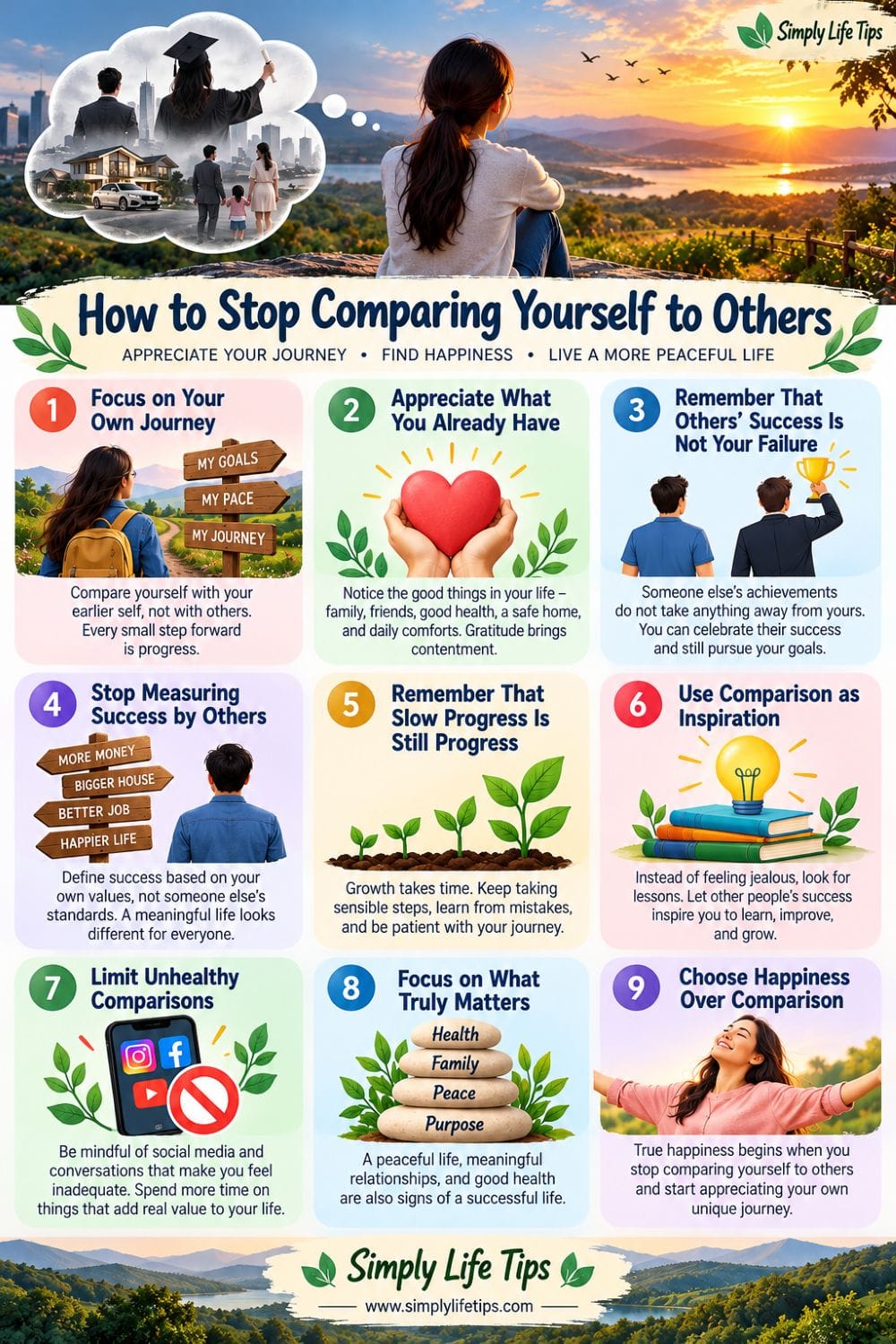
Remember, you don’t have to achieve everything someone else has to live a meaningful life. Your goals, circumstances, and priorities are unique to you.
Use these reminders whenever you feel discouraged by another person’s success. Focus on what you can improve, appreciate the good things already in your life, and keep moving forward at your own pace.
Your life doesn’t need to look like someone else’s to be a successful one.
The Power of Perspective: A Small Change That Matters
Consider these familiar statements:
- Laziness kills ambition.
- Anger kills wisdom.
- Fear kills dreams.
- Ego kills growth.
- Jealousy kills peace.
- Doubt kills confidence.
Now read them from the opposite direction:
- Ambition kills laziness.
- Wisdom kills anger.
- Dreams kill fear.
- Growth kills ego.
- Peace kills jealousy.
- Confidence kills doubt.
The words remain the same, but the direction changes their meaning.
Life can be like that, too. Sometimes, a small change in how we look at a situation changes how we feel about it.
A positive mindset can help us respond to life’s challenges more constructively. Explore our guide to positive thinking to learn more.
Imagine two people earning the same salary. One feels unhappy because a friend earns twice as much. The other feels thankful for a steady income while working toward better opportunities.
Their financial circumstances may be similar, but their perspectives are different.
This doesn’t mean we should stop dreaming of a better future. It means we don’t have to make ourselves miserable while trying to build one.
If you want to explore this idea further, read our article on how to make life more beautiful by changing your perspective.
Why Do We Keep Comparing Ourselves to Others?
We Always Want What We Don’t Have
There is nothing wrong with ambition. Wanting a better job, a comfortable home, financial security, or a brighter future can motivate us to work hard.
The problem begins when we cannot appreciate our present life until we achieve the next thing.
A student wants good marks. After getting them, the student wants a higher rank. Someone gets a job and starts dreaming of a promotion. After receiving the promotion, another goal appears.
Before enjoying what we have achieved, we begin thinking about what comes next.
We keep moving the finish line.
Of course, we need goals. Without them, we may lose direction. But if happiness is always waiting somewhere in the future, when do we get to enjoy the life we are living today?
We can work toward something better without treating our present circumstances as worthless.
We Compare Our Lives With Other People’s Achievements
Imagine someone who has worked hard for years to buy a small house. They feel proud of what they have achieved.
Then they visit a friend who owns a much bigger house.
Suddenly, their own home seems less impressive.
Nothing about the house has changed. The effort, sacrifices, and memories behind it are still there. Only the comparison has changed how the person feels.
The same thing happens with salaries, careers, relationships, children’s achievements, and lifestyles.
We often compare our difficult moments with other people’s happiest moments. We see their achievements but may know very little about the struggles behind them.
Psychologists study this behaviour through the concept of social comparison. As explained in Psychology Today’s overview of social comparison theory, comparing ourselves with others can sometimes motivate improvement, but it can also lead to dissatisfaction and insecurity.
The problem isn’t that we notice other people’s achievements. It is when we use those achievements as proof that our own lives are not good enough.
Society Often Makes Us Feel That We Are Falling Behind
From childhood, many of us hear questions such as:
What marks did you get?
What job did you get?
How much do you earn?
When will you buy a house?
Why can’t you be more like that person?
These questions may come from people who genuinely care about us. Still, constant comparisons can make us feel that our lives must follow a particular pattern to be considered successful.
But people have different responsibilities, opportunities, financial circumstances, talents, and priorities.
One person may achieve financial success early in life. Another may take longer to find the right career. Someone else may choose a simpler life with more time for family.
There is no need for everyone to follow the same timetable.
Your life does not become less valuable simply because someone else reached a milestone before you.
How to Stop Comparing Yourself to Others and Find Happiness
1. Focus on Your Own Journey
Think about where you were five years ago.
Perhaps you have learned new skills, become more patient, improved your finances, overcome a difficult period, or developed a better understanding of yourself.
These changes matter, even if nobody else notices them.
Instead of asking whether you are doing better than someone else, ask whether you are making progress compared with your earlier self.
You may not be where you want to be yet. That is fine. You can appreciate how far you have come while continuing to work toward your goals.
Your journey is yours. You do not need to move at somebody else’s speed.
2. Appreciate What You Already Have
Sometimes, we become so focused on what is missing that we overlook what is going well.
A steady income may seem ordinary until we experience financial uncertainty. A loving family may feel like part of everyday life until we realize how valuable their support is. A safe home, a trusted friend, or a peaceful evening can easily become things we take for granted.
Try noticing these things instead of waiting for a major achievement to make you feel grateful.
You do not need to pretend that every part of your life is perfect. You can acknowledge genuine problems while appreciating the good things that exist alongside them.
Gratitude does not mean giving up on improvement. It means recognizing that your life already has value while you continue to build a better future.
For more practical ideas, explore our article on the magic of gratitude and how it can help you appreciate life.
3. Remember That Someone Else’s Success Is Not Your Failure
A friend gets a promotion. A relative buys a new home. Someone you know starts a successful business.
You may feel disappointed about your own situation. That feeling is human, and there is no need to pretend otherwise.
But ask yourself a simple question: does this person’s success prevent me from improving my own life?
Usually, the answer is no.
You can congratulate someone and still work toward your ambitions. You can learn from their achievements without treating them as evidence of your failure.
Another person’s success is not your defeat.
When we stop treating life as a competition, we can enjoy our relationships more freely. We can appreciate what others accomplish without constantly measuring ourselves against them.
4. Stop Measuring Success by Someone Else’s Standards
What does success mean to you?
For one person, it may mean building a successful business. For another, it may mean financial independence. Someone else may value spending time with family, doing meaningful work, or living with fewer worries.
None of these goals need to look alike.
Problems begin when we adopt someone else’s definition of success without asking whether it fits our own lives.
A high-paying job may sound attractive, but what if it leaves no time for the people you love? A large house may look impressive, but what if maintaining it creates constant financial pressure?
These are not reasons to reject ambition. They are reasons to think carefully about what you truly want.
A successful life should reflect your values, not simply impress other people.
5. Remember That Slow Progress Is Still Progress
Sometimes, we compare our beginning with another person’s years of effort.
We see someone who has built a successful career and forget the years they spent learning. We notice a person’s financial security without knowing the sacrifices, opportunities, or difficulties behind it.
Then we become impatient with our own progress.
But meaningful change takes time.
Learning a new skill, saving money, improving a relationship, or building a business rarely happens overnight. Some periods bring visible progress; others feel frustratingly slow.
That does not mean you are failing.
Keep taking sensible steps. Learn from mistakes and adjust your approach when necessary.
You do not need to move at someone else’s speed to make your progress worthwhile.
6. Use Comparison as Inspiration, Not as a Reason to Feel Inferior
Not every comparison is harmful.
Suppose you know someone who manages money wisely, treats people kindly, or has developed an impressive skill through years of practice.
Instead of feeling jealous, ask what you can learn from that person.
Perhaps you can improve your saving habits, become more patient, or dedicate more time to learning.
The difference lies in your response.
Unhelpful comparison says, “They are doing better than me, so I am a failure.”
Healthy inspiration says, “They have achieved something worthwhile. What can I learn from their example?”
You can admire another person’s progress without devaluing your own life.
How to Stop Comparing Yourself to Others in Everyday Life
Changing your perspective is not always easy. Comparison can become a habit, especially when we repeatedly measure our lives against the achievements of friends, relatives, colleagues, or people online.
Start with a few simple practices.
- Notice your triggers. Pay attention to the situations that make you feel inadequate. Is it a conversation about salaries, a family gathering, or scrolling through social media?
- Pause before judging yourself. When comparison appears, remind yourself that you may not know the complete story behind another person’s life.
- Set personal goals. Choose goals based on your needs, values, and circumstances rather than trying to match someone else’s lifestyle.
- Recognize small achievements. Completing a difficult task, learning something new, or handling a problem calmly is worth acknowledging.
- Take a break from unhealthy comparisons. If certain online accounts or conversations repeatedly leave you feeling inferior, consider limiting your exposure to them.
These steps will not eliminate every moment of comparison. That is not the goal. The aim is to recognize when comparison is taking away your peace and choose a more helpful response.
Research suggests that social comparison is not always harmful. It can inspire personal growth, but it may also leave us feeling inadequate when we focus only on what others appear to have achieved.
Is a Peaceful Life Also a Successful Life?
Society often celebrates visible achievements: impressive job titles, high salaries, expensive homes, awards, and public recognition.
These things can be meaningful. There is nothing wrong with wanting financial security or taking pride in hard work.
But they are not the only measures of a good life.
What about someone who earns a modest income, supports their family, maintains a few genuine friendships, and sleeps peacefully at night?
What about a person who chooses a simpler lifestyle because it gives them more time for the people they love?
Their lives may not look extraordinary to everyone else, but that does not make them unsuccessful.
A peaceful life is not necessarily a life without problems. It is a life in which we learn to deal with difficulties without allowing every comparison, disappointment, or outside opinion to determine our worth.
We can aim higher and still be content. We can celebrate achievements without making them the only source of happiness.
Perhaps success is not just about how much we earn, collect, or accomplish. Perhaps it is also about how we live, how we treat others, and how much peace we preserve along the way.
Happiness Begins When You Stop Comparing Yourself to Others
Learning how to stop comparing yourself to others does not mean giving up your ambitions or ignoring opportunities to improve your life.
It means learning the difference between inspiration and comparison.
Inspiration encourages you to grow. Unhealthy comparison makes you feel that your own life has less value because someone else has something you want.
The next time another person’s success makes you feel unhappy, pause for a moment.
Ask yourself what you genuinely want. Think about what you can do to move toward it. Then look at your own life and recognize what is already worth appreciating.
Someone else’s growth does not stop yours.
Someone else’s happiness does not reduce yours.
Your progress does not have to look impressive to everyone else to be meaningful.
Life will always offer new things to want and new goals to pursue. If we wait until we have everything before allowing ourselves to feel content, we may spend our lives chasing a happiness that keeps moving further away.
Keep working for the life you want, but do not forget to appreciate the life you already have.
A better life is not only about getting more. It is also about learning to see the value in what is already there.
Conclusion
Learning how to stop comparing yourself to others begins with appreciating your own journey. Everyone has different circumstances, challenges, and timelines, so there is no need to measure your happiness or success against someone else’s life. Instead, focus on your personal growth, practice gratitude for what you already have, and celebrate the small steps you take toward your goals. Remember, someone else’s success does not mean you have failed.
Life becomes more peaceful when you stop chasing other people’s standards and start living according to your own values. You may not have everything you want today, but you can still find joy in the things that truly matter. Keep moving forward at your own pace, learn from your experiences, and appreciate how far you have come.
Your journey is unique, and your happiness grows when you focus on making your own life meaningful rather than trying to match someone else’s.
FAQs About How to Stop Comparing Yourself to Others
1. How to Stop Comparing Yourself to Others?
Focus on your own goals, recognize your progress, appreciate what you have, and define success according to your personal values. When comparison makes you feel inadequate, remind yourself that everyone has different circumstances and a different journey.
2. Why Do We Compare Ourselves to Others?
We often compare ourselves with others to evaluate our progress, abilities, achievements, or social position. These comparisons can sometimes motivate us, but they may also lead to dissatisfaction when we constantly feel that others are doing better.
3. Why Does Comparing Yourself to Others Make You Unhappy?
Constant comparison can direct your attention toward what you lack instead of what you have achieved. It can also create unrealistic expectations, especially when you compare your everyday life with the most impressive parts of somebody else’s life.
4. How Can Gratitude Help You Stop Comparing Yourself to Others?
Gratitude encourages you to notice the positive parts of your life, including relationships, opportunities, everyday comforts, and personal progress. It helps you appreciate what you have while continuing to work toward your goals.
5. Is It Wrong to Want a Better Life?
No. Wanting a better job, greater financial security, or new opportunities is perfectly reasonable. The important thing is to pursue your goals without treating your current life as a failure or measuring your worth against somebody else’s achievements.
References and Further Reading
- Social Comparison Theory — Psychology Today
- Social Comparison and Mental Health — Current Treatment Options in Psychiatry

Mathukutty P V is a Blogger, YouTuber, and Content Writer and the founder of Simply Life Tips. After taking voluntary retirement in 2017, he embraced a free lifestyle focused on learning, personal growth, and sharing practical wisdom to help others live with more purpose and positivity.