

The power of a growth mindset is a transformative force that allows individuals to see their potential as an ever-expanding horizon rather than a fixed destination. At its core, this concept is the fundamental belief that your basic qualities, intelligence, and talents are things you can cultivate through your own efforts, strategies, and help from others. While people may differ in every way—in their initial talents and aptitudes, interests, or temperaments—everyone can change and grow through application and experience. In this comprehensive guide, we will explore the depths of this mindset, how to cultivate it, and the life-changing benefits that follow when you stop trying to prove yourself and start trying to improve yourself.
What Exactly is a Growth Mindset?
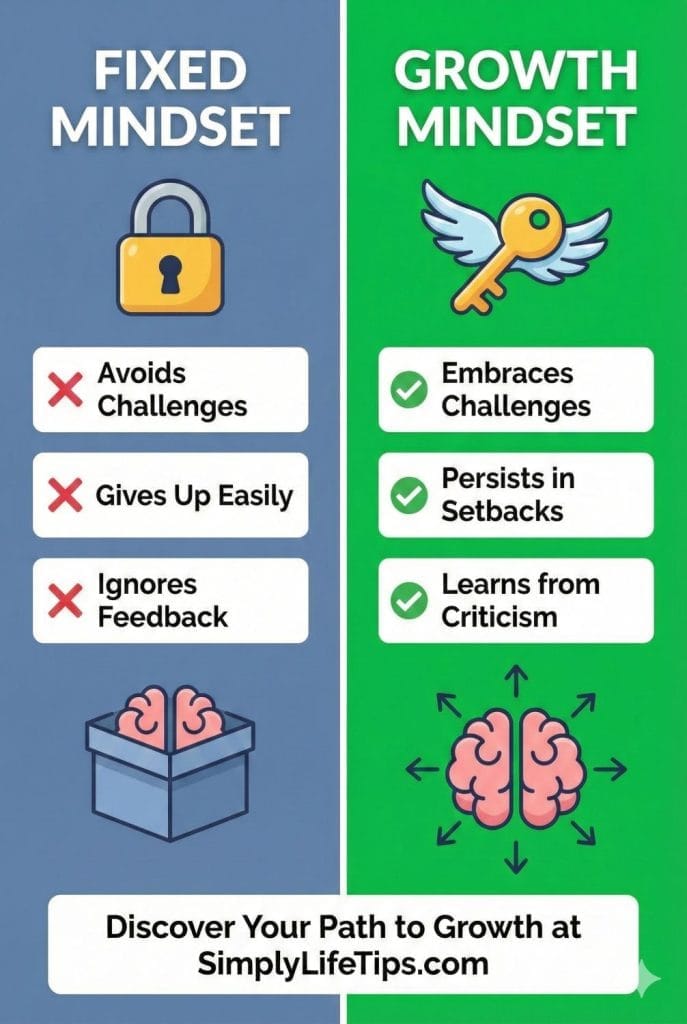
To understand the power of a growth mindset, we must first define what it stands against. For decades, many people operated under a “fixed mindset.” This is the belief that your intelligence, personality, and moral character are carved in stone. In a fixed mindset, every situation is evaluated as a test: “Will I succeed or fail? Will I look smart or dumb? Will I be accepted or rejected?” This creates a constant urgency to prove oneself over and over.
In contrast, a growth mindset thrives on challenge. It is based on the idea that your current skills are just a starting point. This doesn’t mean that anyone can become Einstein or Beethoven just by trying, but it does mean that no one knows what they can truly achieve with years of passion, toil, and training. The power of a growth mindset lies in the word “yet.” When a child says, “I can’t do this math problem,” a growth-oriented parent or teacher adds, “…yet.” This tiny word shifts the focus from a permanent state of failure to a temporary state of learning. It acknowledges that the brain is like a muscle; the more you challenge it, the more neural connections it forms, making you literally smarter over time.
How to Cultivate the Power of Growth Mindset?
Developing this perspective is a journey of conscious effort and self-awareness. It requires you to monitor your internal monologue and catch the “fixed” thoughts before they take root. Here are the primary ways to build and strengthen this mindset:
- Embrace Challenges as Opportunities: Most people avoid challenges because they are afraid of looking incompetent. However, the only way to grow is to step outside your comfort zone. If you only do things you are already good at, you are simply repeating what you know.
- Example: Imagine you are offered a lead role in a project involving a subject you know little about. A fixed mindset would say, “I’ll fail and look like a fraud.” A growth mindset says, “This is a steep learning curve, but the knowledge I gain will make me a much stronger professional.” Read How an Open Mind Leads to Success?
- Reframe Failure as Feedback: In the world of growth, failure is not a death sentence; it is a data point. It tells you that your current strategy isn’t working and that you need to pivot.
- Example: If a business venture fails, instead of saying, “I’m not a good entrepreneur,” you analyse the market, the timing, and the product. You realise that while that specific idea didn’t work, the experience taught you ten things about what not to do next time. Read Learning from Life Experiences | How Everyday Moments Become Our Greatest Teachers?
- Seek Out Constructive Criticism: Many people view feedback as a personal attack. To harness the power of a growth mindset, you must view it as a gift. It is an outside perspective that reveals your blind spots.
- Example: If an editor leaves many red marks on your writing, don’t feel discouraged. Those marks are a roadmap to a better final draft. By studying the corrections, you ensure you won’t make those same mistakes in your next piece of work.
- Value the Process Over the Result: Our society is obsessed with the “overnight success.” We see the gold medal, but we don’t see the thousands of hours of gruelling practice in the rain. Focusing on the process—the daily habits, the small wins, and the grit—makes you more resilient.
- Example: Instead of focusing only on losing twenty pounds, focus on the fact that you showed up to the gym five days this week. The weight loss is the result; the showing up is the growth.
Read Micro-habits for a Stress-Free Life | The Ultimate Guide to Daily Peace
The Power of a Growth Mindset in the Modern World
Why is the power of a growth mindset so critical today? We live in an era of rapid change. Technologies that were cutting-edge five years ago are now obsolete. If you have a fixed mindset, you will find this environment terrifying. You will cling to old ways of doing things because you are afraid you won’t be able to learn the new ways. However, if you have a growth mindset, change is exciting. It represents a new landscape for learning.
Furthermore, this mindset is the foundation of resilience. Resilience is the ability to bounce back from adversity. Research from Stanford University has shown that students with a growth mindset are far more likely to persist in the face of academic difficulty than those who believe their intelligence is fixed. They don’t see a bad grade as a reflection of their worth; they see it as a signal to study harder or try a different method. This same logic applies to the corporate world, where the most successful leaders are those who are willing to admit they don’t have all the answers and are eager to learn from their teams.
A Growth Mindset: Empowerment Checklist
Benefits of The Power of a Growth Mindset
The ripple effects of this mindset touch every corner of your life, from your emotional well-being to your professional trajectory.
1. Enhanced Learning and Intellectual Development
When you aren’t afraid of being “wrong,” you ask more questions. You participate more in discussions. You take on harder projects. This creates a virtuous cycle of learning. Each time you master a difficult concept, your confidence grows, which encourages you to take on even harder concepts. This is how “average” students become exceptional. They aren’t smarter by birth; they are smarter by habit.
2. Improved Performance and Professional Success
In the workplace, the power of a growth mindset translates to higher achievement. Because you are constantly seeking feedback and looking for ways to improve, your work quality naturally rises. You become a “problem solver” rather than a “problem reporter.” While others are complaining that a task is too hard, you are busy figuring out how to break it down into manageable steps. This attitude is what gets people noticed and promoted.
3. Positive Impact on Mental Well-being
A fixed mindset is a breeding ground for anxiety and depression. When your self-worth is tied to being “perfect” or “the best,” any setback feels like a total loss of identity. By adopting a growth mindset, you reduce stress because you realise that your current state is not your permanent state. You become kinder to yourself. You realise that it is okay to be a beginner. This self-compassion is a powerful shield against the pressures of modern life.
The Beginner’s Guide to Emotional Fitness | How to Build a Stronger You?
4. Greater Adaptability and Flexibility
As Darwin famously suggested, it is not the strongest of the species that survives, nor the most intelligent, but the one most responsive to change. A growth mindset makes you flexible. When a global pandemic hits or an industry is disrupted by AI, the growth-oriented person doesn’t panic. They ask, “What new skills do I need to thrive in this new reality?” This adaptability is the ultimate form of job security.
Expert Perspectives and Wisdom
To truly grasp the power of a growth mindset, it is helpful to look at the words of those who have studied human potential and achievement deeply.
“It’s not that I’m so smart, it’s just that I stay with problems longer.” — Albert Einstein
Even one of the greatest geniuses in history attributed his success not to raw brainpower, but to his persistence. This is the essence of growth: the willingness to stay in the struggle until the light breaks through.
Implementation Strategies for Families and Workplaces
How do we spread the power of a growth mindset to those around us?
- Praise the Effort, Not the Trait: Instead of telling a child “You’re so smart,” say “I’m so proud of how hard you worked on that project.” Praising traits makes people afraid to fail (because if they fail, they are no longer “smart”). Praising effort encourages them to keep working hard.
- Celebrate “Great Failures”: In some of the world’s most innovative companies, like those researched by Harvard Business Review, managers hold meetings to discuss what they learned from projects that didn’t work. This removes the stigma of failure and encourages bold experimentation.
- Be a Role Model: Let your children or employees see you struggle with something. Talk out loud about your process: “I’m finding this software really difficult, but I’m going to watch some tutorials, and I know I’ll get it eventually.”
The Life-Changing Power of a Growth Mindset
Imagine transforming your brain to conquer hurdles and reach your highest goals through the power of a growth mindset. By understanding how your brain can physically change and grow, you can build the resilience needed to handle stress and improve your overall mental well-being.
In this video, you will discover:
- The “C Student” Secret: The scientific reason why those with average grades often achieve more success than straight-A students.
- Building Grit: How to keep chasing your dreams even when you hit major setbacks.
- Mental Health Links: Why a “fixed” mindset is often connected to higher levels of anxiety and stress.
- Intelligence Growth: Practical ways to boost your IQ and strengthen your ability to bounce back from difficulty.
Explore the latest science and inspiring stories of high achievers who used these techniques to unlock their boundless potential for lifelong success in this video.
Harnessing the Power of a Growth Mindset
Harnessing the power of a growth mindset is a journey that requires consistent practice, which is why a 30-day structured plan is the perfect way to rewire your brain for success. Instead of seeing your abilities as fixed traits you were born with, this mindset shift allows you to view every day as an opportunity to build new “mental muscles.” Studies on neuroplasticity demonstrate that stepping outside our comfort zones causes the brain to build new neural pathways, confirming that our current abilities are never permanent.
The 30-Day Mindset Shift Calendar
This calendar is designed to take you from understanding the concept to living it. Each day focuses on a small, actionable step that reinforces the belief that you can improve through effort.
Week 1: Awareness and Foundation
In this first week, your goal is to identify your “fixed mindset” triggers and start changing your internal dialogue.
- Day 1: Identify one area where you feel “not good enough.” Write down: “I am not good at this yet.”
- Day 2: Replace a negative thought with a growth thought. Example: Instead of “I made a mistake,” say “Mistakes help me learn.”
- Day 3: Read about a famous person who failed before succeeding. (Example: Michael Jordan being cut from his high school team).
- Day 4: Set a “Learning Goal” for the month instead of a “Performance Goal.” (Example: “I want to learn how to code” vs “I want to get an A”).
- Day 5: Practice the “power of yet.” Whenever you feel frustrated, add the word “yet” to the end of your sentence.
- Day 6: Reflect on a past challenge you overcame. Write down exactly what effort helped you succeed.
- Day 7: Reward yourself for the effort you put into this week, not the results you saw.
Week 2: Embracing Challenges
This week is about getting comfortable with being uncomfortable.
- Day 8: Do one small thing that scares you today. (Example: Speak up in a meeting).
- Day 9: Ask for feedback from a friend or colleague. Listen without defending yourself.
- Day 10: Tackle the hardest task on your to-do list first thing in the morning.
- Day 11: When you hit a roadblock today, stop and say, “This is my brain getting stronger.”
- Day 12: Try a hobby you are “bad” at for 20 minutes. Focus on the fun, not the skill.
- Day 13: Research a new tool or software that could make your life easier and try it out.
- Day 14: Review your progress. What was the most difficult part of the week? Celebrate that difficulty.
Week 3: Learning from Setbacks
Now we focus on how to bounce back when things don’t go as planned.
- Day 15: Think about a mistake you made yesterday. Write down three things you learned from it.
- Day 16: Find a “Learning Partner.” Tell someone about your mindset journey and ask them to keep you accountable.
- Day 17: If someone critiques your work, say, “Thank you for that perspective; how can I improve it?”
- Day 18: Practice mindfulness. When you feel anxious about failing, take 5 deep breaths and focus on the present moment.
- Day 19: Re-do a task you previously failed at using a different strategy.
- Day 20: Look at someone you admire. Instead of being jealous, ask: “What strategies did they use to get there?”
- Day 21: Write a letter to your “future self” about why persistence matters more than perfection.
Week 4: Mastery and Growth
In the final week, you will focus on sustaining these habits for the long term.
- Day 22: Teach someone else about the power of a growth mindset. Teaching is the best way to master a concept.
- Day 23: Spend 15 minutes researching growth mindset activities to keep your momentum going.
- Day 24: Identify a “fixed mindset” thought in a friend and gently offer them a growth perspective.
- Day 25: Focus on “micro-wins.” Celebrate three small things you did well today.
- Day 26: Update your “Learning Goal.” What is the next level you want to reach?
- Day 27: Practice self-compassion. Forgive yourself for any days you slipped back into old habits.
- Day 28: Create a “Growth Mindset” mantra for yourself. (Example: “I am a lifelong learner”).
- Day 29: Look back at Day 1. How has your perspective changed?
- Day 30: Commit to one growth habit you will keep for the next six months.
Why a 30-Day Plan Works?
The importance of a 30-day challenge lies in the concept of habit formation. It takes time for the brain to stop defaulting to “I can’t” and start moving toward “How can I?” By following this calendar, you are providing yourself with the benefits of structure and repetition.
As Carol S. Dweck, the pioneer of this research, wisely said:
“Becoming is better than being.” – Carol S. Dweck
This quote highlights that the process of growing is more valuable than just being “talented.” When you focus on becoming, you are never disappointed by a plateau because you know you have the tools to climb higher.
James Clear, an expert on habits, adds another layer of wisdom:
“Every action you take is a vote for the type of person you wish to become.”
Every time you choose to view a challenge as an opportunity during these 30 days, you are “voting” for a stronger, more resilient version of yourself.
Conclusion
In essence, the power of a growth mindset promotes a proactive and positive approach to every aspect of human existence. It is the engine of innovation, the heart of resilience, and the key to a fulfilling life. When you stop worrying about how much talent you have and start focusing on how much you can grow, the world opens up to you in ways you never thought possible. You are not a finished product; you are a work in progress, and that is a beautiful thing. We hope you found the inspiration you need to start your journey of evolution in this blog.
What is one challenge you’ve been avoiding that you are now ready to tackle using the power of a growth mindset?
- 21 Exercises For A Growth Mindset: Unlocking Your Potential
- How Using The Growth Mindset Can Grow Your Money
FAQs about The Power of a Growth Mindset
1. What is the main difference between a fixed mindset and a growth mindset?
A fixed mindset is the belief that your intelligence and talents are static and cannot be changed. A growth mindset is the belief that these same qualities can be developed and strengthened through dedication, hard work, and learning from your mistakes.
2. Can an adult actually change their mindset, or is it only for children?
Anyone can change their mindset at any age. While it may be easier to start young, the human brain remains “plastic” throughout adulthood, meaning it is always capable of forming new neural connections and learning new ways of thinking.
3. How do I stop being so afraid of failure?
To overcome the fear of failure, you must reframe it as feedback. Instead of seeing a mistake as a sign of your worth, see it as a “data point” that tells you which strategy didn’t work. This shift takes the personal sting out of failing and makes it a tool for progress.
4. Why is the power of a growth mindset important in the workplace?
In a professional setting, a growth mindset makes you more adaptable to new technology, more open to constructive criticism, and more resilient during company changes. It helps you become a creative problem-solver rather than someone who gives up when a task is difficult.
5. Does having a growth mindset mean I can do anything?
While a growth mindset doesn’t guarantee you will become a world-class expert in everything, it does guarantee that you will improve significantly more than someone with a fixed mindset. It is about reaching your highest possible potential, whatever that may be.

Mathukutty P V is a Blogger, YouTuber, and Content Writer and the founder of Simply Life Tips. After taking voluntary retirement in 2017, he embraced a free lifestyle focused on learning, personal growth, and sharing practical wisdom to help others live with more purpose and positivity.



