
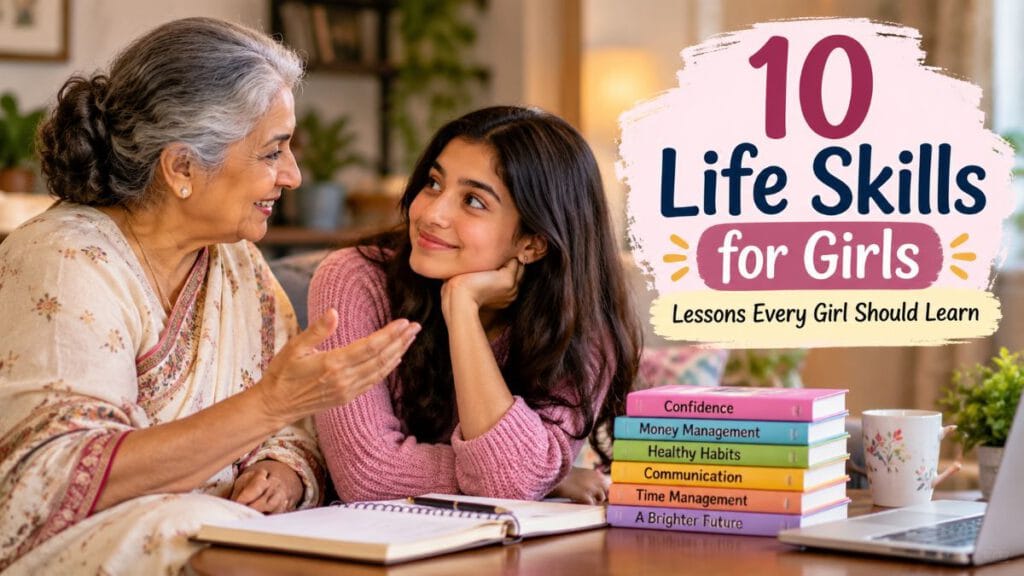
Life skills for girls are not limited to what they learn in school or college. They include the everyday abilities that help them make wise decisions, manage challenges, communicate confidently, protect their well-being, and create opportunities for themselves.
One evening, a young girl sat beside her grandmother and asked, “Grandma, what are the most important things every girl should learn to build a happy and successful future?”
Her grandmother smiled.
“There are many things I could tell you,” she said. “But if you learn these ten life skills, they can guide you through many stages of life.”
The girl listened carefully.
10 Essential Life Skills to Learn
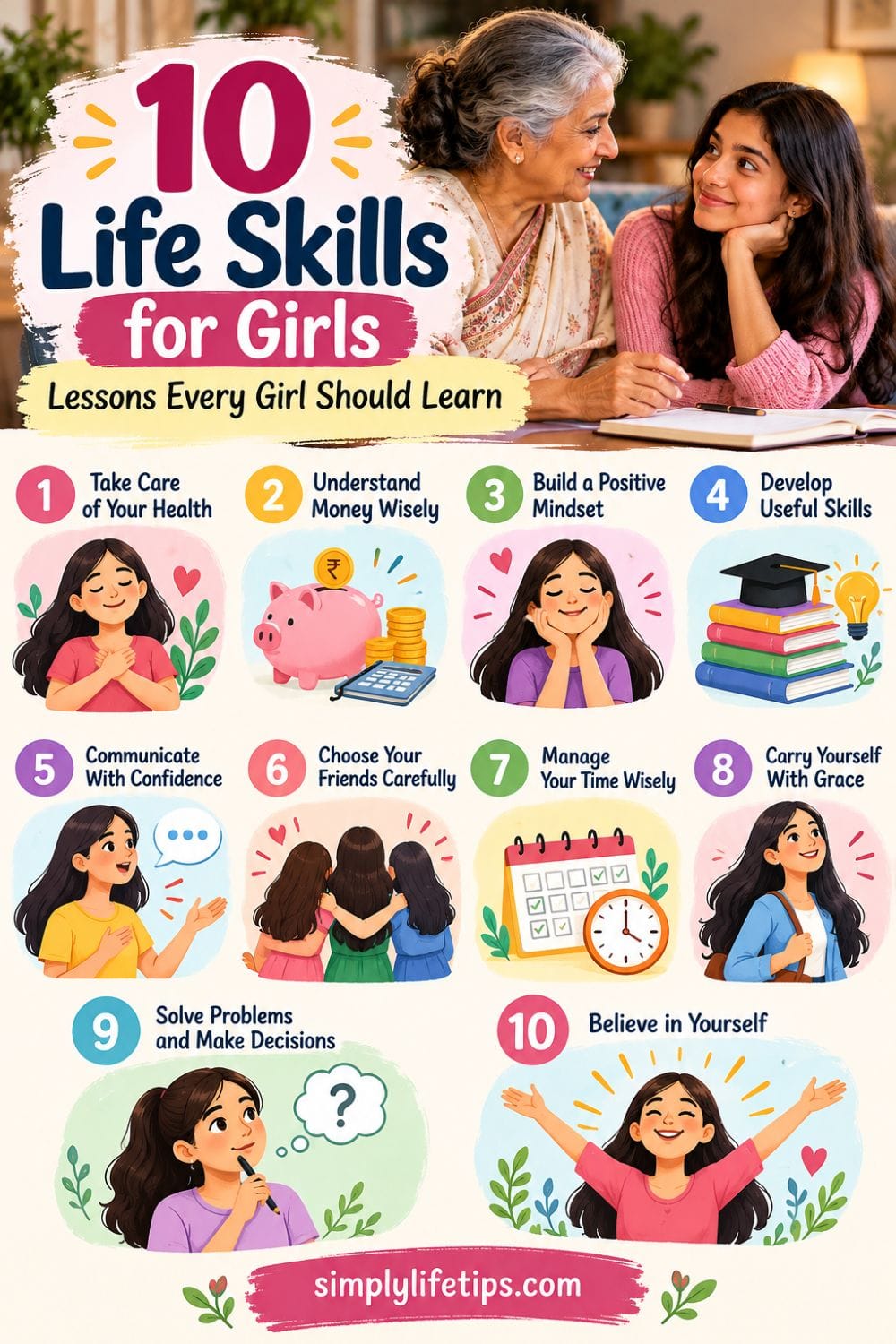
Here’s a quick visual look at the 10 life skills for girls that can help build confidence, independence, and a stronger future.
These life skills are not learned overnight. Start with one, practise it regularly, and gradually build habits that can support you throughout life.
1. Value Your Education
“Grandma, what is the first skill?”
“Learn to value your education,” Grandma replied.
Education should not be viewed only as a way to pass examinations or earn certificates. Learning develops knowledge, curiosity, reasoning, and the ability to make informed decisions.
Read beyond your textbooks. Ask questions. Learn from mistakes. Explore subjects that interest you.
Education can also create opportunities that may not otherwise be available.
“Does that mean I should keep learning even after school?”
“Exactly. Learning should not stop when an examination ends.”
Knowledge can become one of the most valuable resources you carry throughout your life.
Why This Matters
A girl who develops a habit of learning can adapt more easily when circumstances change.
For example, learning communication, technology, financial management, or another practical subject can open doors to new opportunities later in life.
Granddaughter: “That gives me a completely different way of thinking.”
2. Understand Money Wisely
“What’s next, Grandma?”
“Learn how money works.”
Financial skills are important life skills for girls because understanding money can support greater independence and better decision-making.
Learn to:
- Save before spending.
- Create a simple budget.
- Distinguish between needs and wants.
- Avoid unnecessary debt.
- Compare prices before buying.
- Understand basic banking and saving.
- Think carefully before making major purchases.
You don’t need to become a financial expert overnight.
Start with simple habits.
If you receive money, don’t immediately spend everything. Set aside a portion for saving and think about what you genuinely need.
“Grandma, so I should think before buying things I don’t really need?”
“Exactly. Every thoughtful financial decision can strengthen your future.”
If you want to explore the basics of managing money and developing better financial habits, read our guide to the rules of money.
3. Take Care of Your Health
“Number three?”
“Take care of your health.”
Your body and mind support everything else you want to accomplish.
Develop simple habits such as drinking enough water, eating nutritious food, moving regularly, getting adequate sleep, and making time for rest.
Health is not about following every trend or trying to look a certain way.
It is about developing habits that support your well-being over time.
Small Habits Can Make a Difference
Instead of trying to change everything at once, begin with manageable steps.
Take a walk. Drink more water. Establish a consistent bedtime. Spend some time away from your phone. Choose nutritious foods more often.
Healthy routines can gradually become part of everyday life.
Granddaughter: “I should start improving those habits today.”
4. Build Useful Skills
“Is school enough?”
“School gives you a foundation,” Grandma said, “but practical skills can help you use what you learn.”
Useful skills for girls can include:
- Writing
- Public speaking
- Communication
- Digital literacy
- Technology
- Design
- Problem-solving
- Research
- Basic financial management
- Creative skills
You don’t need to master everything. These are some of the most useful life skills for girls to develop early.
Choose one useful skill and practise it consistently.
For example, a girl interested in writing could start a small blog. Someone interested in design could learn basic graphic-design tools. Another person might learn coding, photography, video editing, or presentation skills.
The important thing is to develop abilities that can solve real problems.
Granddaughter: “I want to start learning something useful this week.”
“That’s a wonderful place to begin.”
Building practical abilities can make learning more useful in everyday life. If you’re interested in helping young people develop practical independence, see our guide to essential life skills to teach kids.
5. Communicate With Kindness and Confidence
“Grandma, what makes communication so important?”
“Because people connect through communication.”
Learning to communicate effectively can help in school, friendships, family relationships, workplaces, and many other situations.
Speak clearly.
Listen carefully.
Ask questions when you don’t understand something.
Think before responding when emotions are high.
Being confident does not mean speaking over others. And being kind does not mean being afraid to express your opinion.
Good communication allows you to express your thoughts while respecting other people.
Confidence and Kindness Can Coexist
You can disagree without being disrespectful.
You can say no without being rude.
You can ask for help without feeling ashamed.
You can express your ideas without putting someone else down.
Granddaughter: “I never realized communication was that important.”
Communication is another skill worth developing early. Our guide to communication skills for children explores how young people can develop clearer and more respectful communication.
6. Choose Your Friends Carefully
“Can friendships really affect our future?”
“Yes,” Grandma said. “The people around you can influence how you think, behave, and grow.”
Healthy friendships are built on trust, respect, honesty, and mutual support.
Look for people who:
- Encourage your growth.
- Respect your boundaries.
- Celebrate your achievements.
- Listen when you need support.
- Tell you the truth respectfully.
- Don’t pressure you into harmful choices.
You don’t need a huge number of friends.
A few healthy friendships can be more meaningful than a large social circle.
At the same time, remember that healthy friendship is mutual. Be the kind of friend you hope to have.
Granddaughter: “I’m grateful for friends who help me grow.”
The people around you can influence your habits, confidence, and ambitions. Learn more about the importance of surrounding yourself with successful people.
7. Manage Your Time Wisely
“Grandma, I have so much to do. How can I manage everything?”
“Learn to manage your time before your time manages you.”
Time management is one of the most practical life skills for girls because every day has a limited number of hours.
Make a simple plan.
Decide what needs to be done first.
Break large tasks into smaller steps.
Set aside time for learning, work, exercise, family, rest, and enjoyable activities.
And be careful with endless scrolling.
Social media and entertainment are not automatically bad, but they can consume large amounts of time when used without limits.
Make Small Progress Every Day
You don’t need a perfect schedule.
Even spending 20 focused minutes learning something useful can become valuable when repeated consistently.
Small daily actions can produce remarkable results over time.
Granddaughter: “I really need to use my time better.”
Learning to manage time effectively becomes even more important as responsibilities increase. Our guide to time management for working moms offers additional practical ideas.
8. Carry Yourself With Grace
“What’s the eighth lesson?”
“Learn to carry yourself with confidence and grace.”
Confidence doesn’t require arrogance.
You can know your worth while treating other people with respect.
Your appearance may be the first thing people notice, but your character influences how people remember you.
Be polite.
Keep your promises.
Admit mistakes.
Treat people with dignity, regardless of their position.
Stand up for yourself when necessary, but don’t feel the need to put others down to feel important.
True confidence allows you to remain respectful without becoming a people-pleaser.
Granddaughter: “I’ll always remember that lesson.”
9. Explore the World Around You
“Do I have to learn everything from my phone?”
Grandma laughed.
“No. The world is much bigger than a screen.”
Explore your surroundings.
Visit libraries and museums. Attend workshops and community events. Take part in educational programs. Read books written from different perspectives. Talk to people with experiences different from your own.
Every experience can teach you something.
Learn Beyond the Screen
The internet can provide enormous amounts of information, but real-world experiences can develop skills that cannot be learned entirely from scrolling.
For example, attending a workshop can introduce you to a new skill. Volunteering can teach responsibility and teamwork. Meeting different people can broaden your understanding of the world.
Granddaughter: “I want to learn beyond my phone screen.”
“Then go out and explore.”
10. Believe in Yourself
“And what’s the final lesson, Grandma?”
“Believe in yourself.”
Self-belief doesn’t mean thinking you will never fail.
It means understanding that failure does not have to define you.
You may make mistakes.
You may choose the wrong path.
You may face rejection.
You may sometimes doubt yourself.
Learn from those experiences instead of allowing them to decide your future.
Confidence Grows Through Action
Confidence often develops through practice.
The first time you speak in front of others may feel uncomfortable. The first time you manage your money may feel complicated. The first time you learn a new technology may feel confusing.
Keep practising.
Every small success provides evidence that you can learn and improve.
Granddaughter: “Thank you, Grandma. These lessons will stay with me for life.”
Grandma smiled.
“Start today, my dear. Good habits can help build a strong future. And remember—the best investment you can make is in yourself.”
If you need a reminder to keep moving forward when things become difficult, read Never Stop Believing in Yourself.
Why These Life Skills for Girls Matter
The most important life skills for girls are not necessarily complicated.
They are everyday abilities that can help girls and women become more confident, responsible, adaptable, and independent.
Learning how to communicate, manage money, protect your health, use time wisely, build healthy relationships, and continue learning can benefit you at many different stages of life.
You don’t have to master all ten skills at once.
Choose one.
Start small.
Practise consistently.
Then move to the next.
Learning these life skills for girls can make everyday decisions easier as they grow.
Conclusion
Life skills for girls can provide a foundation for making thoughtful decisions, handling challenges, developing independence, and creating opportunities for the future.
Education can expand your knowledge. Financial awareness can strengthen your decisions. Healthy habits can support your well-being. Communication can improve relationships. Time management can help you focus. Self-belief can give you the courage to keep moving forward.
The goal isn’t to become perfect.
The goal is to keep learning and growing.
As Grandma reminds her granddaughter, the best investment you will ever make is in yourself.
Frequently Asked Questions
What are the most important life skills for girls?
Important life skills include financial management, communication, time management, health awareness, problem-solving, self-confidence, relationship skills, and continuous learning.
Why should girls learn financial skills?
Financial skills can help girls understand saving, spending, budgeting, and financial decision-making, supporting greater independence as they grow older.
How can girls develop useful life skills?
Start with one skill at a time. Read, practise, take courses or workshops, learn from experienced people, and apply the skill in everyday situations.
How can girls become more confident?
Confidence can grow through preparation, practice, learning from mistakes, setting achievable goals, and recognizing personal progress.
Can these life skills help women too?
Yes. These skills remain useful throughout adulthood. Women can continue developing communication, financial, health, time-management, relationship, and professional skills at every stage of life.

Mathukutty P. V. is the founder of Simply Life Tips. He shares practical advice and useful insights on personal growth, health, well-being, technology, and everyday living. His goal is to help readers build positive habits and make informed decisions. He believes in continuous learning and sharing knowledge to help people live healthier, happier, and more meaningful lives.



