
Office stationery items are important tools used in schools, colleges, libraries, and workplaces to improve organization and productivity. Whether you are preparing assignments, managing documents, or organizing study materials, these stationery supplies make daily tasks easier and more efficient. Understanding their names and uses can help students develop better organizational habits and prepare for professional environments.
What Are Office Stationery Items?
Office stationery items are supplies used for writing, filing, organizing, storing, and managing documents. They help maintain order, improve efficiency, and support learning activities.
Why Are Stationery Items Important?
- Improve the organization of notes and documents.
- Increase productivity and efficiency.
- Help students complete assignments neatly.
- Support professional document management.
- Encourage better study habits.
10 Essential Office Stationery Items
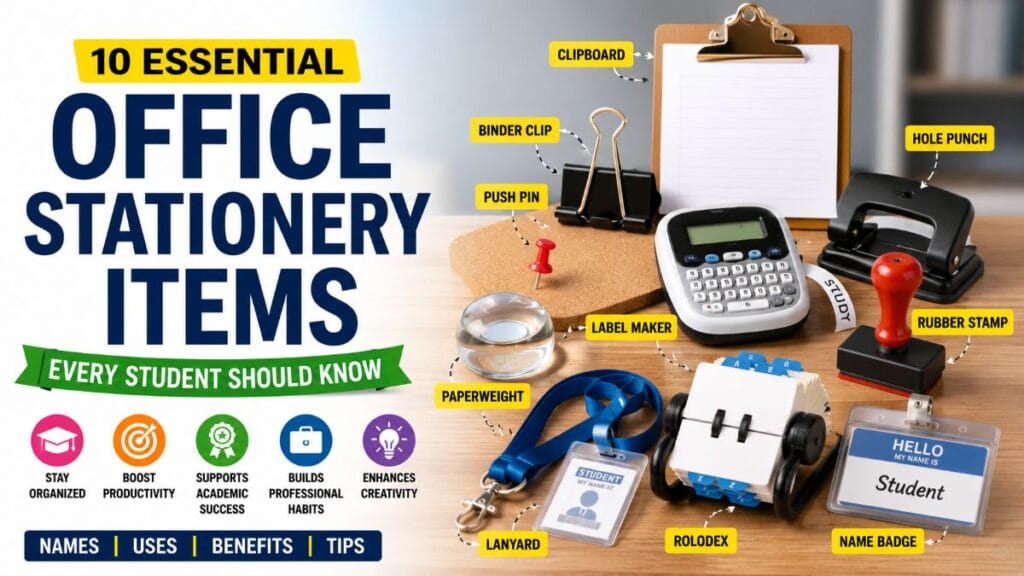
Visual learning can make information easier to understand and remember. The infographic below provides a quick overview of the most common office stationery items used by students, along with their primary functions and benefits. Whether you are organizing class notes, preparing assignments, or working on school projects, these tools can help improve efficiency and productivity. Use this infographic as a handy reference guide to identify essential stationery items and understand how each one contributes to better organization and academic success.

As shown in the infographic, office stationery items are much more than simple supplies. They are practical tools that help students stay organized, manage their time effectively, and complete academic tasks with greater confidence. From keeping documents secure with binder clips to creating professional labels with a label maker, each item serves a specific purpose that supports learning and productivity.
While digital technology has transformed education, traditional stationery items continue to play an important role in classrooms, libraries, and study spaces. Students who develop strong organizational habits using these tools often find it easier to manage coursework, prepare for examinations, and maintain a structured study routine. Investing in the right stationery supplies can be a small step that leads to significant improvements in academic performance and personal organization.
Clipboard
What Is a Clipboard?
A clipboard is a flat board equipped with a metal or plastic clip that holds papers securely in place while writing.
Uses of a Clipboard
- Provides a portable writing surface.
- Holds important documents securely.
- Useful during surveys, inspections, and fieldwork.
- Helps teachers and students take notes while standing.
Example of Clipboard Usage
A student participating in a science exhibition can use a clipboard to record observations without needing a desk.
Benefits of a Clipboard
- Lightweight and portable.
- Protects papers from folding.
- Convenient for outdoor activities.
Binder Clip
What Is a Binder Clip?
A binder clip is a strong metal clip designed to hold multiple sheets of paper together.
Uses of a Binder Clip
- Organizes assignments and reports.
- Keeps loose papers together.
- Secures project documents.
Example of Binder Clip Usage
Students can clip together all worksheets related to a particular subject to prevent loss.
Benefits of a Binder Clip
- Strong and durable.
- Reusable multiple times.
- Available in various sizes.
Push Pin
What Is a Push Pin?
A push pin is a small pin with a plastic head used to attach papers to bulletin boards.
Uses of a Push Pin
- Display reminders.
- Pin schedules and notices.
- Organize study plans.
Example of Push Pin Usage
Students can pin their exam timetable on a notice board for easy reference.
Benefits of a Push Pin
- Easy to use.
- Affordable and widely available.
- Available in different colors.
Hole Punch
What Is a Hole Punch?
A hole punch is a device that creates holes in paper for filing and storage.
Uses of a Hole Punch
- Organizes documents in binders.
- Helps maintain subject folders.
- Improves document management.
Example of Hole Punch Usage
College students often punch lecture notes before storing them in ring binders.
Benefits of a Hole Punch
- Creates uniform holes.
- Makes filing easier.
- Improves document organization.
Paperweight
What Is a Paperweight?
A paperweight is a heavy object placed on documents to prevent them from moving.
Uses of a Paperweight
- Keeps papers from blowing away.
- Organizes desks.
- Adds decorative value to workspaces.
Example of Paperweight Usage
A paperweight is useful in rooms with ceiling fans or open windows.
Benefits of a Paperweight
- Prevents document loss.
- Durable and long-lasting.
- Enhances desk appearance.
Label Maker
What Is a Label Maker?
A label maker is a device used to create printed adhesive labels.
Uses of a Label Maker
- Label files and folders.
- Organizes shelves.
- Identifies storage boxes.
Example of Label Maker Usage
Students can label folders according to subjects for easier access.
Benefits of a Label Maker
- Creates professional-looking labels.
- Saves time when locating items.
- Improves organization.
Rubber Stamp
What Is a Rubber Stamp?
A rubber stamp is used to imprint text, symbols, dates, or logos onto documents.
Uses of a Rubber Stamp
- Mark official documents.
- Approves paperwork.
- Identifies ownership.
Example of Rubber Stamp Usage
Schools often use rubber stamps on certificates and report cards.
Benefits of a Rubber Stamp
- Fast and efficient.
- Produces consistent markings.
- Reusable for years.
Lanyard
What Is a Lanyard?
A lanyard is a strap worn around the neck to carry identification cards or keys.
Uses of a Lanyard
- Holds ID cards.
- Carries access cards.
- Keeps keys accessible.
Example of Lanyard Usage
Students attending workshops often wear event ID cards attached to lanyards.
Benefits of a Lanyard
- Prevents loss of IDs.
- Easy to carry.
- Comfortable for daily use.
Rolodex
What Is a Rolodex?
A Rolodex is a rotating card organizer used to store contact information.
Uses of a Rolodex
- Stores phone numbers.
- Organizes business contacts.
- Provides quick information access.
Example of Rolodex Usage
Before smartphones became common, offices relied on Rolodex systems to manage contacts.
Benefits of a Rolodex
- Simple organization method.
- No electricity required.
- Easy access to information.
Name Badge
What Is a Name Badge?
A name badge displays a person’s name and designation during events or meetings.
Uses of a Name Badge
- Identifies participants.
- Improves networking.
- Enhances security.
Example of Name Badge Usage
Students attending academic conferences often wear name badges.
Benefits of a Name Badge
- Encourages communication.
- Creates a professional appearance.
- Simplifies identification.
How do Office Stationery Items Help Students?
Improve Study Organization
One of the biggest advantages of office stationery items is that they help students stay organized. Managing multiple subjects, assignments, project files, and notes can become overwhelming without proper organization. Stationery tools such as binder clips, folders, hole punches, labels, and clipboards make it easier to arrange study materials systematically.
For example, a student can use binder clips to separate notes for Mathematics, Science, and English. A label maker can be used to clearly identify folders and notebooks, while a hole punch allows important papers to be stored neatly in binders. When everything has a designated place, students can quickly locate the materials they need and avoid losing important documents.
Good organization also reduces stress during examinations because students spend less time searching for notes and more time studying.
Increase Productivity
Productivity is essential for academic success, and stationery items play a significant role in helping students work efficiently. When study materials are organized and easily accessible, students can focus on completing tasks instead of looking for missing papers or supplies.
For instance, a clipboard provides a portable writing surface that allows students to take notes anywhere. Push pins can be used to display study schedules and deadlines on a bulletin board, ensuring important tasks remain visible. A lanyard can keep student ID cards readily available, saving time during school activities.
By reducing distractions and improving access to essential materials, stationery supplies help students complete assignments faster and manage their time more effectively.
Support Academic Success
Academic success often depends on preparation, discipline, and effective study habits. Office stationery items support these habits by helping students maintain a structured learning environment.
Students who keep their notes organized are more likely to review lessons regularly and retain information better. Filing documents properly with hole punches and binders ensures that study materials remain complete and easy to access before exams.
For example, a student who stores all class notes in labeled folders can quickly review an entire semester’s content before final examinations. This organized approach leads to better understanding, improved revision, and higher academic performance.
Additionally, maintaining orderly study materials helps students develop consistency and responsibility, which are essential qualities for educational achievement.
Build Professional Skills
Learning how to use office stationery effectively prepares students for future workplace environments. Many of the organizational practices used in schools are similar to those used in offices and professional settings.
Using file organizers, labels, name badges, rubber stamps, and document management tools teaches students the importance of maintaining records and handling paperwork responsibly. These skills become valuable when they enter higher education, internships, or professional careers.
For example, an employee may need to organize reports, label files, manage documents, and maintain workplace records. Students who have already developed these habits through regular use of stationery items can adapt more easily to professional responsibilities.
Developing organizational skills at an early age also improves attention to detail, time management, and workplace readiness.
Enhance Creativity
Many stationery items encourage creativity and help students present their ideas more effectively. Creative projects often require organization, design, and visual presentation, all of which are supported by stationery tools.
Students can use push pins to create vision boards, label makers to organize project displays, clipboards for outdoor research activities, and name badges during exhibitions or presentations. These tools allow students to communicate ideas clearly and professionally.
For example, during a science fair, students may use labels, clips, badges, and display boards to create an attractive project presentation. Well-organized displays not only improve appearance but also make information easier for judges and visitors to understand.
Creative use of stationery helps students develop presentation skills, problem-solving abilities, and confidence in expressing their ideas.
Tips for Choosing Quality Office Stationery Items
Select Durable Products
Choosing durable stationery products is a smart investment for students. High-quality materials last longer, perform better, and often save money over time because they do not need frequent replacement.
For example, a sturdy metal hole punch can withstand years of use, whereas a low-quality plastic version may break after a few months. Similarly, strong binder clips and durable clipboards can handle repeated use without losing functionality.
When purchasing stationery, look for products made from reliable materials and manufactured by trusted brands. Durability is especially important for items that are used daily.
Consider Functionality
Every student has different academic requirements, so it is important to choose stationery items based on specific needs rather than buying unnecessary supplies.
A student involved in presentations may benefit from clipboards, name badges, and label makers, while a student handling large volumes of notes may need binders, hole punches, and binder clips. Selecting functional tools ensures that every item serves a useful purpose.
Before purchasing stationery, consider questions such as:
- How often will the item be used?
- Does it solve a specific organizational problem?
- Will it improve productivity or learning?
Choosing practical and useful stationery helps students stay organized without wasting money on items they rarely use.
Choose Eco-Friendly Options
As environmental awareness grows, many students and educational institutions are choosing eco-friendly stationery products. Sustainable stationery reduces waste and promotes responsible consumption.
Examples include:
- Recycled paper products.
- Reusable binders and folders.
- Refillable markers and pens.
- Biodegradable stationery materials.
Using environmentally friendly products not only helps protect natural resources but also encourages students to develop sustainable habits. Small choices, such as using reusable supplies, can have a positive impact on the environment over time.
Maintain Essential Supplies
Even the best stationery items are only useful when they are available when needed. Students should regularly check their supplies and replace missing or damaged items before they become a problem.
Keeping a dedicated stationery organizer or storage box can help maintain essential supplies such as:
- Binder clips
- Push pins
- Labels
- Pens and pencils
- Notebooks
- Name badges
For example, a student preparing for an important project presentation should ensure that all required materials are available well in advance. Maintaining a stock of essential supplies prevents last-minute stress and helps students stay prepared for academic tasks.
Regularly organizing and replenishing stationery items also encourages responsibility and improves overall study efficiency. To further enhance your style knowledge, you may also enjoy our guides on Different Types of Shoes and Different Types of Boots.
Conclusion
Office stationery items are more than simple supplies. They are practical tools that help students stay organized, productive, and prepared for academic success. From clipboards and binder clips to label makers and name badges, each item serves a unique purpose that improves efficiency and supports effective learning.
FAQs about Office Stationery Items
What are office stationery items?
Office stationery items are supplies used for writing, organizing, filing, and managing documents in schools and workplaces.
Which stationery item is best for organizing papers?
Binder clips, folders, and hole punches are among the best tools for organizing papers.
What is the purpose of a label maker?
A label maker creates labels for files, folders, shelves, and storage containers.
Are stationery items still important in the digital age?
Yes. Stationery items remain valuable for organization, note-taking, presentations, and document management.

Mathukutty P V is a Blogger, YouTuber, and Content Writer and the founder of Simply Life Tips. After taking voluntary retirement in 2017, he embraced a free lifestyle focused on learning, personal growth, and sharing practical wisdom to help others live with more purpose and positivity.



