

Altruistic personality is one of the most admirable human qualities. People with this personality naturally care for others, offer help without expecting rewards, and often place another person’s happiness above their own. Their compassion strengthens families, friendships, workplaces, and communities. However, this remarkable kindness sometimes comes at a hidden cost. Many highly compassionate people become emotionally exhausted, financially burdened, or repeatedly taken advantage of because they find it difficult to put themselves first.
Modern neuroscience suggests that extraordinary compassion is more than simply being a “nice person.” Research indicates that certain brain regions involved in empathy, emotional processing, and social connection may be more active in highly altruistic individuals. These biological differences can make another person’s pain feel deeply personal, creating a powerful motivation to help.
While kindness is one of humanity’s greatest strengths, healthy compassion also requires balance. Taking care of your emotional well-being begins with maintaining healthy brain habits, which support better decision-making and emotional resilience. Without personal boundaries, generosity can slowly transform into self-neglect. Understanding the science behind an altruistic personality helps explain why some people continue giving even when it hurts them—and why learning to protect yourself does not make you any less kind.
What Is an Altruistic Personality?
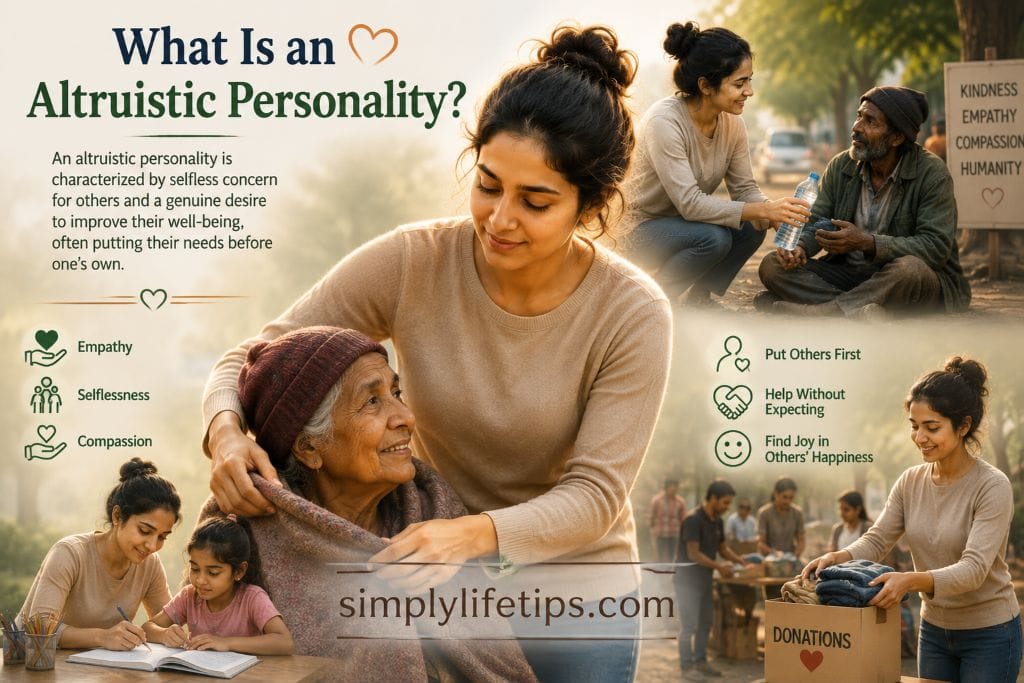
An altruistic personality describes individuals who consistently place the needs and well-being of others ahead of their own, often without expecting recognition, praise, or personal gain. Their motivation comes from genuine compassion rather than obligation or the desire for rewards.
For these individuals, helping someone in need is not merely a moral responsibility. It is a deeply meaningful experience that brings emotional satisfaction and a sense of purpose. Watching another person smile because of their support often provides greater happiness than receiving gifts, money, or appreciation themselves.
Unlike occasional acts of kindness, altruism reflects a consistent pattern of behavior that influences daily decisions, relationships, and life priorities.
Common Characteristics of an Altruistic Personality
People with an altruistic personality often display several distinctive traits.
They typically:
- Show exceptional empathy toward others.
- Feel emotionally affected by another person’s suffering.
- Offer help without expecting anything in return.
- Forgive others easily.
- Find it difficult to refuse requests.
- Prioritize harmony over personal comfort.
- Experience satisfaction from improving another person’s life.
For example, an altruistic person may cancel personal plans to help a friend during a difficult time, donate regularly to charitable causes despite limited income, or spend hours supporting a struggling colleague without expecting recognition.
These qualities make them valued friends, caring family members, and trusted coworkers. However, they can also increase the risk of emotional exhaustion when healthy boundaries are absent.
Altruism Versus People-Pleasing
Although they may appear similar, altruism and people-pleasing are not the same.
An altruistic person helps because they genuinely care about another person’s well-being. Their actions come from compassion and generosity.
A people-pleaser, on the other hand, often helps because they fear rejection, conflict, criticism, or the disappointment of others. Their motivation is frequently driven by anxiety or the need for approval rather than voluntary kindness.
Understanding this difference is important because healthy altruism improves the well-being of both the helper and the recipient, whereas chronic people-pleasing often leads to resentment, stress, and burnout.
Is an Altruistic Personality Inborn or Learned?
One of the most fascinating questions in psychology and neuroscience is whether people are born with an altruistic personality or develop it through life experiences. Research suggests the answer is both. Compassion and generosity result from a combination of biological factors and environmental influences that shape the way we think, feel, and respond to others throughout life.
While some individuals naturally display higher levels of empathy from an early age, upbringing, culture, and personal experiences also play a significant role in strengthening—or weakening—altruistic behavior.
Genetics May Influence Compassion
Scientists have found that personality traits, including empathy and prosocial behavior, have a genetic component. Although there is no single “kindness gene,” inherited characteristics can influence how emotionally sensitive a person is and how strongly they respond to another person’s distress.
Some children naturally show concern when someone is hurt or upset, even before they fully understand social expectations. This suggests that biology contributes to the foundation of altruism.
However, genetics only provide the starting point. Life experiences determine how these traits develop over time.
Childhood Experiences Shape Altruistic Behavior
Children often learn kindness by observing the people around them. Parents, grandparents, teachers, and caregivers who demonstrate compassion teach children that helping others is valuable.
Positive childhood experiences that encourage altruism include:
- Watching parents perform acts of kindness.
- Learning the importance of sharing.
- Being praised for helping others.
- Growing up in supportive communities.
- Experiencing empathy from caregivers.
Conversely, children raised in environments lacking emotional support may struggle to develop strong empathetic responses, although many still become compassionate later in life through positive relationships and experiences.
Culture and Society Influence Kindness
Culture also shapes how altruism is expressed.
Many societies encourage values such as generosity, cooperation, respect, and community service. Religious teachings, cultural traditions, and social expectations often emphasize helping those in need.
For example, volunteering, donating to charity, supporting neighbors during difficult times, and caring for elderly family members are considered important responsibilities in many cultures.
These values reinforce compassionate behavior throughout adulthood.
Life Experiences Can Increase Empathy
Difficult personal experiences often make people more compassionate.
Individuals who have faced illness, financial hardship, grief, or emotional struggles frequently become more understanding of others facing similar challenges.
For example:
- Someone who recovered from a serious illness may volunteer to support patients.
- A person who experienced poverty may regularly donate to food banks.
- Parents raising a child with special needs often become strong advocates for other families facing similar situations.
Adversity can deepen empathy because people understand suffering from personal experience.
Personality Continues to Evolve
Although some aspects of personality remain relatively stable, psychologists agree that people continue to grow throughout life.
Practicing gratitude, volunteering, developing emotional intelligence, and building healthy relationships can strengthen compassionate behavior. Likewise, repeated exposure to toxic relationships or chronic stress may reduce a person’s willingness to help others.
This means altruism is not fixed. It can grow, change, and become healthier over time.
Understanding that both biology and life experiences contribute to an altruistic personality helps explain why compassion varies from one individual to another. It also reminds us that kindness is not simply something we are born with—it is a quality that can be nurtured while still maintaining healthy personal boundaries.
The Neuroscience Behind an Altruistic Personality
Why do some people feel another person’s pain so deeply that they instinctively step forward to help? The answer lies partly in the way the brain processes empathy, emotions, and rewards.
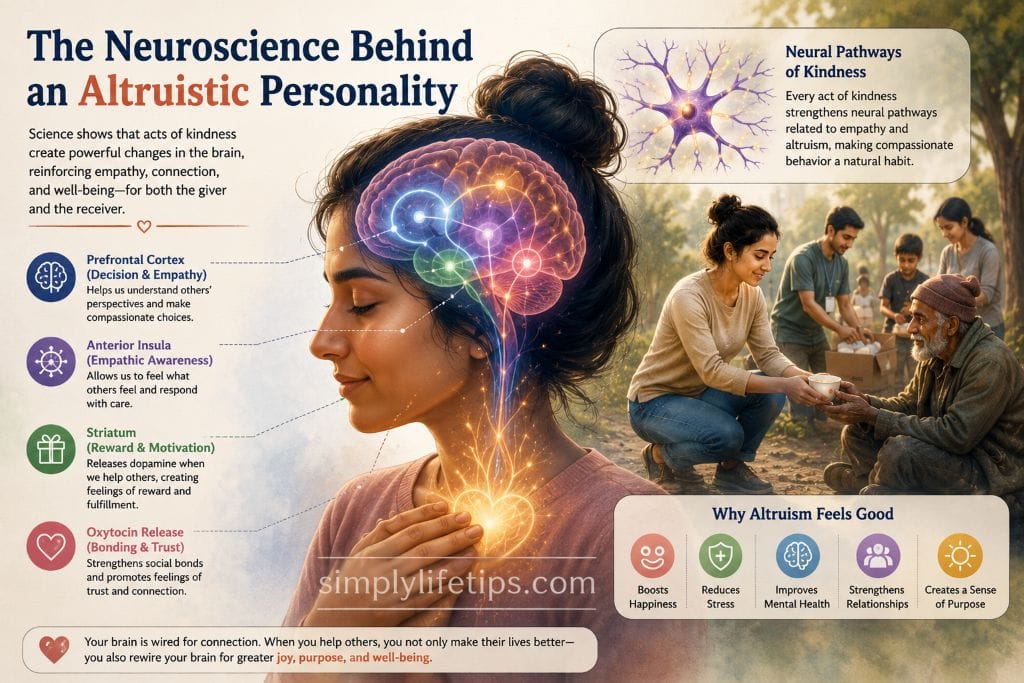
Advances in neuroscience have shown that several brain regions work together to create compassionate behavior. While everyone experiences empathy to some extent, studies suggest that people with an altruistic personality may show stronger activity in specific neural networks associated with caring, emotional understanding, and helping others.
It is important to note that no single “altruism center” exists in the brain. Instead, multiple brain regions interact to influence compassionate behavior.
The Amygdala: Recognizing Emotional Distress
The amygdala is a small, almond-shaped structure deep inside the brain that plays a central role in processing emotions, particularly fear, danger, and emotional significance.
Research has found that highly altruistic individuals often have an amygdala that responds more strongly when they witness another person’s suffering.
For example, if someone nearby is frightened, grieving, or injured, an altruistic person’s brain may react almost as if they were experiencing the distress themselves.
This heightened emotional sensitivity explains why many compassionate individuals struggle to ignore people in need. Walking away may feel emotionally uncomfortable because their brain has already registered another person’s pain as something personally meaningful.
The Anterior Insula: Feeling What Others Feel
The anterior insula is closely linked to empathy and emotional awareness.
Rather than simply recognizing another person’s emotions, this region helps people experience those emotions internally.
When someone sees another individual crying or struggling, the anterior insula helps generate feelings of compassion and emotional connection.
This is why deeply empathetic people often say things like:
- “I could feel their pain.”
- “My heart broke for them.”
- “I couldn’t stop thinking about what they were going through.”
Although these expressions are figurative, neuroscience suggests they reflect genuine emotional processing within the brain.
The Anterior Cingulate Cortex: Turning Empathy Into Action
The anterior cingulate cortex (ACC) helps regulate emotions, decision-making, and social behavior.
Once the brain recognizes another person’s suffering, the ACC helps determine how to respond.
For many altruistic individuals, this region encourages actions such as:
- Offering emotional support.
- Providing practical assistance.
- Comforting someone in distress.
- Protecting vulnerable individuals.
Instead of remaining passive observers, highly compassionate people often feel an internal drive to take action.
Mirror Neurons and Emotional Connection
Scientists also believe that mirror neuron systems contribute to empathy.
These specialized brain cells become active not only when we act ourselves but also when we observe someone else performing the same action or expressing an emotion.
For example:
- Seeing someone smile may make you smile.
- Watching another person yawn often makes you yawn.
- Observing someone cry may trigger feelings of sadness.
Although researchers continue to study exactly how mirror neurons influence human empathy, they are believed to help people understand and emotionally connect with others.
The Brain’s Reward System Encourages Kindness
Helping others does more than improve someone else’s life—it also activates the brain’s reward system.
Learning about the brain chemistry behind happiness explains why helping others often creates a genuine sense of satisfaction.
Acts of generosity stimulate the release of chemicals such as:
- Dopamine, which creates feelings of pleasure and motivation.
- Oxytocin, often called the “bonding hormone,” which strengthens trust and social connection.
- Endorphins, which contribute to feelings of well-being and emotional comfort.
Together, these chemicals create what researchers sometimes refer to as the “helper’s high.”
This natural reward explains why many people report feeling happier after volunteering, donating to charity, comforting a friend, or performing a random act of kindness.
For individuals with an altruistic personality, helping others is not simply a moral choice—it is also emotionally rewarding.
Understanding how your brain works makes it easier to appreciate why empathy and compassion feel so natural for some people.
Why Some People Feel Compassion More Deeply?
Every brain is unique.
Genetics, early childhood experiences, education, relationships, and life events all influence how strongly people respond to another person’s emotions.
Someone who has personally experienced loss, illness, discrimination, or financial hardship may develop even greater empathy because they understand suffering firsthand.
As a result, some individuals naturally experience compassion more intensely than others.
The Brain Was Designed for Cooperation
Humans have survived and thrived largely because of cooperation.
Throughout history, families and communities depended on mutual support for protection, food, childcare, and survival. Neuroscientists believe our brains evolved to encourage cooperation by making helping behavior emotionally rewarding.
This does not mean everyone experiences compassion to the same degree. Rather, it highlights that empathy is deeply rooted in human biology.
An altruistic personality represents one of the many ways the brain supports social connection, trust, and cooperation. However, as we will see next, even the most compassionate brain can become vulnerable when kindness is not balanced with healthy boundaries.
Why Some Kind People Find It So Hard to Say “No”?
For many people, saying “no” is a simple decision. For someone with an altruistic personality, however, it can feel emotionally painful. Even when they are overwhelmed, exhausted, or facing their own challenges, they often agree to help because refusing someone triggers feelings of guilt, anxiety, or responsibility.
This difficulty is not always a lack of confidence. Instead, it often reflects a deep emotional sensitivity that makes another person’s disappointment feel almost unbearable.
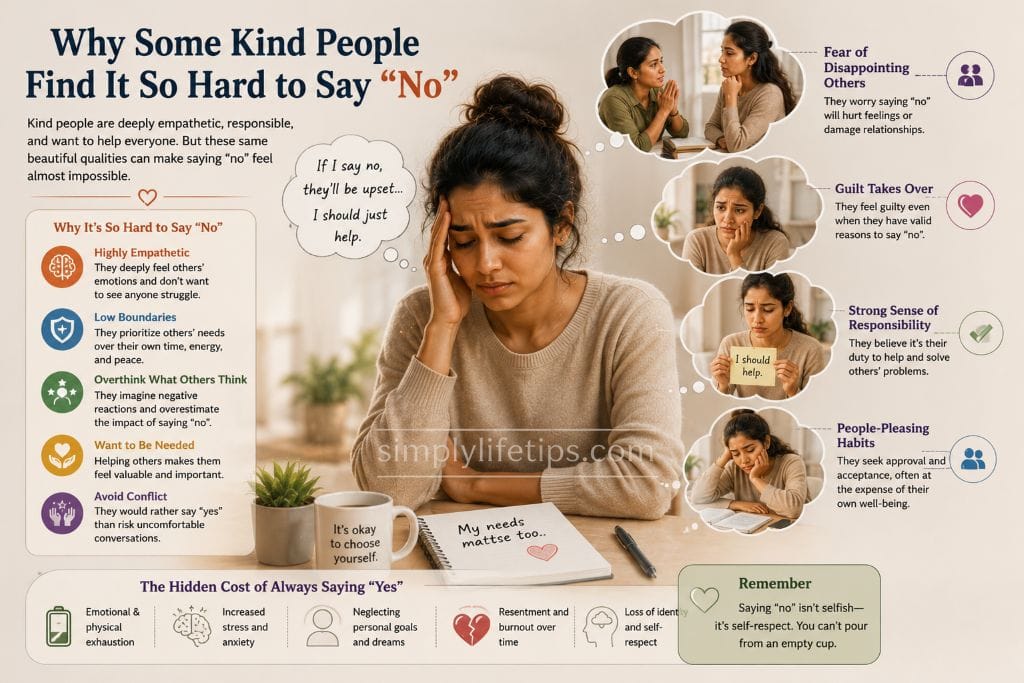
They Feel Responsible for Other People’s Happiness
Highly compassionate individuals often take on emotional responsibility that does not belong to them.
When someone asks for help, they may immediately think:
- “If I don’t help, they’ll struggle.”
- “I don’t want to let them down.”
- “What if they think I don’t care?”
- “I should be able to do more.”
As a result, they place another person’s needs ahead of their own, even when it comes at a personal cost.
Guilt Becomes a Powerful Motivator
One of the biggest reasons kind people struggle to refuse requests is guilt.
Even when saying “no” is the healthiest choice, they may experience thoughts such as:
- “I’m being selfish.”
- “Good people always help.”
- “I can manage somehow.”
- “They need me more than I need rest.”
Unfortunately, this guilt often leads them to ignore their own physical, emotional, and financial limits.
Fear of Disappointing Others
Many altruistic individuals value harmony in relationships. They dislike conflict and worry that refusing a request could damage friendships, family relationships, or professional connections.
Instead of risking temporary disappointment, they choose to sacrifice their own time and energy.
For example:
- Accepting extra work despite an already full schedule.
- Lending money they cannot comfortably afford to lose.
- Canceling personal plans to solve someone else’s problems.
- Agreeing to favors simply to avoid awkward conversations.
Over time, these small sacrifices can accumulate into significant emotional exhaustion.
Childhood Experiences May Play a Role
Psychologists believe that early life experiences can influence how comfortable a person feels setting boundaries.
For example, children who were consistently praised only when they were helpful or obedient may grow up believing that their value depends on pleasing others.
Some may have learned messages such as:
- “Always put others first.”
- “Nice people never refuse.”
- “Don’t upset anyone.”
- “Your needs can wait.”
While these lessons often encourage kindness, they can also make it difficult to recognize healthy personal limits later in life.
Empathy Makes Other People’s Pain Feel Personal
People with an altruistic personality often experience empathy so strongly that another person’s distress feels almost like their own.
Imagine a close friend losing their job.
While many people would feel sympathy, a highly empathetic person may spend days worrying about their friend’s future, lose sleep thinking about ways to help, or even offer financial assistance despite having their own expenses.
Because another person’s suffering creates genuine emotional discomfort, helping becomes a way to reduce both the other person’s pain and their own emotional distress.
The Desire to Be Needed
Some compassionate individuals also develop a strong sense of purpose from helping others.
Being dependable, supportive, and generous becomes part of their identity.
They may feel valued when others rely on them, making it even harder to step back when requests become excessive.
Although helping others is admirable, self-worth should never depend entirely on being available for everyone all the time.
Why Constantly Saying “Yes” Can Become Harmful?
Always agreeing to help may seem generous, but it often comes with hidden consequences.
Without healthy boundaries, people may experience:
- Emotional burnout.
- Chronic stress.
- Compassion fatigue.
- Reduced productivity.
- Financial strain.
- Neglected personal goals.
- Frustration and resentment.
- Physical exhaustion.
Ironically, the more exhausted someone becomes, the less energy they have to genuinely support the people they care about.
Saying “No” Protects Your Ability to Help
Learning to say “no” does not make a person selfish. It allows them to protect their time, energy, and emotional well-being so they can continue helping others in meaningful ways.
A respectful response such as, “I’m sorry, but I can’t commit right now,” is not an act of rejection. It is an act of self-respect.
Healthy compassion means recognizing that your needs matter too. When you protect your own well-being, you become more capable of offering genuine support without sacrificing your peace of mind.
Why Are Altruistic People More Likely to Be Exploited?
Kindness is a beautiful quality, but not everyone responds to it with gratitude. While compassionate people see opportunities to help, manipulative individuals often see opportunities to benefit. As a result, people with an altruistic personality are sometimes more vulnerable to emotional, financial, and even professional exploitation.
This does not mean kindness attracts exploitation by itself. Rather, people who consistently put others’ needs before their own may unintentionally make it easier for others to take advantage of their generosity.
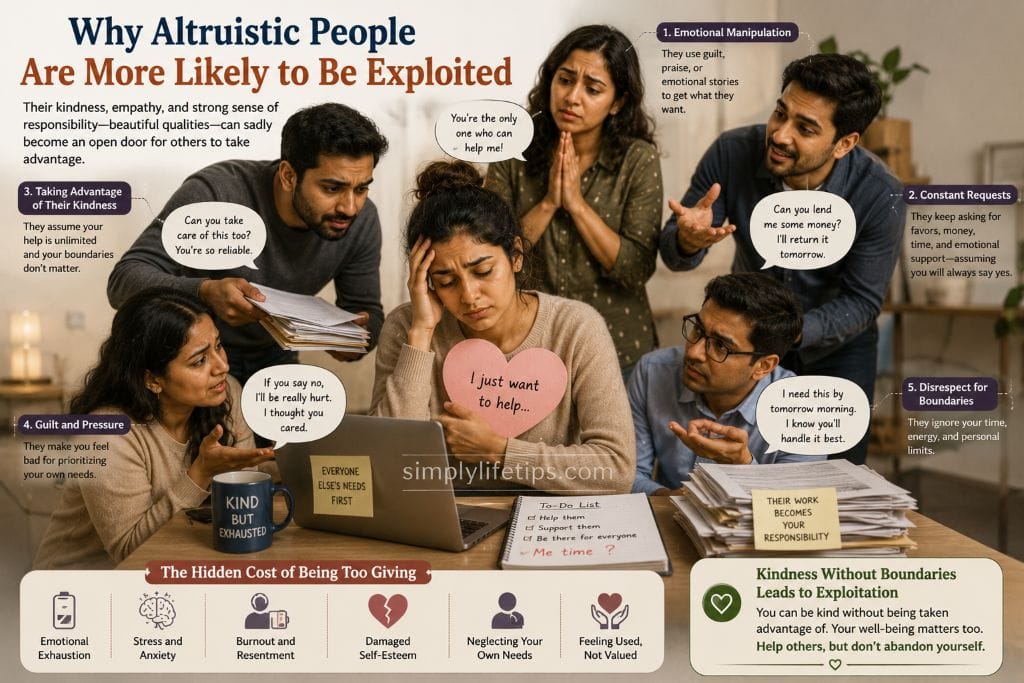
Manipulative People Recognize Kindness Quickly
Some individuals are skilled at identifying people who rarely refuse requests.
They may notice someone who:
- Always agrees to help.
- Avoids conflict.
- Feels guilty saying no.
- Frequently apologizes.
- Gives without expecting anything in return.
Once these patterns become obvious, repeated requests often follow.
For example, a coworker may regularly ask the same generous colleague to complete extra tasks because they know the answer is almost always “yes.”
Emotional Manipulation Creates Guilt
One of the most common tactics used against compassionate people is guilt.
Instead of making reasonable requests, manipulative individuals may use emotional pressure.
Examples include:
- “You’re the only person I can count on.”
- “If you cared about me, you’d help.”
- “After everything I’ve done for you…”
- “I guess I’ll have to handle it alone.”
These statements are designed to make refusal feel selfish, even when the request is unreasonable.
Because highly empathetic people dislike seeing others disappointed, they often give in despite their own needs.
One-Sided Relationships Become Common
Healthy relationships involve mutual care, respect, and support.
In unhealthy relationships, however, one person constantly gives while the other mainly receives.
Signs of a one-sided relationship include:
- You are always the first to offer help.
- Your problems receive little attention.
- People contact you only when they need something.
- Your generosity is expected rather than appreciated.
- Your efforts are rarely acknowledged.
Over time, these relationships become emotionally draining because the balance between giving and receiving disappears.
Financial Generosity Can Be Misused
People with an altruistic personality often believe helping others financially is the right thing to do.
While generosity can make a meaningful difference, repeated financial sacrifices may create serious personal difficulties.
Examples include:
- Lending money without repayment.
- Paying other people’s bills regularly.
- Donating beyond one’s financial means.
- Delaying personal financial goals to solve someone else’s problems.
In extreme cases, individuals may struggle to build savings or achieve long-term financial security because they continually prioritize other people’s needs.
Healthy generosity should never jeopardize your own financial stability.
Workplace Exploitation
The workplace is another environment where excessive kindness can be taken advantage of.
Highly dependable employees often become the people everyone turns to for extra work.
They may:
- Stay late to help coworkers.
- Accept responsibilities outside their job description.
- Cover shifts repeatedly.
- Solve problems that others avoid.
- Hesitate to ask for recognition or promotion.
Ironically, always saying yes does not necessarily lead to greater appreciation. Instead, it can create unrealistic expectations that they will always be available.
Family Members Can Also Cross Boundaries
Exploitation is not limited to strangers or coworkers.
Sometimes it happens within families.
Relatives may repeatedly depend on the same compassionate person for:
- Financial assistance.
- Childcare.
- Emotional support.
- Household responsibilities.
- Conflict resolution.
Although helping family members is important, constantly sacrificing your own needs can eventually create stress, resentment, and burnout.
Along with setting boundaries, enjoying the benefits of laughter for stress relief can help reduce emotional exhaustion and improve overall mental well-being.
Healthy family relationships respect both generosity and personal boundaries.
Why Kind People Often Blame Themselves
One of the most painful aspects of exploitation is that compassionate individuals frequently blame themselves instead of recognizing unhealthy behavior in others.
They may think:
- “I should have done more.”
- “Maybe I wasn’t supportive enough.”
- “It’s my fault they’re upset.”
- “I shouldn’t have said no.”
This self-criticism can continue even after they have clearly been treated unfairly.
Rather than questioning the manipulative behavior, they question their own kindness.
The Emotional Cost of Being Exploited
Repeated exploitation gradually affects emotional well-being.
Common consequences include:
- Emotional exhaustion.
- Chronic stress.
- Loss of self-confidence.
- Compassion fatigue.
- Anxiety.
- Feelings of resentment.
- Difficulty trusting others.
Some people eventually withdraw from helping altogether because they fear being hurt again. Others continue giving despite increasing emotional pain.
Neither extreme is healthy.
Kindness Needs Boundaries
Being compassionate does not require accepting every request or solving every problem.
Healthy kindness includes wisdom.
It recognizes that helping others should never require sacrificing your mental health, financial security, or personal relationships.
The healthiest altruistic people are not those who give endlessly—they are those who know when to help, when to step back, and when to say “no” without guilt.
Learning to recognize manipulation is not becoming cynical. It is protecting your compassion so that it can continue making a positive difference for the people who genuinely value it.
When Compassion Becomes Self-Neglect
Helping others is one of the most meaningful things a person can do. However, when kindness consistently comes at the expense of your own physical, emotional, or financial well-being, compassion can slowly turn into self-neglect.
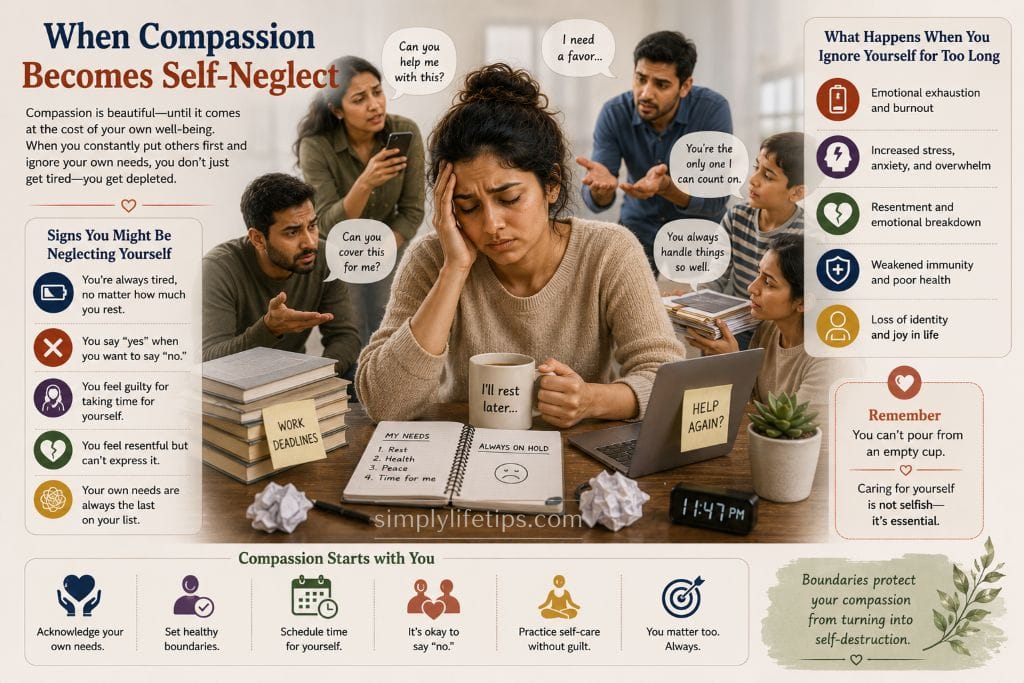
People with an altruistic personality often don’t notice this change because it happens gradually. What begins as occasional self-sacrifice can eventually become a lifestyle where their own needs are always pushed aside.
The problem is not kindness itself—it is the absence of healthy limits.
Emotional Burnout
Constantly caring for others requires emotional energy.
When that energy is never replenished, emotional burnout can develop.
Unlike ordinary tiredness, burnout leaves a person feeling mentally and emotionally drained, making even simple daily tasks feel overwhelming.
Common signs include:
- Feeling exhausted even after resting.
- Losing enthusiasm for activities you once enjoyed.
- Becoming emotionally numb.
- Feeling overwhelmed by small problems.
- Difficulty concentrating.
Ironically, the people who are always available for others are often the least likely to ask for help themselves.
Compassion Fatigue
Psychologists use the term compassion fatigue to describe emotional exhaustion caused by continuously caring for people who are struggling.
Although it is commonly seen among healthcare workers, caregivers, teachers, and emergency responders, anyone who constantly supports others can experience it.
Symptoms may include:
- Emotional numbness.
- Irritability.
- Difficulty sleeping.
- Feeling detached.
- Reduced empathy over time.
- Persistent mental fatigue.
Compassion fatigue does not mean someone has become uncaring. It simply means their emotional resources have been depleted.
Chronic Stress Affects the Body
Emotional stress doesn’t remain in the mind—it affects the entire body.
Long-term stress can contribute to:
- Frequent headaches.
- Muscle tension.
- Digestive problems.
- High blood pressure.
- Weakened immune function.
- Poor sleep quality.
When someone spends years putting everyone else’s needs first, their body often begins to signal that something needs to change.
Personal Dreams Get Left Behind
One of the hidden costs of excessive generosity is that personal goals are often postponed indefinitely.
Many highly compassionate people delay:
- Career advancement.
- Higher education.
- Starting a business.
- Saving for retirement.
- Pursuing hobbies.
- Taking vacations.
- Investing in their own health.
Instead of asking, “What do I need?” they continually ask, “What does everyone else need?”
Over time, this imbalance can lead to regret and frustration.
Family Relationships May Suffer
Many altruistic individuals work tirelessly to help relatives, friends, neighbors, or colleagues.
Ironically, the people closest to them may receive the least attention.
For example:
- A spouse may feel emotionally neglected.
- Children may wish for more quality time.
- Elderly parents may feel overlooked.
- Family finances may become strained because resources are directed elsewhere.
Helping others should never mean unintentionally neglecting the people who depend on you most.
Financial Sacrifice Has Limits
Generosity with money can make a meaningful difference in someone’s life.
However, repeatedly giving beyond your financial capacity creates long-term problems.
Examples include:
- Lending money you cannot afford to lose.
- Paying for other people’s responsibilities.
- Delaying emergency savings.
- Ignoring your own financial goals.
Healthy generosity comes from abundance—not from personal hardship.
Protecting your financial future allows you to continue helping others for years to come.
The Warning Signs of Self-Neglect
If you have an altruistic personality, ask yourself these questions:
- Do I feel guilty whenever I say no?
- Do I put everyone else’s needs before my own?
- Am I emotionally exhausted most of the time?
- Do people contact me mainly when they need something?
- Have I postponed my own goals for years?
- Do I rarely ask others for help?
Answering “yes” to several of these questions may indicate that your kindness has become unbalanced.
Recognizing the problem is the first step toward creating healthier relationships.
Self-Care Is Not Selfish
Many compassionate people believe that taking care of themselves is selfish.
In reality, the opposite is true.
You cannot continue supporting others if you are emotionally, physically, or financially depleted.
Think of the safety instructions given on airplanes: put on your own oxygen mask before helping others.
The same principle applies in everyday life.
When you protect your own well-being, you become a stronger partner, parent, friend, colleague, and caregiver.
Self-care allows kindness to remain sustainable instead of becoming a source of suffering.
Kindness Should Never Cost Your Peace
True compassion is not measured by how much you sacrifice.
It is measured by your ability to make a positive difference while also respecting your own health, happiness, and dignity.
The most compassionate people are not those who give until nothing remains. They are those who understand that preserving their own peace allows them to continue making a meaningful difference in the lives of others.
How to Stay Kind Without Being Exploited?
Being compassionate does not mean saying “yes” to every request or sacrificing your own well-being. In fact, the healthiest and most effective altruistic people are those who combine kindness with wisdom. They understand that protecting themselves allows them to continue helping others over the long term.

Developing habits that make the brain smarter can strengthen emotional intelligence, decision-making, and self-awareness.
Here are practical ways to remain compassionate without becoming vulnerable to exploitation.
Learn to Pause Before Saying Yes
Many people with an altruistic personality respond immediately when someone asks for help. They agree before considering whether they have the time, energy, or resources.
Instead of giving an instant answer, develop the habit of pausing.
You can say:
- “Let me think about it.”
- “I’ll get back to you tomorrow.”
- “I need to check my schedule first.”
A short pause gives you time to decide whether helping is truly possible without harming your own well-being.
Set Healthy Boundaries
Boundaries are not barriers that keep people away. They are guidelines that protect your emotional, physical, and financial health.
Healthy boundaries may include:
- Limiting how much time you dedicate to others.
- Deciding how much financial help you can realistically offer.
- Protecting your personal and family time.
- Refusing requests that interfere with your health or responsibilities.
People who genuinely care about you will usually respect reasonable boundaries.
Stop Feeling Guilty for Saying No
Many compassionate people believe refusing a request makes them selfish.
The truth is that saying “no” simply acknowledges that your time and energy are limited.
Every time you say yes to something unnecessary, you may be saying no to something important, such as:
- Spending time with your family.
- Resting after a stressful week.
- Pursuing your personal goals.
- Looking after your physical or mental health.
A respectful refusal is not a sign of selfishness—it is a sign of emotional maturity.
Recognize Emotional Manipulation
Not every request for help is genuine.
Watch for patterns such as:
- Repeated guilt-tripping.
- Constant emergencies.
- Lack of appreciation.
- One-sided relationships.
- Pressure to make immediate decisions.
If someone only contacts you when they need something, it may be time to reconsider the relationship.
Healthy relationships involve mutual care, not constant sacrifice from one person.
Accept That You Cannot Save Everyone
Highly empathetic people often feel responsible for solving other people’s problems.
However, every person is ultimately responsible for their own choices and actions.
Supporting someone is admirable.
Taking responsibility for their entire life is not.
Sometimes the most helpful response is encouraging people to find their own solutions rather than solving every problem for them.
Prioritize Your Physical and Mental Health
Kindness should never come at the expense of your health.
Make time for activities that restore your energy, such as:
- Getting enough sleep.
- Exercising regularly.
- Spending time with family.
- Practicing mindfulness or meditation.
- Enjoying hobbies.
- Taking regular breaks from responsibilities.
Looking after yourself increases your ability to care for others without becoming emotionally exhausted.
Build Relationships Based on Mutual Respect
Healthy friendships and relationships involve both giving and receiving.
Ask yourself:
- Do they support me when I need help?
- Do they respect my boundaries?
- Do they appreciate my kindness?
- Would they do the same for me?
Relationships that are built on mutual respect tend to be healthier and more fulfilling than those based solely on one person’s generosity.
Remember That Kindness Includes Yourself
Many compassionate people extend unlimited understanding to everyone except themselves.
They forgive others quickly but criticize themselves harshly.
Practice treating yourself with the same compassion you naturally offer others.
Celebrate your achievements.
Accept your limitations.
Forgive your mistakes.
Protect your peace of mind.
Self-compassion is not self-indulgence—it is an essential part of emotional well-being.
You Cannot Pour From an Empty Cup
One of the most powerful lessons for people with an altruistic personality is this:
You cannot continue giving if you have nothing left to give.
Emotional energy, time, health, and financial resources are limited. When these resources are constantly depleted, even the kindest person eventually experiences stress, resentment, or burnout.
Protecting yourself is not abandoning others.
It is ensuring that your compassion remains sustainable throughout your life.
Kindness becomes most powerful when it is supported by healthy boundaries, self-respect, and emotional balance.
Knowing these strategies is one thing, but applying them consistently is what protects your emotional well-being. Healthy boundaries allow you to remain generous without becoming exhausted or taken advantage of. The infographic below summarizes the most important habits that help you stay compassionate while also respecting your own needs.
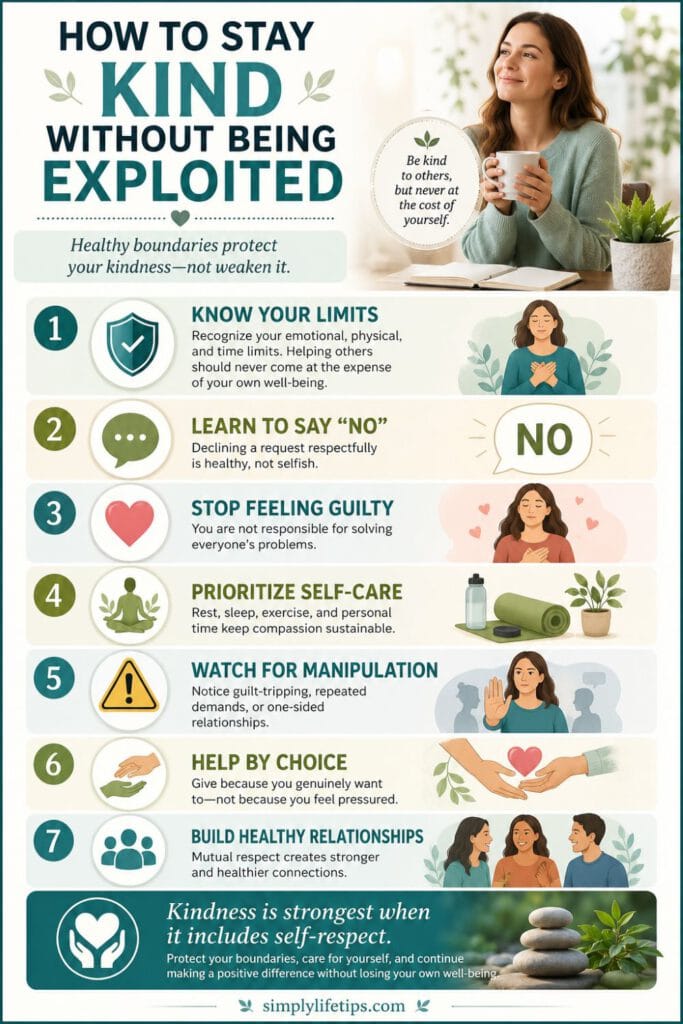
Remember that setting boundaries is not about becoming less caring—it is about ensuring your kindness remains sustainable. By recognizing your limits, communicating honestly, and making self-care a priority, you can continue supporting others without sacrificing your own mental and emotional health.
In the next section, we’ll explore why saying “no” often feels so difficult for compassionate people and why learning this simple skill is one of the healthiest forms of self-respect.
Altruistic Personality – Why Saying “No” Is Not Selfish
One of the biggest misconceptions about kindness is the belief that saying “no” is selfish. Many people with an altruistic personality feel guilty whenever they decline a request, even if they are exhausted, overwhelmed, or unable to help.
In reality, setting healthy boundaries is not an act of selfishness—it is an act of self-respect.
When you protect your own well-being, you preserve your ability to continue helping others in meaningful and sustainable ways.
Kindness Should Never Require Self-Sacrifice
Helping others is admirable, but it should not come at the cost of your physical health, emotional stability, financial security, or family relationships.
Imagine someone who works long hours, supports relatives financially, volunteers on weekends, and is always available to solve everyone else’s problems.
At first, they may feel fulfilled.
Over time, however, they may become exhausted, stressed, and emotionally drained.
Eventually, they have little energy left for themselves or the people closest to them.
True kindness should enrich your life—not slowly consume it.
Healthy Boundaries Protect Everyone
Boundaries are often misunderstood as being cold or uncaring.
In reality, they help create healthier relationships by making expectations clear.
Healthy boundaries allow you to:
- Protect your mental health.
- Respect your personal time.
- Maintain financial stability.
- Prevent emotional exhaustion.
- Build relationships based on mutual respect.
When people know your limits, they are more likely to appreciate your help instead of taking it for granted.
Saying “No” Is Sometimes the Kindest Answer
There are situations where refusing a request is actually the most responsible choice.
For example:
- Declining to lend money you cannot afford to lose.
- Refusing extra work that would harm your health.
- Saying no to commitments that interfere with your family responsibilities.
- Encouraging someone to solve a problem independently instead of creating dependence.
Helping does not always mean doing everything for everyone.
Sometimes the greatest act of kindness is empowering others to become stronger and more independent.
Your Worth Is Not Measured by Constant Giving
Many compassionate people unknowingly connect their self-worth with how much they help others.
They may believe:
- “People will only value me if I’m useful.”
- “I must always be available.”
- “Good people never refuse.”
These beliefs can become emotionally unhealthy.
Your value as a person does not depend on how many problems you solve or how many sacrifices you make.
You deserve respect, care, and compassion simply because you are human.
Boundaries Strengthen Compassion
Contrary to popular belief, healthy boundaries do not reduce kindness—they make it stronger.
When you protect your emotional energy, you can:
- Listen more patiently.
- Help more effectively.
- Make thoughtful decisions.
- Avoid resentment.
- Maintain long-term relationships.
Compassion that is supported by boundaries is far more sustainable than compassion driven by guilt.
Learning to Say “No” Gracefully
Saying no does not have to sound harsh or disrespectful.
You can decline a request politely while still showing empathy.
Examples include:
- “I’m sorry, but I’m not able to help this time.”
- “I appreciate you asking, but I have other commitments.”
- “I wish I could, but I need to focus on my own responsibilities right now.”
- “I hope you understand that I need to take care of myself as well.”
These responses communicate respect without sacrificing your own needs.
Remember the “Empty Cup” Principle
There is a simple truth that applies to every compassionate person:
You cannot pour from an empty cup.
If you neglect your own health, happiness, finances, and relationships, you will eventually have little left to give.
Protecting yourself is not a sign of weakness or selfishness.
It is what allows your kindness to remain genuine, joyful, and sustainable for years to come.
Healthy compassion is not about saying “yes” to everyone.
It is about knowing when to say yes, when to say no, and how to do both with kindness and confidence.
Altruistic Personality Quote
Conclusion
An altruistic personality is one of the most valuable qualities a person can possess. Compassionate individuals make the world a better place through their generosity, empathy, and willingness to support others. Families grow stronger, communities become more connected, and countless lives are improved because of people who genuinely care.
Neuroscience shows that extraordinary kindness is more than a moral choice. Brain regions involved in empathy, emotional awareness, and reward processing help explain why some people feel deeply compelled to help others. Their compassion is not a weakness—it is a remarkable human strength.
However, even the kindest heart has limits.
When generosity is not balanced with healthy boundaries, it can lead to emotional exhaustion, financial hardship, compassion fatigue, and unhealthy relationships. Kindness should never require sacrificing your peace of mind, health, or personal dreams.
Learning to say “no” when necessary does not diminish your compassion. Instead, it protects your emotional well-being and allows your kindness to remain genuine and sustainable. Healthy boundaries ensure that your generosity comes from a place of strength rather than obligation or guilt.
Remember this simple truth:
The goal is not to stop helping others. The goal is to help others without losing yourself in the process.
The world needs compassionate people. But it needs them to be emotionally healthy, confident, and resilient enough to continue making a positive difference for many years to come.
Choose kindness.
Protect your peace.
And never forget that caring for yourself is one of the most compassionate choices you can make.
FAQs – Altruistic Personality
What is an altruistic personality?
An altruistic personality is a personality trait characterized by genuine concern for the well-being of others. People with this trait willingly help others without expecting rewards, recognition, or personal gain.
Is being too kind a weakness?
No. Kindness itself is a strength. However, kindness without healthy boundaries can make a person vulnerable to emotional manipulation, burnout, and exploitation. Balancing compassion with self-care is essential.
Why do kind people often get exploited?
Highly compassionate people may find it difficult to say no, avoid conflict, or prioritize their own needs. Some individuals take advantage of these qualities by using guilt, manipulation, or one-sided relationships to benefit themselves.
Can you learn to set boundaries without becoming less compassionate?
Yes. Healthy boundaries help protect your emotional, physical, and financial well-being. They allow you to continue sustainably helping others without sacrificing your own health or happiness.
What does neuroscience say about altruism?
Research suggests that brain regions such as the amygdala, anterior insula, anterior cingulate cortex, and the brain’s reward system play important roles in empathy and compassionate behavior. These regions help explain why helping others can feel emotionally meaningful and rewarding.
Disclaimer
Disclaimer: This article is for educational and informational purposes only. It is not intended to provide medical, psychological, or mental health advice. While the article discusses findings from neuroscience and psychology research, it should not be used to diagnose or treat any medical or mental health condition. If you are experiencing emotional distress, anxiety, burnout, or other mental health concerns, consult a qualified healthcare professional.
References
- Marsh AA, Stoycos SA, Brethel-Haurwitz KM, et al. Neural and cognitive characteristics of extraordinary altruists. Proceedings of the National Academy of Sciences (PNAS).
- American Psychological Association (APA). Empathy.
- National Institute of Mental Health (NIMH). Caring for Your Mental Health.
- World Health Organization (WHO). Mental Health.
- National Library of Medicine (PubMed). Prosocial Behavior and Altruism (Search results)

Mathukutty P V is a Blogger, YouTuber, and Content Writer and the founder of Simply Life Tips. After taking voluntary retirement in 2017, he embraced a free lifestyle focused on learning, personal growth, and sharing practical wisdom to help others live with more purpose and positivity.


