
Self-forgiveness is an important part of emotional healing, personal growth, and self-acceptance. Everyone makes mistakes. Sometimes, our decisions hurt other people, damage relationships, or leave us with feelings of guilt and regret. Although we cannot change the past, we can learn from our experiences and choose a healthier way forward.
Many people find it easier to forgive others than to forgive themselves. They continue blaming themselves for past mistakes, repeatedly revisit painful memories, and struggle to believe they deserve happiness. However, holding on to guilt and shame indefinitely does not repair the past.
Learning to forgive yourself does not mean denying responsibility or pretending that nothing happened. It means acknowledging your mistakes, making amends where possible, learning from them, and treating yourself with understanding and compassion. The American Psychological Association’s discussion of forgiveness provides further background on forgiveness and its role in emotional well-being.
Let’s explore why self-forgiveness matters, what makes it difficult, and how you can practise it in everyday life.
What Is Self-Forgiveness?
Self-forgiveness is the process of accepting responsibility for something you regret while gradually releasing excessive self-blame, guilt, and shame.
It involves recognising that you made a mistake without allowing that mistake to define your entire identity.
For example, imagine that you said something hurtful to a close friend during an argument. You may regret your words and feel guilty about the pain you caused.
Self-forgiveness does not mean ignoring what happened. Instead, it involves acknowledging your behaviour, offering a sincere apology, learning to communicate better, and making a conscious effort not to repeat the mistake.
Self-forgiveness is not an excuse for irresponsible behaviour. It is a way to combine accountability with self-compassion.
Why Is It So Difficult to Forgive Yourself?
Forgiving yourself can be challenging, particularly when a mistake has affected someone you love or changed an important part of your life.
Several emotions and thought patterns can make the process difficult.
1. Feeling Guilty About Past Mistakes
Guilt often arises when we believe that our actions were wrong or hurtful. It can encourage us to accept responsibility and make amends.
However, guilt becomes unhelpful when we continue punishing ourselves long after we have acknowledged our mistakes and taken reasonable steps to correct them.
2. Experiencing Shame
Guilt and shame are related, but they are not the same.
- Guilt: “I did something wrong.”
- Shame: “There is something wrong with me.”
Guilt focuses on a particular action, while shame can make us feel that we are fundamentally unworthy or bad.
Self-forgiveness helps us recognise that making a mistake does not mean we have no value as a person.
3. Regretting Decisions
Sometimes, we look back and wish we had made different choices. We may regret missed opportunities, broken relationships, financial decisions, or words spoken in anger.
Repeatedly thinking about what might have happened can prevent us from concentrating on the present.
4. Fear of Avoiding Responsibility
Some people believe that forgiving themselves means escaping the consequences of their actions.
This is a misunderstanding. Genuine self-forgiveness includes accountability. We must acknowledge what happened, accept the consequences, and make appropriate efforts to repair the harm.
5. Expecting Perfection
People who expect themselves to make perfect decisions may struggle particularly with self-forgiveness.
Nobody makes the right decision every time. Accepting human imperfection helps us respond to mistakes with greater wisdom rather than endless self-criticism.
Amazing Benefits of Self-Forgiveness
Practising self-forgiveness can support emotional well-being and healthier relationships. It does not erase painful experiences, but it can help us develop a more balanced relationship with ourselves.
1. Reduces Excessive Self-Blame
Constantly blaming yourself for past mistakes can become emotionally exhausting.
Self-forgiveness encourages you to acknowledge what happened without repeatedly condemning yourself. Instead of asking why you failed over and over again, you can begin asking what you learned and what you can do differently.
For example, if you made a poor financial decision, you can recognise the mistake, understand what influenced it, and develop better financial habits.
2. Supports Emotional Healing
Unresolved guilt and shame can keep painful memories alive. Self-forgiveness provides an opportunity to process these emotions and gradually move forward.
It does not mean forgetting a difficult experience. It means learning to remember the past without allowing it to control every aspect of your present life.
For a broader understanding of how forgiveness can contribute to emotional well-being, read our article on the Benefits of Forgiveness: Find Peace and Happiness.
3. Encourages Self-Compassion
Self-compassion means treating yourself with kindness and understanding when you experience failure or difficulty.
Instead of using harsh words against yourself, try responding as you would to a close friend facing a similar situation.
For example, rather than saying, “I always make terrible decisions,” you could say, “I made a mistake, but I can learn from it and make a better decision next time.”
Research discussed in the Annual Review of Psychology examines self-compassion and its relationship with psychological processes and well-being.
4. Promotes Personal Growth
Mistakes can become valuable learning experiences when we are willing to examine them honestly.
Self-forgiveness helps us move beyond regret and concentrate on improvement.
You may discover that you need to develop patience, improve communication, manage emotions, or think more carefully before making important decisions.
Research on self-compassion and well-being has also been examined in BMC Psychology. These findings provide further reading on the relationship between self-compassion and psychological well-being.
5. Helps Repair Relationships
When we accept responsibility for our actions, we become more willing to apologise and make amends.
A sincere apology can help repair a damaged relationship, although the other person may need time and may not be ready to forgive.
Self-forgiveness allows us to take responsibility without demanding immediate acceptance from others.
6. Helps You Move Forward
Holding on to past mistakes can make it difficult to appreciate present opportunities.
Self-forgiveness encourages you to recognise that your past does not have to determine your future.
You can learn from yesterday while making healthier choices today.
How to Practise Self-Forgiveness: 8 Practical Steps
Self-forgiveness is not always immediate. It is a process that requires honesty, patience, and consistent effort. The following steps can help you begin.
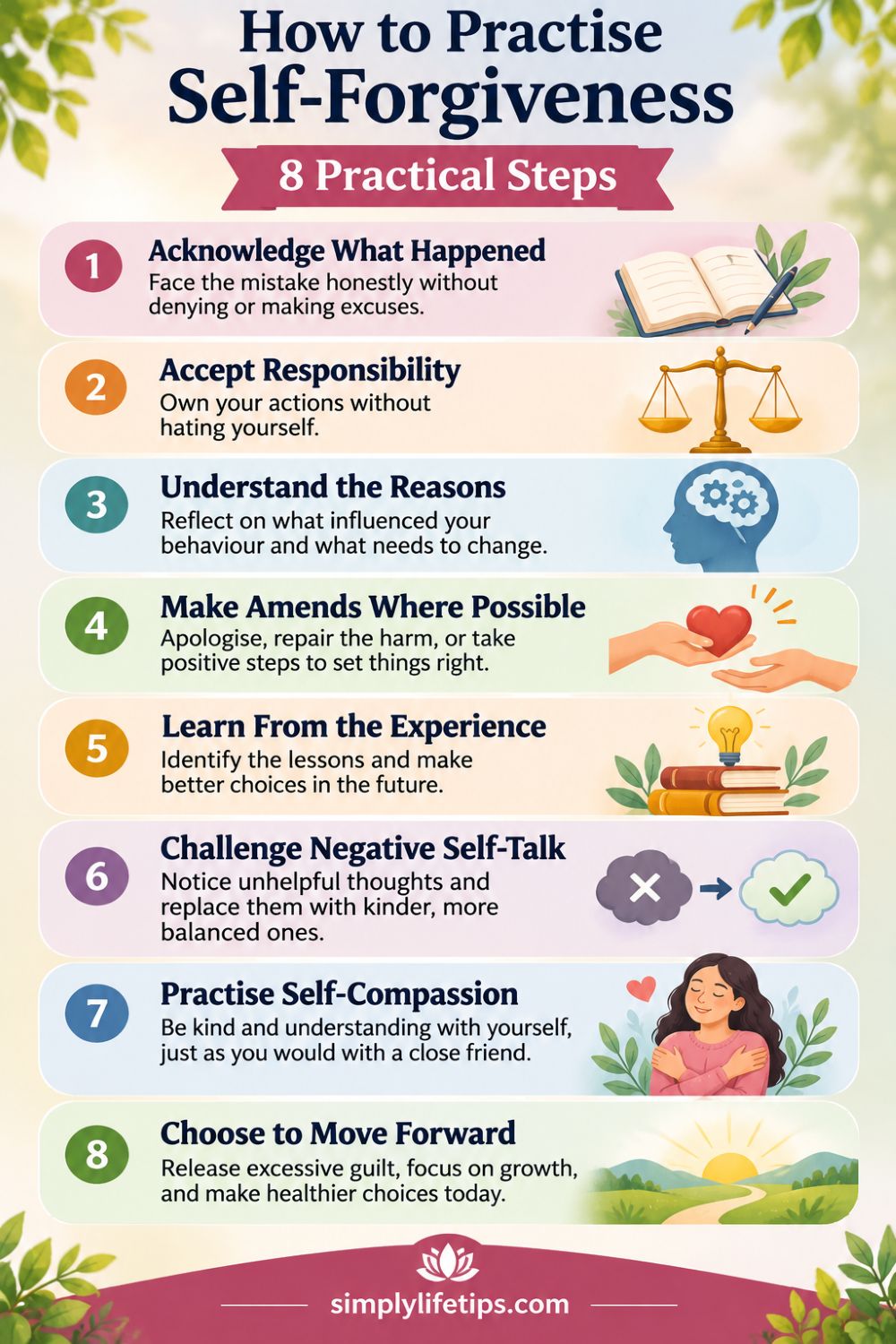
1. Acknowledge What Happened
The first step is to face the mistake honestly.
Avoid denying what happened, making excuses, or blaming everyone else. Recognise your role and identify the specific behaviour you regret.
For example, if you spoke rudely to a family member, acknowledge that your words caused hurt instead of pretending that the argument was entirely their fault.
Honest acknowledgement creates a foundation for meaningful change.
2. Accept Responsibility Without Hating Yourself
Taking responsibility is essential, but it does not require endless self-punishment.
Understand the difference between accepting that you made a mistake and believing that you are a bad person.
You can say:
“I made a mistake. I accept responsibility for my actions, and I will try to do better.”
This approach encourages accountability while allowing room for personal growth.
3. Understand Why You Made the Mistake
Think carefully about the circumstances that contributed to your behaviour.
Were you acting out of anger, fear, stress, insecurity, or a lack of understanding? Did you make a decision without considering its consequences?
Understanding the reasons behind your actions does not excuse harmful behaviour. It helps you identify what needs to change.
For example, if you repeatedly lose your temper during disagreements, learning better ways to manage frustration may help prevent similar situations.
4. Make Amends Where Possible
If your actions hurt someone, consider what you can do to repair the harm.
You might:
- Offer a sincere apology.
- Acknowledge the other person’s feelings.
- Correct misinformation or a harmful statement.
- Replace or repair something you damaged.
- Change the behaviour that caused the problem.
A meaningful apology should not demand immediate forgiveness. The other person has the right to decide how they respond.
Sometimes, direct contact may not be appropriate or safe. In such situations, consider other responsible ways to make amends without causing further harm.
5. Learn From the Experience
Every mistake can teach us something if we are willing to reflect.
Ask yourself:
- What could I have done differently?
- What did this experience teach me?
- What warning signs should I recognise in the future?
- How can I prevent a similar mistake?
Use these answers to develop healthier habits and better decision-making skills.
6. Challenge Negative Self-Talk
Negative self-talk can keep guilt and shame alive.
Thoughts such as “I am worthless,” “I never do anything right,” or “I don’t deserve happiness” are not constructive ways to address mistakes.
When such thoughts arise, examine whether they are fair and accurate.
Replace them with balanced statements:
- “I made a mistake, but I can learn from it.”
- “I cannot change the past, but I can improve my future.”
- “I deserve the opportunity to grow.”
- “My mistake does not define my entire life.”
Changing your inner dialogue takes practice, but it can help you develop a healthier attitude towards yourself.
7. Practise Self-Compassion
Treat yourself with the same understanding you would offer someone you care about.
Recognise that human beings are imperfect and that everyone experiences failure, disappointment, and regret.
Self-compassion does not mean ignoring responsibility. It means responding to your mistakes with understanding rather than cruelty.
You can practise it by writing a kind letter to yourself, speaking with a trusted person, or taking a few quiet moments to acknowledge your feelings without judging them.
For additional reading, explore this research on self-forgiveness and psychological well-being, which discusses the concept and related research.
8. Choose to Move Forward
After acknowledging your mistake, accepting responsibility, and taking reasonable steps to make things right, allow yourself to move forward.
You may still remember what happened. That is normal. The goal is not to erase the memory but to stop using it as a reason to punish yourself indefinitely.
Focus on the choices you can make today and the person you want to become.
Four Important Ways to Develop Self-Forgiveness
Self-forgiveness becomes more meaningful when we combine understanding, compassion, and responsibility.
1. Develop Self-Understanding
Try to understand your thoughts, feelings, and motivations without making excuses for harmful behaviour.
Recognising why you acted in a particular way can help you identify patterns that need attention.
2. Remember Our Common Humanity
Making mistakes is part of being human. Nobody has perfect judgement or behaves wisely in every situation.
Remembering that others also struggle with failure and regret can reduce feelings of isolation and shame.
This does not make harmful behaviour acceptable. It simply reminds us that imperfection is a shared human experience.
3. Practise Self-Compassion
Be patient with yourself as you work through difficult emotions.
Instead of attacking yourself for what happened, acknowledge your pain and consider what support or constructive action would help.
4. Combine Compassion With Accountability
Self-forgiveness should include a genuine willingness to change.
If you hurt someone, take responsibility. If you made a poor decision, learn from it. If you developed an unhealthy habit, take practical steps to improve.
Compassion without accountability can become avoidance, while accountability without compassion can become endless self-punishment. Both are important.
The Power of Self-Healing
Self-healing is often used to describe the process of recovering emotionally from painful experiences and developing healthier ways of thinking and living.
Think about a physical wound. Cleaning it, protecting it, and allowing it time to heal are important parts of recovery. Ignoring it may make the problem worse.
Emotional wounds also deserve attention. Painful memories, guilt, disappointment, and regret should not simply be pushed aside.
Self-forgiveness can be one part of this process. It encourages us to acknowledge emotional pain, learn from difficult experiences, and develop greater self-understanding.
If you are struggling with painful memories, resentment, or emotional wounds caused by past experiences, read our guide on how to heal yourself emotionally. It explains practical ways to process difficult emotions, challenge unhelpful thoughts, establish healthy boundaries, and gradually move forward.
However, self-forgiveness is not a substitute for professional mental health care. If emotional distress is persistent or overwhelming, speaking with a qualified mental health professional can provide valuable support.
What If You Cannot Forgive Yourself?
Sometimes, guilt and regret remain difficult to overcome, even after we have apologised and tried to make amends.
You may repeatedly revisit the same memories, struggle with negative thoughts, or feel that you do not deserve happiness.
If this happens, remember that self-forgiveness takes time. You do not have to force yourself to feel better immediately.
Consider these approaches:
- Talk to someone you trust about what you are experiencing.
- Write down your thoughts and feelings to understand them more clearly.
- Focus on practical actions rather than repeatedly replaying the past.
- Recognise the difference between what you can change and what is beyond your control.
- Seek help from a qualified counsellor or mental health professional if guilt, shame, or distress is affecting your daily life.
You do not have to work through every difficult experience alone.
Conclusion
Self-forgiveness is an important part of personal growth and emotional well-being. It allows us to acknowledge our mistakes, accept responsibility, learn valuable lessons, and gradually release excessive guilt and shame.
Remember that forgiving yourself does not mean forgetting the past, excusing harmful behaviour, or avoiding consequences. It means choosing to learn from your experiences rather than allowing them to define your future.
Be honest about your mistakes, make amends where possible, practise self-compassion, and give yourself time to grow.
You cannot rewrite yesterday, but you can make better choices today.
Frequently Asked Questions About Self-Forgiveness
1. What is the meaning of self-forgiveness?
Self-forgiveness is the process of accepting responsibility for past mistakes while gradually releasing excessive guilt, shame, and self-blame. It involves learning from experiences and choosing to move forward.
2. Why is self-forgiveness important?
Self-forgiveness can help reduce excessive self-criticism, encourage self-compassion, support emotional healing, and promote personal growth. It also helps people take responsibility without remaining trapped in regret.
3. How can I forgive myself for past mistakes?
Acknowledge what happened, accept responsibility, understand why you made the mistake, make amends where possible, learn from the experience, and practise self-compassion.
4. Does forgiving yourself mean forgetting your mistakes?
No. Self-forgiveness does not mean forgetting or excusing mistakes. It means accepting the past, learning from it, and avoiding unnecessary self-punishment.
5. How long does it take to forgive yourself?
There is no fixed timeline. It depends on the nature of the experience, the emotions involved, and the steps taken towards accountability and healing. Be patient and seek professional support if distress remains overwhelming.
References & Further Reading
- American Psychological Association – Forgiveness
- Self-Compassion and Psychological Well-Being – Annual Review of Psychology
- Research on Self-Compassion – BMC Psychology
- Self-Forgiveness Research – Social and Personality Psychology Compass
- Research on Self-Forgiveness – PubMed

Mathukutty P. V. is the founder of Simply Life Tips. He shares practical advice and useful insights on personal growth, health, well-being, technology, and everyday living. His goal is to help readers build positive habits and make informed decisions. He believes in continuous learning and sharing knowledge to help people live healthier, happier, and more meaningful lives.