
The rules for a happy marriage are not about being perfect or avoiding every disagreement. They are about learning how to communicate, respect each other, handle difficult moments, and keep choosing your relationship even when life becomes challenging.
A new marriage can feel exciting in the beginning. You are learning each other’s habits, expectations, strengths, weaknesses, family relationships, financial priorities, and dreams for the future. At the same time, small misunderstandings can become recurring conflicts if couples do not learn how to handle them.
A healthy marriage does not mean that two people always agree. It means they learn how to disagree without destroying their connection. Open communication and making regular time to connect can also help couples maintain a healthy relationship.
Whether you are newly married or have been together for many years, these 10 rules for a happy marriage can help you build greater trust, understanding, and companionship.
So, what are the most important rules for a happy marriage?
10 Important Rules for a Happy Marriage
Every marriage is different, but these simple principles can help couples strengthen their relationship and handle everyday challenges with greater understanding.
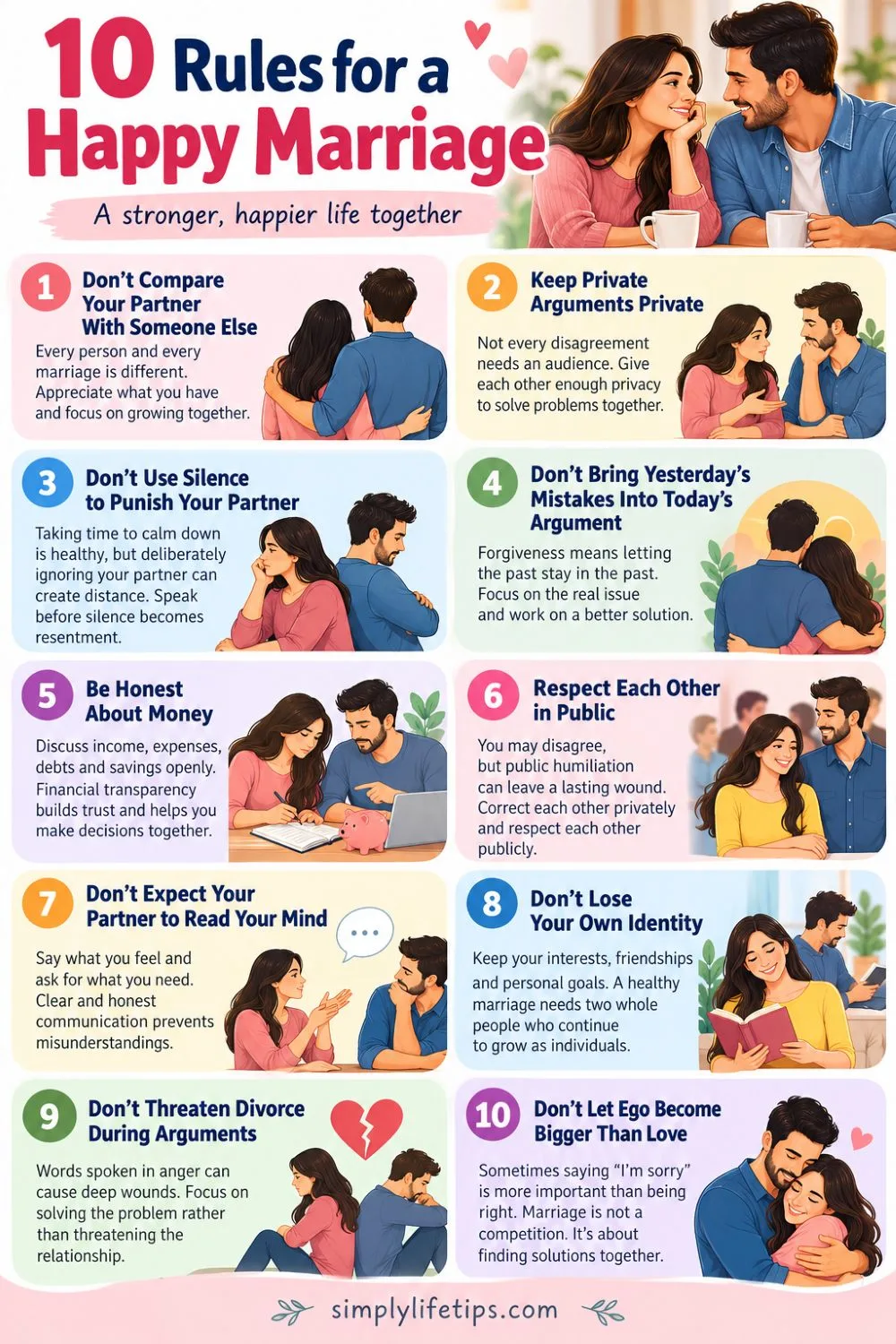
1. Never Compare Your Partner With Someone Else
Comparison can quietly damage respect and confidence in a relationship.
You may see another couple who appears happier, wealthier, more romantic, or more successful. But you rarely see the complete story behind someone else’s marriage. Comparing your partner with another person can make them feel inadequate and can create resentment.
For example, saying, “Why can’t you be more like my friend’s husband?” may seem like a simple criticism during an argument. Your partner may hear something much deeper: “You are not good enough for me.”
Instead, talk about the behavior you would like to see.
Rather than saying:
“Look how much he helps his wife.”
Try:
“I would really appreciate it if we could share more of the household work.”
The second approach focuses on your need instead of attacking your partner’s worth.
A happy marriage grows when couples appreciate what they have while working together on what needs improvement.
2. Keep Private Arguments Private
Every couple has disagreements. Not every disagreement needs to become a family discussion, friendship-group conversation, or social-media story.
Sharing every private argument can make reconciliation more difficult. Once several people know about your partner’s mistake, they may keep remembering it even after you and your partner have moved on.
For example, you may have a heated argument about spending money. You tell your parents, your sibling, and two close friends. The next morning, you and your spouse resolve the issue.
But the people you told may not know that the problem was resolved.
That is why healthy boundaries matter.
This does not mean you should hide serious problems. If there is abuse, coercion, violence, addiction, or another serious concern, reaching out to a trusted person or qualified professional is important.
For ordinary disagreements, however, give each other enough privacy to work through them together.
3. Never Use Silence to Punish Your Partner
There is a difference between taking time to calm down and deliberately using silence as punishment.
Sometimes emotions become too intense to have a productive conversation. Taking a short break can help both partners settle down.
But disappearing emotionally for days, refusing to answer, or deliberately ignoring your partner can create distance.
Imagine that one partner says, “I need some time to calm down. Can we talk about this after dinner?”
That is very different from refusing to speak without explanation.
If emotional withdrawal becomes a pattern, unresolved problems can accumulate. The Gottman Institute also emphasizes the importance of continuing dialogue and addressing disconnection rather than allowing silence to become the normal pattern.
If communication has already become difficult in your relationship, you may also find our guide to communication problems in marriage useful.
The goal is not to talk immediately when you are overwhelmed. The goal is to make sure the conversation eventually happens.
4. Don’t Bring Yesterday’s Mistakes Into Today’s Argument
When couples argue, it can be tempting to bring up every mistake from the past.
“You did this last year.”
“You always do that.”
“And remember what you said three months ago?”
Soon, the original issue disappears beneath a mountain of old grievances.
Forgiveness does not mean pretending that something never happened. It means dealing with the issue, learning from it, and avoiding the habit of repeatedly using it as ammunition.
For example, if your partner once forgot an important family event and genuinely apologized, bringing that incident into every future disagreement will not solve today’s problem.
If an old issue remains unresolved, discuss it separately. Do not use it as a weapon whenever you disagree.
Healthy couples learn to repair after conflict rather than keeping score. Relationship research from the Gottman Institute places particular importance on handling conflict constructively and repairing negative interactions.
5. Be Honest About Money
Money is not just about numbers. It can involve trust, responsibility, priorities, security, and plans.
Hiding debt, secret purchases, loans, or major financial problems can damage trust.
A couple may have different attitudes toward money. One person may prefer saving while the other enjoys spending. That difference does not automatically mean the marriage will fail.
The important thing is to discuss it openly.
For example, instead of hiding a large purchase because you are afraid your partner will be angry, talk about it before making the decision.
You can discuss:
- Monthly expenses
- Savings goals
- Debts and loans
- Emergency funds
- Major purchases
- Support for parents or relatives
- Children’s education
- Long-term financial goals
Financial transparency does not mean that every couple must manage money in exactly the same way. It means both partners understand the financial reality of their household.
For a related perspective, see our article on transparency in marriage with care.
6. Respect Each Other in Public
Disagreements are normal. Public humiliation is not.
Correcting your partner in front of friends or relatives may make you feel that you are proving a point, but it can damage dignity and trust.
Suppose your spouse makes a mistake while talking with guests. You may be tempted to immediately point it out.
Instead, let the moment pass and discuss it privately later.
Respect does not mean pretending your partner is always right. It means remembering that disagreement does not give either person permission to humiliate the other.
A simple principle is:
Correct each other privately. Respect each other publicly.
This also applies to jokes. Repeatedly making your partner the subject of embarrassing jokes can slowly damage emotional safety even when everyone laughs.
7. Don’t Expect Your Partner to Read Your Mind
One of the most common sources of frustration in relationships is expecting a partner to know what you need without being told.
You may think:
“They should know why I’m upset.”
“If they loved me, they would understand.”
“I shouldn’t have to ask.”
But your partner cannot automatically know what is happening inside your mind.
Instead, communicate clearly.
Rather than saying:
“You never care about me.”
Try:
“I’ve been feeling lonely lately, and I’d like us to spend some uninterrupted time together.”
The second statement gives your partner something they can understand and respond to.
The Gottman Institute recommends expressing feelings and needs without blame and using softer approaches to difficult conversations.
If you are struggling to communicate your feelings, our article on communication problems in marriage can provide additional ideas.
Good communication is not simply talking. It is expressing yourself clearly and listening carefully when your partner does the same.
8. Don’t Lose Your Own Identity
Marriage brings two lives together, but it should not erase either person.
A healthy relationship leaves room for individual interests, friendships, personal goals, hobbies, and quiet time.
For example, one partner may enjoy gardening while the other enjoys reading or playing music. They do not have to participate in every activity together.
Maintaining some independence can actually strengthen a relationship because each person continues to grow.
The Gottman Institute similarly highlights the importance of balancing togetherness with individual identity and personal space in a healthy relationship.
If you constantly sacrifice your interests, opinions, friendships, or values simply to avoid upsetting everyone, resentment can eventually build.
A happy marriage needs togetherness, but it also needs two individuals who remain themselves.
9. Don’t Threaten Divorce During Every Argument
Arguments can become emotional, especially when both people feel hurt.
But repeatedly saying “I want a divorce” or “Maybe we should separate” during ordinary disagreements can make the relationship feel unsafe.
Words spoken in anger can stay in your partner’s mind long after the argument ends.
Instead of threatening the relationship, identify the actual problem.
For example:
“I’m extremely upset about what happened. I need some time to calm down, but I want us to discuss this later.”
That communicates seriousness without turning divorce into a weapon.
Of course, this does not mean someone should remain silent about a genuinely unhealthy or unsafe marriage. Serious relationship problems may require professional guidance, and safety should always come first.
For couples dealing with growing emotional disconnection, our article on emotional distance in marriage may also be helpful.
10. Don’t Let Ego Become Bigger Than Love
Perhaps the most difficult rule is also one of the most important.
Sometimes both people know they have contributed to an argument, but neither wants to apologize first.
“I am not saying sorry.”
“They should apologize first.”
“I refuse to give in.”
This is where ego can become more important than the relationship.
Saying “I’m sorry” does not necessarily mean accepting all the blame. Sometimes it simply means acknowledging that your words or actions hurt your partner.
For example:
“I was frustrated, but I shouldn’t have spoken to you that way. I’m sorry.”
That sentence can open the door to reconciliation.
A happy marriage is not about one person always winning an argument. It is about finding solutions that allow both people to move forward.
Patience also matters here. If you want to explore this further, see our article on patience in marriage.
What Is the Biggest Rule for a Happy Marriage?
Marriage is not about winning against each other. It is about winning together.
That may be the simplest way to understand all ten rules.
There will be disagreements. There will be stressful days, financial pressures, family responsibilities, misunderstandings, and moments when one person feels hurt.
The goal is not to create a marriage where nobody ever gets angry.
The goal is to create a relationship where both people know how to come back to respect, communication, affection, and teamwork after difficult moments.
Small daily actions matter. Asking how your partner’s day went, saying thank you, listening without immediately defending yourself, sharing responsibilities, showing affection, and making time for each other can gradually strengthen the relationship.
The American Psychological Association also recommends making time for open communication and regular connection as part of maintaining healthy relationships.
How Couples Can Practice These Rules Every Day
You do not need to change your entire relationship overnight. Start with small habits.
For example, couples can:
- Spend a few minutes each day talking without phones.
- Express appreciation for one specific thing their partner did.
- Discuss money regularly instead of avoiding the subject.
- Address problems before resentment grows.
- Take a break during heated arguments and return to the conversation later.
- Avoid criticizing each other in front of family and friends.
- Make important decisions together.
- Respect each other’s personal interests and boundaries.
- Apologize when necessary.
- Celebrate small successes together.
These habits may look ordinary, but a strong marriage is usually built through ordinary moments repeated over many years.
What If Your Marriage Is Already Struggling?
These rules are not only for newlyweds.
Even couples who have been married for many years can start again by changing the way they communicate.
If conversations have become arguments, start with one small change. Instead of trying to solve every problem at once, choose one issue and discuss it calmly.
If emotional distance has developed, begin with simple connection: sit together, ask how your partner is doing, listen without immediately offering criticism, and spend some uninterrupted time together.
If the same conflicts continue despite your efforts, professional couples counseling may be worth considering.
Following the rules for a happy marriage is not about creating a perfect relationship. It develops when both partners are willing to learn, adjust, communicate, forgive, and grow.
Conclusion
The most important rules for a happy marriage are not complicated. Respect each other, communicate honestly, protect each other’s dignity, and discuss money openly. Forgive genuine mistakes and allow each other to maintain an individual identity. Most importantly, never let ego become more important than your relationship.
A happy marriage is not a competition where one person must prove they are right. It is a partnership. Both people learn to face life’s challenges together, celebrate each other’s successes, and keep choosing each other through ordinary days and difficult seasons.
You do not have to follow every rule perfectly. Start with one small change that can bring more kindness, patience, or understanding into your relationship. Sometimes, a simple conversation, a sincere apology, or a little more time together can make a meaningful difference.
The rules for a happy marriage are not about perfection. They are about choosing respect, communication, patience, and kindness again and again.
After all, the happiest marriages are often built not on grand gestures, but on the little ways two people care for each other every day.
FAQs About Rules for a Happy Marriage
What are the most important rules for a happy marriage?
The most important rules include mutual respect, honest communication, financial transparency, forgiveness, healthy boundaries, emotional connection, and a willingness to work through disagreements together.
How can couples communicate better in marriage?
Couples can communicate better by listening without interrupting, expressing feelings clearly, avoiding blame, discussing problems when both are calm, and making regular time for meaningful conversations.
Is arguing normal in a happy marriage?
Yes. Disagreements are normal because two people will not always have the same opinions or expectations. The important issue is how couples handle conflict and repair the relationship afterward.
Should married couples keep their arguments private?
Ordinary disagreements are usually best handled privately. However, serious problems such as abuse, violence, coercion, or other safety concerns should not be hidden. Seeking help from a trusted person or qualified professional can be important.
Can a struggling marriage become happy again?
Many couples can improve their relationship by changing unhealthy communication patterns, rebuilding trust, spending meaningful time together, and seeking professional help when necessary. Improvement requires genuine effort from both partners.
References
- American Psychological Association — Happy Couples: How to Keep Your Relationship Healthy
- The Gottman Institute — 3 Research-Based Tips for a Happy and Healthy Relationship

Mathukutty P V is a Blogger, YouTuber, and Content Writer and the founder of Simply Life Tips. After taking voluntary retirement in 2017, he embraced a free lifestyle focused on learning, personal growth, and sharing practical wisdom to help others live with more purpose and positivity.