
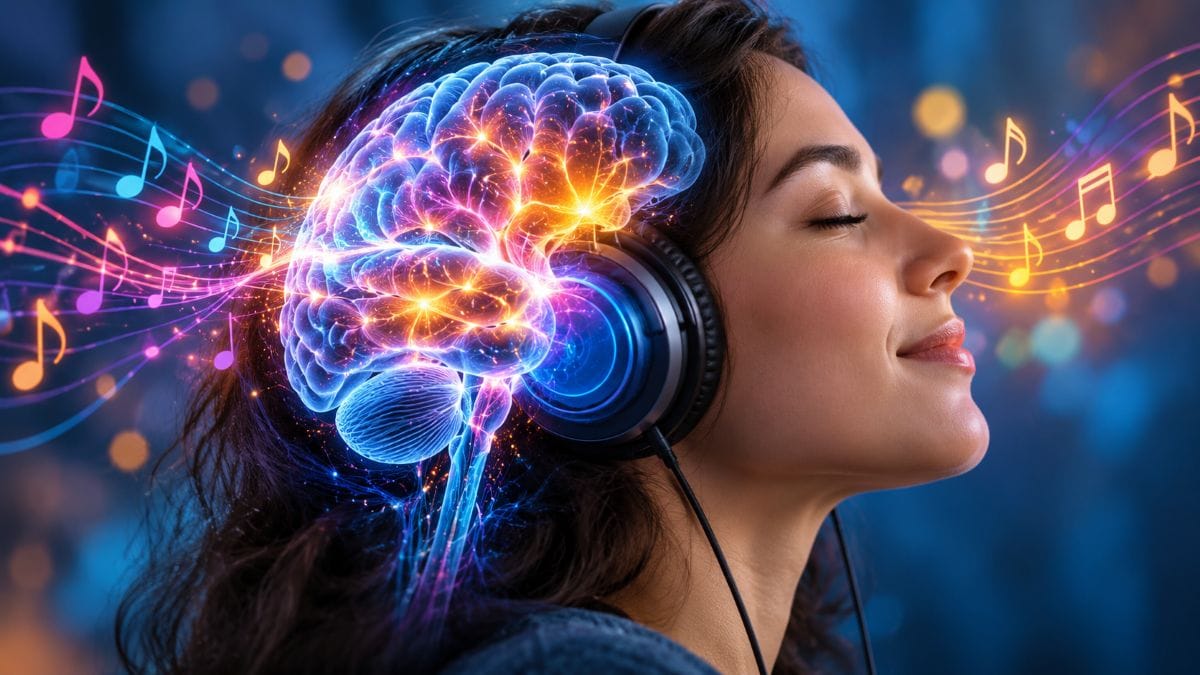
How Music Affects the Brain is more fascinating than simply enjoying a pleasant song. A familiar melody can suddenly bring back an old face, a childhood home, a particular journey, or an emotion we thought we had forgotten.
Have you ever heard an old song after many years and suddenly felt transported to another time?
Perhaps you remember where you were, who was with you, or what was happening in your life when you first heard it.
This powerful connection between music and the brain is not accidental. Music can engage brain networks involved in hearing, memory, emotion, attention, movement, language, and reward.
And its importance goes beyond entertainment. Researchers are studying music-based approaches for rehabilitation after stroke and for movement and communication difficulties associated with neurological conditions. NCCIH
How Music Affects the Brain
When we listen to music, the brain does not process the entire song as one simple sound.
It breaks the experience into different elements, including rhythm, melody, pitch, tempo, lyrics, and emotional characteristics.
The auditory cortex helps process sound, while other brain networks become involved as we recognize patterns, remember familiar melodies, experience emotions, or anticipate what comes next.
This is one reason researchers are so interested in how music affects the brain, particularly in relation to memory and emotion.
For example, when you hear a familiar song, you may recognize the melody almost immediately. Before the singer reaches the next line, you may already know what is coming.
Your brain is not merely hearing the music. It is predicting, remembering, and responding to it.
Understanding how music affects the brain also helps explain why rhythm can influence movement and why familiar songs can trigger powerful memories.
Why Does Music Trigger Memories?
One of the most fascinating effects of music is its ability to bring back autobiographical memories.
A particular song may remind you of:
- your school or college years
- a wedding or family celebration
- an old friend
- a particular journey
- a favourite place
- a difficult period in life
- someone you have not seen for many years
Music, memory and emotion are closely connected
The hippocampus plays an important role in memory, while the amygdala is involved in emotional processing. Music can engage networks associated with both memory and emotion.
This may help explain why a familiar song can sometimes bring back not only an event but also the feeling associated with that event.
For example, hearing a song you listened to during your college years may make you remember your friends, the place you lived, and even the excitement you felt at that time.
The song becomes more than a sequence of sounds. It becomes a memory cue.
Why are old songs sometimes so powerful?
A song repeatedly heard during an important period of life can become associated with many experiences.
Later, hearing the same melody may reactivate some of those associations.
This is particularly interesting in the context of ageing and dementia. Familiar music may sometimes encourage recognition, emotional responses or engagement, although music does not cure dementia or reliably restore lost memories.
That distinction is important.
Music may provide a pathway to memories and emotions, but it is not a treatment that reverses dementia.
Why Does a Song Get Stuck in Your Head?
Have you ever stopped playing a song but found yourself continuing to hear its melody in your mind?
This experience is commonly known as an earworm. Researchers also use the term involuntary musical imagery.
The experience can happen without deliberately trying to remember the song.
Why does this happen?
Songs with repetitive melodies, memorable rhythms or frequently repeated lyrics may be particularly easy for the brain to reproduce internally.
For example, you may hear a catchy chorus in the morning and find yourself mentally repeating it several hours later while doing completely unrelated work.
The external music has stopped, but your brain is still reconstructing part of the musical pattern.
This is another example of how strongly the brain can encode and replay musical information.
Why Does Music Make Us Move?
Music has a natural connection with movement.
When you hear a strong rhythm, you may automatically:
- tap your fingers
- nod your head
- move your feet
- clap your hands
- sway your body
You may not consciously decide to do any of these things.
The auditory-motor connection
The brain’s auditory and motor systems interact when we respond to rhythm.
This relationship has important implications for rehabilitation.
A regular beat can act as an external timing cue, helping a person organize movement.
For example, someone practising walking may try to coordinate their steps with a regular rhythmic beat.
This principle is used in approaches such as Rhythmic Auditory Stimulation (RAS).
Can Music Help After a Stroke?
Stroke can affect walking, balance, coordination, communication, and other functions.
Music-based rehabilitation is being studied as a complementary approach alongside conventional rehabilitation.
A rhythmic cue, for example, may provide an external structure that helps some people work on the timing and coordination of walking.
Research reviews have found beneficial effects from auditory cueing on aspects of gait and postural stability after stroke. A 2026 systematic review and meta-analysis of randomized controlled trials also reported improvements in several rehabilitation outcomes when music-based interventions were added to conventional rehabilitation, although the evidence should still be interpreted in the context of study quality and individual patient differences. PubMed
An example of rhythmic rehabilitation
Imagine a person who has difficulty maintaining a regular walking pattern after a stroke.
Instead of concentrating only on each step, a therapist may incorporate a steady rhythmic cue into rehabilitation.
The rhythm can provide a predictable external timing structure.
The music is not repairing the damaged brain by itself.
Rather, the rhythm may help the person practise a particular movement in a structured way.
This is an important distinction.
For readers interested in the broader recovery process, your existing article on Dementia Care can also provide useful context about caring for people with neurological and cognitive difficulties.
Can Music Help People With Parkinson’s Disease?
Parkinson’s disease can affect movement, balance and walking. Some people also experience freezing of gait, in which initiating or continuing a step becomes difficult.
Rhythmic auditory cues have therefore attracted considerable research interest.
Systematic reviews and meta-analyses have reported improvements in measures such as gait speed and stride length with rhythmic auditory stimulation in people with Parkinson’s disease, although the strength and quality of evidence varies between studies. PubMed
How might rhythm help walking?
Consider someone whose walking becomes irregular.
A steady beat may provide an external reference point:
Beat → step → beat → step
This can give the person a predictable rhythm around which to organize movement.
However, rhythmic cueing should not be treated as a universal solution. Parkinson’s symptoms vary considerably, and rehabilitation strategies should be individualized.
Can Music Help With Speech After a Stroke?
Another fascinating area involves aphasia, a language disorder that can occur after a stroke.
Some people with aphasia may have difficulty producing ordinary speech but retain the ability to sing familiar words or phrases.
This difference between singing and ordinary speech has contributed to rehabilitation approaches such as Melodic Intonation Therapy.
Why is singing sometimes easier than speaking?
Speech and singing involve overlapping but not identical neural processes.
Music can provide additional structure through:
- melody
- rhythm
- repetition
- familiar phrases
- predictable patterns
For example, a therapist may use a simple melodic pattern while practising a short phrase with a person recovering from aphasia.
The goal is not to make the person “sing instead of speak.”
The goal is to use musical elements as part of structured language rehabilitation.
A systematic review and meta-analysis found evidence that music therapy could improve some language outcomes, including functional communication, repetition and naming, in people with post-stroke aphasia, although it did not improve every language domain equally. PubMed
What Is the Role of Neuroplasticity?
Neuroplasticity refers to the brain’s ability to adapt and reorganize in response to experience, learning, and repeated practice.
It is an important concept in neurological rehabilitation.
But neuroplasticity should not be presented as a magical process in which the brain automatically repairs itself.
Meaningful rehabilitation usually involves repeated, structured, and goal-directed practice.
Researchers continue to study how music affects the brain because music can combine auditory processing, attention, memory, emotion, and movement during structured activities.
Why is music interesting for neuroplasticity?
Music can combine several activities at once:
- listening
- timing
- movement
- attention
- memory
- emotional engagement
- repetition
- motivation
For example, a person practising walking with rhythmic cues is simultaneously listening to sound, processing timing and coordinating movement.
Similarly, someone practising language through melody may combine auditory processing, speech production, memory and repetition.
This combination is one reason researchers continue to investigate music-based rehabilitation.
Music affects much more than our ability to hear a melody. It can engage brain systems involved in memory, emotion, attention, movement, reward and language. The infographic below summarizes some of the key ways music interacts with the brain and highlights how music-based approaches may support neurological rehabilitation.
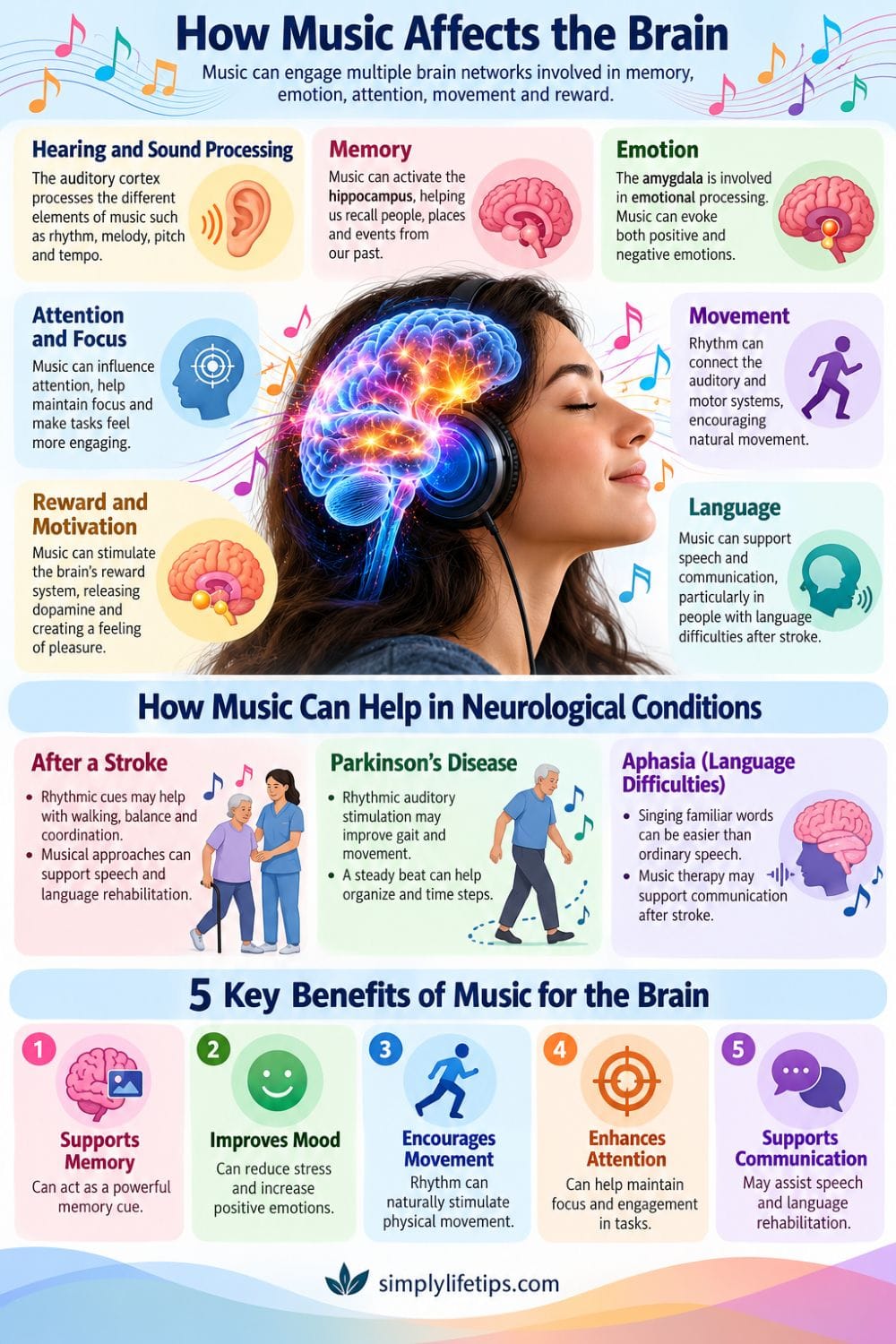
The effects of music can vary from person to person. Enjoying a familiar song may simply improve your mood or bring back a memory, while structured music-based rehabilitation may have a specific therapeutic goal. In conditions such as stroke, Parkinson’s disease and aphasia, music may be used as a complementary tool alongside appropriate medical and rehabilitation care.
What Is Music Therapy?
Music therapy is more than simply listening to your favourite songs.
In a therapeutic setting, trained professionals use music and musical activities in a structured way to address specific goals.
Depending on the individual, those goals may involve:
- communication
- movement
- speech and language
- emotional expression
- cognitive functioning
- social interaction
- engagement
Music therapy vs. listening to music
Suppose you listen to your favourite song while drinking tea because it makes you happy.
That can certainly be a meaningful and enjoyable experience.
But it is not automatically music therapy.
Now consider a rehabilitation programme in which a trained professional selects a particular rhythm to help a patient practise walking or uses structured musical exercises to support communication.
That is a very different process.
The purpose, structure and therapeutic goal matter.
For a broader discussion of healthy ageing and maintaining mental and physical engagement, your article on Small Habits That Support Healthy Aging would make a natural internal link here.
Does Music Improve Mood and Reduce Stress?
Music can also influence how we feel.
A familiar, enjoyable song may help someone relax, feel motivated, or become emotionally engaged.
Research summarized by the National Center for Complementary and Integrative Health reports beneficial effects of music-based interventions on psychological and stress-related outcomes, although results vary depending on the intervention and population studied. NCCIH
An everyday example
Think about the difference between listening to calm music after a stressful day and listening to energetic music before exercise.
The music does not necessarily change the circumstances causing stress or tiredness.
But it can influence the emotional experience of the moment.
This is one reason music is such a powerful part of everyday life.
3 Common Myths About Music Therapy
Myth 1: “Music can cure neurological diseases.”
Fact: Music is not a miracle cure for stroke, Parkinson’s disease, dementia or other neurological disorders.
However, appropriately designed music-based interventions may support specific rehabilitation goals in some people.
Myth 2: “Listening to music is the same as music therapy.”
Fact: Enjoying music can be beneficial, but music therapy involves structured therapeutic use of music according to an individual’s needs and goals.
Myth 3: “Music works equally well for everyone.”
Fact: The response depends on the person’s condition, abilities, musical preferences, rehabilitation goals, and the way the intervention is delivered.
A technique that helps one person may not produce the same result in another.
Music Is Not a Miracle Cure
Music does not replace medication, neurological treatment, physiotherapy, speech therapy or other appropriate medical care.
But growing research into how music affects the brain shows why music deserves attention as more than entertainment.
A rhythm may provide a useful cue during movement rehabilitation.
A melody may support language practice.
A familiar song may evoke an old memory or encourage emotional engagement.
And the simple act of listening to music can connect hearing, memory, emotion and attention in a remarkably rich experience.
Perhaps that is why a song can sometimes feel like much more than a song.
You may hear a melody today and suddenly find yourself back in another place, another time, or with someone you remember deeply.
The music ends. The memory may remain.
What song takes you back to a special person, place, or moment in your life?
Conclusion
How Music Affects the Brain shows how closely music connects with our memory, emotions, attention, movement, and language. A familiar song can bring back memories, lift our mood, or support rehabilitation in certain neurological conditions. Music is not a miracle cure, but its ability to connect different parts of the brain makes it a fascinating part of our lives.
FAQs About How Music Affects the Brain
How does music affect the brain?
Music can engage several brain networks involved in hearing, memory, emotion, attention, movement, and reward. The experience varies depending on the type of music and the individual listener.
Can music improve memory?
Music can act as a powerful memory cue, particularly when a song is associated with a person, place, or important period of life. However, listening to music should not be considered a treatment for memory disorders.
Can music help after a stroke?
Music-based approaches may support specific rehabilitation goals after stroke. Rhythmic cues can be used to practise aspects of movement, while structured musical approaches may also support language rehabilitation in some people with aphasia.
Is music therapy the same as listening to music?
No. Listening to music for enjoyment is not automatically music therapy. Music therapy involves structured use of music by a trained professional to address specific therapeutic goals based on an individual’s needs.
Can music help people with Parkinson’s disease?
Rhythmic auditory cues may help some people with Parkinson’s disease work on aspects of walking and movement. However, results vary, and music-based approaches should complement rather than replace appropriate medical and rehabilitation care.
References
- National Center for Complementary and Integrative Health (NCCIH) — evidence overview on music and health, including stroke rehabilitation. Music and Health: What the Science Says — NCCIH
- PubMed — systematic review and meta-analysis on rhythmic auditory stimulation and gait in Parkinson’s disease. Rhythmic Auditory Stimulation and Parkinson’s Disease — PubMed
- PubMed — systematic review and meta-analysis on music therapy and language recovery after stroke-related aphasia. Music Therapy and Aphasia After Stroke — PubMed

Mathukutty P V is a Blogger, YouTuber, and Content Writer and the founder of Simply Life Tips. After taking voluntary retirement in 2017, he embraced a free lifestyle focused on learning, personal growth, and sharing practical wisdom to help others live with more purpose and positivity.


