
Protect your peace by learning to recognize what deserves your attention, what does not, and when it is healthier to step away than to continue an argument. Your time, energy, and emotional well-being are valuable. You do not have to give them to every problem, every opinion, or every person.
Life will always bring difficult people, unexpected problems, disagreements, and situations you cannot control. The goal is not to eliminate every source of stress. Instead, protecting your peace means becoming more intentional about where you invest your attention and emotional energy.
What Does Protect Your Peace Mean?
To protect your peace means to make conscious choices that support your emotional well-being instead of allowing unnecessary conflict, negativity, or other people’s opinions to constantly disturb you.
It does not mean ignoring every problem or walking away from every difficult situation. Some problems need your attention, and some conversations are important.
The difference is learning to ask yourself:
Does this situation deserve my time, energy, and response?
Sometimes the healthiest response is to speak calmly. Sometimes it is to set a boundary. And sometimes it is simply to walk away.
10 Ways to Protect Your Peace
Protecting your peace starts with small, intentional choices. The infographic below highlights 10 simple ways to protect your emotional energy, set healthy boundaries, and create more calm in your everyday life.
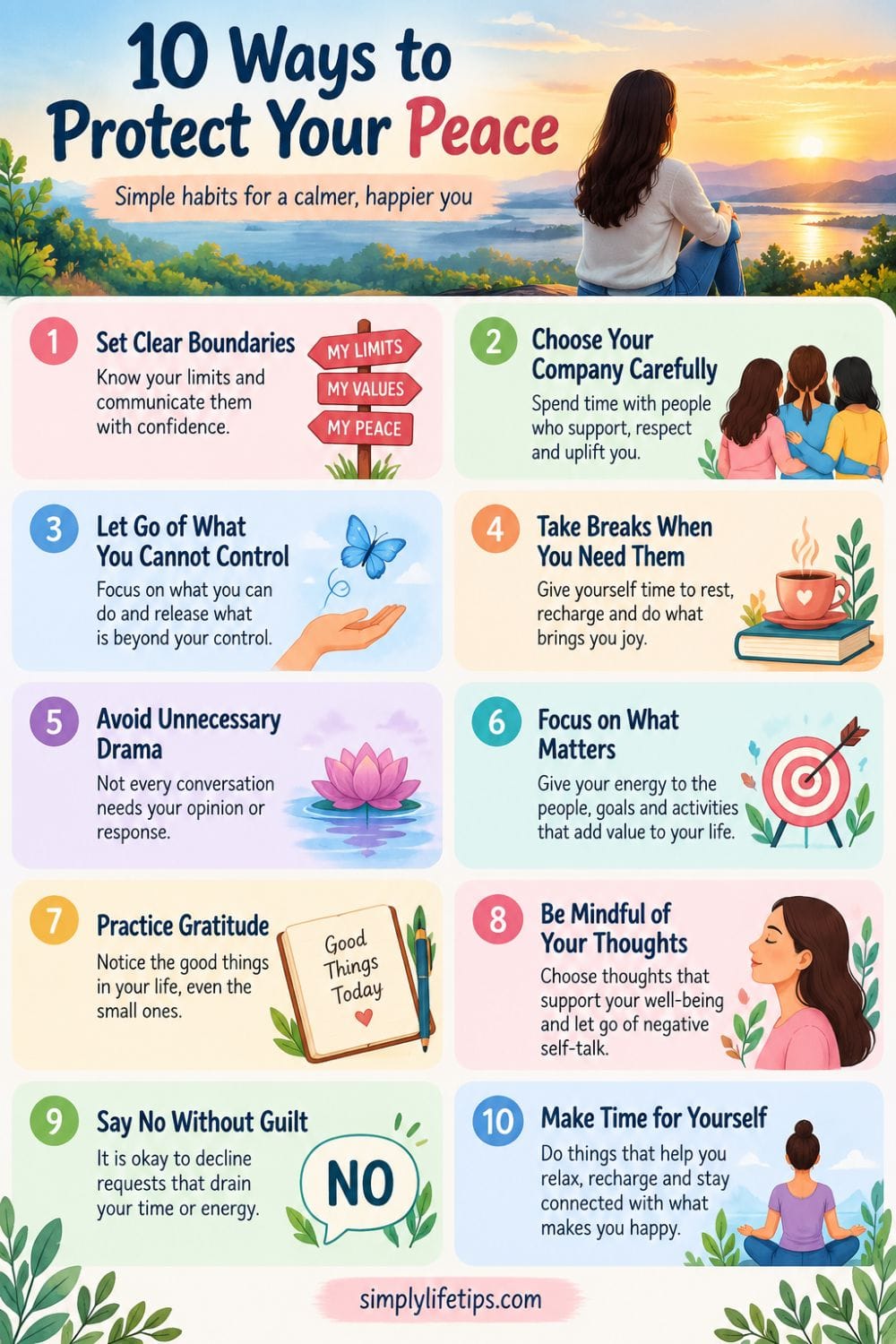
1. Stop Responding to Every Argument
Not every argument needs your response.
Some people are looking for a genuine conversation, while others simply want to keep an argument going. Responding to every criticism or provocation can leave you emotionally exhausted without solving anything.
Before responding, pause and ask whether your response will improve the situation.
For example, if someone misunderstands you online, you do not always need to spend an hour trying to convince them that they are wrong.
Sometimes silence is a better choice.
2. Set Boundaries Without Feeling Guilty
Healthy boundaries are an important part of protecting your peace.
You have the right to decide what behavior you will accept, how much time you can give someone, and when you need space.
Setting a boundary does not necessarily mean rejecting another person. It can simply mean communicating what you are comfortable with.
For example:
“I cannot discuss this right now. Let’s talk when we are both calmer.”
A clear boundary can prevent a small disagreement from becoming a much bigger conflict.
If you are working on setting healthier boundaries, these affirmations for healthy boundaries can help reinforce your intentions and remind you that healthy boundaries are not selfish.
3. Walk Away From Unnecessary Drama
Drama can consume a surprising amount of emotional energy.
You may hear gossip, complaints, accusations, or arguments that have nothing to do with you. Getting involved may provide temporary excitement, but it can also create unnecessary stress.
You do not have to participate simply because other people are participating.
Walking away from unnecessary drama is sometimes one of the simplest ways to protect your peace.
4. Stop Trying to Prove Yourself to Everyone
You cannot control what everyone thinks about you.
Even when your intentions are good, someone may misunderstand your actions, criticize your decisions, or form an opinion based on incomplete information.
Trying to convince everyone that you are a good person can become exhausting.
Explain yourself when clarification is genuinely necessary. But remember that you do not need everyone’s approval.
Your life does not have to be a constant attempt to prove your worth.
5. Learn to Say No
Sometimes protecting your peace begins with one small word:
No.
You do not have to accept every invitation, request, responsibility, or favor.
Saying no does not automatically make you selfish. It can mean that you understand your limits.
For example, if you are already overwhelmed, accepting another unnecessary responsibility may increase your stress.
A respectful “No, I can’t take this on right now” can be healthier than saying yes and feeling resentful later.
6. Choose Your Company Carefully
The people around you can influence your thoughts, habits, emotions, and outlook. This does not mean avoiding everyone who disagrees with you. Healthy relationships can include different opinions.
However, constantly spending time with people who manipulate, insult, criticize, or create unnecessary conflict can gradually affect your emotional well-being.
Choosing supportive relationships can make a meaningful difference in your outlook. Read more about why it matters to surround yourself with positive people.
Choose relationships where respect, honesty, and healthy communication are present.
7. Do Not Take Everything Personally
Not everything people say or do is about you.
People sometimes speak from their own frustrations, insecurities, experiences, or expectations.
That does not mean hurtful behavior should always be accepted. It simply means you do not need to carry every comment with you.
Before taking something personally, ask:
“Is this really about me?”
That simple question can help you create emotional distance from unnecessary negativity.
8. Limit Conversations That Constantly Drain You
Some conversations solve problems. Others simply repeat them.
If you repeatedly have the same argument with someone and nothing changes, continuing the conversation may only increase frustration.
You can pause the discussion and return to it later when there is a genuine opportunity for productive communication.
Protecting your peace sometimes means knowing when a conversation has reached its limit.
9. Focus on What You Can Control
Many things in life are outside your control.
You cannot control another person’s opinion, behavior, choices, or reaction. You cannot control everything that happens around you.
But you can often control your response.
Instead of repeatedly asking, “Why did they do this?” try asking:
“What can I do about this now?”
Shifting your attention from what you cannot control to what you can influence can make difficult situations feel more manageable.
10. Make Time for Yourself
Protecting your peace is not only about dealing with difficult people.
It is also about creating space for yourself.
A quiet walk, reading, prayer or meditation, listening to music, spending time in nature, writing in a journal, or simply sitting quietly can give your mind a break from constant stimulation.
You do not always need to be productive.
Sometimes your mind needs permission to slow down.
Protect Your Peace Without Avoiding Every Problem
Protecting your peace does not mean running away from every uncomfortable situation.
The Gottman Institute also discusses the importance of distinguishing healthy boundaries from avoiding difficult conversations and responsibilities. Read more about protecting your peace and avoiding hard situations
Some problems require a conversation. Some mistakes require an apology. Some responsibilities cannot simply be ignored.
The goal is not avoidance.
The goal is intentionality.
Setting boundaries can become easier when you are clear about what you will and will not accept. You may also find these tips for setting boundaries helpful.
For example, walking away from a pointless argument can protect your peace. Walking away from an important responsibility simply because it is uncomfortable may create a bigger problem later.
Healthy peace comes from dealing with important issues while refusing to waste energy on unnecessary conflict.
You Do Not Have to Explain Yourself to Everyone
One of the hardest lessons in life is accepting that some people will misunderstand you.
You can explain your intentions clearly and still be misunderstood.
You can do the right thing and still be criticized.
You can make a reasonable decision and still disappoint someone.
That does not mean you should never listen to criticism. Constructive feedback can help you grow.
But there is a difference between listening to useful feedback and constantly seeking approval.
You are allowed to make thoughtful decisions without explaining every detail of your life to everyone.
Protect Your Peace Quotes
- Protect your peace. Not every problem needs your attention.
- Not every argument deserves your response.
- Your energy is valuable. Spend it where it matters.
- You do not have to explain yourself to everyone who misunderstands you.
- Choose peace over proving a point.
- Set boundaries without guilt. Your peace matters too.
- You cannot control everyone’s opinion, but you can control how much power you give it.
- Sometimes protecting your peace means knowing when to stop explaining.
- Walking away from unnecessary drama can be an act of self-respect.
- A peaceful life does not require a problem-free life.
Protect Your Peace Every Day
Protecting your peace is not something you do once.
It is a daily practice.
You may need to say no today, set a boundary tomorrow, ignore unnecessary criticism the next day, and have an important conversation after that.
The more intentional you become about your time and emotional energy, the easier it can become to recognize what deserves your attention.
You do not need to respond to everything.
You do not need to please everyone.
You do not need to win every argument.
You do not need to prove your worth to people who have already decided to misunderstand you.
Your peace is valuable.
Protect it.
Conclusion
Protect your peace by becoming more selective about what receives your attention, energy, and emotional investment.
Not every problem needs your attention. Not every person deserves unlimited access to your energy. Not every argument needs your response.
Set healthy boundaries. Say no when necessary. Walk away from unnecessary drama. Focus on what you can control. And when a situation truly matters, deal with it calmly rather than reacting impulsively.
Peace does not mean having a life without problems. It means learning which problems deserve your energy and which ones are better left behind.
Your peace is valuable. Protect it.
Frequently Asked Questions
What does protect your peace mean?
Protecting your peace means making intentional choices that support your emotional well-being, such as setting boundaries, avoiding unnecessary conflict, and focusing your energy on things you can control.
How can I protect my peace?
You can protect your peace by setting healthy boundaries, learning to say no, avoiding unnecessary arguments, limiting draining conversations, choosing your relationships carefully, and focusing on what you can control.
Does protecting your peace mean avoiding problems?
No. Protecting your peace does not mean avoiding every difficult situation. Important problems may need to be addressed. It means avoiding unnecessary conflict while dealing with genuine responsibilities calmly and thoughtfully.
Why is setting boundaries important for peace?
Boundaries help you communicate what behavior you will accept and what you are unable or unwilling to do. Clear boundaries can reduce unnecessary conflict and protect your time and emotional energy.
What is a good protect your peace quote?
“Protect your peace. Not every problem needs your attention.” This simple reminder captures the idea that you do not have to give your energy to every conflict or situation.

Mathukutty P. V. is the founder of Simply Life Tips. He shares practical advice and useful insights on personal growth, health, well-being, technology, and everyday living. His goal is to help readers build positive habits and make informed decisions. He believes in continuous learning and sharing knowledge to help people live healthier, happier, and more meaningful lives.