

Business Rules for Success are not complicated formulas or secret shortcuts to getting rich. They are simple principles that can help you build a business that creates value, earns trust, manages money wisely, and grows steadily. You don’t build a successful business in a day. It grows when you understand people, solve real problems, learn from experience, and make responsible decisions consistently.
Whether you are starting a small business, running an online business, or planning to become an entrepreneur, these seven business rules can provide a practical foundation for long-term success.
7 Simple Business Rules for Success
Building a successful business does not always require a complicated strategy. These seven simple business rules for success focus on the fundamentals that matter most: solving real problems, earning trust, managing money wisely, continuing to learn, staying consistent, building strong relationships, and reinvesting for future growth. Whether you are starting a small business or growing an existing one, these principles can help you make better decisions and build something that lasts.
1. Solve a Problem, Don’t Just Sell a Product
One of the most important business rules for success is to solve a real problem instead of simply trying to sell something. People usually do not buy a product just because it exists. They buy because the product or service helps them solve a problem, save time, reduce effort, improve their lives, or achieve something they want.
Before starting a business, ask yourself a simple question: What problem am I solving?
For example, imagine someone starts a meal-delivery business. They are not simply selling food. They may be solving a problem for busy employees and families who do not have enough time to cook every day.
A business can begin by identifying a simple but meaningful need, as illustrated by the Amma Kitchen success story in Patna
The same idea applies to an online business. A website that provides useful information can solve problems by helping readers understand a difficult subject, make better decisions, or learn a new skill.
Understand What People Need
A good business begins with understanding customers. Listen to their questions, complaints, frustrations, and expectations. These can reveal opportunities.
For example, if many customers complain that existing products are difficult to use, a simpler alternative could become valuable. If people are spending too much time completing a particular task, a service that saves their time could solve the problem.
The bigger or more widespread the problem, the greater the potential opportunity. However, solving a problem well is more important than simply choosing a large market.
Understanding your customers before launching or expanding a business is important. Market research can help identify customer demand, competitors, market size, and pricing, according to the U.S. Small Business Administration.
2. Earn Trust Before You Earn Money
Trust is one of the most valuable assets in any business. You can have an excellent product, but if customers do not trust you, they may not buy from you.
One of the most important business rules for success is therefore simple: build trust before focusing only on profit.
Be honest about what your product can and cannot do. Give customers accurate information. Keep your promises. If something goes wrong, acknowledge it and try to fix it.
For example, suppose an online store receives an order but discovers that the product is temporarily unavailable. Instead of ignoring the customer, the business can explain the situation honestly and offer a refund or another option.
That kind of experience can strengthen trust.
One Happy Customer Can Bring More Customers
Satisfied customers often tell other people about businesses they trust. A customer who has a good experience may recommend the business to friends, family members, or colleagues.
The opposite can also happen. Poor service or dishonest behavior can damage a reputation quickly, especially when customers share their experiences online.
Profit matters in business, but trust creates the foundation that allows a business to earn profit repeatedly.
Transparency is one of the best ways to build lasting customer trust, and a transparent business can create stronger relationships with customers
3. Control Your Expenses
Making money is important, but controlling expenses is equally important. A business can generate good revenue and still struggle if it spends money carelessly.
One of the basic business rules is to understand where your money is coming from and where it is going.
For example, imagine a small business earns ₹1 lakh in a month. If its unnecessary expenses consume most of that money, the business may have very little left for savings, investment, emergencies, or growth.
This is why business owners should regularly review expenses.
Spend Money With a Purpose
Not every expense is bad. Some expenses can help a business grow. The important question is whether the spending has a clear purpose.
For example, investing in better equipment may improve productivity. Paying for useful training may improve employees’ skills. Spending money on effective marketing may help the business reach new customers.
On the other hand, spending heavily on things that do not improve the product, service, customer experience, or business operations can create unnecessary financial pressure.
Good financial management is not about avoiding every expense. It is about spending wisely.
Good financial management also requires keeping track of revenue and expenses. The U.S. Small Business Administration recommends proper bookkeeping and analyzing costs to help maintain a sustainable balance between profit and loss.
4. Never Stop Learning
Markets change. Technology changes. Customer expectations change. New competitors appear. Because of this, learning should never stop.
Never stop learning is one of the most practical business rules for success because yesterday’s knowledge may not always be enough for tomorrow’s challenges.
A business owner can learn from books, courses, customers, competitors, employees, mistakes, and real-world experience.
For example, a shop owner who learns how to use digital payments, social media, online marketing, and customer analytics may discover new ways to serve customers.
Similarly, an online business owner who learns about SEO, content creation, email marketing, and changing search behavior may improve the way the business reaches its audience.
Learn From Mistakes
Learning does not mean avoiding every mistake. Mistakes are often valuable sources of information.
Suppose a business launches a product and customers do not respond as expected. Instead of simply declaring the launch a failure, the owner can ask:
- Did we understand the customer’s needs?
- Was the price appropriate?
- Was the product clearly explained?
- Did we reach the right audience?
- What feedback did customers provide?
The answers can help improve the next decision.
5. Be Patient and Consistent
Another important rule for success in business is to understand that meaningful growth usually takes time.
Building a successful business often requires patience, determination, and the ability to keep moving forward despite difficulties, as shown in the story of Kalpana Saroj, a self-made entrepreneur
Social media often makes success look instant. We may see stories about businesses that suddenly became popular, but we rarely see the years of work, failed attempts, learning, and persistence behind those stories.
A new business may have very few customers during its first months. That does not automatically mean the idea will fail.
Entrepreneurship can be rewarding, but it also comes with pressure, uncertainty, and setbacks, so understanding the dark side of entrepreneurship can help new entrepreneurs develop realistic expectations.
Consistency Creates Progress
Consider a small bakery that starts with only a few customers. If the owner consistently provides good-quality products, treats customers well, maintains reasonable prices, and improves the business, the customer base may gradually grow.
The same principle applies to an online business. Publishing one useful article may not produce significant traffic immediately. But consistently creating helpful content can build a larger collection of resources over time.
Patience does not mean waiting without action. It means continuing to improve while allowing results to develop naturally.
6. Build Relationships, Not Just Sales
A business is not only about transactions. It is also about relationships.
Customers remember how a business treats them. A friendly response, quick solution, honest explanation, or thoughtful follow-up can create a positive experience.
For example, imagine two businesses sell similar products at almost the same price. One treats customers as numbers, while the other listens carefully and helps customers choose the right product. Customers may remember the better experience long after they forget the exact price they paid.
Happy Customers Can Become Your Advocates
When customers genuinely trust a business, they can become valuable sources of recommendations.
A restaurant with excellent food and service may receive repeat customers and word-of-mouth recommendations. A freelancer who consistently delivers quality work may receive referrals from previous clients.
Building relationships does not mean trying to sell something during every interaction. Sometimes it simply means being helpful, reliable, and respectful.
Over time, these relationships can become one of the strongest assets of a business.
7. Reinvest in Your Business
The final rule among these business rules for success is to reinvest wisely.
When a business starts making a profit, it can be tempting to spend everything on personal wants. There is nothing wrong with enjoying the rewards of hard work, but using some profits to strengthen the business can support future growth.
For example, a business owner might reinvest profits in:
- Better equipment
- Employee training
- Product development
- Website improvements
- Customer service
- Marketing
- New technology
- Professional skills
Let Your Profits Help Build the Future
Imagine a small business earns an unexpected profit. Instead of spending all of it immediately, the owner uses part of the money to improve equipment and another portion for marketing.
The improved equipment may increase productivity, while better marketing may attract new customers. In this way, some of today’s profit can help create tomorrow’s opportunities.
Reinvestment does not mean spending money without thinking. Like every other business expense, it should have a clear purpose and reasonable expectation of value.
Successful entrepreneurship can take many forms, and the story of Sheela Kochouseph Chittilappilly and her entrepreneurial journey offers another example of building a business through determination and long-term effort.
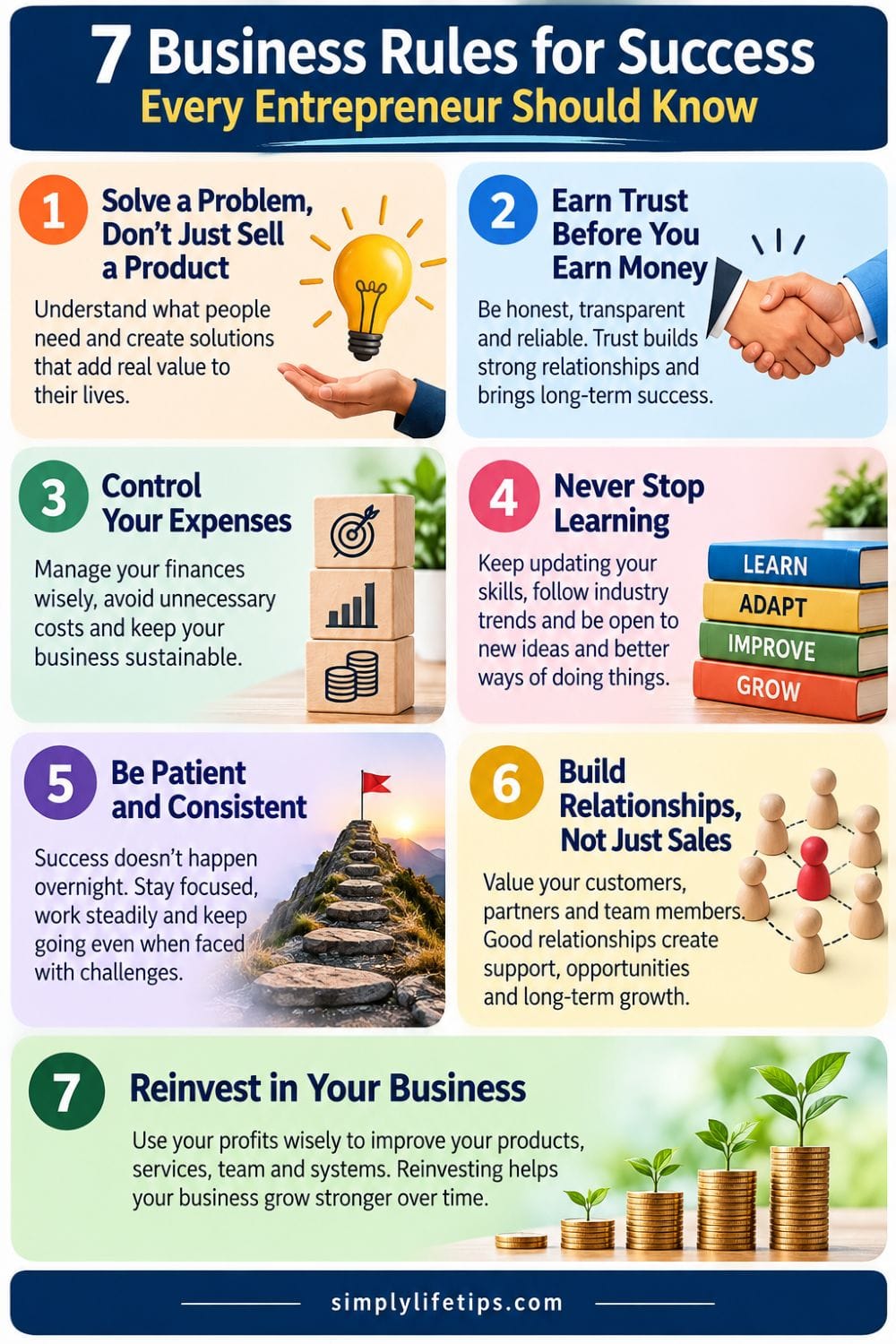
The infographic below summarizes the seven business rules for success that can help entrepreneurs build a stronger and more sustainable business.
What These Business Rules for Success Teach Us
These seven business rules share one important idea: long-term business success comes from creating value consistently.
Solve real problems. Earn trust. Control expenses. Keep learning. Be patient. Build relationships. Reinvest wisely.
None of these principles promises overnight success. Instead, they provide a practical way to think about building something that can survive and grow over time.
A business becomes stronger when its customers receive real value, its finances are managed responsibly, its people continue learning, and its owner is willing to improve.
Conclusion
Business Rules for Success are not about getting rich quickly. They are about building a business that people value and trust. If you focus on solving real problems, managing money carefully, learning continuously, treating customers well, and reinvesting in your business, you create a stronger foundation for long-term growth.
Success may take time, but consistent effort, responsible decisions, and genuine value can make that journey worthwhile.
Which of these seven business rules do you think is the most important for building a successful business?
Frequently Asked Questions
What are the most important business rules for success?
Some important business rules include solving real customer problems, earning trust, controlling expenses, continuing to learn, being consistent, building relationships, and reinvesting profits.
Why is trust important in business?
Trust encourages customers to buy, return, recommend the business, and maintain long-term relationships. Honest communication and reliable service can help build that trust.
How can a small business control expenses?
A small business can track income and expenses, avoid unnecessary spending, compare suppliers, create a budget, and prioritize expenses that directly support customers and business growth.
Why should business owners never stop learning?
Customer expectations, technology, markets, and competition continually change. Learning helps business owners adapt and make better decisions.
Should businesses reinvest their profits?
Reinvesting a reasonable portion of profits can help improve products, skills, equipment, marketing, technology, and customer service. The amount and type of reinvestment should depend on the business’s financial situation and goals.

Mathukutty P. V. is the founder of Simply Life Tips. He shares practical advice and useful insights on personal growth, health, well-being, technology, and everyday living. His goal is to help readers build positive habits and make informed decisions. He believes in continuous learning and sharing knowledge to help people live healthier, happier, and more meaningful lives.


