
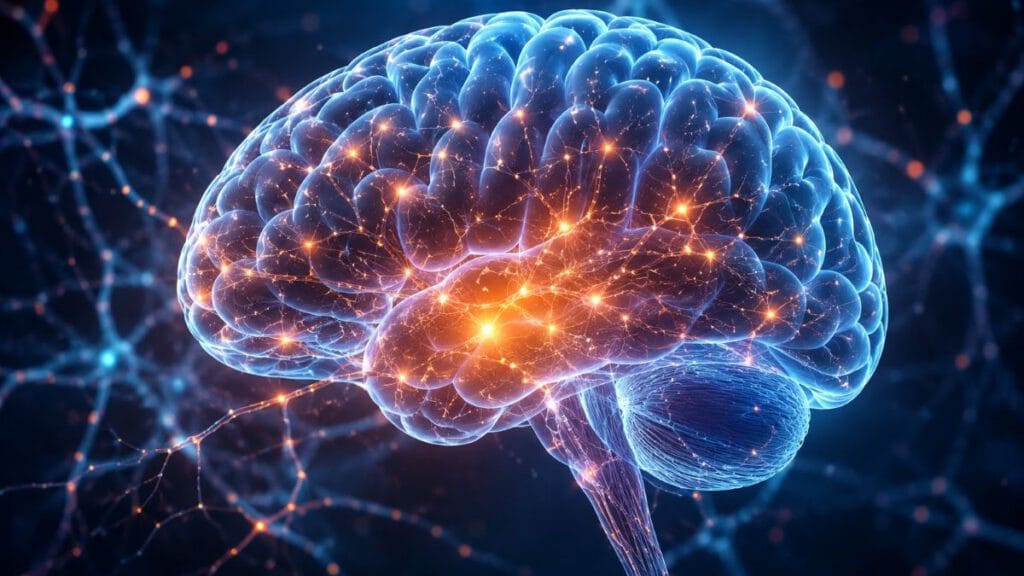
Neuroplasticity is one of the most fascinating abilities of the human brain—the capacity of the nervous system to adapt, reorganize, and change in response to learning, experience, behaviour, and, in some circumstances, injury.
Think about who you might be five years from now.
It is easy to believe that our personality, abilities, habits, and ways of thinking are permanently fixed. But neuroscience tells a more interesting story. The brain is a dynamic organ that continues to respond to what we learn, practise, experience, and encounter throughout life.
That does not mean we can simply think ourselves into becoming a completely different person. Neuroplasticity is not magic, and it does not guarantee that every habit or thought will physically predictably reshape the brain.
Instead, it describes a real biological capacity of the nervous system to adapt.
Every time we learn a new skill, practise a movement, solve a problem, or repeatedly respond to an experience, the brain is involved in processes that support learning and adaptation.
This remarkable ability is known as neuroplasticity, also called brain plasticity or neural plasticity.
What Is Neuroplasticity?
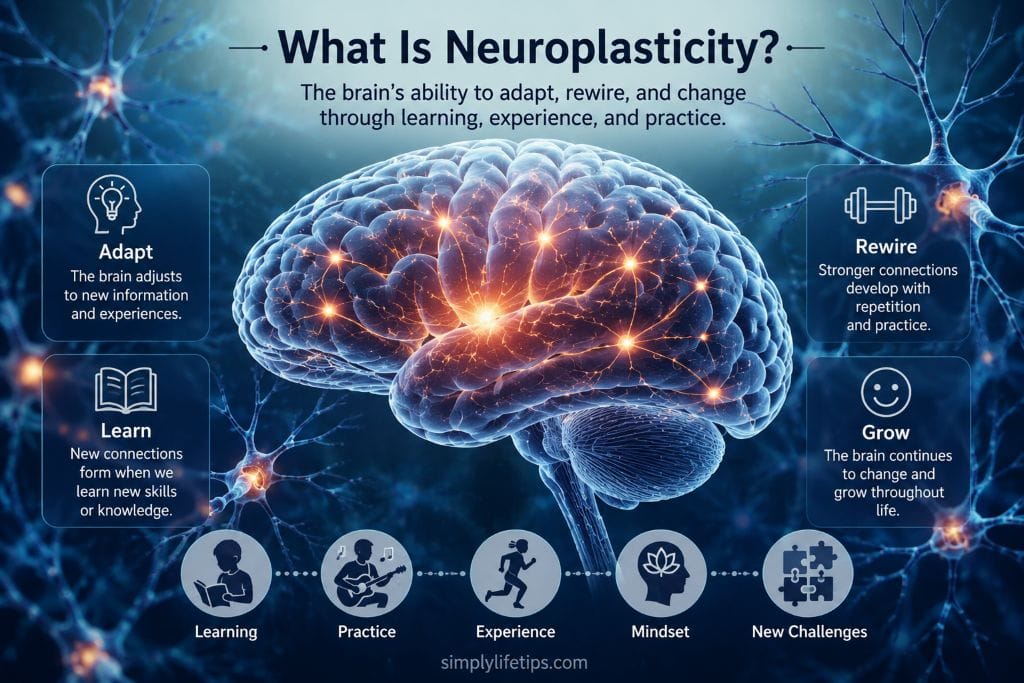
Neuroplasticity is the ability of the nervous system to change its activity, connections, and organisation in response to internal or external experiences.
These changes can involve the strength of connections between neurons, changes in neural networks, and functional reorganisation. Neuroplasticity is involved in learning and adaptation and can also play an important role after certain types of neurological injury.
In simple terms:
The brain is capable of adapting to what we repeatedly experience and practise.
This ability is especially important during childhood and development, but neuroplasticity does not disappear when we become adults. The adult brain continues to learn and adapt.
That is one of the most encouraging discoveries in modern neuroscience.
Neuroplasticity Meaning: What Does It Really Mean?
The word “plasticity” does not mean that the brain is soft or physically malleable like plastic.
In neuroscience, plasticity means the capacity to change and adapt.
When we learn something new, the nervous system can adjust the way different neural networks communicate. Repeated practice can strengthen aspects of a learned skill, while other connections may become less important or less frequently used.
For example, imagine someone learning to play the guitar.
At first, remembering chords, positioning the fingers, and coordinating both hands may feel difficult. With regular practice, these actions can become more familiar and efficient.
The improvement is not simply a matter of “trying harder.” Learning involves changes in the nervous system that help support the newly acquired skill.
This is one way to understand the practical meaning of neuroplasticity.
Neuroplasticity of the Brain: How Does the Brain Change?
The brain contains billions of nerve cells called neurons that communicate through complex networks.
Learning and experience can influence these networks.
Neuroplastic changes can involve alterations in synapses—the points where neurons communicate—as well as changes in the organisation and activity of neural networks.
These changes are not necessarily permanent. The brain continues to adapt according to experience, use, disuse, learning, and other factors.
This is why repeated practice matters.
If you practise a new language regularly, you repeatedly engage systems involved in understanding, remembering, speaking, and retrieving words.
If you practise a musical instrument, you repeatedly engage networks involved in hearing, movement, timing, attention, and memory.
If you repeatedly practise a physical movement, the nervous system becomes increasingly familiar with the demands of that movement.
The brain does not simply store every experience in the same way. It continually adjusts to the demands placed upon it.
How Does Neuroplasticity Work?
Neuroplasticity is not one single process.
It involves multiple biological mechanisms, including changes in synaptic strength, changes in neural connections, and functional reorganisation.
One important principle is that repeated activity can influence the efficiency of neural networks involved in learning.
This helps explain why practice is so important.
Consider learning to ride a bicycle.
The first attempts may require considerable concentration. Balance, steering, pedalling, and coordination all compete for attention.
After repeated practice, many of these actions become much more automatic.
You do not consciously think about every tiny movement required to maintain balance.
Learning has changed the way your nervous system handles the task.
Research on motor-skill learning provides substantial evidence that practice is associated with neuroplastic changes in the brain.
Can Your Brain Change Throughout Adulthood?
Yes.
The idea that the adult brain is completely fixed is outdated.
Adults continue to learn new information, acquire skills, form memories, and adapt to changing environments.
However, this does not mean that the brain changes at the same rate or in exactly the same way at every age.
Age, health, sleep, physical activity, previous experience, motivation, and the difficulty of a task can all influence learning and adaptation.
So, learning something new at 50 may not feel the same as learning it at 15.
But being an adult does not mean that your learning capacity has disappeared.
Learning and personal development do not have to stop with age. You can also explore how to train your mindset for continued growth.
Our Daily Experiences Can Influence the Brain
The brain is constantly responding to the world around us.
Learning a language, reading, practising an instrument, exercising, developing a new skill, interacting socially, and solving unfamiliar problems all require different forms of brain activity.
However, it is important not to exaggerate what this means.
It would be inaccurate to say that every individual activity automatically “rewires the brain” dramatically or predictably.
Learning doesn’t stop when formal education ends. Read more about the importance of never stop learning throughout life.
A better way to understand it is this:
Repeated and meaningful experiences provide opportunities for the nervous system to adapt.
The more consistently we practise a skill, the more opportunity the brain has to learn that skill.
Neuroplasticity Exercises: 10 Ways to Challenge Your Brain
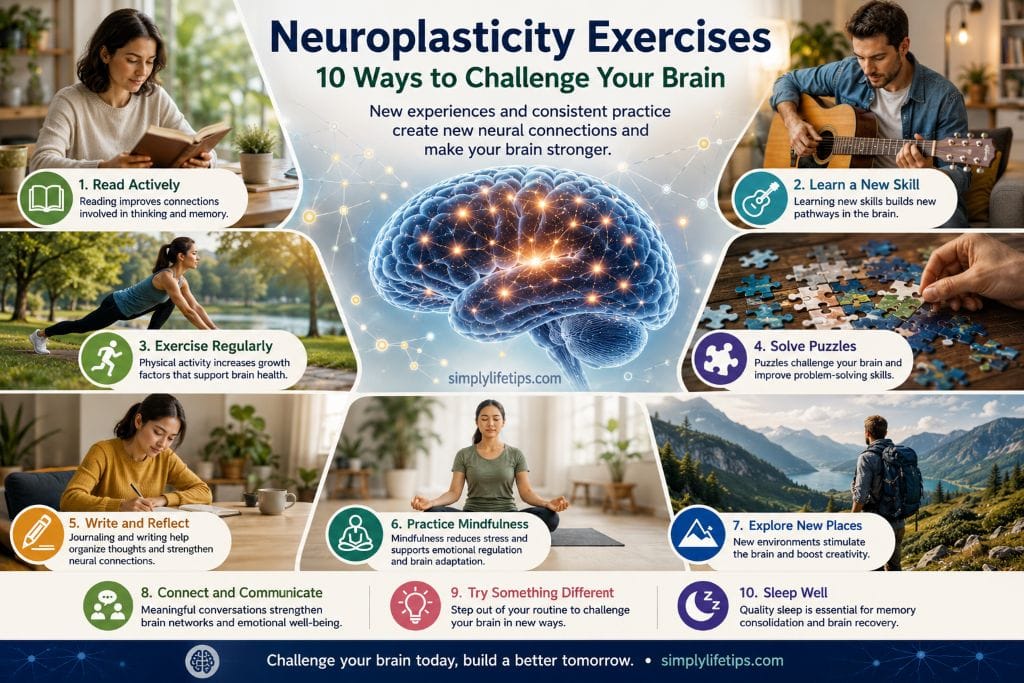
There is no single exercise that can magically “rewire” the brain.
But activities involving learning, movement, attention, memory, problem-solving, and new experiences can provide useful cognitive and physical challenges.
Here are ten practical ways to keep learning and challenging yourself.
1. Learn a New Language
Learning another language requires attention, memory, listening, vocabulary retrieval, and repeated practice.
You do not need to become fluent immediately.
Learning a few new words every day and using them regularly is already a meaningful challenge.
2. Learn a Musical Instrument
Music combines several skills at once.
You may need to read symbols, remember patterns, coordinate your hands, listen carefully, maintain rhythm, and correct mistakes.
That combination makes learning an instrument a demanding form of practice.
3. Read and Explain What You Learn
Reading is useful, but try going one step further.
After reading something interesting, close the book or article and explain the main idea in your own words.
This requires recall and active processing rather than simple recognition.
4. Try an Unfamiliar Skill
Learning something outside your normal routine can provide a new challenge.
Try photography, drawing, gardening, cooking, writing, coding, woodworking, or another skill that genuinely interests you.
The goal is not to become an expert overnight.
The goal is to learn.
5. Exercise Regularly
Physical activity is important for overall health and has also been studied in relation to brain function and neuroplasticity.
Research reviews suggest that exercise can influence processes associated with neuroplasticity, although the effects vary according to the type, intensity, duration, and population studied.
So exercise should be viewed as part of a healthy lifestyle rather than a guaranteed brain-rewiring technique.
6. Practise Mindfulness
Mindfulness involves deliberately paying attention to present-moment experiences.
Meditation and mindfulness have been studied for their potential effects on attention, stress, emotional regulation, and other aspects of brain function.
If you want to try it, begin with a few minutes of quiet attention rather than expecting dramatic results immediately.
7. Solve Problems
Puzzles, mathematics, strategy games, logic problems, and other challenging activities can require attention, reasoning, memory, and planning.
Choose genuinely challenging activities rather than repeating something you can already do effortlessly.
8. Change a Familiar Routine
Occasionally doing something differently can make you pay more attention.
Try taking a different walking route, learning a new recipe, rearranging a familiar task, or approaching a problem from another perspective.
These small changes can make everyday activities more mentally engaging.
9. Practise a Physical Skill
Physical skills require communication between the brain, spinal cord, nerves, and muscles.
Dancing, swimming, yoga, balancing exercises, sports, and other movement-based activities can require coordination, timing, attention, and repeated practice.
10. Keep Challenging Yourself
Perhaps the most important exercise is simply to keep learning.
Choose something slightly beyond your current ability.
Make mistakes.
Correct them.
Try again.
Progress does not require perfection. Curiosity can also encourage us to explore unfamiliar subjects and develop new skills. Read about the power of curiosity
Can Negative Habits Influence the Brain?
Neuroplasticity is not automatically positive.
The nervous system adapts to experiences, and repeated behaviours can become increasingly familiar.
For example, repeatedly avoiding a situation because of fear can reinforce an avoidance pattern. Likewise, repeatedly practising a particular skill can make that skill easier and more automatic.
But this does not mean that one negative thought permanently changes your brain.
Human beings naturally experience unwanted thoughts, fear, anger, sadness, and worry.
The important distinction is between an occasional thought or emotion and a repeated behavioural pattern.
Instead of trying to eliminate every negative thought, it can be more useful to notice unhelpful patterns and practise healthier responses.
How to Increase Neuroplasticity?
There is no guaranteed formula for increasing neuroplasticity.
However, several behaviours can support learning, physical health, and the conditions in which the brain functions and adapts.
Keep Learning
Give yourself regular opportunities to acquire new knowledge and skills.
Practise Consistently
Short, regular practice can be more sustainable than occasional bursts of intense effort.
Stay Physically Active
Regular physical activity supports overall health and may influence processes associated with brain plasticity.
Prioritise Sleep
Sleep is important for normal cognitive function, attention, memory, and learning.
Challenge Yourself
Choose activities that require genuine effort and learning.
Maintain Social Connections
Meaningful social interaction provides cognitive and emotional stimulation and forms an important part of overall wellbeing.
Avoid Expecting Instant Results
Brain adaptation is a biological process, not an overnight transformation.
Consistency matters more than dramatic short-term effort.
Neuroplasticity and Stroke Recovery
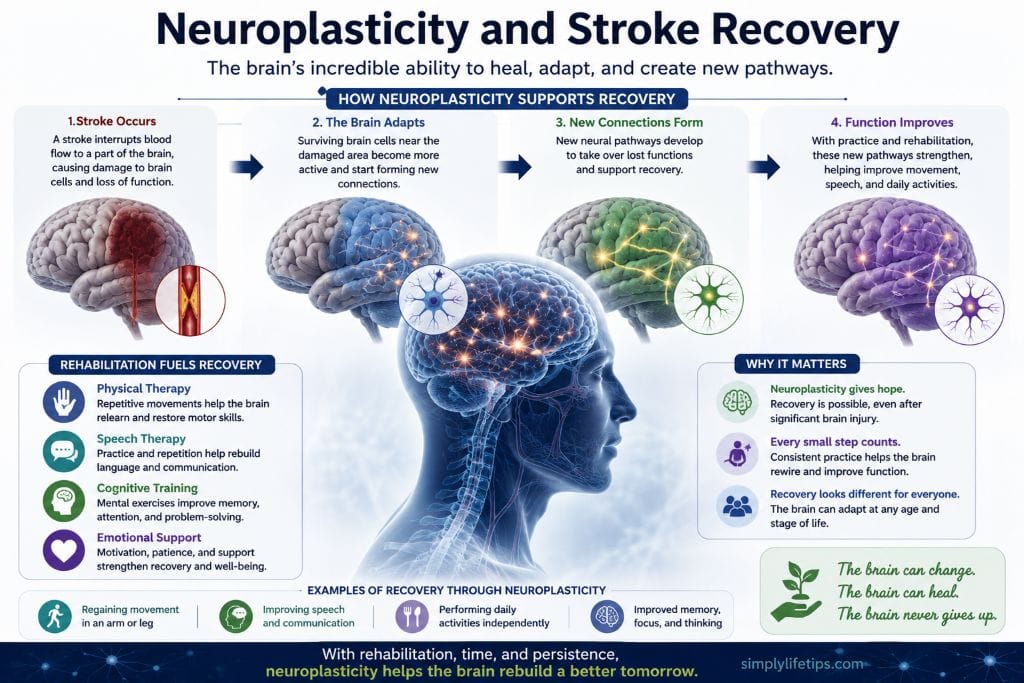
One of the most important applications of neuroplasticity is neurological rehabilitation.
Following a stroke, some areas of the brain may be damaged. During recovery, changes can occur in surviving neural networks and in the way different brain regions contribute to functions affected by the injury.
Rehabilitation can use repeated, meaningful, and task-specific practice to help patients regain abilities and improve everyday functioning. Research has linked post-stroke rehabilitation with neuroplastic changes and brain reorganisation, although recovery varies considerably between individuals.
This does not mean that neuroplasticity is a cure for stroke.
Rather, neuroplasticity helps explain part of the biological basis for rehabilitation and recovery.
The type and intensity of rehabilitation should always be determined by qualified healthcare professionals according to the individual’s condition.
Is Neuroplasticity Relevant to Other Neurological Conditions?
Neuroplasticity is also an important area of research in other neurological conditions.
Researchers are investigating how the nervous system adapts following brain injury and how rehabilitation might encourage useful forms of plasticity.
However, the presence of neuroplasticity does not mean that every neurological disease can be reversed.
Conditions such as Parkinson’s disease, multiple sclerosis, traumatic brain injury, and other neurological disorders are complex. Their causes, progression, treatment, and outcomes differ considerably.
Therefore, neuroplasticity should be understood as a biological concept that may contribute to adaptation and rehabilitation—not as a universal cure.
Neuroplasticity Is Not a Magic Cure
This distinction is essential.
Neuroplasticity does not mean that you can completely “rewire your brain” in 30 days.
It does not mean that positive thinking can cure depression.
It does not mean that a particular brain exercise can reverse neurological disease.
And it does not replace professional medical treatment.
Neuroplasticity is a biological capacity of the nervous system.
Its effects depend on many factors, and useful change can require time, appropriate practice, rehabilitation, and individual circumstances.
The science is fascinating precisely because it is real—not because it promises miracles.
If prolonged stress is affecting your concentration and mental energy, learn more about mental exhaustion and ways to recover.
Does Neuroplasticity Decrease With Age?
Brain plasticity can change with age, but it does not simply disappear.
The developing brain generally has a particularly high capacity for certain forms of change. Nevertheless, adults continue to learn, adapt, and develop new skills.
This is why older adults can learn languages, musical instruments, technologies, physical skills, and completely new hobbies.
The process may sometimes require more practice or different strategies, but learning remains possible.
Rather than asking whether you are “too old” to learn something, a better question may be:
What learning strategy works best for you now?
Why Consistency Matters?
Imagine planting a tree.
Watering it once does not produce a mature tree the next morning.
Growth requires repeated care.
Learning works similarly.
One day of language study will not make you fluent.
One workout will not transform your fitness.
One meditation session will not permanently change your emotional life.
One attempt at playing an instrument will not make you a musician.
But repeated practice gives the brain repeated opportunities to learn.
That is why consistency is more useful than chasing instant transformation.
The Hope Behind Neuroplasticity
Perhaps the most encouraging message of neuroplasticity is not that we can control everything about our brains.
We cannot.
Genetics, age, health, environment, injury, disease, and life circumstances all matter.
But the brain is not simply a static structure that stops changing after childhood.
It retains an ability to adapt.
We can continue to learn.
We can practise new skills.
We can develop healthier routines.
We can challenge ourselves.
And, when appropriate, structured rehabilitation can help the nervous system adapt after injury.
These possibilities do not guarantee a particular outcome.
But they provide a scientifically grounded reason to keep learning and practising.
Neuroplasticity is closely connected with the idea of continuing to learn and adapt throughout life. See these practical lessons on keeping growing in every season of life
Conclusion
Neuroplasticity gives us a fascinating insight into the human brain: the nervous system is capable of adapting throughout life.
The brain changes in response to learning, experience, practice, and other influences. Some forms of neuroplasticity can support learning and skill development, while plastic changes can also play a role in recovery and rehabilitation after neurological injury.
The lesson is not that every thought instantly rewires your brain.
The more useful lesson is simpler:
What we repeatedly learn and practise can matter.
So, if there is something you have always wanted to learn, perhaps today is a good day to begin.
You do not need to change everything at once.
Choose one useful skill.
Practise it.
Learn from your mistakes.
Keep going.
Over time, those repeated experiences can become part of the remarkable process through which the brain learns and adapts.
FAQs About Neuroplasticity
What is neuroplasticity?
Neuroplasticity is the ability of the nervous system to adapt its activity, connections, and organisation in response to experiences such as learning, practice, and, in some cases, injury.
Can adults develop neuroplasticity?
Adults retain the ability to learn and adapt. Neuroplasticity continues throughout adulthood, although the nature and extent of plastic changes can vary with age, health, experience, and other factors.
What are the best neuroplasticity exercises?
There is no single exercise proven to universally “rewire” the brain. Learning a new skill, practising a musical instrument, physical activity, problem-solving, mindfulness, and other challenging activities can provide opportunities for learning and adaptation.
Can neuroplasticity help after a stroke?
Neuroplasticity is an important part of the science behind neurological rehabilitation after stroke. Repeated, meaningful, and task-specific rehabilitation can support recovery, but outcomes vary, and treatment should be guided by qualified healthcare professionals.
Can neuroplasticity cure neurological or mental health conditions?
No. Neuroplasticity is a biological process, not a universal cure. It may be relevant to learning and rehabilitation, but neurological and mental health conditions require appropriate assessment and treatment from qualified healthcare professionals.
Medical Disclaimer
This article is intended for general educational and informational purposes only. It is not a substitute for professional medical advice, diagnosis, or treatment. Information about neuroplasticity, neurological conditions, and rehabilitation should not be used to diagnose or treat a health condition. If you have a medical concern, consult a qualified healthcare professional.
Inspiration
This article was inspired by discussions on neuroplasticity by neurosurgeon Dr. Arun Oommen. The article has been independently developed using additional scientific and medical references.
Further Reading and References
- NCBI → basic explanation of neuroplasticity
- PMC → neuroplasticity and rehabilitation
- PubMed → exercise and neuroplasticity

Mathukutty P. V. is the founder of Simply Life Tips. He shares practical advice and useful insights on personal growth, health, well-being, technology, and everyday living. His goal is to help readers build positive habits and make informed decisions. He believes in continuous learning and sharing knowledge to help people live healthier, happier, and more meaningful lives.


