
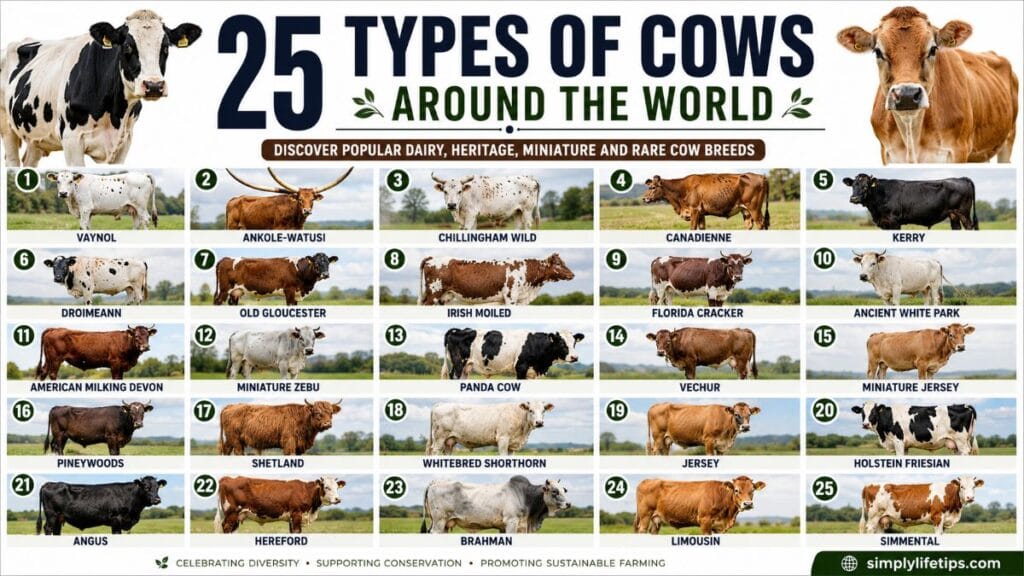
Types of cows vary greatly across the world, with each breed possessing unique characteristics, physical features, and agricultural importance. Some breeds are famous for producing rich, nutritious milk, while others are valued for their adaptability, gentle temperament, cultural significance, or ability to thrive in challenging climates. From the tiny Vechur cow of India to the globally recognized Holstein Friesian, every breed has evolved to meet the needs of farmers and communities in different parts of the world.
Understanding the different types of cows helps farmers choose the most suitable breed for their climate and farming goals. It also allows students, animal enthusiasts, and livestock keepers to appreciate the remarkable diversity found within the cattle family. Many traditional breeds have been preserved for centuries because of their resilience, disease resistance, and ability to survive on limited resources. Others have become internationally recognized due to their excellent milk production and adaptability to modern dairy farming.
Today, more than 800 recognized cattle breeds exist worldwide, each contributing to agriculture in its own way. Some are rare heritage breeds protected through conservation efforts, while others remain among the most productive dairy animals in commercial farming. Whether you are interested in sustainable agriculture, livestock management, or simply want to learn about these incredible animals, this guide covers some of the most popular types of cows from around the world.
In this comprehensive article, you’ll discover their origins, physical characteristics, farming benefits, interesting facts, and why each breed continues to play an important role in agriculture and biodiversity.
What are the types of Cows?
The term types of cows refers to the various breeds of domestic cattle that have been selectively developed over hundreds or even thousands of years. Each breed possesses distinctive genetic characteristics that influence its appearance, size, milk production, temperament, adaptability, and overall usefulness to farmers.
Although all domestic cattle belong to the species Bos taurus or Bos indicus, selective breeding has produced remarkable diversity. Some breeds have thick coats to withstand freezing winters, while others have loose skin and large ears that help them stay cool in tropical climates. Certain breeds are naturally smaller, making them suitable for small farms, whereas others are larger and better suited for commercial dairy operations.
The diversity among types of cows reflects the different environmental conditions and farming traditions around the world. European countries developed many high-yield dairy breeds, while Asian and African regions produced cattle capable of surviving intense heat and scarce grazing conditions.
Today, preserving traditional and indigenous cattle breeds has become increasingly important. Many rare breeds contribute valuable genetic diversity that may help future livestock adapt to changing climates and emerging diseases. Learning about these remarkable breeds also encourages sustainable farming practices and supports biodiversity conservation.
Categories of Types of Cows
Understanding the major categories of types of cows makes it easier to appreciate why each breed has developed unique qualities.
Dairy Breeds
Dairy breeds are primarily known for producing nutritious milk. These cows generally have lean bodies, well-developed udders, and calm temperaments that make them ideal for regular milking.
Popular dairy breeds include:
- Holstein Friesian
- Jersey
- Canadienne
- Kerry
- American Milking Devon
Heritage Breeds
Heritage breeds have been preserved for generations because of their historical importance and genetic diversity. Many of these breeds are now protected through conservation programs.
Examples include:
- Vaynol
- Chillingham Wild
- Ancient White Park
- Old Gloucester
Indigenous Breeds
Indigenous cattle have naturally adapted to local climates over centuries.
Examples include:
- Vechur
- Miniature Zebu
- Ankole-Watusi
Miniature Breeds
Miniature cattle are increasingly popular among hobby farmers and small homesteads because they require less space and feed.
Popular miniature breeds include:
- Miniature Jersey
- Miniature Zebu
- Panda Cow
Types of Cows Around the World
1. Vaynol
The Vaynol is one of the rarest heritage cattle breeds in the world and originates from Wales in the United Kingdom. Conservationists consider this breed extremely valuable because only a small population remains today. Its preservation helps protect valuable cattle genetics that have survived for centuries.
Vaynol cattle are easily recognized by their elegant white bodies combined with distinctive black ears and black markings around the eyes. Both males and females usually have graceful upward-curving horns that give them an impressive appearance. Despite their striking looks, these animals are known for being hardy and capable of thriving on natural grazing land with minimal human intervention.
Farmers and conservation organizations value the Vaynol breed because of its ability to survive in challenging environments. Rather than focusing solely on productivity, this breed represents an important part of Britain’s agricultural history. Many wildlife parks and conservation farms continue breeding Vaynol cattle to prevent their extinction.
Origin: Wales, United Kingdom
Characteristics
- White coat with black ears
- Elegant curved horns
- Excellent grazing ability
- Extremely rare heritage breed
- Hardy and adaptable
Interesting Fact
The Vaynol is listed among the rarest cattle breeds in Europe and remains under active conservation.
2. Ankole-Watusi
Among all types of cows, the Ankole-Watusi is perhaps the easiest to recognize because of its enormous horns. Native to East Africa, particularly Uganda, Rwanda, and surrounding regions, this remarkable breed has become an international symbol of African cattle.
Its spectacular horns can span more than eight feet from tip to tip. These horns are not merely decorative—they contain numerous blood vessels that help regulate body temperature during extremely hot weather. This natural cooling system allows the breed to thrive in tropical climates.
Ankole-Watusi cattle are highly resilient and can survive on sparse vegetation while tolerating drought conditions that many other breeds cannot endure. Their calm temperament and impressive appearance also make them popular attractions in wildlife parks and educational farms.
Origin: East Africa
Characteristics
- Extremely large horns
- Heat tolerant
- Strong disease resistance
- Adaptable to dry climates
- Calm temperament
Interesting Fact
The hollow horns act as natural cooling systems by circulating blood through their large surface area.
3. Chillingham Wild
The Chillingham Wild cattle represent one of the oldest surviving populations of semi-wild cattle anywhere in the world. They have lived in Chillingham Park in northern England for hundreds of years with very little human interference.
Unlike most domestic cattle, these animals maintain many natural instincts. They live in social groups, establish territories, and reproduce without selective breeding. Their unique genetic isolation has fascinated scientists studying livestock evolution.
Chillingham cattle are entirely white with distinctive red ears and dark noses. They survive throughout the year by grazing naturally, even during harsh winters. Their ability to thrive under minimal management makes them a living example of historical cattle populations.
Conservation organizations continue protecting these remarkable animals because they represent an irreplaceable genetic resource.
Origin: England
Characteristics
- White body
- Red ears
- Naturally hardy
- Semi-wild behavior
- Rare heritage population
Interesting Fact
The Chillingham herd has remained genetically isolated for several centuries.
4. Canadienne
The Canadienne is Canada’s oldest registered cattle breed and has played a significant role in the country’s agricultural development. Introduced by French settlers during the 17th century, this breed quickly adapted to Canada’s cold winters.
Canadienne cows are medium-sized with black or dark brown coats and sturdy bodies. They are especially admired for producing milk with high butterfat and protein levels, making it ideal for cheese and butter production.
Although commercial dairy breeds later became more common, Canadienne cattle remain popular among heritage farmers who value their longevity, fertility, and adaptability. They require relatively little feed compared to larger dairy breeds while continuing to produce excellent-quality milk.
Origin: Canada
Characteristics
- Excellent dairy breed
- Rich milk composition
- Cold-weather adaptability
- Strong immune system
- Long productive life
Interesting Fact
The Canadienne is often called the “Little Iron Cow” because of its remarkable endurance.
5. Kerry
Originating from County Kerry in Ireland, the Kerry is one of Europe’s oldest dairy cattle breeds. For centuries, Irish farmers depended on these cattle because they could produce nutritious milk even on poor-quality pasture.
Kerry cows are relatively small, usually black in color, and known for their gentle nature. Their efficient feed conversion allows them to remain productive without requiring intensive feeding programs.
One of the greatest strengths of the Kerry breed is its longevity. Many cows remain productive for far longer than modern commercial dairy breeds, making them valuable for sustainable farming operations.
Their milk is rich in butterfat and protein, making it suitable for producing premium dairy products.
Origin: Ireland
Characteristics
- High-quality milk
- Small body size
- Gentle temperament
- Long lifespan
- Efficient grazing ability
Interesting Fact
The Kerry is one of the oldest native cattle breeds still surviving in Europe.
6. Droimeann
The Droimeann is another rare Irish heritage breed that nearly disappeared before conservation efforts helped restore its population. Farmers appreciate this breed for its calm personality and striking spotted coat.
Droimeann cattle display attractive combinations of white, brown, black, and red markings, making every individual unique. Besides their beautiful appearance, they are highly adaptable and perform well in extensive grazing systems.
These cattle contribute to biodiversity by preserving valuable genetic traits that commercial breeding programs often overlook. Their resilience and ease of management make them increasingly popular among conservation farmers.
Origin: Ireland
Characteristics
- Beautiful spotted coat
- Calm temperament
- Hardy grazing animal
- Heritage breed
- Excellent adaptability
Interesting Fact
The Droimeann was once close to extinction but has recovered through dedicated conservation programs.
7. Old Gloucester
The Old Gloucester is a traditional English cattle breed with a rich agricultural history dating back several centuries. Originally developed in Gloucestershire, this breed became well known for producing rich, creamy milk used to make the famous Single Gloucester cheese.
Old Gloucester cows are easily recognized by their deep reddish-brown coats with a distinctive white stripe running along their backs and tails. They are medium-sized animals with a calm temperament, making them easy to manage on family farms. Their ability to graze efficiently on natural pasture allows them to thrive in low-input farming systems.
Although their population declined significantly during the twentieth century, dedicated breeding programs have helped preserve this historic breed. Today, many farmers continue raising Old Gloucester cattle to support traditional dairy farming and protect valuable livestock genetics.
Origin: England
Characteristics
- Rich milk production
- Attractive reddish-brown coat
- Excellent grazing ability
- Calm temperament
- Heritage dairy breed
Interesting Fact
The Old Gloucester breed is closely associated with the production of the famous Single Gloucester cheese, a protected traditional cheese from England.
8. Irish Moiled
The Irish Moiled is one of Northern Ireland’s oldest native cattle breeds and is instantly recognizable because it is naturally hornless. This unique feature makes the breed easier to manage while reducing the risk of injuries among cattle.
Irish Moiled cattle have distinctive red or reddish-brown coats with white markings and are admired for their gentle and friendly nature. They are highly adaptable to the cool, wet climate of Ireland and perform exceptionally well on grass-based farming systems.
Farmers value this breed for its resilience, fertility, and long productive life. Unlike many commercial breeds that require intensive management, Irish Moiled cattle remain healthy under relatively simple farming conditions. Conservation organizations continue working to increase their numbers and ensure that this important heritage breed remains part of Ireland’s agricultural future.
Origin: Northern Ireland
Characteristics
- Naturally hornless
- Friendly temperament
- Excellent grazing ability
- Hardy and adaptable
- Heritage breed
Interesting Fact
Irish Moiled cattle are considered one of the oldest surviving native cattle breeds in Ireland and are actively protected through conservation programs.
9. Florida Cracker
The Florida Cracker is one of the oldest cattle breeds developed in the United States and traces its ancestry to cattle brought by Spanish explorers during the 1500s. Over centuries, these cattle adapted naturally to the hot, humid climate of Florida, making them one of the most resilient types of cows found in North America.
Florida Cracker cattle are generally small to medium in size with a variety of coat colors, including black, brown, red, gray, and spotted patterns. Their upward-curving horns and alert appearance distinguish them from many modern breeds. They are active grazers that thrive on native grasses and require minimal supplemental feeding, making them well suited for sustainable farming.
Because of their adaptability and natural resistance to heat and parasites, Florida Cracker cattle remain an excellent choice for conservation grazing and small-scale farms. Their ability to survive under challenging conditions has helped preserve this remarkable heritage breed.
Origin
United States (Florida)
Characteristics
- Heat tolerant
- Excellent for natural grazing
- Hardy and disease-resistant
- Wide variety of coat colors
- Heritage breed
Interesting Fact
Florida Cracker cattle are descendants of cattle introduced by Spanish explorers more than 500 years ago.
10. Ancient White Park
Among the oldest types of cows, the Ancient White Park breed has a history stretching back nearly a thousand years. Native to Great Britain, these striking cattle are admired for their elegant white coats, black ears, dark noses, and impressive curved horns.
Ancient White Park cattle are exceptionally hardy and thrive on rough grazing land where many other breeds struggle. They play an important role in conservation grazing by naturally controlling vegetation and helping maintain healthy ecosystems in parks and nature reserves.
Their calm temperament and attractive appearance have also made them popular in historic estates and wildlife parks. Today, conservation groups continue breeding these cattle to preserve their unique genetics and cultural heritage.
Origin
United Kingdom
Characteristics
- White coat with black points
- Graceful curved horns
- Hardy grazing animal
- Calm disposition
- Excellent for conservation
Interesting Fact
Many Ancient White Park cattle live in protected parks where they help maintain natural grasslands without machinery.
11. American Milking Devon
The American Milking Devon is one of the oldest established cattle breeds in the United States. It originated from Devon cattle brought from England by early settlers during the seventeenth century. For generations, this versatile breed supported family farms through reliable milk production and excellent adaptability.
These medium-sized cattle have a rich ruby-red coat, strong legs, and a balanced body structure. They are known for producing nutritious milk with high butterfat content, making it ideal for butter, yogurt, and artisan cheese production.
American Milking Devon cattle are highly efficient grazers and perform well on pasture-based farms. Their calm temperament, easy calving, and long productive life make them popular among farmers seeking sustainable livestock systems.
Origin
United States
Characteristics
- Rich red coat
- High-quality milk
- Strong grazing ability
- Calm temperament
- Long productive lifespan
Interesting Fact
The American Milking Devon is considered one of America’s oldest surviving dairy cattle breeds.
12. Miniature Zebu
The Miniature Zebu is one of the most distinctive types of cows, originating from South Asia. These small cattle are descendants of ancient Zebu cattle and are recognized by their shoulder hump, loose skin, and large ears.
Miniature Zebus are remarkably heat-tolerant and highly resistant to many tropical diseases. Their compact size makes them ideal for hobby farms, educational centers, and families with limited grazing land. Despite their small stature, they are intelligent, friendly, and surprisingly hardy.
Many people keep Miniature Zebus as companion animals because they are easy to manage and require less feed than larger cattle breeds. Their unique appearance also makes them popular attractions at petting farms and agricultural exhibitions.
Origin
India and the surrounding South Asian regions
Characteristics
- Small body size
- Distinct shoulder hump
- Heat tolerant
- Disease resistant
- Friendly temperament
Interesting Fact
Miniature Zebus are among the oldest domesticated cattle breeds, with ancestors dating back thousands of years.
13. Panda Cow
The Panda Cow is one of the rarest and most eye-catching types of cows in the world. It is named after its distinctive black-and-white markings, which closely resemble those of a giant panda. Unlike traditional breeds developed for farming, Panda cows are mainly appreciated for their extraordinary appearance and rarity.
These cattle are generally compact in size and have a gentle, curious nature. Because their unique markings occur through selective breeding and rare genetics, only a limited number exist worldwide.
Panda cows often appear in educational farms, exhibitions, and conservation programs where they attract visitors interested in unusual livestock breeds. Their rarity has made them one of the most photographed cattle breeds globally.
Origin
Selective breeding programs
Characteristics
- Panda-like markings
- Small to medium size
- Gentle temperament
- Extremely rare
- Attractive appearance
Interesting Fact
Only a small number of Panda cows exist worldwide, making them one of the rarest cattle breeds.
14. Vechur
The Vechur is widely recognized as one of the world’s smallest types of cows and is native to Kerala, India. This remarkable indigenous breed has gained international recognition for its compact size, exceptional adaptability, and production of nutritious A2 milk.
Adult Vechur cows typically stand less than one meter tall, making them ideal for small farms and households with limited land. They require significantly less feed than larger cattle breeds while remaining highly productive for their size.
Vechur cattle are naturally resistant to many diseases and tolerate hot, humid climates exceptionally well. Their gentle temperament and low maintenance requirements have made them increasingly popular among organic and sustainable farmers.
Origin
Kerala, India
Characteristics
- One of the smallest cattle breeds
- Produces A2 milk
- Heat tolerant
- Disease resistant
- Low feed requirement
Interesting Fact
The Vechur cow is listed among the world’s smallest cattle breeds and is an important part of India’s indigenous livestock heritage.
15. Miniature Jersey
The Miniature Jersey combines the excellent dairy qualities of the traditional Jersey breed with the convenience of a smaller body size. This makes it one of the most popular types of cows for homesteads, family farms, and small dairy operations.
Miniature Jerseys are gentle, intelligent, and easy to handle. They produce rich, creamy milk containing high levels of butterfat, making it ideal for butter, yogurt, cream, and homemade cheese.
Because they consume less feed and require less grazing land than full-sized dairy cattle, Miniature Jerseys offer an economical option for small-scale farmers. Their friendly personality also makes them excellent educational and companion animals.
Origin
Developed from Jersey cattle
Characteristics
- Compact body
- Rich, creamy milk
- Friendly temperament
- Easy to manage
- Suitable for small farms
Interesting Fact
Miniature Jerseys can provide a family’s daily milk needs while requiring considerably less space than standard dairy breeds.
16. Pineywoods
The Pineywoods is one of the oldest heritage types of cows in the United States. This resilient breed developed naturally in the forests and grasslands of the southeastern states, where it adapted to hot summers, humid conditions, and limited grazing resources. For generations, Pineywoods cattle have been an important part of traditional farming systems because of their ability to thrive with minimal care.
Pineywoods cattle are generally small to medium in size and display a wide variety of coat colors, including black, brown, red, white, brindle, and spotted patterns. Their horns vary in shape and size, giving each animal a distinctive appearance. These cattle are active grazers and can efficiently utilize native vegetation that many other breeds would ignore.
One of the greatest advantages of the Pineywoods breed is its adaptability. They are naturally hardy, have excellent maternal instincts, and require fewer inputs than many commercial breeds. Their ability to flourish on pasture makes them an excellent choice for sustainable agriculture and conservation grazing.
Origin
United States
Characteristics
- Excellent grazing ability
- Highly adaptable
- Heat and humidity tolerant
- Diverse coat colors
- Heritage breed
Interesting Fact
Pineywoods cattle can survive on native forage with very little supplemental feeding, making them ideal for sustainable farming.
17. Shetland
The Shetland is a hardy heritage breed that originated on Scotland’s remote Shetland Islands. Centuries of exposure to strong winds, cold temperatures, and limited grazing shaped this remarkable breed into one of the toughest types of cows in Europe.
Shetland cattle are relatively small, making them easier to manage than many larger breeds. Their thick double-layered coat protects them from harsh weather, allowing them to remain outdoors throughout the year. They come in a variety of colors, including black, red, dun, brindle, and gray.
These cattle are highly efficient grazers and can utilize rough pasture where other livestock may struggle. Their calm temperament and strong natural instincts make them suitable for conservation grazing, organic farming, and small family farms.
Origin
Scotland
Characteristics
- Thick weather-resistant coat
- Small and hardy
- Efficient grazer
- Calm temperament
- Long lifespan
Interesting Fact
Shetland cattle have successfully adapted to one of the windiest and coldest island environments in Europe.
18. Whitebred Shorthorn
The Whitebred Shorthorn is a traditional British cattle breed developed in northern England and southern Scotland. It is one of the oldest recognized types of cows and has long been appreciated for its adaptability and gentle disposition.
Whitebred Shorthorn cattle are easily identified by their clean white coats and medium-sized bodies. They perform exceptionally well on pasture-based farming systems and are known for their excellent fertility and longevity. Their calm temperament makes them easy to manage for both experienced farmers and beginners.
Today, this heritage breed plays an important role in preserving valuable livestock genetics. Conservation organizations continue promoting Whitebred Shorthorn cattle because they represent an important part of Britain’s agricultural history.
Origin
United Kingdom
Characteristics
- Pure white coat
- Gentle temperament
- Excellent fertility
- Hardy and adaptable
- Heritage breed
Interesting Fact
The Whitebred Shorthorn has been preserved for centuries because of its strong genetic traits and adaptability.
19. Jersey
The Jersey is one of the world’s most popular dairy types of cows, renowned for producing exceptionally rich and creamy milk. Originating from the Channel Island of Jersey, this breed has become a favorite among dairy farmers across the globe because of its efficiency and gentle nature.
Jersey cows are smaller than many commercial dairy breeds, making them economical to maintain. Their light brown or fawn-colored coats, expressive eyes, and elegant appearance make them instantly recognizable. Despite their smaller size, Jerseys produce milk with some of the highest butterfat and protein levels among dairy cattle.
Their friendly temperament, easy calving, and efficient feed conversion make them an excellent choice for both commercial dairies and small family farms. The rich milk produced by Jersey cows is ideal for making butter, cheese, yogurt, cream, and other premium dairy products.
Origin
Channel Island of Jersey
Characteristics
- Rich butterfat milk
- Compact body
- Friendly temperament
- Efficient feed conversion
- Excellent dairy breed
Interesting Fact
Jersey milk naturally contains higher butterfat than many other dairy breeds, making it especially popular for artisan dairy products.
20. Holstein Friesian
The Holstein Friesian is the most recognizable and widely raised dairy breed in the world. Among all types of cows, it is best known for its exceptional milk production and distinctive black-and-white markings.
Originally developed in the Netherlands, Holstein Friesians have become the backbone of modern dairy farming in many countries. These large cattle possess well-developed udders and are capable of producing impressive quantities of milk under proper management and nutrition.
Holsteins are intelligent, adaptable, and perform well in a variety of climates when provided with appropriate care. Their high productivity has made them the preferred choice for commercial dairy farms, while continuous breeding programs have further improved their health and efficiency.
Origin
Netherlands
Characteristics
- High milk production
- Black-and-white coat
- Large body size
- Adaptable to various climates
- Excellent dairy breed
Interesting Fact
Holstein Friesians account for a significant percentage of dairy cattle used in commercial milk production around the world.
21. Angus
The Angus is a globally recognized cattle breed that originated in Scotland. While often associated with commercial farming, Angus cattle are also admired for their adaptability, calm temperament, and ability to thrive in a variety of environments, making them one of the most versatile types of cows.
These naturally hornless cattle have solid black or red coats and are known for their strong maternal instincts and easy management. Angus cattle adapt well to both cool and warm climates and efficiently utilize pasture, making them suitable for sustainable grazing systems.
Their docile behavior makes them popular among farmers who value livestock that are easy to handle. Angus cattle continue to contribute to breeding programs around the world because of their resilience and overall hardiness.
Origin
Scotland
Characteristics
- Naturally hornless
- Calm temperament
- Strong adaptability
- Efficient grazers
- Hardy breed
Interesting Fact
Angus cattle are naturally polled, meaning they are born without horns.
22. Hereford
The Hereford originated in Herefordshire, England, and is one of the oldest and most recognizable types of cows. Their attractive reddish-brown bodies with distinctive white faces make them easy to identify.
Hereford cattle are valued for their calm personality, adaptability, and ability to thrive in diverse climates. They perform well in both temperate and semi-arid regions and are highly efficient grazers.
Their strong immune systems, easy calving, and long productive lives have helped establish Herefords as dependable livestock for farmers around the world. They also contribute valuable genetics to numerous crossbreeding programs.
Origin
England
Characteristics
- White face
- Gentle temperament
- Climate adaptability
- Strong maternal instincts
- Excellent grazing ability
Interesting Fact
The white-faced appearance of Hereford cattle has become one of the most recognizable features among cattle breeds worldwide.
23. Brahman
The Brahman is one of the most heat-tolerant types of cows and traces its ancestry to indigenous Zebu cattle from India. It has become an important breed in tropical and subtropical regions because of its exceptional ability to withstand high temperatures and humid conditions.
Brahman cattle are easily recognized by their prominent shoulder hump, loose skin, large drooping ears, and sleek coat. These physical features help regulate body temperature and protect the animals from insects and harsh sunlight.
Their natural resistance to parasites and diseases makes them particularly valuable for sustainable farming in warm climates. Brahman cattle also have excellent longevity and adapt well to challenging environmental conditions.
Origin
India
Characteristics
- Prominent shoulder hump
- Heat tolerant
- Disease resistant
- Long lifespan
- Adaptable to tropical climates
Interesting Fact
The Brahman’s loose skin and large ears help dissipate heat naturally, allowing the breed to remain comfortable in hot weather.
24. Limousin
The Limousin is a historic French cattle breed known for its strength, athletic build, and adaptability. It is one of the most resilient types of cows, capable of thriving in mountainous regions as well as fertile grasslands.
Limousin cattle have a golden-red coat, muscular body, and strong legs that enable them to graze across rugged landscapes. Their active nature and efficient feed utilization make them well suited to extensive pasture-based farming.
Farmers appreciate the breed for its hardiness, fertility, and ease of management. Limousin cattle continue to be an important part of sustainable livestock systems in many countries.
Origin
France
Characteristics
- Golden-red coat
- Strong body
- Adaptable to various climates
- Efficient grazers
- Hardy breed
Interesting Fact
The Limousin breed has been raised in central France for several hundred years and remains one of the country’s best-known heritage cattle breeds.
25. Simmental
The Simmental is one of the oldest and most widely distributed types of cows in the world. Originating in Switzerland, this breed has earned a reputation for its versatility, adaptability, and excellent dairy qualities.
Simmental cattle are large, powerful animals with distinctive white faces and coats that range from golden to reddish-brown. They produce nutritious milk while adapting well to different climates and grazing systems.
Their calm temperament, strong maternal instincts, and long productive lives make them a preferred choice for many family farms. Today, Simmental cattle are raised in numerous countries because of their dependable performance and ability to adapt to changing farming conditions.
Origin
Switzerland
Characteristics
- Large body
- High-quality milk
- White face
- Adaptable to many climates
- Calm temperament
Interesting Fact
Simmental cattle are among the oldest documented cattle breeds, with a history that dates back many centuries.
Types of Cows at a Glance
Before exploring each breed in detail, take a moment to review this infographic. It provides a quick overview of the most popular types of cows from around the world, including dairy, heritage, indigenous, miniature, and rare breeds. The infographic highlights their names and unique characteristics, making it easier to compare different cattle breeds at a glance.
Whether you’re a farmer, student, livestock enthusiast, or simply curious about cattle, this visual guide offers an excellent introduction to the remarkable diversity of types of cows found across different countries and climates.
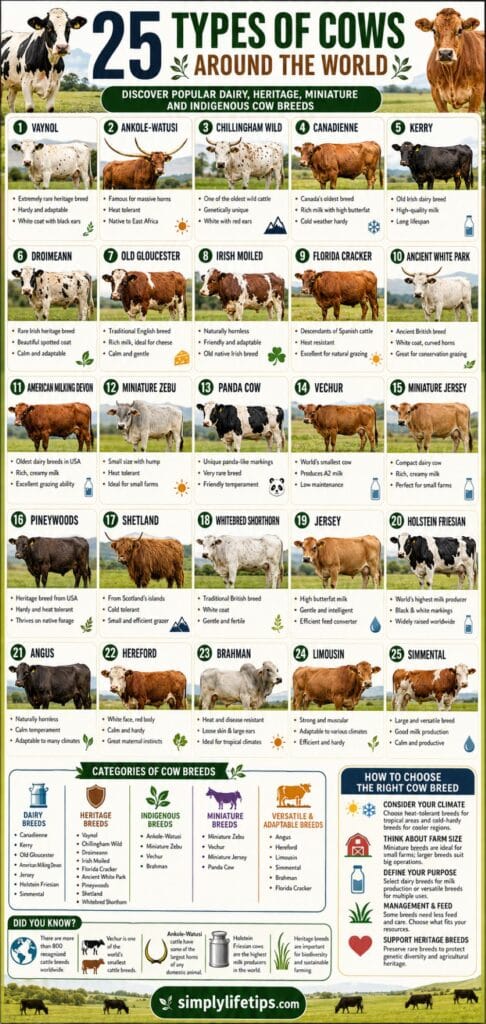
The infographic above offers a visual summary of the most well-known types of cows, but each breed has its own fascinating history, unique characteristics, and role in agriculture. Some breeds are prized for producing rich, high-quality milk, while others are celebrated for their adaptability, resilience, conservation value, or cultural significance.
In the following sections, we’ll explore each of these types of cows in detail, covering their origins, physical appearance, temperament, farming advantages, and interesting facts. This comprehensive guide will help you better understand what makes every breed unique and why these remarkable cattle continue to play an important role in sustainable farming and livestock conservation around the world.
Comparison Table of the Types of Cows
The following table summarizes the 25 types of cows covered in this guide. It highlights their country of origin, primary characteristics, and what makes each breed unique.
| Cow Breed | Origin | Category | Key Characteristics |
|---|---|---|---|
| Vaynol | Wales | Heritage | Extremely rare, hardy, white coat |
| Ankole-Watusi | East Africa | Indigenous | Massive horns, heat tolerant |
| Chillingham Wild | England | Heritage | Semi-wild, genetically unique |
| Canadienne | Canada | Dairy | Rich milk, cold hardy |
| Kerry | Ireland | Dairy | High-quality milk, long lifespan |
| Droimeann | Ireland | Heritage | Spotted coat, rare breed |
| Old Gloucester | England | Dairy | Rich milk, calm temperament |
| Irish Moiled | Northern Ireland | Heritage | Naturally hornless, adaptable |
| Florida Cracker | USA | Heritage | Heat resistant, efficient grazer |
| Ancient White Park | United Kingdom | Heritage | White coat, curved horns |
| American Milking Devon | USA | Dairy | Rich milk, pasture friendly |
| Miniature Zebu | India | Miniature | Small, heat tolerant |
| Panda Cow | Selective Breeding | Rare | Panda-like markings |
| Vechur | India | Indigenous | World’s smallest, A2 milk |
| Miniature Jersey | Jersey | Miniature Dairy | Compact, creamy milk |
| Pineywoods | USA | Heritage | Hardy, excellent grazer |
| Shetland | Scotland | Heritage | Cold tolerant, small size |
| Whitebred Shorthorn | United Kingdom | Heritage | White coat, gentle nature |
| Jersey | Jersey Island | Dairy | High butterfat milk |
| Holstein Friesian | Netherlands | Dairy | World’s highest milk producer |
| Angus | Scotland | Heritage | Hornless, adaptable |
| Hereford | England | Heritage | White face, calm temperament |
| Brahman | India | Indigenous | Heat resistant, disease resistant |
| Limousin | France | Heritage | Strong, adaptable |
| Simmental | Switzerland | Dairy | Large, versatile, productive |
How to Choose the Right Types of Cows?
Choosing among the many types of cows depends on your farming goals, available land, climate, and level of experience. Every breed offers unique advantages, so understanding your needs before selecting cattle is essential.
Consider Your Climate
Climate is one of the most important factors when selecting cattle. Some breeds naturally perform better in hot environments, while others thrive in colder regions.
For tropical and humid climates, breeds such as Brahman, Miniature Zebu, Vechur, and Ankole-Watusi are excellent choices because they tolerate heat and resist many common diseases.
If you live in colder regions, breeds like Shetland, Canadienne, Kerry, and Ancient White Park are well adapted to harsh winters and can graze successfully throughout much of the year.
Think About Farm Size
Not every farmer has access to extensive grazing land. Fortunately, some types of cows are naturally smaller and require less space.
Small farms can benefit from breeds such as:
- Vechur
- Miniature Jersey
- Miniature Zebu
- Kerry
Larger farms with abundant pasture can successfully manage:
- Holstein Friesian
- Simmental
- Jersey
- Hereford
Selecting the right breed for your available land improves animal welfare while reducing feed costs.
Choose Based on Milk Production
If your primary goal is dairy farming, selecting a breed known for consistent milk production is essential.
Excellent dairy breeds include:
- Holstein Friesian
- Jersey
- Canadienne
- Kerry
- American Milking Devon
- Simmental
These breeds are widely recognized for producing nutritious milk with excellent quality.
Support Heritage and Indigenous Breeds
Many heritage types of cows are considered endangered because modern farming has favored a limited number of commercial breeds. By raising indigenous and heritage cattle, farmers help preserve valuable genetics that may become increasingly important in the future.
Examples include:
- Vaynol
- Chillingham Wild
- Droimeann
- Irish Moiled
- Pineywoods
- Ancient White Park
Supporting these breeds contributes to biodiversity and sustainable agriculture.
Interesting Facts About Types of Cows
Cows have fascinated humans for thousands of years. Here are some interesting facts about different types of cows around the world.
- More than 800 cattle breeds are recognized worldwide.
- The Vechur is among the world’s smallest cattle breeds.
- Ankole-Watusi cattle have some of the largest horns of any domestic animal.
- Holstein Friesian cows are the most widely used dairy cattle globally.
- Jersey milk naturally contains high levels of butterfat.
- Some heritage breeds have existed for several hundred years with very little genetic change.
- Cows have an excellent sense of smell and can recognize familiar people.
- Many cattle breeds have adapted naturally to specific climates without modern breeding techniques.
- Heritage cattle play an important role in protecting biodiversity.
- Indigenous cattle are often more resistant to local diseases than imported breeds.
- Different Types of Hats | History, Styles, and Uses of Popular Hats
- Types of Shoes | The Ultimate Guide to Popular Shoe Styles and Their Uses
Conclusion
The remarkable diversity of types of cows demonstrates how cattle have adapted to different climates, landscapes, and farming traditions around the world. From the miniature Vechur of India to the iconic Holstein Friesian, every breed has unique characteristics that make it valuable in its own way.
Learning about different types of cows not only helps farmers choose the right breed for their needs but also highlights the importance of preserving rare and heritage cattle. Indigenous breeds contribute valuable genetic diversity, require fewer resources in their native environments, and often play an essential role in sustainable agriculture.
Whether you are interested in dairy farming, livestock conservation, homesteading, or simply expanding your knowledge, understanding these fascinating cattle breeds provides a greater appreciation for their contribution to agriculture and rural communities. As conservation efforts continue worldwide, protecting these remarkable types of cows ensures that future generations can continue to benefit from their diversity, resilience, and agricultural importance.
Frequently Asked Questions
How many types of cows are there in the world?
There are more than 800 recognized cattle breeds worldwide. Each breed has unique characteristics that have developed over centuries to suit different climates, farming practices, and cultural traditions.
Which type of cow produces the most milk?
The Holstein Friesian is widely recognized as the world’s highest-producing dairy breed and is commonly used on commercial dairy farms across many countries.
Which is the smallest type of cow?
The Vechur cow from Kerala, India, is one of the smallest breeds of cow in the world. Despite its compact size, it produces nutritious A2 milk and adapts well to tropical climates.
Which cow breeds are best for small farms?
Small farms often prefer compact and easy-to-manage breeds such as Vechur, Miniature Jersey, Miniature Zebu, and Kerry because they require less space and feed while remaining productive.
Why is it important to conserve heritage cow breeds?
Heritage cow breeds preserve valuable genetic diversity, support sustainable farming, and protect centuries of agricultural history. Conserving these breeds helps maintain biodiversity and ensures resilient livestock populations for the future.
References:
If this resonated with you, share it with someone who needs it.
PVM

Mathukutty P V is a Blogger, YouTuber, and Content Writer and the founder of Simply Life Tips. After taking voluntary retirement in 2017, he embraced a free lifestyle focused on learning, personal growth, and sharing practical wisdom to help others live with more purpose and positivity.



