

Overcoming procrastination starts with taking action instead of waiting for the perfect moment or feeling motivated. Whether you delay work, study, exercise, important decisions, or everyday responsibilities, understanding why you procrastinate can help you make starting easier.
People often procrastinate not because they are lazy, but because a task may trigger discomfort such as fear of failure, boredom, uncertainty, overwhelm, perfectionism, or self-doubt. Avoiding the task can provide short-term relief, but the unfinished responsibility often creates more pressure later.
The good news is that procrastination is a behavior that can be changed. In this guide, you’ll discover practical tips for overcoming procrastination, reducing distractions, breaking difficult tasks into manageable steps, and building consistent habits that make taking action easier.
What Is Procrastination?
Procrastination is the voluntary delay of an intended task even when you expect that delaying it may make things more difficult later.
It is not simply poor time management. A person may know exactly what needs to be done and still avoid doing it because the task feels unpleasant, difficult, boring, or emotionally uncomfortable.
For example, an employee may postpone preparing a presentation because they are worried about being judged. A student may keep delaying an assignment because they are afraid of producing poor work. Someone else may repeatedly postpone an important phone call because they expect the conversation to be uncomfortable.
In these situations, avoiding the task can provide short-term relief. However, the task remains unfinished, and the resulting pressure can worsen the situation. Research has linked procrastination with attempts to regulate immediate emotions at the expense of longer-term goals.
Why Do People Procrastinate?
There is no single reason why people procrastinate. Different tasks can trigger different forms of avoidance.
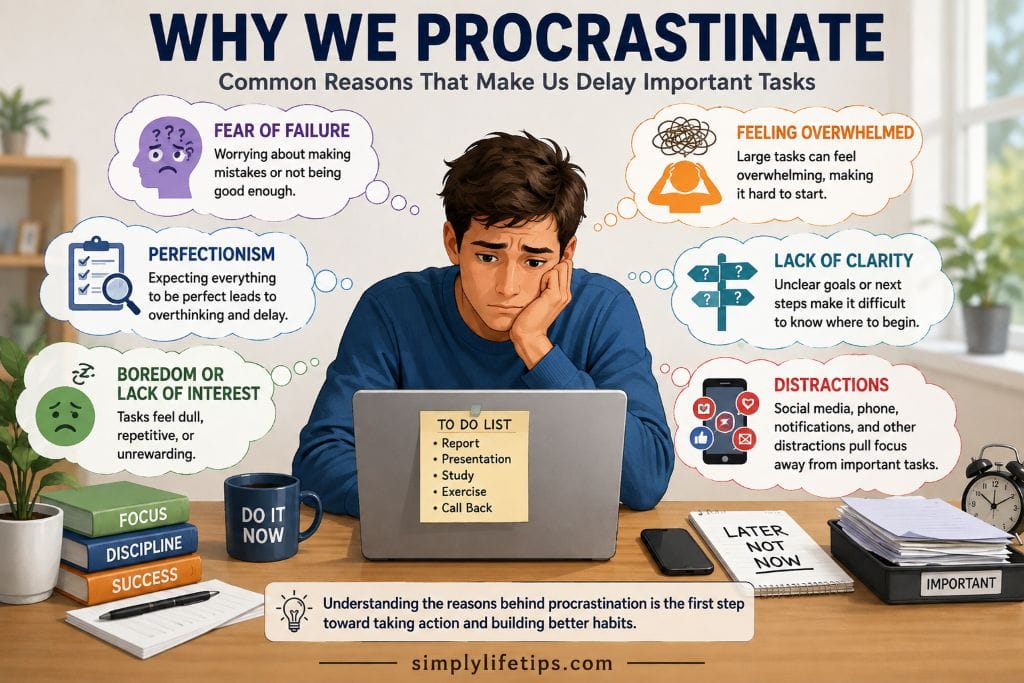
Fear of Failure
Fear of failure can make starting a task feel threatening. When people believe that their performance will be judged, they may delay starting to avoid confronting the possibility of failure.
A useful approach is to treat the first attempt as a draft rather than a final judgment.
For example, instead of trying to write a perfect report immediately, begin by creating headings and adding a few rough ideas under each.
Perfectionism
Perfectionism can make ordinary tasks feel much harder than they need to be.
When someone believes that the result must be excellent from the beginning, starting can become intimidating. The person may spend more time thinking about the task than actually doing it.
Define what “finished” means before you begin.
For example, if you are preparing a report, decide what information it needs to contain and what standard is required. You can improve the work after completing the first version.
Feeling Overwhelmed
Large or complicated tasks can create a sense that there is too much to do.
Instead of thinking, “I have to finish the entire project,” identify the smallest useful action.
For example:
Instead of: “Work on my project.”
Try: “Open the document and write the first three headings.”
A clear first step reduces uncertainty and makes starting easier.
Lack of Clarity
Vague goals encourage delay because it is difficult to know exactly where to begin.
“Get healthier” is a broad goal.
“Walk for 20 minutes after dinner” is a specific action.
The more clearly you define the next action, the less mental effort you need to spend deciding what to do.
Boredom or Lack of Interest
Some tasks are simply unpleasant or boring.
You may not be able to make every task interesting, but you can make the starting point easier. Use a short work session, change your environment, or combine the task with a simple routine that helps you begin.
Why Is It Important to Stop Procrastinating?
Repeatedly delaying important tasks can create a cycle of pressure and avoidance.
A task that could have been completed calmly may eventually become an urgent problem. Working under last-minute pressure can increase stress and leave less time for careful work.
Procrastination can also affect everyday responsibilities such as:
- Preparing for an important meeting
- Completing work assignments
- Studying for an examination
- Making financial plans
- Scheduling routine appointments
- Having an important conversation
- Starting a healthy habit
- Learning a new skill
The problem is not that every delayed task is harmful. Strategic delay can sometimes be reasonable. Procrastination becomes problematic when you repeatedly postpone something you intended to do despite expecting the delay to create negative consequences.
Benefits of Taking Action
Overcoming procrastination is not simply about getting more work done. Taking action can improve how you think, how you feel about your abilities, and how you manage your time. When important tasks are no longer repeatedly pushed aside, several practical benefits can follow.
Greater Mental Clarity
Unfinished tasks can continue to occupy your attention, even when you are doing something else. Completing important tasks can reduce this mental load and make it easier to focus on what needs your attention next.
For example, sending an important email that you have been avoiding may take only a few minutes, but completing it can stop you from repeatedly thinking, “I still need to do that.”
Increased Self-Trust
Every time you make a reasonable commitment and follow through, you build evidence that you can rely on yourself. This can gradually strengthen confidence in your ability to take action even when a task feels difficult or uncomfortable.
For example, deciding to spend 20 minutes working on an important project and actually doing it reinforces the habit of keeping promises you make to yourself.
Better Productivity
Taking action earlier gives you more time to think, review your work, correct mistakes, and deal with unexpected problems. It also reduces the need to rush when a deadline approaches.
For example, starting a presentation several days before the deadline gives you an opportunity to improve the content instead of trying to complete everything under last-minute pressure.
More Time for Other Priorities
Completing important tasks can create more space for activities that matter outside work. Instead of carrying unfinished responsibilities in your mind throughout the day, you can give more attention to rest, family, relationships, hobbies, creativity, or personal development.
For example, completing a household task early may leave your evening free for spending time with family rather than worrying about what still needs to be done.
Greater Sense of Control
Taking consistent action can also give you a stronger sense of control over your responsibilities. You may not be able to control every deadline, interruption, or unexpected problem, but you can control the next step you choose to take.
The goal is not to eliminate every delay. It is to reduce unnecessary avoidance and become more willing to act on important tasks.
7 Practical Tips for Overcoming Procrastination
You do not need a complicated productivity system to start changing your habits. The following strategies can help you understand what is holding you back, make tasks easier to start, and build consistent action.
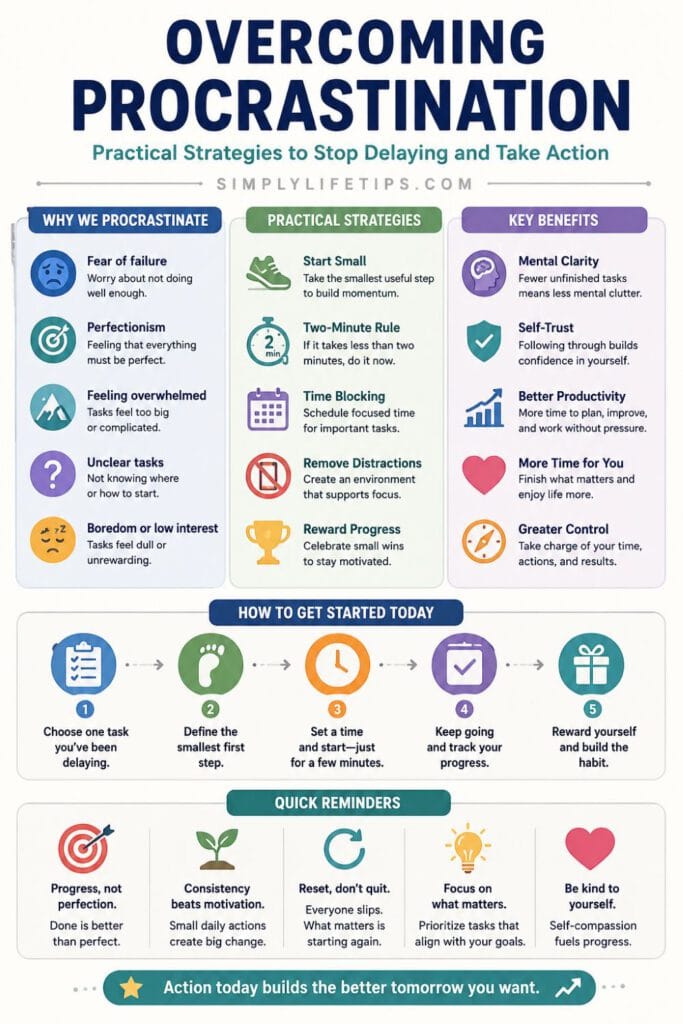
These strategies work best when you choose one or two that fit your situation and practice them consistently rather than trying to change everything at once.
Start With the Smallest Useful Step
When a task feels overwhelming, reduce it to the first action you can actually perform.
For example:
- Open the document.
- Write the title.
- Read the first page.
- Send one email.
- Put the first item away.
- Make one phone call.
The goal is not to finish everything immediately. The goal is to move from avoidance to action. This simple approach can make overcoming procrastination feel more manageable.
Try the Two-Minute Approach
For very small tasks, consider completing them immediately instead of allowing them to accumulate.
For example, if you need to reply to a simple message, put something away, or make a quick appointment, doing it now may take less effort than remembering to do it later.
For larger tasks, the same principle can be used as a starting technique: commit to working on the task for just a couple of minutes.
Starting is often harder than continuing.
Use Time Blocking
Instead of writing:
“Work on presentation.”
Schedule:
“9:30–10:00 — create presentation outline.”
This turns a general intention into a specific commitment.
Time blocking can also reduce repeated decisions about when to begin, which can be especially useful when you have several competing responsibilities.
Remove the Biggest Distraction
You do not need to eliminate every distraction. Start with the one that most often pulls you away from the task.
For example:
- Put your phone in another room.
- Close unnecessary browser tabs.
- Turn off nonessential notifications.
- Use a website blocker during focused work.
- Study somewhere with fewer interruptions.
A supportive environment makes the desired behavior easier.
Work in Short Focus Sessions
If starting a task feels difficult, use a short period of focused work.
For example, work for 15 or 25 minutes without switching to another activity. After the session, take a short break and decide whether to continue.
The purpose is to make the task feel manageable rather than demanding that you complete everything at once.
These small actions can make overcoming procrastination at work more practical.
Define “Good Enough”
If perfectionism is causing delay, decide in advance what an acceptable completed version looks like.
For example, the first draft of an article does not need to be perfect. It needs to exist so that you can review and improve it.
Progress gives you something to improve. An unfinished task gives you nothing to work with.
Reward Progress
Acknowledge progress rather than waiting until the entire project is finished.
After completing a focused work session, you might take a short break, have a cup of tea, stretch, or spend a few minutes doing something enjoyable.
The reward should support the habit rather than become another form of avoidance.
Psychological Techniques for Overcoming Procrastination
Changing procrastination often involves changing how you respond to uncomfortable thoughts and feelings.
One common thought is:
“I need to feel motivated before I start.”
A more useful approach is:
“I can start even if I do not feel motivated.”
Motivation does not always come before action. Sometimes taking the first step creates momentum.
Another useful technique is to notice the emotion behind the delay.
Ask yourself:
What am I trying to avoid feeling right now?
The answer might be boredom, uncertainty, fear of making a mistake, frustration, or feeling overwhelmed.
Once you identify the discomfort, you can respond to the actual obstacle instead of simply criticizing yourself for delaying.
Research supports the connection between emotional regulation and procrastination, although procrastination has multiple contributing factors and should not be reduced to a single psychological explanation.
How to Overcome Procrastination in 10 Minutes
When a task feels difficult or overwhelming, you do not need to finish it immediately. Your first goal is simply to break the cycle of avoidance and start.
Try this simple 10-minute method:
1. Choose One Task
Pick one important task you have been delaying. Avoid choosing several tasks at once.
For example, instead of deciding to “catch up on everything,” choose one specific task such as replying to an important email.
2. Define the Next Action
Ask yourself: What is the smallest useful action I can take right now?
Instead of “write my report,” try “open the document and write the first heading.”
3. Remove One Distraction
Identify the distraction most likely to interrupt you and remove it before starting.
Put your phone away, close unnecessary browser tabs, or turn off nonessential notifications.
4. Set a 10-Minute Timer
Commit to working on the task for just 10 minutes.
You do not have to promise yourself that you will finish the entire task. You only need to begin.
5. Start Before You Feel Ready
Do not wait for motivation or the perfect mood. Begin with the smallest action you have identified.
Once you start, the task may feel easier because you have replaced uncertainty with actual progress.
6. Decide What Comes Next
When the 10 minutes are over, ask yourself whether you want to continue.
If you continue, keep working while your momentum lasts. If you stop, identify the next action and schedule another short session.
The purpose of this method is not to complete every task in 10 minutes. It is to make starting easier and replace avoidance with action.
Overcoming Procrastination at Work
Procrastination at work can affect deadlines, reliability, teamwork, and professional confidence.
A practical approach is to identify the most important task and define its next action.
For example:
Instead of: “Prepare the quarterly report.”
Try: “Collect the sales figures for the first quarter.”
Breaking a large responsibility into visible steps makes progress easier to track.
Managers can also help by setting clear expectations, realistic deadlines, and regular progress checks rather than relying entirely on last-minute pressure.
For more ideas on building productive habits and making better choices at work, see 20 Behaviours That Earn Respect and Successful Decision Making in the Workplace.
Overcoming Procrastination in Personal Life
Procrastination does not only affect work and education. It can also influence personal responsibilities.
You may postpone:
- Exercising
- Organizing finances
- Making appointments
- Cleaning and organizing
- Learning a new skill
- Calling someone you care about
- Having an important conversation
One useful strategy is to connect the task with something you value.
Instead of thinking, “I have to exercise,” think, “I am taking care of my future health.”
Instead of “I have to organize my finances,” think, “I am creating more control over my future.”
You can also schedule important personal tasks as appointments rather than leaving them as vague intentions.
The same principles can help with overcoming procrastination in everyday life.
For a related mindset approach, see Affirmations for Happiness.
How to Maintain Progress
Changing procrastination habits takes consistency rather than perfection.
A setback does not mean that you have failed. If you delay a task, identify what happened and restart with a smaller action.
A simple weekly review can help:
- What did I keep delaying?
- Why did I avoid it?
- What made starting easier?
- What distraction caused the most trouble?
- What small change can I make next week?
Self-compassion can also be useful. Constantly criticizing yourself may add more negative emotion to a task you are already avoiding. A calmer response can make it easier to restart.
The goal is not to become someone who never delays anything. The goal is to become better at recognizing unnecessary delay and returning to purposeful action.
Building better habits does not require perfect consistency. What matters is continuing to take small steps, learning from setbacks, and returning to the task when you lose momentum.
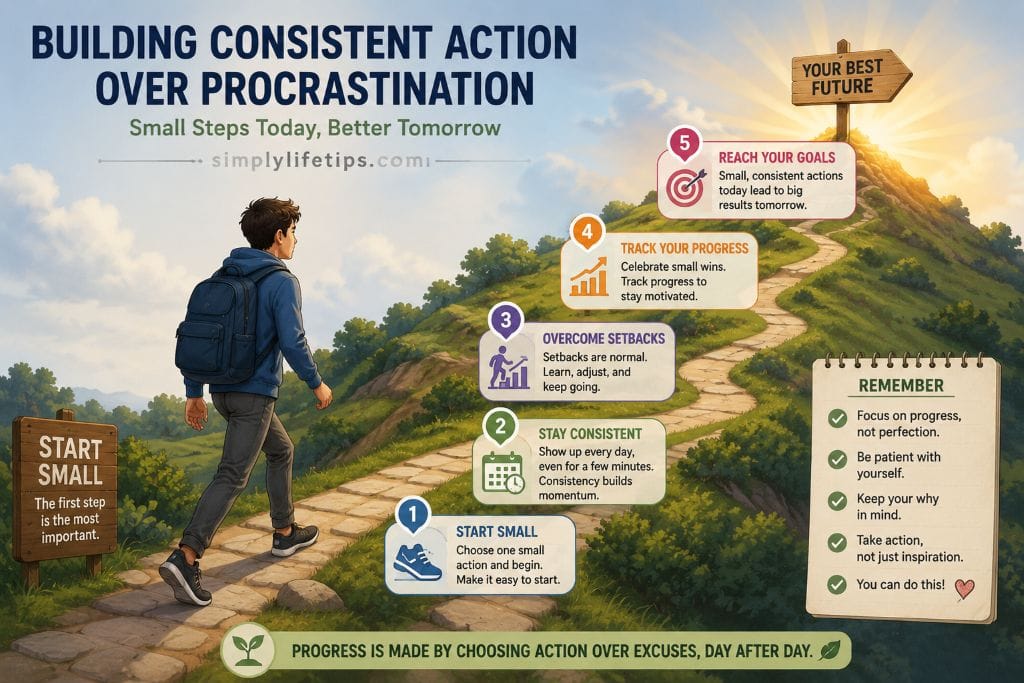
Progress is rarely a straight line. Occasional setbacks are normal, but returning to action can prevent a temporary delay from becoming a long-term pattern.
When Procrastination May Need More Attention
Occasional procrastination is common. However, persistent and severe procrastination that repeatedly interferes with work, education, relationships, finances, or daily responsibilities may deserve closer attention.
Procrastination can occur alongside other difficulties, including problems with stress, anxiety, mood, attention, or self-regulation. That does not mean procrastination automatically indicates a mental health condition.
If persistent procrastination is significantly affecting your daily life and you are unable to change the pattern on your own, consider discussing the situation with a qualified mental health professional.
Conclusion
Overcoming procrastination is less about forcing yourself to work harder and more about understanding why you are delaying, making the first step manageable, and building systems that support consistent action.
You do not have to finish everything today. Start with one important task, define the smallest useful action, remove one major distraction, and begin.
Small actions repeated consistently can gradually replace a habit of delay with a habit of progress.
FAQs About Overcoming Procrastination
What is the main reason people procrastinate?
There is no single cause. People may procrastinate because a task feels unpleasant, overwhelming, boring, uncertain, or threatening to their confidence. Emotional regulation and self-regulation can play important roles.
Can overcoming procrastination reduce stress?
Reducing unnecessary delays can help prevent the last-minute pressure, guilt, and frustration that often accompany unfinished responsibilities. However, the effect varies from person to person, and procrastination itself can have several causes.
Is procrastination linked to perfectionism?
Perfectionism can contribute to procrastination for some people, particularly when high standards make starting feel risky. However, research suggests that the relationship is more complex than simply saying that perfectionism causes procrastination.
How long does it take to overcome procrastination?
There is no fixed timeframe. Progress depends on the person, the type of task being delayed, the reasons for the delay, and how consistently new strategies are practiced. Focus on building a repeatable pattern of action rather than expecting an immediate change.
Do digital tools help with procrastination?
Digital tools such as task managers, focus timers, calendars, and distraction blockers can provide structure and reminders. They work best when they simplify action rather than creating another complicated productivity system.
How Can I Stop Procrastinating Immediately?
Start with one small action instead of trying to finish the entire task. Choose the task you have been avoiding, identify the smallest useful step, remove one major distraction, and work on it for 10 minutes. The goal is to start rather than wait until you feel motivated.
What Is the Best Way to Overcome Procrastination?
There is no single method that works for everyone. A practical approach is to understand why you are delaying, break the task into a manageable first step, reduce distractions, and use short, focused work sessions. Consistency is more important than finding a perfect productivity technique.
How Do I Overcome Procrastination Step by Step?
Start by identifying the task you are avoiding. Then determine why you are delaying it, define the smallest useful action, remove a major distraction, and begin with a short work session. Afterward, review your progress and decide on the next action. Repeating this process can gradually make starting easier.
References
- Emotion Regulation Difficulties and Academic Procrastination – PMC
- Roles of Impulsivity, Motivation, and Emotion Regulation in Procrastination – PMC
- “I’ll Worry About It Tomorrow” – Fostering Emotion Regulation Skills to Overcome Procrastination – PMC

Mathukutty P V is a Blogger, YouTuber, and Content Writer and the founder of Simply Life Tips. After taking voluntary retirement in 2017, he embraced a free lifestyle focused on learning, personal growth, and sharing practical wisdom to help others live with more purpose and positivity.



