
Love Languages play a powerful role in building healthy, lasting relationships. While every person expresses and receives love differently, understanding these differences can help strengthen emotional connections, improve communication, and reduce misunderstandings. Whether you are married, dating, raising children, or nurturing friendships, learning the 5 love languages can help you show care in ways that truly matter.
The idea of love languages was introduced by Dr. Gary Chapman in his bestselling 1992 book The Five Love Languages. Since then, millions of people have used the framework to improve their relationships. Although recent research suggests that people may not have just one fixed love language, many relationship experts agree that discussing how partners prefer to give and receive love encourages healthier communication and deeper emotional understanding.
Rather than assuming others feel loved the same way you do, this guide will help you recognise different expressions of love and learn practical ways to build stronger relationships with your spouse, children, family members, friends, and even colleagues.
What Are Love Languages?
Love languages are the different ways people express affection and feel appreciated. While everyone enjoys kindness and care, the actions that make one person feel deeply loved may have little impact on someone else.
Imagine a husband who works long hours to provide for his family. He believes his sacrifices demonstrate love. However, his wife may simply want uninterrupted conversations every evening. Both value the relationship, but they communicate love differently.
Similarly, a parent may frequently buy gifts for a child, while the child longs for quality time together. A friend may constantly offer help during difficult times, while another friend values encouraging words more than practical assistance.
These differences do not mean one person loves more than another. They simply highlight that people experience love in unique ways.
Understanding love languages helps us move beyond assumptions and express love in ways that make others genuinely feel valued.
Importance of Understanding Love Languages
Many relationship problems are not caused by a lack of love but by a lack of understanding.
For example:
- A husband keeps buying thoughtful gifts, but his wife wishes he would spend more time with her.
- Parents work hard to provide everything their children need, yet the children simply want more meaningful conversations.
- Friends exchange expensive presents but rarely check on each other during difficult times.
In each case, love is present, but it is being communicated differently.
When you understand another person’s preferred way of receiving love, you become more intentional in your actions. This creates stronger emotional bonds, reduces unnecessary conflicts, and builds trust over time.
Love languages can be especially helpful in:
- Marriage and romantic relationships
- Parent-child relationships
- Friendships
- Extended families
- Workplace relationships
- Caregiving situations
They are not a magical solution to every relationship challenge, but they provide a practical starting point for understanding emotional needs and improving communication. Research suggests that the greatest benefit comes from openly discussing each other’s needs and expressing love in multiple ways rather than focusing on only one “primary” love language.
The 5 Love Languages
According to Gary Chapman, there are five primary ways people commonly express and receive love:
- Words of Affirmation
- Acts of Service
- Quality Time
- Physical Touch
- Receiving Gifts
Each person may appreciate all five, but some expressions naturally feel more meaningful than others.
The 5 Love Languages Explained
Each person expresses and receives love differently. While you may appreciate all five love languages, one or two often feel especially meaningful. Learning to recognise these preferences can strengthen emotional bonds and reduce misunderstandings in everyday relationships.
1. Words of Affirmation
For people whose primary love language is Words of Affirmation, spoken and written words have a lasting emotional impact. Genuine compliments, appreciation, encouragement, and gratitude make them feel recognised and valued.
Positive words can build confidence, strengthen trust, and deepen emotional intimacy. Learn how emotional intimacy in marriage creates stronger communication, trust, and lasting connection between couples. On the other hand, harsh criticism, sarcasm, or constant negative comments may affect them more deeply than others.
Examples include:
- “I appreciate everything you do for our family.”
- “I’m proud of how hard you’ve worked.”
- “You handled that situation really well.”
- “Thank you for always being there for me.”
- Leaving a heartfelt note before work.
- Sending an encouraging message during a difficult day.
Imagine a wife preparing breakfast every morning before work. Her husband rarely notices because he assumes it is simply part of the routine. One morning, he sincerely says, “Thank you for taking care of us every day. I truly appreciate your love and dedication.” Those simple words may mean far more than an expensive gift.
Parents can also use this love language effectively. Praising a child’s effort instead of only celebrating achievements encourages confidence and emotional security.
Likewise, managers who recognise employees’ contributions create more positive and motivated workplaces.
How to Practise Words of Affirmation?
- Express appreciation regularly.
- Give sincere compliments.
- Encourage rather than criticise.
- Celebrate small achievements.
- Write thoughtful notes or messages.
- Say “thank you” more often.
The key is sincerity. Empty praise or excessive flattery is usually easy to recognise and rarely has the same emotional impact.
2. Acts of Service
Some people feel most loved when others willingly help them. For them, actions truly speak louder than words.
Acts of Service involve reducing another person’s burden through thoughtful and practical help. These actions communicate care, reliability, and commitment.
Examples include:
- Cooking dinner after a long workday.
- Helping with household chores.
- Driving someone to a medical appointment.
- Looking after children while a partner rests.
- Repairing something that has been broken for weeks.
- Making tea for someone who is feeling unwell.
Consider a husband who notices his wife has had an exhausting week. Without being asked, he prepares dinner, washes the dishes, and helps the children complete their homework. Although he may not repeatedly say, “I love you,” his actions clearly communicate love and support.
Similarly, an adult child who regularly assists ageing parents with shopping, hospital visits, or household tasks is expressing love through service.
Acts of Service are not about keeping score or expecting something in return. They are meaningful when offered freely and with genuine concern.
How to Practise Acts of Service?
- Offer help before being asked.
- Share household responsibilities.
- Support loved ones during stressful periods.
- Complete small tasks that ease another person’s day.
- Be dependable and consistent.
Remember, these actions should come from kindness rather than obligation. When service becomes resentful or transactional, its emotional value is greatly reduced.
People often assume that buying gifts or saying loving words is enough. However, for someone whose love language is Acts of Service, consistently helpful actions may communicate love far more effectively than grand romantic gestures. While many people find the love languages framework helpful, relationship experts also encourage couples to express affection in multiple ways instead of relying exclusively on one preferred style.
3. Quality Time
For some people, nothing says “I love you” more than giving them your undivided attention. If Quality Time is their primary love language, they value meaningful conversations and shared experiences more than expensive gifts or grand gestures.
Quality Time is not simply being in the same room. It means being fully present—putting away distractions, listening attentively, and enjoying each other’s company.
In today’s digital world, many families spend hours together while everyone is looking at a phone or television. Physical presence alone does not create an emotional connection. Genuine attention does.
Examples of Quality Time include:
- Having dinner together without phones.
- Going for an evening walk.
- Planning a weekend outing.
- Watching a favourite movie together.
- Cooking a meal as a family.
- Sitting together and discussing the day’s experiences.
Imagine a father who works long hours. Every Sunday morning, he takes his daughter to the park, where they play, laugh, and talk without interruptions. Those few hours create memories that last far longer than any expensive toy.
Similarly, couples who regularly schedule date nights often strengthen their emotional bond because they intentionally make time for each other despite busy schedules.
How to Practise Quality Time?
- Give your full attention during conversations.
- Listen without interrupting.
- Plan regular family activities.
- Create technology-free moments every day.
- Share hobbies or learn something new together.
- Celebrate important milestones together.
Family mealtimes are one of the simplest ways to enjoy uninterrupted quality time while strengthening communication and emotional bonds. Learn how regular meals together support children’s learning, confidence, and family relationships in our guide on Family Mealtimes and Child Development.
The goal is not to spend every minute together but to make the time you do spend meaningful. Even fifteen minutes of focused conversation each day can strengthen a relationship when both people are fully engaged.
4. Physical Touch
For many people, affectionate and appropriate physical touch communicates love more powerfully than words.
Physical Touch includes simple gestures such as holding hands, hugging, placing a reassuring hand on someone’s shoulder, or giving a warm embrace after a difficult day. These actions often provide comfort, reassurance, and emotional security.
It is important to remember that physical touch should always be respectful, welcomed, and appropriate to the relationship. Healthy affection strengthens trust, while unwanted touch can have the opposite effect.
Examples include:
- Hugging your spouse before leaving for work.
- Holding hands during a walk.
- Giving your child a comforting hug after a difficult day at school.
- A reassuring pat on the back.
- Sitting close while watching a movie.
- Celebrating achievements with a warm embrace.
Consider an elderly parent living alone. A gentle hug during a visit may communicate love and belonging more deeply than many spoken words.
Likewise, children who receive appropriate affection from their parents often feel more emotionally secure and connected.
How to Practise Physical Touch?
- Offer hugs regularly.
- Hold hands while walking.
- Sit close during conversations.
- Comfort loved ones with a reassuring touch.
- Respect personal boundaries and individual comfort levels.
- Remember that not everyone enjoys the same amount of physical affection.
Physical touch is about emotional connection rather than frequency. A sincere hug offered at the right moment can sometimes express more than a lengthy conversation. Research also shows that touch plays an important role in communicating emotions and strengthening close relationships.
5. Receiving Gifts
People whose love language is Receiving Gifts do not necessarily value expensive presents. Instead, they appreciate the thought, effort, and meaning behind the gift.
A carefully chosen gift serves as a tangible reminder that someone was thinking about them.
The value lies in the intention rather than the price.
Meaningful gifts can include:
- A handwritten letter.
- A favourite book.
- Flowers picked for a special occasion.
- Their favourite chocolate.
- A handmade greeting card.
- A framed family photograph.
- A souvenir from a holiday.
Imagine a wife returning from a business trip with her husband’s favourite local coffee. The gift may cost very little, but it communicates, “I thought about you while I was away.”
Likewise, children often treasure handmade birthday cards from their parents long after expensive toys have been forgotten.
How to Practise Receiving Gifts?
- Choose gifts thoughtfully rather than impulsively.
- Focus on personal meaning instead of cost.
- Surprise loved ones with birthdays and anniversaries.
- Remember important dates.
- Include handwritten notes whenever possible.
- Celebrate small achievements with meaningful tokens of appreciation.
Receiving Gifts is often misunderstood as materialism. In reality, most people with this love language value the emotional message behind the gift far more than its monetary value. A simple flower, favourite snack, or heartfelt letter can sometimes become a treasured memory because it represents love, thoughtfulness, and care.
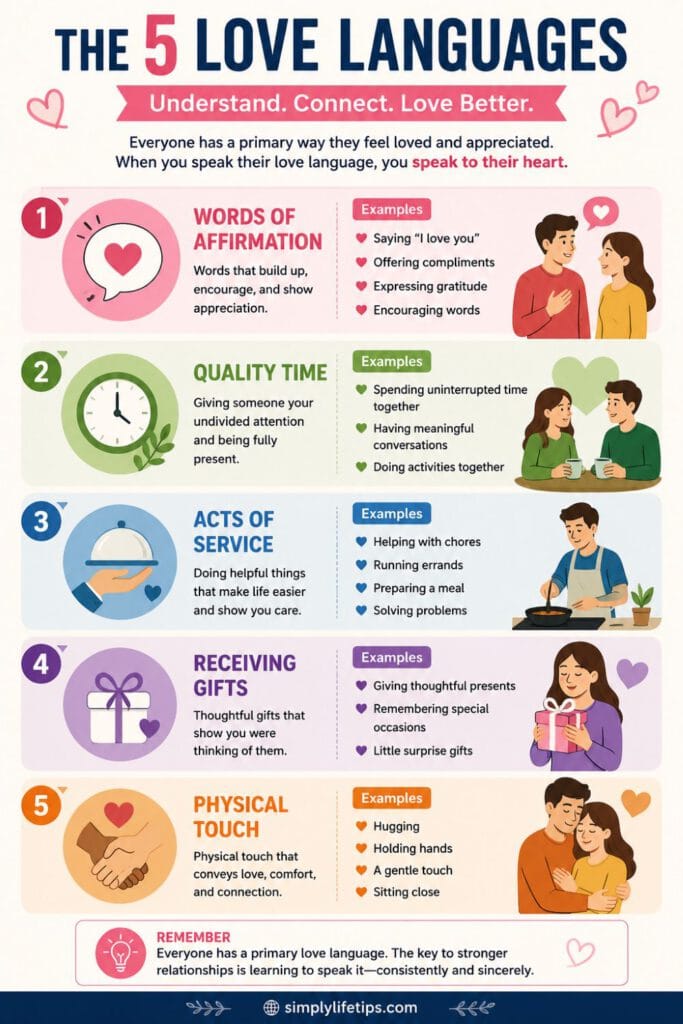
The infographic below provides a quick overview of the five love languages and practical examples of how each one can strengthen healthy relationships.
Can You Have More Than One Love Language?
Absolutely. While many people identify strongly with one love language, it is common to appreciate several forms of affection. Your preferences may also change as your relationships and life circumstances change.
For example:
- A newly married couple may value Physical Touch and Quality Time most.
- New parents may appreciate Acts of Service because they are busy caring for a baby.
- Older adults may treasure Quality Time and Words of Affirmation more than gifts.
- Someone recovering from illness may feel most loved through practical help and emotional encouragement.
Instead of trying to identify a single “perfect” love language, focus on understanding which expressions of love make you and your loved ones feel most appreciated. Recent research suggests that relationship satisfaction is linked more closely to experiencing a variety of caring behaviours than to matching one specific love language.
How to Discover Your Love Language?
Understanding your love language begins with observing how you naturally express love and what makes you feel genuinely appreciated.
Ask yourself these questions:
What makes you feel happiest?
- Do compliments brighten your day?
- Do thoughtful gifts make you feel remembered?
- Do you enjoy spending uninterrupted time together?
- Do hugs and affectionate gestures comfort you?
- Do practical acts of help make you feel supported?
Your answers often reveal the types of affection that matter most to you.
Notice what you naturally do for others
People frequently express love in the same way they like to receive it.
For example:
- If you constantly compliment people, you may value Words of Affirmation.
- If you enjoy helping others with everyday tasks, Acts of Service may be important to you.
- If you regularly buy thoughtful presents, Receiving Gifts may resonate most.
- If you often plan family outings, Quality Time may be your preferred expression of love.
Think About Past Disappointments
Sometimes, what hurts us most reveals what we value most.
Ask yourself:
- Did you feel hurt because someone forgot your birthday?
- Were you disappointed because your partner was always too busy?
- Did criticism affect you more than expected?
- Did you wish someone had simply helped when you were overwhelmed?
These experiences can provide valuable clues about your emotional needs.
A Simple Love Language Self-Check
Read each statement and choose the one that sounds most like you.
- I feel happiest when someone sincerely appreciates or encourages me.
- I feel loved when someone helps me without being asked.
- I value uninterrupted time together more than expensive gifts.
- I feel close through hugs, holding hands, or affectionate touch.
- I treasure thoughtful gifts because they remind me someone was thinking of me.
You may identify with more than one statement, and that’s perfectly normal. The purpose of this exercise is not to place yourself in a fixed category but to become more aware of how love is expressed and received in your relationships.
Comparing the Five Love Languages
| Love Language | What It Means | Simple Example |
|---|---|---|
| Words of Affirmation | Expressing love through encouraging words | “I’m proud of you.” |
| Acts of Service | Showing love by helping | Cooking dinner after a long day |
| Quality Time | Giving undivided attention | Enjoying a phone-free walk together |
| Physical Touch | Appropriate affectionate touch | A warm hug or holding hands |
| Receiving Gifts | Thoughtful tokens of appreciation | A handwritten note or favourite snack |
Remember that healthy relationships rarely depend on only one of these expressions. The strongest relationships often include all five, used naturally according to each person’s needs and preferences.
Applying Love Languages in Everyday Relationships
Love languages are often discussed in the context of marriage, but they can strengthen almost every type of relationship. The key is to understand that every person has unique emotional needs. By expressing care in ways that matter to others, you build stronger, healthier, and more meaningful connections.
Love Languages in Marriage
Marriage thrives on trust, communication, and consistent acts of love. As responsibilities increase with work, finances, and parenting, couples may unintentionally stop expressing appreciation.
For example, a husband may believe that working hard to provide financial security is enough to show love. Meanwhile, his wife may simply want uninterrupted conversations each evening. Neither person is wrong—they are expressing and receiving love differently.
Healthy marriages often include:
- Expressing gratitude regularly.
- Making time for weekly conversations or date nights.
- Sharing household responsibilities.
- Celebrating milestones together.
- Supporting each other during difficult times.
The strongest marriages are not built on grand romantic gestures alone but on consistent expressions of care and respect.
Love Languages Between Parents and Children
Children need more than food, clothing, and education. They also need emotional security and reassurance.
Every child experiences love differently.
Some children light up when parents praise their efforts.
Others simply want to spend time playing together.
Some feel most secure through hugs and affectionate touch.
Parents can strengthen their relationship with children by:
- Reading together every day.
- Listening without interrupting.
- Celebrating effort instead of only success.
- Offering hugs and encouragement.
- Creating family traditions.
Children who feel emotionally connected are often more confident and willing to communicate openly with their parents.
Love Languages in Friendships
Strong friendships are built on mutual care rather than convenience.
Friends can express love through:
- Checking in during difficult times.
- Celebrating achievements.
- Spending quality time together.
- Offering practical help when needed.
- Remembering birthdays and important occasions.
A thoughtful phone call during a difficult week may mean far more than an expensive birthday gift.
True friendship is demonstrated through consistent care and presence.
Love Languages at Work
Although workplaces are professional environments, appreciation and kindness still matter.
Managers and colleagues can build healthier workplaces by:
- Recognising good work.
- Offering encouragement.
- Helping teammates meet deadlines.
- Respecting each other’s time.
- Celebrating team achievements.
Simple expressions of appreciation improve teamwork, trust, and motivation.
Employees who feel valued are generally more engaged and committed to their work.
Common Mistakes People Make
Many people misunderstand the purpose of love languages. Avoid these common mistakes.
Expecting Others to Read Your Mind
Your partner, family members, or friends cannot always guess what makes you feel appreciated.
Healthy relationships require honest communication.
Instead of becoming frustrated, explain your needs with kindness and listen to theirs.
Believing Everyone Has Only One Love Language
Many people enjoy all five love languages in different situations.
Your preferences may also change over time depending on life experiences, age, stress, and responsibilities. Recent studies suggest that people often benefit from receiving affection in multiple ways rather than having a single dominant love language.
Using Love Languages as a Scorecard
Love should never become a competition.
Avoid keeping track of who gave more compliments, bought more gifts, or completed more household tasks.
Healthy relationships are built on generosity rather than keeping score.
Ignoring Communication
Love languages complement communication—they do not replace it.
Even if you understand each other’s preferences, honest conversations remain essential for resolving disagreements and building trust.
Assuming Love Languages Solve Every Problem
Love languages can improve understanding, but they cannot fix issues such as abuse, dishonesty, manipulation, addiction, or a lack of respect.
Healthy relationships require:
- Trust
- Mutual respect
- Honest communication
- Emotional safety
- Shared commitment
Love languages work best when these foundations already exist. Research consistently shows that relationship quality depends on many factors, including responsiveness, communication, and mutual support, rather than love languages alone.
Practical Tips to Speak Your Partner’s Love Language
Understanding love languages is only the first step. The real difference comes when you intentionally express love in ways that are meaningful to the people around you.
Here are some practical ways to apply the five love languages in everyday life.
Observe Before You Assume
Pay attention to what makes your loved one smile, feel appreciated, or emotionally connected.
Ask yourself:
- What do they thank me for most often?
- What disappoints them?
- How do they naturally express love to others?
- What do they frequently ask for?
Careful observation often reveals their emotional needs better than assumptions.
Talk Openly About Your Needs
Healthy relationships grow through honest communication.
Instead of expecting your partner to guess your needs, have a simple conversation.
For example:
- “I really enjoy spending uninterrupted time together.”
- “Words of encouragement mean a lot to me.”
- “I feel supported when you help me with everyday tasks.”
Likewise, ask your partner what makes them feel most appreciated.
Show Love Consistently
Small, consistent expressions of love usually have a greater impact than occasional grand gestures.
Examples include:
- Saying “Thank you” every day.
- Leaving a kind note before work.
- Sharing a meal without distractions.
- Giving a reassuring hug.
- Helping with daily responsibilities.
Relationships become stronger through repeated acts of kindness rather than rare moments of extravagance.
Be Flexible
People change.
A person’s preferred way of receiving love may change during different stages of life.
For example:
- New parents often appreciate practical help.
- Someone grieving may need emotional support and quality time.
- Older adults may value companionship more than gifts.
Continue learning about each other instead of assuming preferences never change.
Love Languages Are Part of a Healthy Relationship
Love languages are a useful communication tool, but they are only one part of a healthy relationship.
Strong relationships also require:
- Trust
- Respect
- Honesty
- Empathy
- Forgiveness
- Healthy communication
- Emotional support
- Shared values
Even if you perfectly understand someone’s love language, the relationship will struggle without these essential qualities.
Modern relationship research suggests that understanding your partner’s emotional needs and responding with care and flexibility is more important than trying to match a single “primary” love language exactly.
The five love languages are practical expressions of affection. To explore the deeper meaning behind these expressions, read our guide on the Language of Love and how love is communicated through words, actions, trust, time, gifts, and touch.
Healthy relationships flourish when love is expressed in ways that resonate with others. This reminder captures the heart of the five love languages.

Putting Love Languages Into Practice
Understanding your preferred love language is only the beginning. Building a healthy relationship also requires expressing love through consistent actions, thoughtful communication, and mutual respect.
If you’re looking for practical ideas, explore our guide on how to express love, where you’ll discover meaningful ways to show appreciation and strengthen your relationships every day.
Conclusion
Love is expressed in many different ways, and no single approach works for everyone. The 5 Love Languages—Words of Affirmation, Acts of Service, Quality Time, Physical Touch, and Receiving Gifts—offer a practical framework for understanding how people prefer to give and receive affection.
While recent research suggests that people do not always have one fixed love language, the framework remains valuable because it encourages meaningful conversations about emotional needs and helps people become more thoughtful, intentional partners, parents, family members, and friends.
The healthiest relationships are built on love, respect, trust, and communication. By learning how the important people in your life feel most appreciated, you can create stronger emotional connections and build relationships that continue to grow through every stage of life.
Love is not simply about saying, “I care.”
It is about showing that care in ways that others truly understand.
Frequently Asked Questions
What are the five love languages?
The five love languages are Words of Affirmation, Acts of Service, Quality Time, Physical Touch, and Receiving Gifts. They describe common ways people express and experience love.
Can a person have more than one love language?
Yes. Many people appreciate several love languages, and their preferences may change over time depending on life experiences, age, or circumstances.
Do love languages only apply to romantic relationships?
No. Love languages can strengthen relationships with spouses, children, parents, siblings, friends, and even colleagues by improving communication and understanding.
Are love languages scientifically proven?
Love languages are widely used as a communication framework, but research has found limited evidence for some of the original theory’s core claims, such as everyone having one primary love language. Many experts recommend using the framework as a guide for discussing emotional needs rather than as a strict scientific model.
How can I discover my love language?
Reflect on what makes you feel most appreciated, observe how you naturally express love to others, discuss preferences with your loved ones, and remember that your needs may evolve.
References
- Chapman, G. (2015). The Five Love Languages: The Secret to Love That Lasts. Northfield Publishing.
- PubMed – Testing the predictions of Chapman’s five love languages theory
- PubMed – Affection preference, enactment, and relationship satisfaction

Mathukutty P V is a Blogger, YouTuber, and Content Writer and the founder of Simply Life Tips. After taking voluntary retirement in 2017, he embraced a free lifestyle focused on learning, personal growth, and sharing practical wisdom to help others live with more purpose and positivity.