

The subconscious mind is a fascinating subject that has attracted attention in psychology, neuroscience, self-development, and popular culture for generations. We often use the term when talking about habits, automatic reactions, memories, intuition, beliefs, and behaviours that seem to happen without deliberate thought.
You may have wondered why you repeatedly behave in a particular way, why certain situations trigger an immediate emotional response, or why some activities become almost automatic after enough practice. These experiences can make it seem as though another part of the mind is working behind the scenes.
But what is the subconscious mind actually doing?
The answer is more nuanced than many popular self-help claims suggest. The subconscious mind is not a separate organ or a mysterious control centre inside your brain. Instead, “subconscious” is commonly used to describe mental processes that occur outside our immediate conscious awareness.
Your brain is constantly processing information, recognizing patterns, learning from experience, and supporting familiar behaviours. You don’t consciously direct every mental process taking place throughout the day.
Understanding this can change the way you think about the power of subconscious mind.
Rather than believing that you can simply think about something and make it happen, you can look at how repeated experiences, habits, expectations, attention, and behaviour influence the way you respond to everyday life.
In this guide, we’ll explore what the subconscious mind means, how subconscious processes relate to habits and behaviour, the difference between conscious and subconscious processes, common myths, and practical ways to develop healthier patterns.
What Is the Subconscious Mind?
The term subconscious mind is commonly used to describe mental activity that occurs outside our immediate conscious awareness.
It is important to clarify that the subconscious mind is not a specific physical structure in the brain. Modern neuroscience does not divide the brain into a literal “conscious section” and “subconscious section.”
Instead, the term is useful in everyday discussion because many mental processes happen without deliberate attention.
The APA specifically identifies nonconscious processes and their interaction with consciousness as an area of psychological research.
Think about walking around your home.
You don’t consciously calculate every movement required to walk from one room to another. Your brain has learned the coordination involved, allowing you to perform the familiar activity with relatively little conscious attention.
The same principle can apply to many learned behaviours.
When you first learn a new skill, you often need to concentrate carefully. With repeated practice, parts of that skill can become more automatic.
For example, someone learning to type may initially search for individual keys. An experienced typist can type familiar words without consciously thinking about the location of every key.
This illustrates an important aspect of how subconscious mind works: learned patterns can reduce the amount of conscious attention required for familiar activities.
How Does the Subconscious Mind Work?
Your brain processes enormous amounts of information, but your conscious attention is limited.
You cannot deliberately focus on every sound, visual detail, memory, sensation, and decision occurring around you at the same time. Many processes therefore occur outside your immediate awareness.
Learning and repetition
Repetition plays an important role in learning.
When you repeatedly perform an action, your brain becomes increasingly familiar with the sequence. This can make the behaviour easier to perform.
Consider driving a car.
When someone first learns to drive, they may consciously think about the steering wheel, pedals, mirrors, road signs, traffic, and other vehicles.
With experience, many basic driving actions become more familiar. The driver can still consciously focus when necessary, but familiar aspects of the activity require less deliberate attention.
The same general principle applies to many everyday skills and routines.
Automatic responses
You may also experience automatic responses to familiar situations.
For example, if you regularly check your phone whenever you feel bored, the combination of boredom and the phone can become strongly associated.
Eventually, you may reach for your phone before consciously deciding to do so.
This doesn’t mean that your subconscious mind has taken control of you. It means that a repeated behaviour has become familiar and can be triggered by a particular situation.
Learned associations
Experiences can also create associations.
A particular song may remind you of a specific period of your life. A smell may bring back a childhood memory. A particular location may make you feel relaxed because of previous experiences there.
These reactions can occur quickly, sometimes before you consciously analyze why you are responding in that way.
The Power of the Subconscious Mind
The power of the subconscious mind is often exaggerated in popular culture.
You may encounter claims that your subconscious mind can attract wealth, create perfect relationships, heal every problem, or make any desire become reality simply through positive thinking.
There is no need to rely on these claims to appreciate the genuine importance of automatic mental processes.
The practical power of subconscious processes can be seen in habits, learned skills, automatic responses, attention, expectations, and repeated behaviour.
For example, imagine two people learning a difficult skill.
One person repeatedly thinks:
“I’m terrible at this. There’s no point continuing.”
They may become discouraged and stop practicing.
Another person thinks:
“This is difficult, but I can improve with practice.”
That thought doesn’t guarantee success. However, it may encourage the person to continue practicing.
The important connection is:
Thoughts can influence behaviour, and repeated behaviour can influence habits.
That is a much more realistic interpretation of the power of your subconscious mind than the idea that thoughts alone can control external reality.
How Thoughts and Habits Become Connected
One reason people associate the subconscious mind with behaviour is that habits can eventually feel automatic.
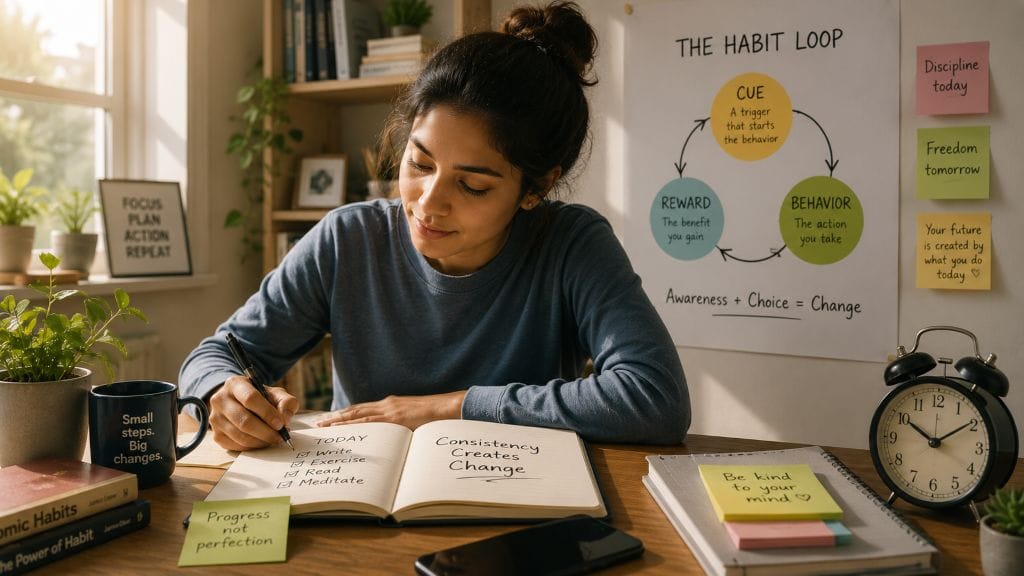
A simple way to understand a habit is:
Cue → Behaviour → Outcome
For example:
Cue: Feeling bored
Behaviour: Checking social media
Outcome: Temporary entertainment
If this pattern is repeated frequently, the behaviour can become increasingly familiar.
A different pattern might be:
Cue: Feeling bored
Behaviour: Take a short walk
Outcome: Refreshment and a break
The important lesson is that changing a habit generally requires more than simply thinking differently.
You need to practice a different behaviour.
Small actions can become routines
Suppose you want to read more.
You could begin by reading for ten minutes after dinner every evening.
At first, you may need to remind yourself.
After repeated practice, the routine can become more familiar.
The same principle can apply to:
- Exercise
- Writing
- Studying
- Meditation
- Practicing a skill
- Organizing your day
- Reducing unnecessary phone use
Small behaviours become more useful when you can repeat them consistently.
Conscious Mind vs. Subconscious Mind
The conscious and subconscious mind are often presented as two completely separate systems. In reality, human cognition is more complicated.
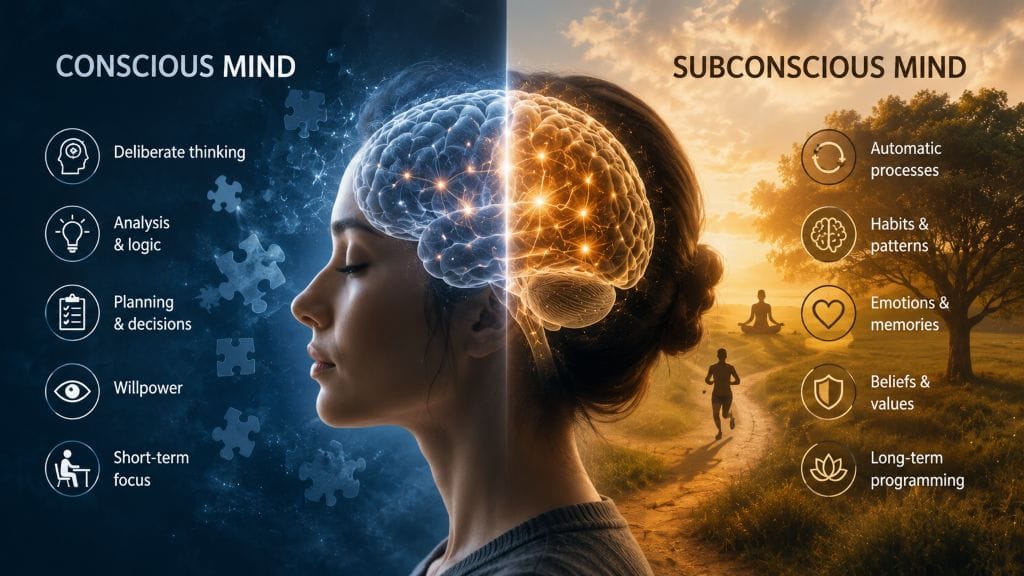
A useful distinction is between mental processes that you are actively aware of and processes that occur outside your immediate awareness.
| Conscious awareness | Processes outside immediate awareness |
|---|---|
| Deliberate thinking | Automatic responses |
| Focused attention | Familiar patterns |
| Planning | Learned behaviours |
| Solving a new problem | Established habits |
| Making deliberate choices | Familiar associations |
For example, when you deliberately plan your day, you are consciously considering what you want to accomplish.
But when you perform a familiar morning routine, you may not consciously think through every individual step.
The distinction is useful, but it should not be interpreted as proof that there are two independent minds operating inside the brain.
How the Subconscious Mind Influences Habits
Habits can make everyday life easier because they reduce the amount of conscious effort required for familiar behaviours.
Imagine having to consciously think through every step of brushing your teeth.
You would need to decide where to stand, how to hold the toothbrush, how much toothpaste to use, how to move the brush, and when to stop.
Because you’ve practiced the behaviour many times, you can perform it with very little conscious thought.
This automaticity is useful.
However, automatic habits can also become unhelpful.
For example:
- Automatically checking your phone during work
- Reaching for unhealthy food when stressed
- Avoiding difficult tasks
- Staying up late despite wanting better sleep habits
- Responding angrily to familiar triggers
- Repeatedly using negative self-talk
Recognizing an automatic pattern gives you an opportunity to change your response.
The peer-reviewed review available through PubMed Central. It explains how habits can be triggered by learned associations between situations and behaviours – Habit and automatic behaviour research – PMC
Can You Control Your Subconscious Mind?
You cannot consciously control every thought, emotion, memory, or automatic response.
Trying to control every mental process would be unrealistic.
A better goal is awareness and influence.
Suppose someone criticizes you.
Your immediate response might be anger.
You cannot necessarily prevent the initial emotional reaction, but you can create a pause before deciding what to do next.
You might:
Pause → Breathe → Consider the situation → Choose your response
That small pause can allow deliberate thinking to influence what happens next.
This is a practical way to work with automatic patterns without believing that you can control every aspect of your mind.
How to Influence Subconscious Patterns
You can work on established patterns through consistent practice.
Become aware
First, identify the behaviour you want to change.
Ask:
- What triggers it?
- What do I normally think?
- What do I normally do?
- What happens afterward?
For example, you may discover that you procrastinate whenever a task feels overwhelming.
Change the response
Once you’ve identified the pattern, experiment with a different response.
Instead of:
Overwhelming task → Avoidance → Phone
try:
Overwhelming task → Break task into one small step → Start for five minutes
The goal is not perfection.
The goal is to practice a different response.
Repeat the new behaviour
A new behaviour becomes more useful when you repeatedly practice it.
If you want to develop a writing habit, write regularly.
If you want to exercise, create a realistic exercise routine.
If you want to reduce phone use, establish specific phone-free periods.
Your actions provide the practical foundation for behavioural change.
Can You Reprogram Your Subconscious Mind?
The phrase “reprogram your subconscious mind” is common in self-development.
It can be useful as shorthand for changing established patterns of thinking and behaviour, but it shouldn’t be interpreted literally as rewriting a separate computer-like program inside your brain.
You can work on patterns by:
- Identifying unhelpful habits
- Challenging unrealistic thoughts
- Practicing new behaviours
- Creating supportive routines
- Changing environmental cues
- Repeating useful actions
- Learning from setbacks
For example, someone who believes:
“I always give up when things become difficult.”
can examine whether that belief is actually accurate.
They may remember situations where they persisted despite difficulties.
They can then practice staying with challenging tasks for slightly longer periods.
Over time, new experiences can provide evidence that their old pattern isn’t necessarily permanent.
If you want to explore practical techniques in greater detail, read our guide on how to reprogram your subconscious mind.
Does Positive Thinking Change the Subconscious Mind?
Positive thinking can be useful when it encourages constructive behaviour, but it shouldn’t be treated as a guaranteed method for changing reality.
For example, telling yourself:
“I can improve this skill through practice.”
may encourage persistence.
But saying:
“I can achieve anything without effort.”
doesn’t remove the need for learning, practice, resources, and opportunity.
The most useful form of positive thinking is connected to realistic action.
Positive thought + practical action + repetition
is a much stronger approach than positive thought alone.
Manifestation and the Subconscious Mind
Manifestation is another popular concept associated with the power of subconscious mind.
Some manifestation practices involve setting intentions, visualization, affirmations, and focusing attention on desired outcomes.
These practices may be useful as personal-development tools when they help clarify goals or encourage action.
However, there is no good scientific basis for believing that simply thinking about an outcome guarantees that it will happen.
For example, visualizing yourself becoming a successful writer may help you imagine the process.
But becoming a better writer still requires:
- Writing
- Learning
- Editing
- Publishing
- Getting feedback
- Improving over time
The useful part of visualization is therefore better understood as mental preparation and goal-directed behaviour, rather than magical control over external events.
Practical Ways to Work With Your Mind
If you want to apply these ideas to everyday life, keep the process simple.
Practice mindful awareness
Notice your thoughts and reactions without immediately acting on them.
Ask:
“What triggered this response?”
That question can help you identify patterns.
Use realistic self-talk
Replace extreme statements with constructive alternatives.
Instead of:
“I can’t do this.”
try:
“I can learn this step by step.”
Create useful cues
Make desirable behaviours easy to remember.
Want to read more?
Keep a book somewhere visible.
Want to exercise?
Prepare your clothes beforehand.
Want to reduce phone use?
Keep your phone away from your workspace.
Replace unwanted behaviours
Instead of only trying to stop a habit, decide what you will do instead.
For example:
Stress → Social media
can become:
Stress → Short walk → Return to task
Start small
A five-minute behaviour that you repeat consistently can be more useful than a two-hour routine that you abandon after three days.
Review your progress
At the end of the day or week, ask:
- What worked?
- What triggered the old behaviour?
- What new response did I practice?
- What can I improve?
This creates a feedback loop for continued learning.
Common Myths About the Subconscious Mind
Myth 1: Your subconscious mind can give you anything you want
Your thoughts don’t guarantee external outcomes.
Goals still require action, skills, resources, opportunities, and circumstances.
Myth 2: Positive thinking alone changes your life
Positive thinking can influence your attitude and behaviour, but it doesn’t replace practical action.
Myth 3: You can completely control your subconscious mind
You cannot consciously control every mental process.
The practical goal is to increase awareness and influence your behaviour.
Myth 4: One affirmation can reprogram your mind
Repeating an affirmation doesn’t guarantee permanent change.
Affirmations are more useful when combined with realistic thinking and behaviour.
Myth 5: You can change your subconscious mind overnight
There is no universal shortcut for changing established behavioural patterns.
Consistent practice matters more than a specific number of days.
Myth 6: The subconscious mind is a magical force
The concept doesn’t need supernatural explanations.
The influence of habits, learned responses, expectations, and automatic behaviour is already useful enough to understand.
How Long Does It Take to Change a Habit?
There is no universal number of days required to change a habit or behavioural pattern.
You may have heard that a habit takes 21 days to form. In reality, habit formation varies depending on the person, behaviour, environment, and consistency.
A simple behaviour may become familiar relatively quickly.
A deeply established behaviour may require much more time and effort.
Instead of asking:
“How many days will this take?”
ask:
“Am I becoming more consistent?”
If you miss a day, return to the behaviour rather than assuming that you’ve failed.
Progress depends on repeated practice, not perfection.
The recent systematic review and meta-analysis. It found substantial variation in the time required for health-related habits to become automatic, so we should avoid claiming that every habit takes exactly 21 or 66 days. Habit Formation Systematic Review – PMC
The Bottom Line
The subconscious mind is best understood as a useful term for mental processes that operate outside our immediate conscious awareness.
These processes can be connected with learned behaviours, habits, automatic responses, memories, and associations.
Understanding them doesn’t give you magical control over your life.
But it can help you recognize patterns that influence your behaviour.
When you combine awareness with realistic self-talk, supportive environments, deliberate practice, and consistent action, you can work toward changing habits and developing healthier responses.
The real power of the subconscious mind is not that it can magically create whatever you imagine. Its practical value lies in helping us understand how repeated experiences and behaviours can shape familiar patterns—and how deliberate practice can help us develop new ones.
Conclusion
The subconscious mind remains an interesting and useful concept for understanding automatic patterns in everyday life. Although popular culture often presents it as a mysterious force capable of manifesting anything you desire, a more realistic perspective focuses on learning, habits, attention, expectations, and behaviour.
You don’t need to control every thought.
Instead, become aware of your patterns, choose useful behaviours, and repeat them consistently.
Your thoughts can influence your choices. Your choices can become repeated behaviours. And repeated behaviours can become habits.
That is a practical way to understand and use the power of your subconscious mind in everyday life.
Frequently Asked Questions
What is the subconscious mind?
The subconscious mind is a commonly used term for mental processes that occur outside our immediate conscious awareness. It is often associated with habits, learned patterns, automatic responses, and familiar behaviours.
What is the power of the subconscious mind?
The power of the subconscious mind refers to the influence that automatic patterns, habits, expectations, and learned responses can have on behaviour. It should not be interpreted as a supernatural ability to control external reality.
Can you reprogram your subconscious mind?
You cannot literally rewrite a separate part of the brain like computer software. However, you can work on established behavioural patterns through awareness, repeated practice, realistic self-talk, and consistent action.
How does the subconscious mind affect behaviour?
Learned patterns and automatic responses can influence how you react to familiar situations. Recognizing these patterns can help you deliberately practice different responses.
Can positive thinking change your subconscious mind?
Positive thinking may support motivation and constructive behaviour, but thoughts alone are unlikely to create lasting change. Combining realistic self-talk with repeated action is a more practical approach.

Mathukutty P V is a Blogger, YouTuber, and Content Writer and the founder of Simply Life Tips. After taking voluntary retirement in 2017, he embraced a free lifestyle focused on learning, personal growth, and sharing practical wisdom to help others live with more purpose and positivity.



