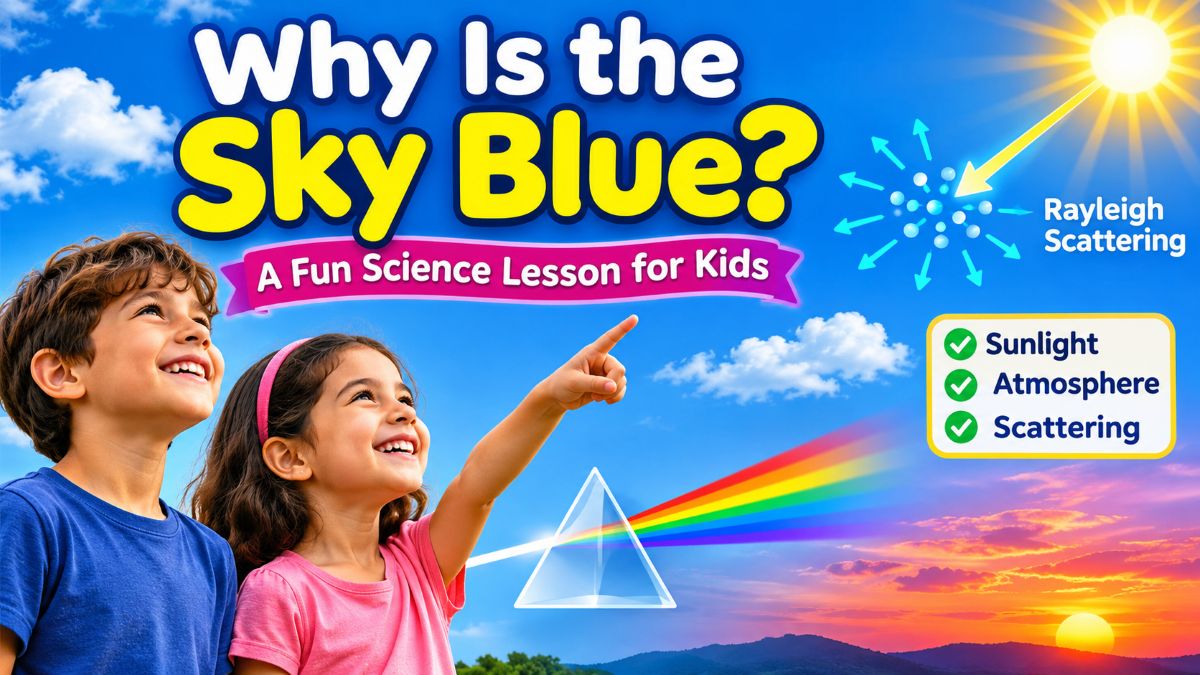
Have you ever looked up at the sky and wondered, ‘Why is the sky blue? Why doesn’t it look green, purple or pink during the day? And why does it turn beautiful shades of orange, red and pink at sunrise and sunset?
The answer to why the sky is blue lies in sunlight, tiny air molecules and an amazing scientific process called Rayleigh scattering.
In this fun science lesson for kids, we’ll explore the colours of sunlight, discover how a prism separates white light into a rainbow, understand why the sky looks blue and learn why sunsets are so colourful. Let’s begin our journey into the fascinating science of light!
What Is Sunlight Made Of?
When you look at the Sun during the day, its light appears white or slightly yellow. However, sunlight is actually made up of all the colours of the visible spectrum.
The seven familiar colours of the rainbow are:
- Violet
- Indigo
- Blue
- Green
- Yellow
- Orange
- Red
Each colour has a different wavelength. A wavelength is the distance between two corresponding points on a wave, such as one peak and the next.
Red light has a longer wavelength, while blue and violet light have shorter wavelengths.
These different wavelengths play an important role in explaining why the sky appears blue.
How Does a Prism Reveal the Colours of Sunlight?
Have you ever seen a rainbow appear when sunlight passes through a glass object? A prism can produce a similar effect.
A prism is a transparent object, often made of glass, with flat surfaces that bend light.
When white sunlight passes through a prism, it refracts, or bends. Different colours bend by slightly different amounts, separating the white light into a colourful band called a spectrum.
This simple demonstration shows that white sunlight contains many colours.
Try this: With an adult’s help, shine a beam of sunlight through a glass prism onto a white sheet of paper. You may see a beautiful rainbow of colours.
Never look directly at the Sun or point sunlight into anyone’s eyes.
Understanding the colours of sunlight is the first step towards discovering why is the sky blue and how Earth’s atmosphere changes the appearance of light.
Understanding Light Waves
Light travels as waves of electromagnetic energy. Different colours of visible light have different wavelengths.
Think about waves on the surface of water. Some waves have peaks that are close together, while others have peaks farther apart.
Light waves behave differently, too.
- Blue light: Has a relatively short wavelength.
- Violet light: Has an even shorter wavelength than blue.
- Red light: Has a much longer wavelength.
These differences help determine how light behaves when it enters Earth’s atmosphere.
Why Is the Sky Blue?
Now let’s discover the main question: why does the sky look blue on a clear day?
Earth is surrounded by an atmosphere containing gases such as nitrogen and oxygen. When sunlight enters the atmosphere, it interacts with these tiny gas molecules.
The molecules scatter sunlight in different directions. However, they do not scatter every colour equally.
Shorter wavelengths, particularly blue and violet light, are scattered much more strongly than longer wavelengths such as red light.
This process is called Rayleigh scattering.
As blue light spreads in different directions throughout the atmosphere, some of it reaches our eyes wherever we look. This makes the sky appear blue.
This explains why is the sky blue during the day: tiny molecules scatter blue light throughout the atmosphere, allowing it to reach our eyes from different directions.
Why Don’t We See a Violet Sky?
You might be wondering something interesting: violet light has an even shorter wavelength than blue light. If shorter wavelengths scatter more, why isn’t the sky violet?
There are two important reasons:
- Our eyes are more sensitive to blue light than violet light.
- The sunlight reaching our atmosphere contains less violet light than blue light.
The combination of these factors makes the sky appear predominantly blue rather than violet.
The same science that explains why the sky is blue also helps us understand why the sky changes colour when the Sun approaches the horizon.
Why Does the Sky Look Red and Orange at Sunrise and Sunset?
Have you noticed how beautiful the sky looks during sunrise and sunset? It may turn shades of red, orange, pink and yellow.
This happens because sunlight travels through a much longer path in Earth’s atmosphere when the Sun is close to the horizon.
During this longer journey, much of the shorter-wavelength blue and violet light is scattered away from the direct path between the Sun and our eyes.
More of the longer-wavelength red and orange light continues towards us. This is why we often see beautiful warm colours during sunrise and sunset.
Dust, smoke and other tiny particles in the atmosphere can also influence the colours we see.
The next time you watch a sunset, remember that the same scattering process responsible for the blue daytime sky also helps create those colourful evening views.
Why Does the Sky Look Pale Near the Horizon?
Look at the sky directly above you and then towards the horizon. You may notice that the sky overhead looks deeper blue, while the sky near the horizon often appears pale blue or whitish.
Why does this happen?
Light reaching your eyes from near the horizon travels through more atmosphere. The blue light is scattered repeatedly, and other scattered light can mix into what you see.
Dust, moisture and other particles can also affect the appearance of the sky.
That is why the colour of the sky can change depending on the direction you look and the condition of the atmosphere.
Why Are Clouds White If the Sky Is Blue?
Clouds are made up of tiny water droplets and sometimes ice crystals.
These droplets scatter sunlight differently from the much smaller gas molecules responsible for Rayleigh scattering.
Cloud droplets scatter the different colours of visible light more equally. When these colours reach our eyes together, they appear white.
Thick clouds can look grey or dark because less sunlight passes through them and reaches their lower surfaces.
So, the blue sky and white clouds are both results of sunlight interacting with the atmosphere, but the scattering processes are different.
Simple Science Experiment: See Light Scattering at Home
Would you like to see how tiny particles can scatter light? Here is a simple activity you can try with an adult.
What You Need
- A clear glass jar or transparent container
- Water
- A small amount of milk
- A flashlight
- A darkened room
How to Do the Experiment
- Fill the transparent jar with clean water.
- Add a small amount of milk and mix it gently.
- Turn off the room lights or make the room darker.
- Shine a flashlight through the side of the jar.
- Look at the light from different directions.
You may notice that the light becomes visible inside the water because tiny milk particles scatter it.
This is a simple model of light scattering. The milk particles are much larger than the gas molecules responsible for Rayleigh scattering in Earth’s atmosphere, so the experiment does not reproduce the same process. However, it helps demonstrate how particles can scatter light.
Safety: Use a flashlight rather than looking directly at the Sun.
Why Is the Sky Blue? Animated Science Video for Kids
Watch this educational video to understand how sunlight interacts with Earth’s atmosphere and why blue light is scattered in different directions.
You can also explore the explanation from National Geographic Kids for additional learning.
Summary: What Have We Learned?
Let’s quickly review the science behind the blue sky.
- Sunlight appears white but contains all the colours of the visible spectrum.
- Different colours of light have different wavelengths.
- Blue and violet light have shorter wavelengths than red light.
- Tiny molecules in Earth’s atmosphere scatter shorter wavelengths more strongly.
- This scattering process is called Rayleigh scattering.
- We see the sky as blue because scattered blue light reaches our eyes from different directions.
- At sunrise and sunset, sunlight travels through more atmosphere, allowing more red and orange light to reach our eyes directly.
- Clouds look white because their water droplets scatter different colours more equally.
Conclusion
Understanding why the sky is blue is a fascinating way to discover how sunlight and Earth’s atmosphere work together to create the colours we see.
Sunlight contains many colours, but when it enters Earth’s atmosphere, tiny gas molecules scatter blue light more strongly than most other visible colours. This process, called Rayleigh scattering, makes the sky appear blue.
The same process also helps explain the beautiful red and orange colours we see during sunrise and sunset.
The next time you look up at the sky, remember the amazing journey of sunlight through Earth’s atmosphere. Keep observing, asking questions and exploring science. Wonderful discoveries are waiting everywhere!
Frequently Asked Questions About Why Is the Sky Blue
1. Why is the sky blue in simple words?
The sky looks blue because tiny gas molecules in Earth’s atmosphere scatter blue sunlight in different directions. Some of this scattered blue light reaches our eyes from all around the sky.
2. What is Rayleigh scattering?
Rayleigh scattering is the process in which tiny particles, such as gas molecules in Earth’s atmosphere, scatter shorter wavelengths of light more strongly than longer wavelengths.
3. Why isn’t the sky violet?
Although violet light scatters even more strongly than blue light, our eyes are less sensitive to violet, and sunlight contains less violet than blue. As a result, we mainly see a blue sky.
4. Why does the sky turn red during sunset?
During sunset, sunlight travels through a longer path in Earth’s atmosphere. Much of the blue and violet light is scattered away from the direct path, allowing more red and orange light to reach our eyes.
5. Why are clouds white when the sky is blue?
Clouds contain tiny water droplets that scatter the different colours of sunlight more equally. When these colours mix, the clouds appear white. Thick clouds may appear grey because less sunlight reaches their lower surfaces.
Recommended Further Reading
- Solar Energy For Kids: Fun Facts About How the Sun Powers Our World!
- Nuclear Energy For Kids – How It Works And Why It’s Important
- Types Of Sound For Kids: Exploring Audible, Infrasonic, And Ultrasonic Sounds
- Life Cycle Of Fish For Kids | Stages From Egg To Fish
References
- NASA Space Place – Why Is the Sky Blue?
- National Weather Service – Why Is the Sky Blue?
- NOAA – The Color of Clouds
- National Geographic Kids – The Sky

Mathukutty P. V. is the founder of Simply Life Tips. He shares practical advice and useful insights on personal growth, health, well-being, technology, and everyday living. His goal is to help readers build positive habits and make informed decisions. He believes in continuous learning and sharing knowledge to help people live healthier, happier, and more meaningful lives.