
Job interview questions can determine whether you move closer to your dream job or miss a valuable career opportunity. Even qualified candidates sometimes struggle because they are unprepared, give unclear answers, or fail to explain how their skills match the position.
Preparing for common job interview questions helps you communicate your experience, strengths, career goals and professional values more effectively. You do not need to memorise every answer. Instead, understand what the interviewer wants to know and prepare relevant examples from your own experience.
Whether you are a fresher attending your first interview or an experienced professional looking for a better opportunity, this guide will help you prepare for 35 frequently asked job interview questions and answer them confidently.
Understanding what employers expect from common job interview questions can help you prepare relevant and convincing answers.
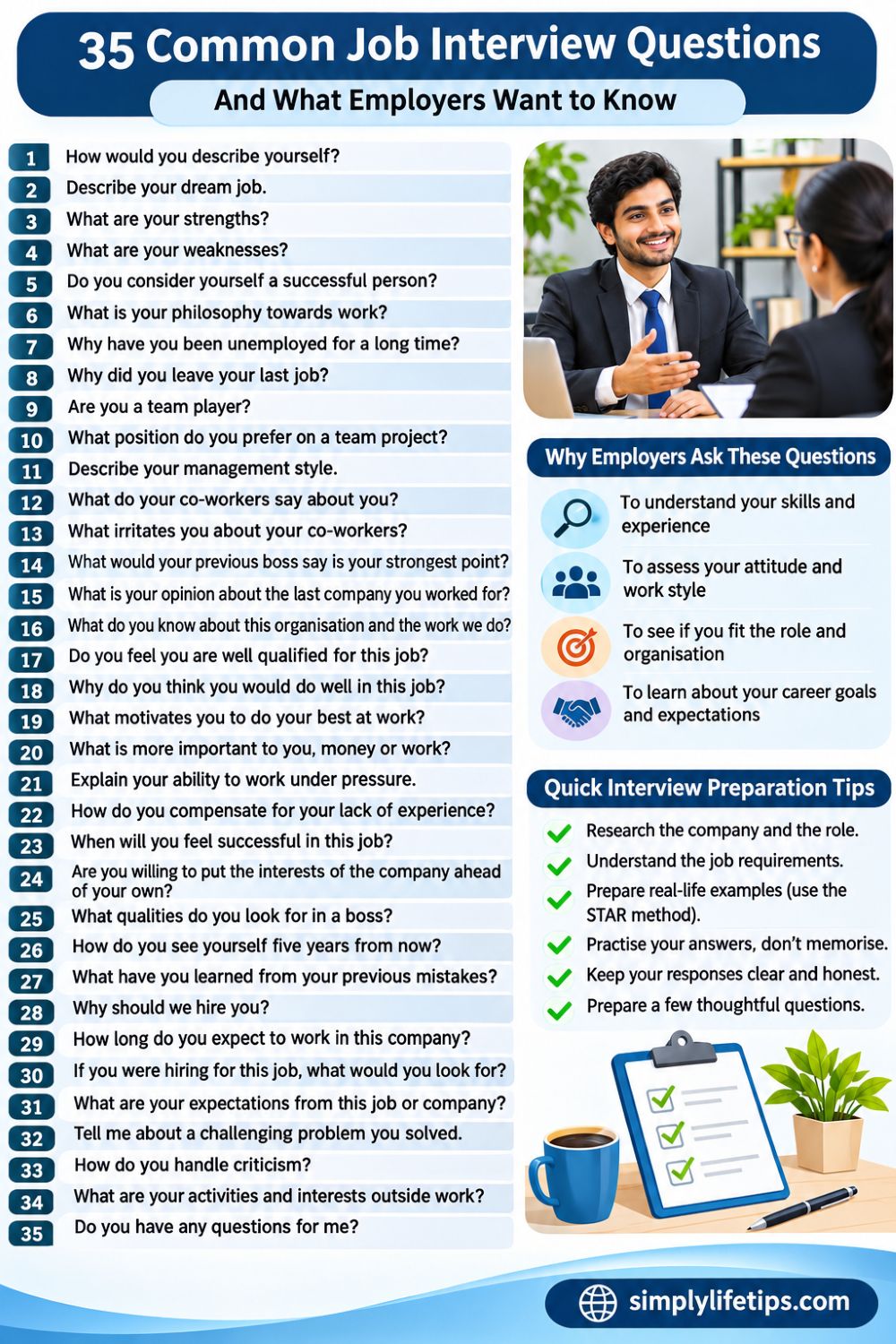
How to Prepare for Job Interview Questions
Good preparation begins before you enter the interview room. Interviewers want to understand not only your qualifications but also your communication skills, attitude, problem-solving ability and suitability for the position.
Use these practical steps to prepare.
1. Understand the job description
Read the job advertisement carefully. Identify the qualifications, technical skills, experience and responsibilities required for the position.
Think about how your education, previous work and personal strengths match those requirements. Prepare examples that demonstrate your suitability.
For additional career guidance and employment-related resources in India, visit the National Career Service (NCS) portal.
2. Research the company
Visit the company’s official website and learn about its products, services, history, values and recent developments.
You should be able to explain what the organisation does and why you are interested in working there. Avoid asking basic questions such as, “What is this company all about?” when the information is readily available online.
Instead, ask meaningful questions about the position, team responsibilities and expectations.
3. Prepare examples from your experience
Interviewers often ask questions that require examples of how you handled workplace situations.
Prepare examples involving teamwork, leadership, problem-solving, communication, challenges and achievements.
The STAR method can help you organise these answers:
- Situation: Describe the background.
- Task: Explain your responsibility.
- Action: Describe what you did.
- Result: Explain the outcome or lesson learned.
4. Practise without memorising
Practising answers helps you organise your thoughts and reduce nervousness. However, memorising complete sentences can make your responses sound unnatural.
Understand the main points you want to communicate and express them in your own words.
You can also explore Indeed’s interview advice and preparation resources for additional guidance on handling interviews professionally.
5. Prepare thoughtful questions
An interview is also an opportunity for you to understand the employer and the position.
Prepare questions about responsibilities, team structure, training, performance expectations and working arrangements. You can also ask about salary, leave and benefits at an appropriate stage.
35 Common Job Interview Questions and Best Answers
The following job interview questions cover personal background, strengths, weaknesses, work experience, teamwork, career goals and workplace expectations. Use the sample answers as guidance and adapt them to your actual qualifications and experience.
1. How would you describe yourself?
This question allows the interviewer to understand your professional background and personality.
Focus on qualities relevant to the position instead of explaining every detail of your personal life.
Sample answer:
“I am a responsible and organised professional who enjoys learning new skills and solving problems. I work well independently and as part of a team. I also value communication, reliability and continuous improvement.”
If you are a fresher, mention your education, relevant skills, projects, internships or other practical experience.
2. Describe your dream job.
The interviewer wants to understand your career interests and what motivates you professionally.
Avoid describing a job only in terms of salary, designation or status. Explain the type of work environment and responsibilities in which you can contribute and grow.
Sample answer:
“My ideal job would allow me to use my skills, take responsibility, learn continuously and contribute to meaningful projects. I would also value a supportive work environment where teamwork and professional development are encouraged.”
3. What are your strengths?
Choose two or three strengths that are relevant to the position. Support each strength with a practical example.
Avoid listing every positive quality you can think of. A few well-explained strengths are more convincing than a long list without evidence.
Sample answer:
“My main strengths are problem-solving, communication and adaptability. In my previous role, I helped resolve customer complaints by listening carefully, understanding the issue and coordinating with the relevant team. This helped improve customer satisfaction.”
Freshers can use examples from academic projects, volunteering, internships or extracurricular activities.
4. What are your weaknesses?
The interviewer wants to understand your self-awareness and willingness to improve.
Do not claim that you have no weaknesses or disguise every weakness as a strength. Choose a genuine but manageable area for improvement and explain what you are doing about it.
Sample answer:
“I sometimes spend too much time checking my work because I want to avoid mistakes. I am improving by setting clear time limits and prioritising the most important checks while maintaining accuracy.”
Choose a weakness that does not undermine an essential requirement of the position.
5. Do you consider yourself a successful person?
This question explores how you define success and whether you recognise your achievements.
You do not need to claim that you have achieved everything you want. Explain what success means to you and provide a relevant example.
Sample answer:
“Yes, I consider myself successful in the sense that I have achieved important goals and continue to improve. One achievement I value was completing a challenging project within the deadline while working with a team. It taught me the importance of planning and cooperation.”
6. What is your philosophy towards work?
The interviewer wants to understand your professional values and approach to responsibilities.
Discuss qualities such as honesty, accountability, teamwork, discipline and continuous learning.
Sample answer:
“I believe in taking responsibility for my work, maintaining professional standards and treating colleagues respectfully. I also believe that good communication and teamwork are essential for achieving organisational goals.”
7. Why have you been unemployed for such a long time?
Employment gaps can occur for many reasons, including further studies, family responsibilities, health-related circumstances, job-market conditions or career changes.
Be honest and avoid becoming defensive. Explain the reason briefly and mention any constructive activities you undertook during that period.
Sample answer:
“During that period, I focused on improving my skills and preparing for suitable opportunities. I completed an online course in data analysis and worked on practical exercises to strengthen my knowledge. I am now ready to apply those skills in a professional role.”
Do not invent unpaid work experience or claim to have completed courses you never attended.
8. Why did you leave your last job?
The interviewer wants to understand your reasons for changing jobs and whether you are likely to fit into the new organisation.
Avoid insulting your previous employer, manager or colleagues, even if you had a difficult experience. Explain your reasons professionally.
Sample answer:
“I appreciate the experience and opportunities I received in my previous organisation. I am now looking for a role that offers opportunities to develop additional skills, take on greater responsibilities and contribute to more challenging projects.”
If your departure involved restructuring, relocation or another specific reason, explain it honestly and briefly.
9. Are you a team player?
Most organisations value employees who can cooperate, communicate and contribute to shared goals.
Do not simply say yes. Explain how you have worked with others to achieve a result.
Sample answer:
“Yes. I enjoy working with others and believe that different perspectives can improve the quality of a project. In my previous role, I worked with colleagues from different departments to complete a project within the deadline. We shared responsibilities and communicated regularly to resolve problems.”
10. What position do you prefer on a team working on a project?
The interviewer wants to know whether you can adapt to different responsibilities.
You do not need to claim that you always prefer to lead or always prefer to follow. Explain that your role depends on the needs of the project and your experience.
Sample answer:
“I am comfortable taking responsibility when my skills are needed, and I am equally comfortable supporting a colleague who is leading the project. My priority is to help the team achieve its objectives.”
11. Describe your management style.
This question is particularly relevant to candidates applying for supervisory or management positions.
Explain how you organise work, communicate expectations, support employees and handle challenges.
Sample answer:
“My management style is based on clear communication, accountability and teamwork. I believe in setting realistic goals, giving employees the support they need and encouraging them to take responsibility. I also value feedback because it helps the entire team improve.”
If you have no formal management experience, describe how you have coordinated a group project or supported colleagues.
12. What do your co-workers say about you?
The interviewer wants to understand how other people experience working with you.
Mention two or three qualities that colleagues have genuinely recognised. Support them with an example if possible.
Sample answer:
“My colleagues generally describe me as dependable, cooperative and approachable. They know they can rely on me to complete assigned tasks and help when the team faces a challenge.”
Avoid exaggerating or making claims that you cannot support.
13. What irritates you about your co-workers?
This question examines your ability to manage workplace relationships and disagreements.
Avoid saying that nothing ever bothers you. Instead, explain how you respond constructively when differences arise.
Sample answer:
“I understand that people have different working styles. I find it challenging when communication is unclear, or deadlines are not respected, but I prefer to address such issues through a calm discussion and practical solutions rather than personal criticism.”
14. What would your previous boss say your strongest point is?
Choose a quality that a previous manager could reasonably recognise, such as reliability, initiative, problem-solving or attention to detail.
Sample answer:
“My previous manager would probably describe me as dependable and proactive. I made an effort to complete tasks on time, communicate progress and identify possible problems before they affected the project.”
If you have a performance review or specific feedback that supports your answer, you can refer to it.
15. What is your opinion about the last company you worked for?
The interviewer wants to understand how you view your previous workplace and whether you can discuss professional experiences respectfully.
Avoid bad-mouthing your previous employer or revealing confidential business information.
Sample answer:
“My previous organisation gave me valuable opportunities to improve my skills and understand professional responsibilities. I learned a great deal from my colleagues and the projects I handled. I am grateful for that experience, and I am now looking forward to taking the next step in my career.”
You can be honest about genuine challenges without making personal attacks.
16. What do you know about this organisation and the type of work we do?
This is one of the job interview questions that clearly tests your preparation.
Before attending the interview, research the organisation’s official website, products, services, values, business activities and recent announcements.
Sample answer:
“From my research, I understand that your organisation provides products and services in its industry and focuses on delivering value to its customers. I was particularly interested in your work and the responsibilities of this position. This role appeals to me because my skills and experience match several of its requirements.”
Adapt the answer to the actual organisation. Never use a generic response that could apply to any company.
17. Do you feel you are well qualified for this job?
The interviewer wants to know whether you understand the requirements and can explain how your qualifications match them.
Show confidence without exaggerating your abilities.
Sample answer:
“Based on the job description, I believe my qualifications and experience match the main requirements. I have practical experience in the relevant areas and am willing to learn any additional skills needed to perform the role effectively.”
If you do not meet every requirement, explain your transferable skills and willingness to develop.
18. Why do you think you would do well in this job?
This question is similar to asking why the employer should hire you. Focus on the connection between your abilities and the actual responsibilities.
Sample answer:
“I believe I would do well because I have the relevant technical knowledge, problem-solving ability and communication skills required for this position. I am also comfortable learning new processes and working with a team. I would use these strengths to contribute to the organisation’s goals.”
Whenever possible, include a brief example of a previous achievement.
19. What motivates you to do your best at work?
The interviewer wants to understand what encourages you to perform well.
It is perfectly reasonable to value salary and benefits. However, you can also discuss professional growth, meaningful responsibilities, achievement and teamwork.
Sample answer:
“I am motivated by the opportunity to solve problems, develop my skills and see the results of my work. I also value a respectful work environment where people cooperate and work towards shared goals. Fair compensation is important to me as well.”
An honest and balanced answer is better than pretending that money has no importance.
20. What is more important to you, money or work?
This question explores your professional priorities.
You do not need to suggest that salary is unimportant. Explain that compensation and meaningful work are both relevant to a sustainable career.
Sample answer:
“Both are important. Fair compensation reflects the responsibilities and value of the role, while meaningful work gives me opportunities to use my abilities and develop professionally. I look for a position that offers a reasonable balance between the two.”
21. Explain your ability to work under pressure.
The interviewer wants to understand how you respond to deadlines, competing responsibilities and unexpected problems.
Give an example that demonstrates planning, prioritisation and communication.
Sample answer:
“I try to remain organised when working under pressure. In my previous role, we had to complete an urgent project within a short deadline. I divided the work into priorities, coordinated with colleagues and provided regular updates. We completed the important tasks on time without compromising essential quality checks.”
Avoid claiming that pressure never affects you. Explain how you manage it.
22. How do you compensate for your lack of experience?
This question is common for freshers and candidates changing careers.
Focus on transferable skills, education, practical projects, internships, volunteering and your willingness to learn.
Sample answer:
“Although I do not have extensive professional experience, I have developed relevant skills through my academic projects and practical training. I am comfortable learning new tools, accepting feedback and taking responsibility. I believe my enthusiasm and willingness to improve will help me contribute to the team.”
Do not apologise repeatedly for being inexperienced. Show how you are preparing for the role.
23. When will you feel successful in this job?
The interviewer wants to know how you measure performance and professional achievement.
Explain that success involves meeting expectations, learning and contributing to the organisation.
Sample answer:
“I would feel successful when I consistently meet the responsibilities and performance expectations of the position, contribute to the team’s objectives and continue improving my skills. I would also value receiving constructive feedback and taking on additional responsibilities as I develop.”
24. Are you willing to put the interests of the company ahead of your own?
This question explores your understanding of professional responsibility and organisational priorities.
Avoid promising unconditional loyalty or suggesting that you would ignore your personal well-being. Explain that you understand the importance of balancing individual responsibilities with team and organisational goals.
Sample answer:
“I understand that employees need to work towards the organisation’s objectives and meet their responsibilities. I am committed to contributing to the team’s success while maintaining professional standards, effective communication and a healthy balance in my responsibilities.”
25. What qualities do you look for in a boss?
The interviewer wants to understand the kind of leadership environment in which you work effectively.
Mention qualities such as fairness, clear communication, competence, respect and constructive feedback.
Sample answer:
“I value a manager who communicates clearly, treats employees fairly and provides guidance when needed. I also appreciate leaders who encourage accountability, teamwork and professional development.”
Avoid describing an unrealistic or overly specific list of expectations.
26. How do you see yourself five years from now?
This question explores your career ambitions and whether your goals are compatible with the position.
You do not need to promise that you will remain in the same company for a fixed period. Explain how you hope to develop professionally.
Sample answer:
“In five years, I hope to have developed stronger professional skills, gained valuable experience and taken on greater responsibilities. I would like to become someone who can contribute to important projects and support the success of the team.”
You can discuss leadership ambitions or specialisation if they are relevant to your career path.
27. What have you learned from your previous mistakes?
The interviewer wants to understand your ability to accept responsibility and learn from experience.
Choose a genuine example that is not unnecessarily damaging to your suitability for the position.
Sample answer:
“Earlier in my career, I underestimated the time needed to complete a project. I learned that planning should include time for unexpected problems and review. Since then, I have started setting realistic milestones and communicating possible delays earlier.”
Do not blame colleagues or hide your responsibility.
28. Why should we hire you?
This is an opportunity to summarise your suitability for the position.
Connect your qualifications, skills, experience and attitude to the employer’s requirements.
Sample answer:
“You should consider me for this position because my skills and experience match the main requirements. I am responsible, willing to learn and comfortable working with others. I can contribute through my existing abilities while continuing to develop and take on new responsibilities.”
Avoid claiming that you are better than every other candidate.
29. If hired, how long would you expect to work in this company?
The interviewer wants to understand your interest in the role and your expectations about career development.
Do not make promises you cannot guarantee or give an arbitrary number of years.
Sample answer:
“I am looking for a meaningful opportunity where I can contribute, develop my skills and take on increasing responsibilities. If the role continues to provide opportunities for professional growth and mutual value, I would be interested in building a long-term career here.”
Be honest about any plans that may affect your availability when they are relevant.
30. If you were hiring a person for this job, what would you look for?
This question tests whether you understand the requirements of the position.
Refer to the job description and identify the qualities that would help someone succeed.
Sample answer:
“I would look for someone with the necessary technical skills, a responsible attitude and good communication abilities. I would also value adaptability, problem-solving and the ability to work effectively with colleagues. These qualities help an employee contribute to both individual and team goals.”
31. What are your expectations from this job or company?
The interviewer wants to understand what you hope to gain and whether your expectations are realistic.
Discuss responsibilities, learning opportunities, communication, professional development and a supportive working environment.
Sample answer:
“I expect to have clear responsibilities, opportunities to use my skills and access to the guidance needed to perform well. I also hope to work in an environment that values teamwork, constructive feedback and professional development. In return, I will contribute responsibly and work towards the organisation’s objectives.”
32. Tell me about a challenging problem you solved.
This question is more useful than repeating the earlier question about why you would do well in the job. It allows the interviewer to assess your problem-solving process.
Use the STAR method to explain the situation, your responsibility, the action you took and the result.
Sample answer:
“In my previous role, a customer-facing process was causing repeated delays. I was responsible for identifying the issue and suggesting improvements. I reviewed the process, discussed the difficulties with colleagues and recommended a clearer task allocation system. This helped reduce confusion and improve coordination.”
Choose an example that reflects the skills required for the new position.
33. How do you handle criticism?
The interviewer wants to know whether you can accept feedback and use it to improve.
Show that you listen carefully, consider the feedback and take appropriate action.
Sample answer:
“I try to treat constructive criticism as an opportunity to improve. I listen carefully, ask questions if something is unclear and consider how I can apply the feedback. In my previous role, a manager suggested that I improve my progress updates. I started communicating more regularly, which helped the team coordinate its work more effectively.”
You do not have to agree with every criticism, but you should respond professionally.
34. What are your activities and interests outside work?
This question helps the interviewer understand your interests and personality.
Mention genuine hobbies and activities. You can explain how they help you develop useful qualities, but do not force a connection with the job.
Sample answer:
“I enjoy reading, walking and learning new skills through online courses. These activities help me stay curious, maintain a healthy routine and continue developing my knowledge.”
Keep your answer natural and reasonably brief.
35. Do you have any questions for me?
This is an important opportunity to demonstrate interest in the position and understand the organisation better.
Avoid replying that you have no questions. Prepare a few relevant questions in advance.
You could ask:
- What are the main priorities for someone joining this position?
- How will performance be evaluated during the first few months?
- What does a typical working day look like?
- What training or professional development opportunities are available?
- How is the team structured?
- What are the next steps in the recruitment process?
You can also ask about salary, working hours, leave policies and other benefits when the interviewer invites questions or when employment conditions are being discussed.
It is not wrong to ask about compensation or holidays. These are legitimate considerations when deciding whether to accept a job. The important thing is to discuss them professionally and at an appropriate stage.
Additional Job Interview Tips for Freshers
Attending your first interview can feel challenging, especially when you have limited professional experience. However, you can demonstrate your potential through preparation, communication and a willingness to learn.
Some job interview questions are particularly challenging for candidates attending their first interview.
Consider these practical suggestions:
- Identify your skills: Make a list of your technical, communication, problem-solving and organisational skills.
- Research suitable companies: Look for organisations whose job requirements match your qualifications and interests.
- Understand the role: Read the job description and identify the skills you need to demonstrate.
- Prepare academic examples: Use college projects, internships, presentations and volunteering activities to demonstrate your abilities.
- Develop relevant skills: Improve your knowledge through practical courses, workshops and projects.
- Prepare your resume: Make sure your education, skills, projects and experience are accurate and easy to understand.
- Practise common questions: Rehearse your answers without memorising them word for word.
- Prepare thoughtful questions: Show that you are interested in understanding the role and organisation.
- Discuss salary professionally: Research the role and local market before discussing compensation. You do not have to reject fair salary discussions simply because it is your first job.
- Learn from every interview: If you are unsuccessful, review your performance and identify areas for improvement.
Your first job does not have to define your entire career. Look for opportunities that offer relevant experience, fair working conditions and room to develop.
Common Interview Mistakes to Avoid
Even a well-qualified candidate can create an unfavourable impression through careless communication or inadequate preparation.
Avoid these common mistakes:
- Asking what the company does without researching it first.
- Speaking disrespectfully about a previous employer, manager or colleagues.
- Responding to questions about your experience by saying, “That’s already on my resume.”
- Giving vague answers without relevant examples.
- Claiming to have skills or experience you do not possess.
- Saying that you have no weaknesses or have never made a mistake.
- Showing no interest in the responsibilities of the position.
- Asking only about holidays, salary and benefits before discussing the role.
- Suggesting that you intend to leave immediately after gaining experience.
- Failing to prepare questions for the interviewer.
Remember that ambition is positive. You should not hide your career goals. Instead, explain how you intend to develop your skills and contribute responsibly while pursuing those goals.
For more practical guidance, read our article on 15 job interview pitfalls to avoid.
How to Answer Job Interview Questions With Confidence
Confidence does not mean knowing every answer or pretending to be perfect. It means understanding your abilities, communicating honestly and responding thoughtfully.
Try these suggestions:
- Practise speaking clearly and at a comfortable pace.
- Maintain natural eye contact without staring.
- Listen carefully before answering.
- Ask for clarification if you do not understand a question.
- Use specific examples instead of vague claims.
- Admit when you do not know something, and explain how you would find the answer.
- Avoid exaggerating your qualifications or achievements.
- Take a brief moment to organise your thoughts before responding.
Arrive early enough to settle down and prepare yourself. Choose professional clothing appropriate for the organisation and keep your resume and other required documents ready.
You can also read our detailed guide on how to face an interview with confidence.
Conclusion
Preparing for job interview questions is an important step towards presenting yourself as a suitable candidate. The 35 questions in this guide cover many topics that employers may explore, from your personal background and strengths to your experience, career goals and professional values.
Remember that there is no need to memorise every sample answer. Understand the purpose of each question, prepare genuine examples and communicate in your own words.
Research the organisation, understand the job requirements, practise your responses and prepare thoughtful questions. Most importantly, be honest about your abilities and demonstrate your willingness to learn.
Every interview is an opportunity to understand yourself better, improve your communication and move closer to your career goals.
Frequently Asked Questions About Job Interview Questions
1. What are the most common job interview questions?
Common job interview questions include “Tell me about yourself,” “What are your strengths and weaknesses?”, “Why do you want this job?”, “Why should we hire you?” and “Where do you see yourself in five years?” Employers may also ask about your previous experience, teamwork and problem-solving abilities.
2. How should I answer job interview questions?
Listen carefully, understand what the interviewer wants to know and give a clear, relevant answer. Use real examples from your education or work experience. For questions about past situations, the STAR method can help you organise your response.
3. How can freshers prepare for job interview questions?
Freshers should research the company, understand the job description, prepare examples from academic projects and internships, practise common questions and improve their communication skills. They should also be ready to explain their willingness to learn and develop professionally.
4. What should I avoid saying during a job interview?
Avoid insulting previous employers, dismissing questions by saying “That’s already on my resume,” exaggerating your qualifications or giving answers that show a lack of preparation. You should also avoid making promises you cannot keep.
5. Is it acceptable to ask about salary and holidays during a job interview?
Yes. Salary, working hours, holidays and employee benefits are legitimate employment considerations. Ask about them professionally when the interviewer invites questions or when discussing the employment offer. You should understand the working conditions before accepting a position.

Mathukutty P. V. is the founder of Simply Life Tips. He shares practical advice and useful insights on personal growth, health, well-being, technology, and everyday living. His goal is to help readers build positive habits and make informed decisions. He believes in continuous learning and sharing knowledge to help people live healthier, happier, and more meaningful lives.