
Phone checking has become such a common part of everyday life that many people unlock their smartphones without even thinking about it. You pick up your phone, look at the screen, find no new notifications, put it down and reach for it again a few minutes later. Why does this happen even when there is nothing important to check?
You may not be expecting a phone call or an urgent message. You may already know that nobody has contacted you. Yet, the urge to look at your screen continues.
This behaviour is more than a simple habit of using technology. Psychological factors such as boredom, reward anticipation, fear of missing out (FOMO) and automatic behaviour can encourage repeated phone checking.
An article published in Hindustan Times also explores why people repeatedly check their phones even when nothing is happening
Understanding why we keep checking our phones is the first step towards developing a healthier relationship with technology. Let’s explore the reasons behind this behaviour and practical ways to reduce unnecessary phone checking.
Why Do We Keep Checking Our Phones Without Notifications?
Repeated phone checking does not always happen because someone sends a message or an alert. Sometimes, the urge comes from our own thoughts, emotions and learned behaviour.
A smartphone provides instant access to messages, social media, news, entertainment and countless other activities. Even when there is nothing new, the possibility of discovering something interesting can encourage us to check again.
For example, imagine waiting for a bus. You have already checked your messages, read the news and looked at social media. There is nothing new, but you unlock your phone again simply because you have a few unoccupied minutes.
This is one way an ordinary smartphone activity can gradually become an automatic behaviour.
Psychological Reasons Behind Repeated Phone Checking
1. Boredom and the Need for Stimulation
Boredom is one of the common reasons people reach for their smartphones repeatedly. When nothing is interesting to do, the phone offers an easy source of entertainment and stimulation.
Our minds naturally look for something engaging when we have nothing to occupy our attention. A smartphone makes this particularly easy because it provides access to different types of content within seconds.
For example, someone sitting alone in a waiting room may repeatedly unlock their phone even without receiving notifications. They might scroll through social media, open a news application or watch a short video simply to avoid feeling bored.
Over time, reaching for the phone can become the usual response to any unoccupied moment.
A 2025 study published in the Journal of Behavioural Addictions examined the relationship between boredom and the desire to use smartphones. Its findings suggested that people experiencing greater boredom reported stronger cravings for smartphone use, with FOMO influencing this relationship. PubMed
2. Anticipation of Rewards
Our brains are naturally attracted to experiences that may provide pleasure, excitement or useful information. Smartphones offer many opportunities for these experiences.
Every time we unlock a phone, we may discover an interesting message, an entertaining video, a new comment or an important update. However, we cannot always predict what we will find.
This uncertainty can encourage repeated checking.
For example, you may post a photograph on social media and receive a few likes. Even after checking the notifications, you might open the application again to see whether anyone else has reacted.
Similarly, someone expecting an important email may keep checking their inbox even though no new message has arrived.
The possibility of receiving something rewarding can be enough to encourage another check. Eventually, the behaviour may become automatic.
3. Fear of Missing Out (FOMO)
Fear of Missing Out, commonly known as FOMO, is the feeling that other people may be experiencing something interesting or important without us.
Social media makes it easy to see what friends, relatives, colleagues and acquaintances are doing. This constant availability of updates can create a feeling that we must remain connected.
For example, someone may repeatedly check WhatsApp because they are worried about missing an important family discussion. Another person may keep refreshing Instagram because they want to know what their friends are sharing.
Even without notifications, the thought that something important might be happening can create an urge to check.
FOMO can also make people uncomfortable when they are away from their phones for extended periods. They may feel that they are missing conversations, opportunities or social activities.
Research reviews have identified connections between FOMO, frequent online checking and problematic technology use.
4. Automatic Habit Formation
Repeated phone checking can gradually become an automatic habit.
Initially, you may unlock your phone for a specific reason, such as checking a message or making a call. However, after repeating this action many times, you may start doing it without consciously deciding to.
Certain situations can trigger the behaviour. Sitting on the sofa, waiting for someone, taking a short break or hearing another person’s phone notification may make you reach for your own device.
For example, you might be working on an important task when you suddenly feel like checking your phone. You unlock it, browse for a few seconds and return to work without remembering why you picked it up.
This is an example of habitual behaviour in which an action becomes less dependent on a deliberate decision.
Research published in Mobile Media & Communication discusses how mobile checking habits can develop through internal and external cues, including boredom, loneliness and notifications. Adrian Meier, 2022
5. Anxiety and the Need for Reassurance
For some people, repeated phone checking is connected with anxiety and uncertainty.
They may worry about missing an important message, receiving unexpected news or failing to respond to someone quickly. Checking the phone provides temporary reassurance.
For example, someone waiting for a job interview result may repeatedly check their email even when they know the organisation has not provided a specific response time.
Similarly, a parent waiting for a message from a child travelling home may check the phone frequently.
In these situations, phone checking may temporarily reduce worry. However, when the reassurance does not last, the person may repeat the behaviour.
It is important to recognise that occasional checking is normal. The concern arises when the behaviour becomes difficult to control or starts interfering with everyday activities.
Here is a quick visual summary of why we repeatedly check our phones, how this habit affects everyday life and what we can do to reduce unnecessary phone checking.
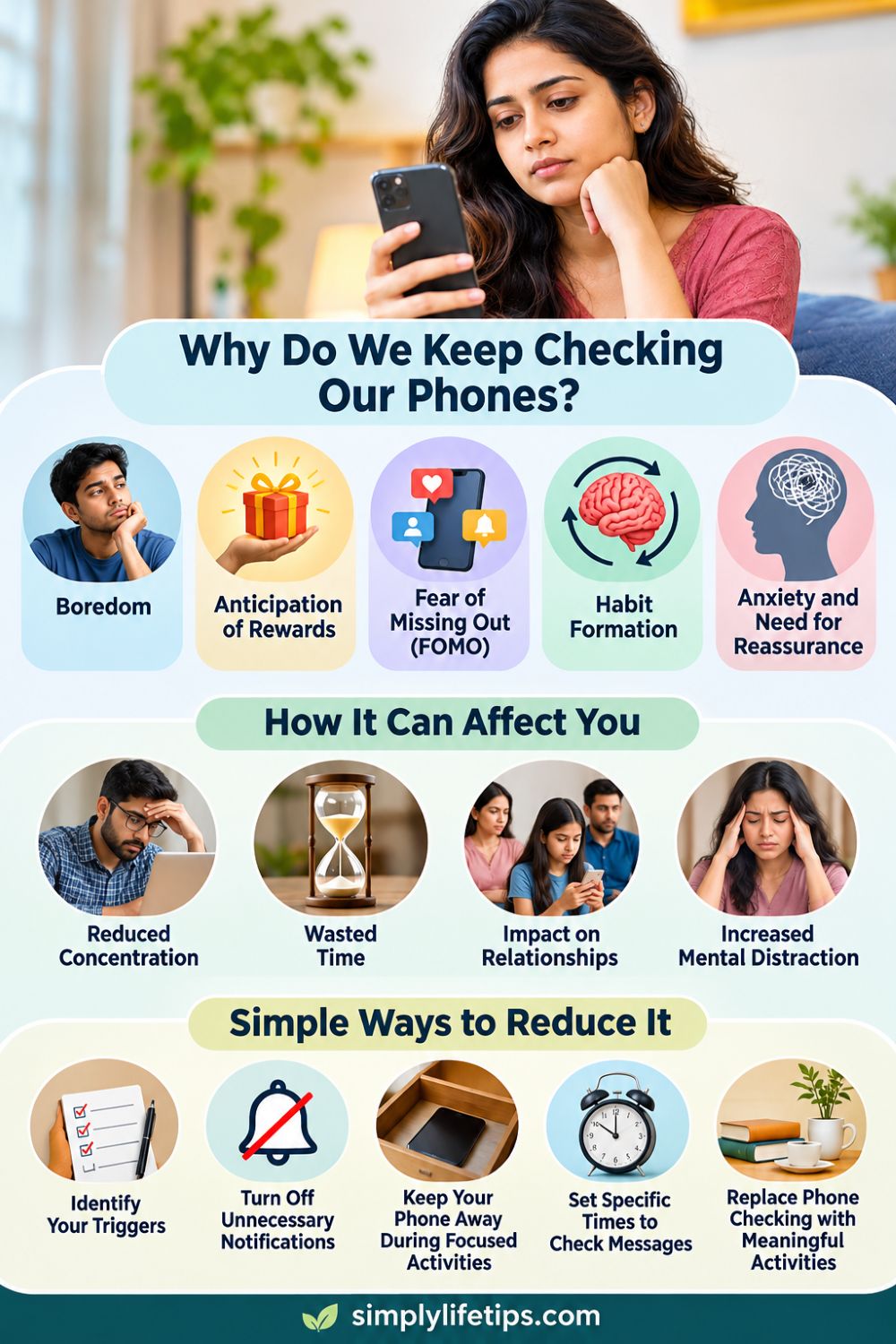
How Repeated Phone Checking Affects Everyday Life
Checking a smartphone occasionally is not necessarily harmful. Phones are useful tools for communication, education, work and entertainment. However, unnecessary checking throughout the day can interfere with our routines.
Reduced Concentration and Productivity
Frequent phone checking can interrupt concentration, particularly when someone is involved in work or study.
For example, a student preparing for an examination may stop studying every few minutes to check messages or social media. Even a short interruption can make it harder to regain focus.
Similarly, an employee writing an important report may repeatedly switch between the document and smartphone applications. These interruptions can delay the completion of tasks.
Wasted Time
A quick phone check can easily turn into several minutes of browsing.
Someone who intends to check one notification may start reading messages, watching videos and scrolling through social media. Before realising it, much more time has passed than intended.
When this happens repeatedly, small periods of wasted time can accumulate throughout the day.
Disturbed Personal Interactions
Repeated phone checking can also affect relationships.
Imagine having dinner with family members while repeatedly looking at your smartphone. Even if you are not responding to anyone, the behaviour may make others feel ignored.
Similarly, checking a phone during a conversation can give the impression that the person speaking does not have your full attention.
Being physically present does not always mean being mentally engaged.
Increased Mental Distraction
Constantly thinking about messages, updates and social media can make it difficult to remain focused on the present moment.
A person may sit down to relax but continue wondering whether something new has appeared on their phone.
This can reduce the quality of leisure time and make ordinary activities less enjoyable.
Frequent and uncontrolled smartphone use can also have wider consequences for our daily lives. Read more about the negative impact of mobile phone addiction.
How to Reduce Unnecessary Phone Checking
Breaking a repeated phone checking habit does not require abandoning smartphones. The goal is to use technology intentionally rather than allowing automatic behaviour to control our attention.
1. Identify What Triggers Your Phone Checking
The first step is to recognise when and why you reach for your phone.
Do you check it when you feel bored? Do you unlock it whenever you are alone? Do you repeatedly look at the screen while waiting for a message?
For example, if you notice that you check your phone whenever you sit down to relax, try identifying another activity that can replace this behaviour.
Understanding your triggers helps you make more conscious decisions.
2. Turn Off Unnecessary Notifications
Not every application needs permission to interrupt you.
Social media alerts, promotional messages, shopping updates and unnecessary application notifications can encourage frequent phone checking.
Review your notification settings and disable alerts that do not require immediate attention.
Keep essential notifications, such as important family calls, work-related messages and emergency alerts.
This reduces unnecessary interruptions and allows you to decide when to check less urgent updates.
3. Keep Your Phone Away During Important Activities
Keeping your smartphone within easy reach makes it tempting to check repeatedly.
During work, study, meals or family conversations, place your phone somewhere that is not immediately accessible.
For example, if you are reading a book, keep your phone in another room or inside a drawer. This simple change can reduce the temptation to unlock it without a reason.
4. Set Specific Times to Check Messages
Instead of checking your phone whenever you feel the urge, establish reasonable times to review messages and updates.
For example, you might check personal messages during a morning break, lunchtime and evening relaxation.
This does not mean ignoring urgent communication. You can keep important calls and emergency alerts available while reducing unnecessary browsing.
Having a routine can help you regain control over your smartphone use.
5. Replace Phone Checking with Meaningful Activities
Simply telling yourself not to check your phone may not be enough. It is often more effective to replace the behaviour with another activity.
When you feel bored, try reading a few pages of a book, going for a short walk, listening to music or talking to someone nearby.
For example, instead of scrolling through your phone while waiting for an appointment, observe your surroundings or read something useful.
These small alternatives help you become more comfortable with moments when you are not using technology.
6. Practise Spending Time Without Your Phone
Start with short periods during which you deliberately avoid checking your phone.
You could begin with 10 or 15 minutes while eating, reading or spending time with family.
Gradually increase these phone-free periods as you become more comfortable.
For example, enjoy your morning tea without checking messages or social media. Give your attention to the activity rather than automatically reaching for your smartphone.
The purpose is not to avoid technology completely but to develop greater control over when and why you use it.
7. Monitor Your Screen Time and Pickups
Most modern smartphones provide information about screen time and application usage. Some devices also display how frequently you unlock your phones or pick them up.
Reviewing this information can help you recognise patterns that you may not have noticed.
For example, you may discover that you spend more time on social media than expected or unlock your phone repeatedly during working hours.
Use this information to set realistic goals and gradually reduce unnecessary checking.
When Does Phone Checking Become a Problem?
Repeatedly checking a phone does not automatically mean someone has a smartphone addiction. Occasional checking is a normal part of modern life.
However, it deserves attention when the behaviour becomes difficult to control or begins affecting daily responsibilities and relationships.
For example, a person may repeatedly interrupt important work to check messages, feel restless when separated from their phone or continue checking even after deciding to stop.
If phone-related behaviour causes persistent distress, affects sleep or interferes with work, studies or relationships, seeking guidance from a qualified mental health professional may be helpful.
It is important to understand the difference between a common smartphone habit and a pattern of problematic use.
For further reading, explore our article on smartphone addiction and its problems and solutions.
Developing a Healthier Relationship with Your Smartphone
Smartphones have become an essential part of modern life. They help us communicate, learn, work, manage daily activities and stay informed.
The problem is not necessarily owning or using a smartphone. It is allowing unnecessary checking to occupy our attention throughout the day.
A healthier approach begins with awareness. Before unlocking your phone, pause for a moment and ask yourself why you are checking it. Is there something important to do, or are you simply responding to boredom or habit?
Small changes can make a meaningful difference. Turning off unnecessary notifications, keeping the phone away during focused activities and spending some time without digital distractions can help develop healthier habits.
You can also explore our guides on essential habits for safe smartphone use and reducing gadget addiction for a harmonious family life.
Conclusion
The habit of repeatedly checking our phones, even when there are no notifications, can be influenced by boredom, reward anticipation, FOMO, anxiety and automatic behaviour. Although occasional checking is normal, doing it unnecessarily throughout the day can affect concentration, productivity and personal relationships.
The solution is not to stop using smartphones altogether. Instead, we should become more aware of our habits and use technology with greater purpose.
Every time you feel the urge to unlock your phone, pause and ask yourself whether you really need to check it. That small moment of awareness can be the beginning of a healthier digital habit.
Do you find yourself checking your phone repeatedly even when there are no notifications? What do you do to control this habit? Share your thoughts in the comments.
Frequently Asked Questions (FAQs)
1. Why do I keep checking my phone when there are no notifications?
You may repeatedly check your phone because of boredom, curiosity, FOMO, anxiety or an automatic habit. The possibility of finding something interesting can encourage you to unlock your phone even when no new notifications are available.
2. Is repeatedly checking your phone a sign of addiction?
Not necessarily. Frequent phone checking can be a learned habit without indicating addiction. However, if you cannot control the behaviour and it interferes with your work, sleep or relationships, it may indicate problematic smartphone use.
3. How can I stop checking my phone unnecessarily?
Identify the situations that trigger the behaviour, turn off unnecessary notifications, keep your phone away during focused activities and establish specific times to check messages. Replacing unnecessary phone use with meaningful activities can also help.
4. Does boredom make people check their phones more often?
Yes. When people feel bored, they may reach for their smartphones to find entertainment or stimulation. Social media, videos and online content provide immediate distractions, which can gradually reinforce repeated checking.
5. What is the difference between phone checking and smartphone addiction?
Phone checking refers to looking at a smartphone to see messages, notifications or other updates. Smartphone addiction generally describes a more problematic pattern of use involving difficulty controlling phone use despite negative consequences. Repeated checking alone does not establish addiction.
References and Further Reading
The following sources provide additional information about the psychology of repeated phone checking, boredom and digital behaviour.

Mathukutty P. V. is the founder of Simply Life Tips. He shares practical advice and useful insights on personal growth, health, well-being, technology, and everyday living. His goal is to help readers build positive habits and make informed decisions. He believes in continuous learning and sharing knowledge to help people live healthier, happier, and more meaningful lives.