

The mobile phone effect on brain function is an increasingly important topic in our digital lives. Have you ever picked up your phone to check one message, only to find yourself scrolling through videos half an hour later? Or finished reading a paragraph and immediately forgotten what it said?
These everyday experiences raise an important question: Is our memory becoming weaker, or is our attention constantly being distracted by our smartphones?
A mobile phone helps us communicate, learn, work, and stay connected. However, frequent notifications, social media feeds, short videos, and constant task switching can compete for our attention. When we fail to concentrate fully on what we see or hear, we may find it harder to remember the information later.
Inspired by a brain-health Facebook Post of neurosurgeon Dr. Arun Oommen, this article explores seven important facts about the effects of mobile phone use on the brain, including attention, memory, multitasking, and sleep. It also explains what scientific evidence tells us and how simple changes in our daily habits can help us manage digital distractions.
How does mobile phone use affect the brain? Frequent notifications, social media, and constant task switching can interrupt our attention and make it harder to process information. This infographic highlights seven key facts about the mobile phone effect on brain function, including attention, memory, multitasking, sleep, and healthy smartphone habits.
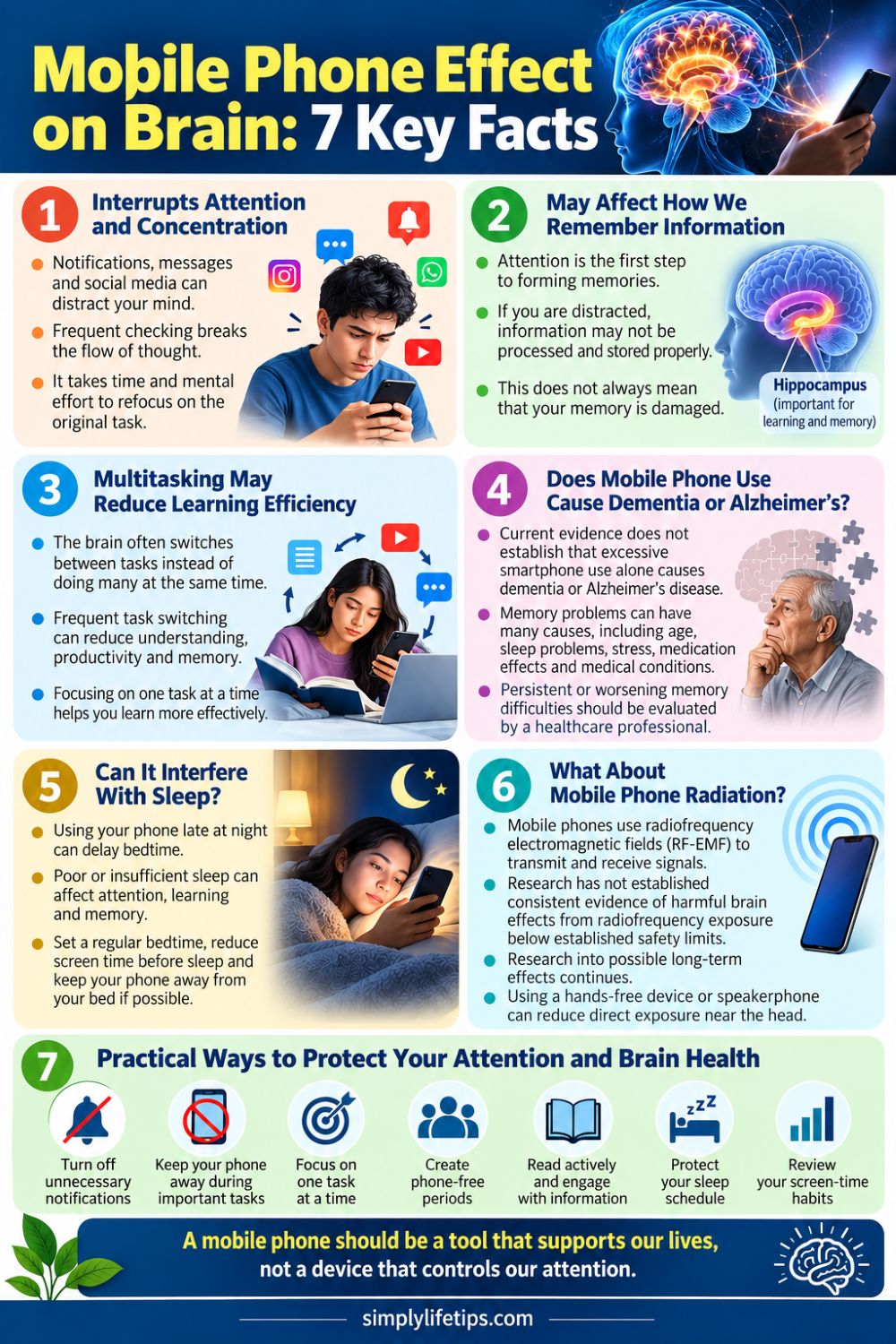
Although mobile phones offer many benefits, frequent digital distractions can affect our concentration and everyday activities. The good news is that simple habits, such as turning off unnecessary notifications, focusing on one task at a time, and protecting sleep, can help us use technology more mindfully. Remember, occasional forgetfulness does not automatically mean that your memory is failing.
How Does Mobile Phone Use Affect the Brain?
Our brains continuously process information from our surroundings. We listen to conversations, read messages, solve problems, recognise faces, and respond to events. Attention helps us select and process the information that matters at a particular moment.
Smartphones can interrupt this process by introducing competing demands for our attention. A notification, message, or interesting video can draw us away from an activity that requires concentration.
A review published in Frontiers in Psychology examined research on smartphone habits and cognitive functioning, including attention and memory. The authors noted that some immediate effects of smartphone-related distractions are supported by evidence, while conclusions about lasting changes in cognitive ability remain limited and uncertain.
Read the research review on smartphones and cognition.
Consider a simple example. You are reading an article when a WhatsApp notification appears. You stop reading, open the message, reply to a friend, and check another notification. When you return to the article, you may need to read the same paragraph again.
The phone has not necessarily damaged your memory. Instead, the interruption may have prevented you from processing the original information properly.
Understanding this difference helps us make better decisions about how we use technology.
1. Mobile Phones Can Interrupt Attention and Concentration
One of the most noticeable effects of frequent smartphone use is the interruption of ongoing activities.
Every time you respond to a notification or switch to another app, your attention moves away from what you were doing. Returning to the original task may require additional mental effort.
How digital distractions affect everyday activities
Imagine that you are preparing an important document on your computer. Your phone vibrates, so you check a message. While replying, you notice a social media notification. You open it, watch a video, and then return to your document.
You may have spent only a few minutes checking your phone, but you must now remember where you stopped and what you intended to write next.
The same thing happens when students study, adults read, or family members talk while checking their phones.
Repeated interruptions can make it harder to maintain a train of thought and complete tasks efficiently.
Why constant checking becomes a habit
Some people check their phones even when there is no notification. They reach for the device while waiting for a bus, standing in a queue, eating a meal, or sitting quietly.
Over time, checking the phone may become an automatic response to boredom or a brief pause in activity.
For example, a person who intends to spend five minutes waiting for a friend may open a social media app without consciously deciding to do so. One video leads to another, and the original purpose of checking the phone is forgotten.
The practical solution is not to avoid smartphones completely. It is to recognise unnecessary checking and create periods when your attention can remain on one activity.
2. Mobile Phone Use May Affect How We Remember Information
Memory does not begin when we try to recall something. It begins earlier, when we pay attention to information and process it.
The hippocampus, a brain structure important for forming many new memories, works with other brain regions involved in learning and remembering. If information is not adequately processed, it may be difficult to recall later.
Is forgetfulness always a memory problem?
Consider these three situations.
- You enter a room and forget why you went there.
- You read a page while repeatedly checking your phone and cannot recall its main points.
- Someone tells you an appointment time while you are replying to a message, and later you cannot remember the time.
These experiences can occur for different reasons. In the second and third examples, divided attention may have prevented the information from being processed effectively.
This does not mean that all forgetfulness is caused by smartphones. Stress, inadequate sleep, medication effects, health conditions, and other factors can also affect memory.
Many common beliefs about the brain are not supported by scientific evidence. Learn more in our article on 12 common brain myths debunked by science.
How to improve everyday recall
When reading something important, put your phone aside and concentrate on the material. After finishing a section, summarise its main point in your own words.
For example, after reading an article about healthy eating, ask yourself which two recommendations you learned. Explaining the information to another person can also help you engage with it more actively.
The key lesson is simple: to remember information well, give it your attention before trying to recall it.
3. Multitasking May Reduce Learning Efficiency
Many people believe that they can efficiently perform several activities at once. They might watch videos while studying, reply to messages while working, or scroll through social media during a conversation.
However, when two activities both require conscious attention, the brain often switches between them rather than processing both fully at the same time.
Psychologists refer to this as task switching.
What happens when you switch between tasks?
Suppose a student studies for an examination for one hour. During that time, the student reads a textbook, replies to messages, watches short videos, and checks social media.
Although the student spends an hour studying, the actual time devoted to uninterrupted learning may be much shorter.
Each interruption can break the flow of thought. The student may need to reread sentences, reconstruct an argument, or repeat a calculation.
The same problem can affect adults preparing reports, writing articles, or handling complex work.
If you want to improve concentration and stay focused on important tasks, explore these practical ways to tune out distractions and focus on studies.
Why single-tasking can help
When an activity requires concentration, complete a reasonable portion of it before moving to something else.
For example, read for 25 minutes without checking your phone, then take a short break. During the reading period, keep unrelated notifications out of sight.
This approach can help you organise your attention and reduce unnecessary interruptions. It does not guarantee perfect memory, but it creates better conditions for learning.
4. Can Excessive Mobile Phone Use Cause Dementia?
The relationship between smartphone use and brain health is often discussed in alarming terms. Some claims suggest that frequent mobile phone use inevitably damages memory or causes dementia.
Such claims go beyond what the evidence establishes.
Current research does not establish that excessive smartphone use alone causes Alzheimer’s disease or dementia. Dementia involves a decline in cognitive abilities that interferes with everyday functioning, and it has several possible causes. Alzheimer’s disease is one of the major causes of dementia.
Everyday distraction is not the same as a progressive neurological disorder.
When should memory problems be taken seriously?
Occasionally forgetting a name, misplacing an object, or losing track of a thought does not automatically indicate dementia.
However, repeatedly forgetting recent conversations, becoming lost in familiar places, struggling with previously familiar activities, or experiencing progressively worsening memory should not be dismissed as the result of phone use.
The National Institute on Aging explains that memory difficulties can have several causes, including sleep problems, medication effects, and medical conditions.
Learn about memory problems, forgetfulness, and ageing.
If memory problems persist, worsen, or interfere with daily life, consult a healthcare professional for an appropriate assessment. Sudden confusion or sudden difficulty speaking or understanding requires urgent medical attention.
5. Mobile Phone Use at Night Can Interfere With Sleep
Sleep is essential for attention, learning, memory, and overall health. Yet many people spend more time on their phones at night than they intended.
A quick message check can turn into an extended session of scrolling through videos, reading news, or chatting with friends.
The main concern is often that phone use delays bedtime or interrupts sleep, rather than the assumption that every instance of screen exposure directly harms the brain.
A common example of late-night scrolling
Suppose you plan to sleep at 10:30 p.m. Before bed, you decide to check a message. You then watch a video, read a few comments, and open another app.
When you finally put the phone down, it is midnight.
If you must wake up early the next morning, the lost sleep may leave you tired and less able to concentrate. You might forget details, struggle to follow conversations, or find ordinary tasks more difficult.
To separate common misconceptions from scientific evidence, read our guide to sleep myths and facts.
How to establish healthier phone habits at night
- Set a regular bedtime and a time to stop scrolling.
- Silence nonessential notifications while sleeping.
- Keep the phone away from your bed if it encourages repeated checking.
- Replace late-night scrolling with reading, relaxation, or another calming activity.
- Make sure you allow enough time for sleep.
These habits can support better sleep routines and help you feel more alert during the day.
6. Does Mobile Phone Radiation Affect the Brain?
The effects of mobile phone use on the brain should be discussed carefully because distraction and radiofrequency radiation are different issues.
Mobile phones use radiofrequency electromagnetic fields to transmit and receive signals. Researchers have investigated whether exposure to these fields could affect health, including whether mobile phone use is associated with brain tumours.
The World Health Organization explains that research has not established consistent adverse health effects from radiofrequency exposure below levels that cause tissue heating. However, scientific investigation of possible long-term effects has continued.
Read the WHO information on electromagnetic fields and mobile technology.
It is important to distinguish between what is known and what remains uncertain.
- Attention and distraction: Notifications and frequent task switching can interrupt ongoing activities.
- Memory and learning: Divided attention can make it harder to process and recall information.
- Radiofrequency exposure: This is a separate scientific question, and it would be misleading to claim that ordinary phone use has been proven to cause brain damage or dementia through radiation.
If you wish to reduce direct exposure while making calls, you can use a speakerphone or a hands-free accessory. Such measures can reduce exposure near the head, but they should not be presented as proof that normal mobile phone use is dangerous.
7. Seven Practical Ways to Protect Your Attention and Brain Health
You do not need to give up your smartphone to build healthier habits. The goal is to use it intentionally and prevent unnecessary interruptions from taking over your day.
For more practical advice on maintaining cognitive well-being, explore these proven ways to keep your brain healthy.
1. Turn off unnecessary notifications
Keep alerts for essential calls and messages, but disable notifications from apps that do not need your immediate attention.
For example, you may not need to know the moment someone likes a photograph or publishes a social media post.
Fewer interruptions can help you stay focused on work, reading, and conversations.
2. Keep your phone away while working
Place your phone in a drawer, bag, or another room while completing tasks that require concentration.
If you are writing an article, finish a section before checking unrelated messages. If you are studying, focus on the lesson instead of switching between the textbook and social media.
3. Practise one-task-at-a-time working
Choose one activity and give it your attention for a set period.
For instance, spend 25 minutes reading, writing, or completing a household task without opening unrelated apps. Take a short break afterwards if needed.
The aim is to reduce unnecessary task switching, not to eliminate every interruption from life.
4. Create phone-free periods
Set aside specific times when you do not use your phone unless it is necessary.
You might begin with the first 20 minutes after waking, family mealtimes, a daily reading session, or a conversation with a friend.
These small periods can help you reconnect with activities that deserve your attention.
5. Read actively instead of passively
After reading a paragraph or section, pause and explain its main idea in your own words.
For example, if you read about the importance of exercise, identify the two main benefits discussed rather than immediately moving to another article.
Active reading encourages understanding and gives you a chance to check what you have learned.
6. Protect your sleep schedule
Set a reasonable time to stop using your phone at night. Silence unnecessary alerts and avoid browsing in bed if it delays sleep.
If you use your phone as an alarm, consider enabling do-not-disturb mode and placing it beyond easy reach.
Adequate sleep supports attention and memory, although persistent memory problems may need a separate medical assessment.
7. Review your screen-time habits
Use your phone’s built-in screen-time or digital-wellbeing settings to understand how you spend your time.
Look beyond the total number of hours. Consider which apps you use most, how frequently you check your phone, and whether your habits affect sleep, work, or relationships.
For example, if you discover that you spend an hour scrolling through short videos every evening without intending to, try reducing that time gradually and replacing part of it with walking, reading, or conversation.
The objective is not to feel guilty about technology. It is to make technology serve your priorities.
Conclusion
The mobile phone effect on brain function deserves attention, but it is important to separate scientific evidence from exaggerated claims.
Smartphones are valuable tools for communication, learning, and everyday life. At the same time, frequent notifications, habitual checking, and unnecessary task switching can interrupt concentration. If phone use also reduces sleep, it may affect how alert and focused we feel the next day.
Occasional forgetfulness does not automatically mean that your memory is failing. Sometimes, the information was never fully processed because your attention was elsewhere. However, persistent or worsening memory problems should not simply be blamed on smartphones.
We can make practical changes by turning off unnecessary notifications, concentrating on one task at a time, protecting our sleep, and setting aside time away from our screens.
A mobile phone should be a tool that supports our lives, not a device that dictates where our attention goes every minute.
The next time you reach for your phone without a clear reason, pause and ask yourself: “Do I really need to check this now, or can I give my attention to what I am doing?”
How often do you check your mobile phone without a particular reason, and have you noticed any effect on your concentration or memory?
Frequently Asked Questions
1. What is the effect of mobile phones on the brain?
Mobile phones can interrupt attention through notifications, messages, and frequent switching between apps. These distractions may make it harder to concentrate on tasks or process information. Smartphones can also support learning and communication, so their effects depend partly on how they are used.
2. Can excessive mobile phone use cause memory loss?
Frequent distractions can make it harder to encode and recall information because attention is divided. However, this does not establish that smartphone use causes permanent memory loss. Persistent or worsening memory difficulties should be assessed by a healthcare professional.
3. Does mobile phone use cause dementia or Alzheimer’s disease?
Current evidence does not establish that excessive smartphone use alone causes dementia or Alzheimer’s disease. Memory problems have many possible causes. Do not ignore significant or progressive symptoms simply because you use your phone frequently.
4. How can I reduce the harmful effects of mobile phones on my attention?
Turn off unnecessary notifications, keep your phone away during focused tasks, avoid unnecessary multitasking, review your screen-time habits, and protect your sleep schedule. These steps can help reduce digital distractions.
5. Does mobile phone radiation damage the brain?
Research has not established consistent adverse health effects from radiofrequency exposure below levels that cause tissue heating. Questions about possible long-term effects continue to be studied. Radiation exposure should be distinguished from the everyday attention interruptions caused by smartphone use.
Inspired By Facebook Post of Neurosurgeon Dr. Arun Oommen

Mathukutty P. V. is the founder of Simply Life Tips. He shares practical advice and useful insights on personal growth, health, well-being, technology, and everyday living. His goal is to help readers build positive habits and make informed decisions. He believes in continuous learning and sharing knowledge to help people live healthier, happier, and more meaningful lives.