

How to be a good husband is a question every man should reflect on, not just before marriage but throughout his married life. A happy marriage is not built on love alone. It grows through respect, trust, patience, affection, and the small things couples do for each other every day.
Think about a wife who has had a difficult day. She is tired, worried, and emotionally drained. Her husband notices, puts his phone aside, asks how she is feeling, and listens without interrupting. He may not solve every problem, but his attention reminds her that she is not alone.
That is what a loving marriage often looks like in real life.
Being a good husband does not mean being perfect, agreeing with your wife about everything, or never making mistakes. It means treating your wife as an equal partner, taking responsibility for your actions, and making a consistent effort to protect the relationship you share.
A healthy marriage grows when both partners respect each other’s needs, independence, and feelings; these marriage tips for women offer another perspective on building a balanced and respectful relationship.
Here are seven important things every husband should remember to build a stronger, healthier, and happier marriage.
1. Respect Your Wife Without Making Her Compete With Your Mother
Loving and respecting your mother is important. She may have sacrificed a great deal to raise you, and your relationship with her deserves care. However, your wife should never feel that she must compete with your mother for your love, attention, or loyalty.
Your mother and your wife have different roles in your life. They do not need to be compared, and neither should be expected to replace the other.
Why this matters in marriage
Imagine that your wife prepares dinner after a tiring day at work. You taste the food and say, “My mother makes this much better. You should learn from her.”
Perhaps you do not intend to hurt your wife. You may even think you are making an innocent observation. But she may hear something very different: that her efforts are never good enough.
Repeated comparisons can create resentment and make your wife feel unappreciated in her own home.
A better response would be to appreciate her effort and discuss preferences kindly. If you prefer a particular recipe, you can suggest making it together rather than turning the conversation into a competition.
How to balance your responsibilities
- Respect your parents without allowing them to disrespect your wife.
- Discuss important family decisions with your wife rather than making promises to others on her behalf.
- Avoid comparing cooking, household habits, parenting styles, or personal sacrifices.
- Set respectful boundaries when family disagreements begin to affect your marriage.
For example, if your mother criticizes your wife’s way of managing the household, you can listen respectfully while making it clear that your wife deserves the freedom to manage her home in her own way.
Being a good son and being a good husband are not opposing responsibilities. You can honour both relationships without making either person feel inferior.
2. Never Use Your Wife’s Vulnerability Against Her
Trust is one of the most valuable gifts a person can offer in a relationship. When your wife shares her fears, insecurities, painful memories, or family problems with you, she is allowing you to see a side of herself that she may hide from everyone else.
She needs to know that her honesty will be treated with care.
Protect the trust she places in you
Imagine that your wife once told you about a painful experience from her childhood. She shared it because she trusted you and believed you would understand.
Months later, during a heated argument, you bring up that experience to embarrass her or prove that you are right.
Even if you apologise afterward, she may begin to wonder whether it is safe to open up to you again.
You might win that particular argument, but you risk damaging the emotional safety that makes a marriage strong.
How to be a good husband when emotions run high
- Never use private confessions as weapons during disagreements.
- Avoid mocking your wife’s fears, appearance, mistakes, or insecurities.
- Do not share intimate details of your marriage with friends simply to gain sympathy or make her look bad.
- If you need advice, speak discreetly with a trustworthy person or a qualified counsellor without unnecessarily exposing your wife’s private information.
Of course, seeking support is appropriate when you need help, especially if you are facing serious relationship difficulties or abuse. Protecting privacy should never mean hiding harmful behaviour or preventing someone from getting help.
The goal is to handle sensitive information responsibly.
A simple promise can make a difference: “You can tell me what you feel. I may not always understand immediately, but I will try to listen without judging you.”
A wife who feels emotionally safe is more likely to communicate honestly, and honest communication gives both partners a better chance of resolving problems together.
Honest communication helps couples avoid misunderstandings and build lasting trust; learn more about transparency in marriage and how to practise it with care.
3. Never Threaten Your Marriage Every Time You Get Angry
Every marriage has disagreements. Even couples who deeply love each other can become frustrated over money, parenting, household responsibilities, relatives, or misunderstandings.
The real test of a relationship is not whether disagreements happen. It is how both partners handle them.
Words spoken in anger can leave lasting wounds
Consider a husband who says, “I regret marrying you,” whenever an argument becomes uncomfortable. Later, after calming down, he acts as though nothing happened.
His wife may accept his apology, but she might still wonder whether he genuinely wants to remain married to her.
Repeated threats such as “I will leave you,” “You can find another husband,” or “This marriage was a mistake” can make the relationship feel unstable.
Over time, a spouse may become afraid to raise concerns because every difficult conversation seems to threaten the future of the marriage.
What to do instead
When you feel overwhelmed, pause before responding. You do not have to solve every disagreement immediately.
Try saying:
“I am upset right now, and I do not want to say something hurtful. Can we take a short break and talk about this calmly?”
This approach gives both partners space to settle their emotions without suggesting that the relationship itself is at risk.
A useful disagreement rule is to focus on the problem rather than attacking the person.
Instead of saying, “You never care about me,” explain the specific issue: “I felt hurt when we made plans together, and you cancelled without discussing it with me.”
The second statement gives your wife something concrete to understand and respond to.
If you have already said something cruel, take responsibility. A sincere apology acknowledges what you said, recognises its impact, and includes a genuine effort to change.
A healthy marriage does not require you to avoid every difficult conversation. It requires you to handle those conversations without deliberately destroying your partner’s sense of security.
4. Keep Showing Love and Affection After Marriage
One common relationship mistake is believing that the effort needed to win someone’s heart is no longer necessary once the wedding is over.
Before marriage, a man may plan thoughtful dates, send affectionate messages, remember special occasions, and make time for meaningful conversations. After marriage, work, finances, children, and daily responsibilities can gradually push these gestures aside.
Love may still be present, but a lack of attention can make a partner feel forgotten.
Small gestures can make a big difference
Imagine a wife who spends most of her day managing work and family responsibilities. Her husband returns home, looks at his phone, eats dinner, and watches television without asking how her day went.
There may be no major conflict between them. Nevertheless, she may begin to feel that they are living together without truly connecting.
Now imagine a different evening. He greets her warmly, asks about her day, helps with dinner, and spends a few minutes talking with her without distractions.
The circumstances have barely changed, but the emotional experience is different.
When affection and meaningful conversations become less frequent, couples may begin to drift apart; learn how to recognise and address emotional distance in marriage
Practical ways to keep the relationship alive
- Offer genuine compliments rather than noticing only what needs improvement.
- Make time for conversations that are not limited to bills, chores, or children’s schedules.
- Show affection in ways your wife enjoys and feels comfortable with.
- Remember important occasions, but also appreciate ordinary days.
- Plan occasional time together, even if it is only a walk or a cup of tea after dinner.
For example, you do not need an expensive restaurant reservation to show that you care. Preparing her favourite meal, remembering something she mentioned, or taking over a household task when she is exhausted can communicate love more meaningfully than an elaborate gift.
The important thing is consistency.
Beyond showing love through actions, husbands can strengthen their relationships by building trust and emotional closeness, as explained in this guide to emotional intimacy in marriage
Marriage is not the finish line of romance. It is an opportunity to keep discovering, appreciating, and choosing one another as life changes.
5. Never Use Intimacy as a Weapon During Disagreements
Physical affection and emotional intimacy can help couples feel close, connected, and loved. However, intimacy should never become a tool for controlling a partner or punishing them for disagreeing.
A marriage is a partnership, not a transaction in which affection is exchanged for obedience.
Understand the difference between boundaries and punishment
Imagine that a husband and wife argue. He deliberately withdraws all affection to make her apologise, even though he has not tried to understand her concerns.
In another situation, a wife may feel emotionally hurt and need time before she feels comfortable being physically close again.
These situations are not necessarily the same. One involves using affection to control a partner; the other may reflect a genuine emotional need for space.
Neither spouse owes physical intimacy on demand. Consent, comfort, and mutual respect remain important throughout marriage.
How couples can handle intimacy respectfully
- Discuss emotional and physical needs without blaming or pressuring one another.
- Respect your partner’s right to say no.
- Avoid using affection, sex, or emotional withdrawal to force compliance.
- Address unresolved disagreements instead of expecting physical intimacy to erase them.
- Recognise that stress, illness, exhaustion, and emotional difficulties can affect desire.
For example, if your wife says she feels distant because you have not spent meaningful time together, do not dismiss her concerns or demand immediate affection. Listen to what she is telling you and work together to rebuild closeness.
Similarly, if you feel rejected or disconnected, explain your feelings honestly without treating your wife as responsible for meeting every need regardless of her own comfort.
A healthy intimate relationship grows from trust, open communication, mutual desire, and respect.
Your bedroom should be a place where both partners feel safe and valued, not another battlefield in which one person tries to win.
6. Remember That Your Children Are Watching Your Marriage
Parents often concentrate on teaching children good manners, honesty, discipline, and responsibility. Yet children also learn powerful lessons by observing how their parents treat one another.
They notice how you speak when you are frustrated, whether you listen when your wife expresses an opinion, and how you behave when you disagree.
Even when children do not understand every conversation, they can often recognise tension, affection, disrespect, and kindness.
Your behaviour becomes a lesson
Imagine a child watching his father dismiss his mother’s opinions whenever the family makes a decision.
The child may begin to believe that one partner’s voice matters more than the other’s. A daughter observing the same behaviour might come to expect that disrespect is a normal part of married life.
Now imagine children watching their father listen respectfully, share household responsibilities, apologise when he makes a mistake, and treat their mother as an equal.
They see that love includes responsibility, fairness, and consideration.
These everyday experiences can influence how they approach their own relationships in the future.
Set a positive example
- Speak respectfully about your wife, especially in front of your children.
- Share household and parenting responsibilities rather than treating them as one person’s job.
- Show children that disagreements can be resolved without insults or intimidation.
- Admit your mistakes and apologise when necessary.
- Support your wife’s role as a parent without undermining her in front of the children.
For example, if you disagree with your wife’s decision about screen time, discuss the issue privately rather than telling your child that their mother is wrong or unreasonable.
You can still disagree with each other. What matters is demonstrating that different opinions can be discussed respectfully.
Children do not need parents who never argue. They benefit from seeing adults handle disagreements responsibly and repair their relationships afterward.
By treating your wife with kindness and respect, you are not only strengthening your marriage. You are also demonstrating the qualities of a healthy relationship to the next generation.
7. Make Your Wife Feel Valued, Heard, and Appreciated
A lasting marriage is built through partnership. Your wife should not have to carry every emotional burden, manage every household responsibility, or repeatedly ask for basic consideration.
Being a good husband means recognising that your partner has her own needs, ambitions, frustrations, and dreams.
It also means remembering that providing financially, while important for many families, is not the only way to contribute to a marriage.
Appreciation is more than saying thank you
Consider a wife who manages her job, prepares meals, arranges appointments, remembers family birthdays, helps the children with schoolwork, and keeps track of household needs.
Her husband may work hard, too. But if he assumes that she will automatically manage everything at home, she may become exhausted and feel that her efforts are invisible.
Now imagine that he notices the imbalance, asks what needs to change, takes responsibility for several regular tasks, and follows through without waiting to be reminded.
His actions communicate that her time and energy matter as much as his own.
Ways to show that you value your wife
- Listen to her opinions and include her in decisions that affect both of you.
- Share household tasks and parenting responsibilities fairly.
- Encourage her personal interests, friendships, education, and career goals.
- Ask what kind of support she needs instead of assuming you already know.
- Thank her for everyday contributions, including things that might otherwise go unnoticed.
- Make room for her to rest, recharge, and pursue her own goals.
For example, if your wife tells you she feels overwhelmed, do not immediately respond with, “Just tell me what to do.” Take the initiative to notice recurring responsibilities and agree on a practical division of work.
Likewise, when she shares a problem, ask whether she wants advice or simply needs you to listen. Sometimes the most helpful response is not a solution but your full attention.
Appreciation should also flow both ways. A healthy marriage allows both partners to feel seen, supported, and respected.
No husband can meet every need perfectly, and no wife should be expected to do so either. The goal is to keep communicating, adjusting, and working as a team.
When both partners know that their contributions matter, everyday responsibilities can become opportunities for cooperation rather than sources of resentment.
Understanding how to be a good husband involves more than saying “I love you.” It means showing respect, building trust, communicating honestly, and making your wife feel valued through everyday actions. This infographic highlights seven important habits that can help couples build a stronger, healthier, and happier marriage.
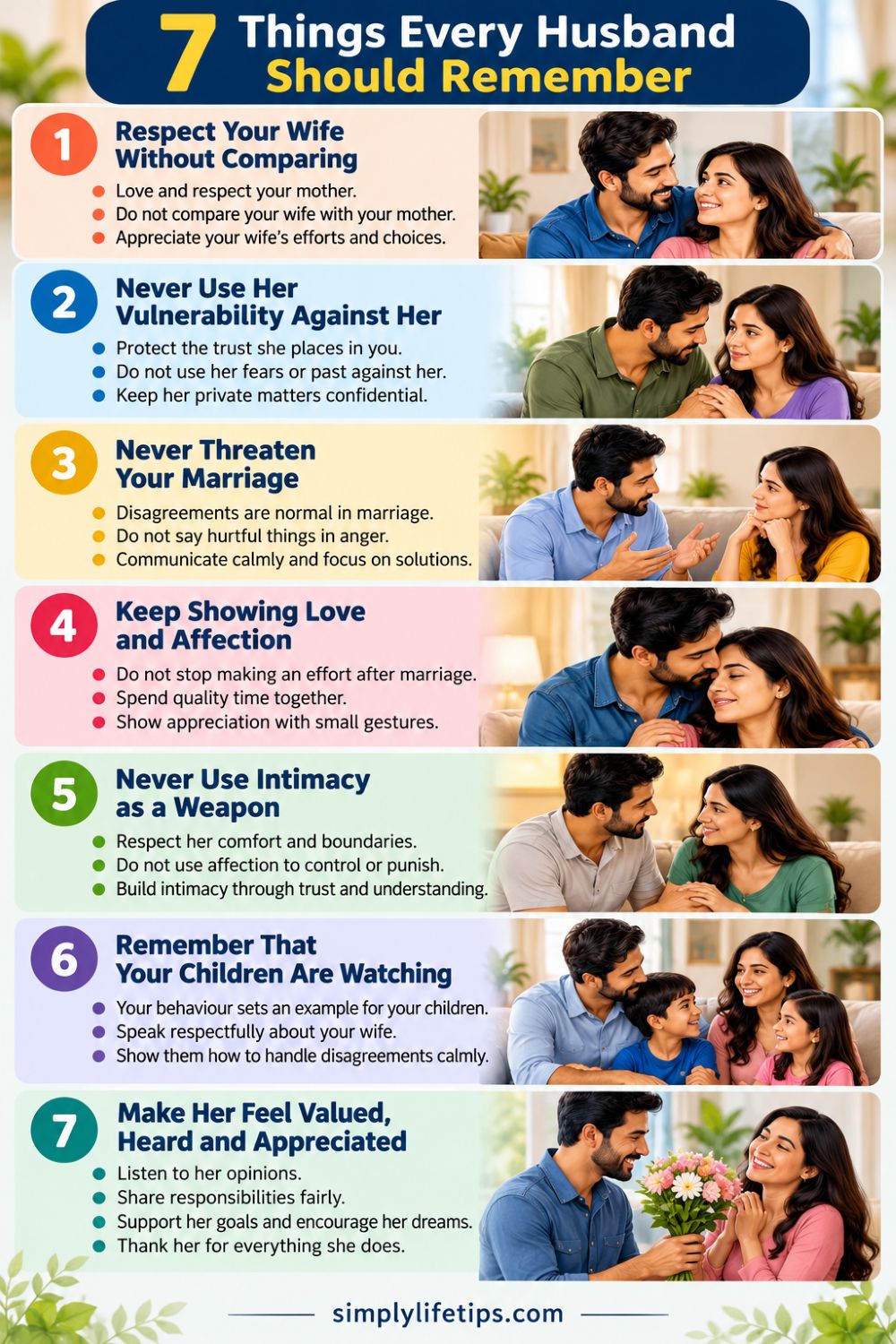
These seven tips offer a practical starting point for becoming a more thoughtful and supportive husband. Remember, a healthy marriage requires effort from both partners. Small acts of kindness, honest conversations, shared responsibilities, and mutual respect can strengthen your relationship over time.
Which of these seven habits do you think makes the biggest difference in a happy marriage?
Conclusion
Learning how to be a good husband is not about following a perfect set of rules. It is about making daily choices that strengthen trust, protect emotional safety, and remind your wife that she matters.
Respect her without comparisons. Protect the trust she places in you. Handle anger without threatening the marriage. Keep showing affection, respect her boundaries, set a good example for your children, and make sure she feels valued as your equal partner.
You will make mistakes along the way. What matters is whether you are willing to acknowledge them, apologise sincerely, and change your behaviour.
A strong marriage is not built through grand gestures alone. It grows through the everyday moments when you listen instead of dismissing, support instead of criticising, and cooperate instead of expecting your partner to carry everything alone.
The best husband is not the man who never makes a mistake. He is the man who continues learning how to love his wife with greater understanding, patience, and respect.
Remember: Your wife does not need you to be perfect. She needs a partner who is willing to grow with her, stand beside her, and keep choosing the relationship you are building together.
Frequently Asked Questions About How to Be a Good Husband
1. What makes a man a good husband?
A good husband treats his wife with respect, communicates honestly, keeps his commitments, shares responsibilities, and supports her emotional and personal well-being. He recognises that marriage requires ongoing effort from both partners.
2. How can I become a better husband every day?
Start with small, consistent actions. Listen without distractions, express appreciation, share household responsibilities, spend quality time together, and discuss disagreements calmly. Ask your wife what would help her feel more supported, then follow through.
3. How can a husband make his wife feel loved?
Show affection in ways she appreciates, spend meaningful time together, notice her efforts, remember important details, and take her concerns seriously. Consistent attention and thoughtful actions often mean more than occasional expensive gifts.
4. How should a husband handle arguments with his wife?
Focus on the issue rather than attacking her character. Avoid insults, threats, humiliation, and bringing up private information to win an argument. If emotions become overwhelming, take a mutually understood break and return to the discussion when you can communicate respectfully.
5. Can a good husband make a marriage successful on his own?
A husband can make a meaningful difference through his own behaviour, but a healthy marriage generally requires effort, respect, and cooperation from both partners. If serious problems persist, couples counselling may help when it is safe and appropriate. No one person can control every outcome in a relationship.

Mathukutty P. V. is the founder of Simply Life Tips. He shares practical advice and useful insights on personal growth, health, well-being, technology, and everyday living. His goal is to help readers build positive habits and make informed decisions. He believes in continuous learning and sharing knowledge to help people live healthier, happier, and more meaningful lives.