

The sunk cost fallacy can influence everyday decisions in ways we may not notice, from staying in an unhappy relationship to continuing a failing business, watching a movie we dislike, or remaining in a career simply because we have already spent years building it.
Have you ever thought, “I have already invested so much time, so I cannot stop now”?
Perhaps you spent a large amount of money on something that no longer seems worthwhile. Maybe you have remained in a relationship because you have been together for many years. Or perhaps you continued with a project because abandoning it would make all the previous effort feel wasted.
These reactions are understandable. But the money, time, and effort already spent cannot be recovered simply by continuing.
That is the central idea behind the sunk cost fallacy.
Research in psychology and behavioral decision-making has found that people often allow previous investments to influence decisions about whether to continue. The effect can occur even though those past costs are no longer recoverable.
Understanding the sunk cost fallacy can help us recognize when the past is influencing a decision that should instead be based on the present situation and the future.
What Is the Sunk Cost Fallacy?
The sunk cost fallacy is the tendency to continue investing in something because of the time, money, effort, or other resources already invested, even when the current evidence suggests that continuing may not be worthwhile.
A sunk cost is a cost that has already been incurred and cannot be recovered.
For example, suppose you spend ₹2,000 on a concert ticket. On the day of the concert, you discover that you no longer want to attend.
The ₹2,000 has already been spent.
Whether you attend or stay home, you cannot get that money back simply by going to the concert.
If you decide to attend only because you think, “I paid ₹2,000, so I have to go,” your decision is being influenced by a sunk cost.
The more useful question is:
“If I had not already paid for the ticket, would I still choose to attend?”
That question shifts your attention from the past to the choice in front of you.
Research by Arkes and Blumer helped establish the sunk-cost effect, showing that previous investments of money, effort, or time can increase the tendency to continue an endeavor. The Psychology of Sunk Cost — ScienceDirect
Sunk Cost Fallacy Meaning in Simple Words
The simplest way to understand the sunk cost fallacy is this:
“I have already invested so much, so I must continue.”
But what has already been spent is gone.
The better question is:
“Knowing what I know today, is continuing still worth it?”
This distinction matters because future decisions should generally consider the costs and benefits that can still change.
Imagine that you have already spent ₹50,000 repairing an old vehicle. It now requires another ₹80,000 in repairs.
The ₹50,000 already spent should not automatically determine whether you spend another ₹80,000.
Instead, you need to consider the vehicle’s current condition, expected future repairs, reliability, alternatives, and the value you are likely to receive from continuing to own it.
The past expenditure is relevant to your personal history, but it cannot be recovered.
What Is a Sunk Cost?
A sunk cost is something you have already spent and cannot recover.
It can include:
- Money
- Time
- Effort
- Energy
- Resources
- Previous work
- Emotional investment
- Opportunities that have already passed
For example, money already spent on a failed project is a sunk cost. Hours already spent on a project are also gone.
Time is particularly important because people often feel that leaving something after many years means those years were wasted. Research has found evidence of a sunk-time effect, showing that previous investments of time can influence subsequent decisions.
However, recognizing a cost as sunk does not mean that the experience had no value.
The experience may have taught you something.
The relationship may have given you meaningful memories.
The business may have helped you develop valuable skills.
The education may have opened opportunities.
What matters is not whether the past had value. It is whether that past investment should determine your next decision.
Sunk Cost Fallacy Example
Finishing a Bad Movie
One of the easiest examples is a movie.
Imagine you have watched 90 minutes of a two-hour movie and realize that you dislike it.
You have two choices.
You can stop watching.
Or you can continue for another 30 minutes because you think:
“I have already watched 90 minutes.”
But those 90 minutes are gone either way.
Watching the final 30 minutes does not recover them.
If the remaining 30 minutes are likely to be unpleasant and there is something better you could do with your time, continuing simply because you have already invested 90 minutes may be an example of sunk-cost thinking.
This kind of everyday example is also used in discussions of the sunk cost fallacy by educational and psychological sources.
Sunk Cost Fallacy in Business
The sunk cost fallacy can have serious consequences in business.
Imagine that a business owner invests ₹10 lakh in a new venture.
After two years, the business continues to lose money. Market conditions have changed, customer demand is weak, and there is little evidence that additional investment will make the business sustainable.
The owner may think:
“I have already invested ₹10 lakh.”
“I have spent two years building this business.”
“I cannot stop now.”
But spending more money does not recover the ₹10 lakh already spent.
The decision should instead consider what is likely to happen from this point forward.
Would another ₹5 lakh realistically improve the business?
Is there evidence that demand will increase?
Could the remaining resources be used more effectively elsewhere?
Would closing or changing the business prevent larger future losses?
This is why sunk-cost thinking can become dangerous when it encourages people to throw additional resources into an option simply to justify what they have already invested.
Research has documented the tendency to continue an endeavor after investments of money, effort, or time have already been made.
Sunk Cost Fallacy in Careers
The sunk cost fallacy can also influence career decisions.
Consider someone who spends five years preparing for a particular profession.
After entering the field, they realize that it is not suitable for them. The work does not match their interests, values, or long-term goals.
They may think:
“I have already spent five years studying for this.”
“I cannot start again.”
“All that effort will be wasted.”
But the five years cannot be recovered by remaining in an unsuitable career.
The skills gained during those years may still be useful.
The experience may transfer to another field.
The person may discover a better career direction using what they have already learned.
The National Institutes of Health’s Office of Intramural Training and Education uses career decisions as an example of how sunk-cost thinking can cause people to continue with a path simply because they have already invested substantial time and effort.
Changing direction is not necessarily wasting the past.
Sometimes it is learning from the past.
The sunk cost fallacy can also influence career decision-making. NIH Career Decision-Making Resource
Sunk Cost Fallacy in Relationships
The sunk cost fallacy in relationships is particularly interesting because relationships involve more than money.
They involve time, emotions, memories, trust, shared experiences, family connections, and personal sacrifices.
A person may remain in an unhappy relationship because they think:
“We have been together for 15 years.”
“I have given this relationship so much.”
“We have built a life together.”
“I cannot walk away after all these years.”
These feelings are understandable.
A long relationship can represent a significant part of someone’s life.
However, the length of a relationship does not automatically determine its future value.
Before deciding what to do with a difficult relationship, it can also help to understand the healthy relationship skills that support communication, trust, empathy, respect, and healthy boundaries.
Research has specifically examined sunk-cost effects in interpersonal relationships, and psychological science has discussed how the tendency can extend beyond financial decisions into relationships.
The important question is not simply:
“How many years have we been together?”
It is also:
“What is this relationship like today, and what is it likely to be like in the future?”
Research has also examined whether sunk-cost effects extend to interpersonal decisions. The Interpersonal Sunk-Cost Effect — PubMed
Sunk Cost Fallacy in Marriage
Marriage can make this problem especially complicated.
After many years of marriage, a person may feel that leaving would mean admitting that the entire relationship was a mistake.
But that conclusion is not necessarily true.
A marriage can contain many good memories and meaningful experiences even if the relationship later changes.
The years already lived together do not become worthless simply because circumstances change.
At the same time, remaining in a relationship solely because of the number of years invested can prevent someone from honestly evaluating the present.
A useful question is:
“If this relationship remains exactly as it is for the next five years, would I willingly choose this future?”
That question does not automatically mean that separation is the answer.
It means that the future deserves consideration.
If both partners are willing to communicate, address problems, rebuild trust, establish healthier boundaries, or seek appropriate professional help, a relationship may change.
The important point is to avoid making the decision solely because leaving would make the past feel wasted.
Sometimes a relationship becomes unhappy because recurring conflicts, control, or unresolved differences gradually create emotional distance. Learn more about power struggles in relationships and how healthier communication can help restore emotional connection.
Sunk Cost Fallacy in Friendship
Friendships can be affected by the same pattern.
Imagine two people who have been friends since childhood.
Over time, however, one person begins to feel consistently ignored, rejected, criticized, or emotionally drained.
Still, they continue the friendship because:
“We have known each other for 30 years.”
“We have so many memories.”
“I cannot end a friendship after all this time.”
The history is meaningful.
But history alone does not guarantee that a friendship remains healthy.
People change.
Circumstances change.
Priorities change.
Sometimes a friendship that once worked well no longer fits the lives or needs of the people involved.
The decision should therefore consider the relationship as it exists today, rather than being determined entirely by what it was years ago.
The quality of our relationships can also influence emotional wellbeing. Understanding the connection between relationships and mental health can provide additional perspective when evaluating a relationship that has become consistently stressful or emotionally draining.
Why Do People Fall Into the Sunk Cost Fallacy?
If the past cannot be recovered, why does it influence us so strongly?
One reason is that people generally do not want their previous decisions to feel wasteful.
Research on the sunk-cost effect has linked the behavior to attempts at self-justification and the desire not to appear wasteful.
Several psychological factors can contribute.
We Do Not Like Admitting a Mistake
Stopping can feel like admitting that our original decision was wrong.
A person may think:
“I made the wrong choice.”
“I should have known better.”
“I wasted my money.”
Continuing can temporarily protect us from that uncomfortable feeling.
We Fear Loss
Loss can feel more painful than an equivalent gain feels rewarding.
The thought of “losing” years of effort can therefore become emotionally powerful, even though those years cannot actually be recovered by continuing.
We Become Emotionally Attached
The more time and energy we invest in something, the more personally important it may become.
This can make an objective evaluation more difficult.
We Hope Things Will Improve
Sometimes people continue because they genuinely believe the future will be better.
Hope itself is not a problem.
The problem arises when hope is based mainly on the amount already invested rather than evidence that circumstances are actually changing.
Sunk Cost Fallacy vs. Commitment
It is important not to confuse commitment with the sunk cost fallacy.
Commitment can be healthy.
For example:
“I believe this relationship is valuable, and we are both willing to work through this difficult period.”
That is a future-focused decision.
Sunk-cost thinking sounds more like:
“I have already spent 20 years in this relationship, so I have no choice but to stay.”
The difference is significant.
Commitment is based on the value of continuing.
The sunk cost fallacy is based primarily on the fear of wasting what has already been invested.
A person can remain committed to a relationship, business, education, or career because there are good reasons to continue.
The issue is whether those reasons concern the future or merely the past.
Does Continuing Always Mean You Are Making a Sunk Cost Error?
No.
This is an important point.
The sunk cost fallacy does not mean that every decision to continue something after a large investment is irrational.
Sometimes continuing is the best decision.
Suppose you have already spent years developing a business, and new evidence shows that the business is finally becoming profitable.
Your previous investment may not be the reason to continue. The improved future prospects are.
Likewise, a long-term relationship may have experienced a difficult period but still have mutual respect, affection, willingness to change, and realistic potential for improvement.
Remaining in that relationship is not automatically a sunk-cost error.
The key question is:
“Would I choose to continue based on the situation and likely future outcomes if I were making the decision today?”
How to Avoid the Sunk Cost Fallacy
You cannot eliminate every influence of past investment from human decision-making. Research suggests that sunk-cost effects are real but can vary depending on the type of decision and circumstances.
Making important decisions can become harder when your mind is already overloaded. Understanding decision-making and decision fatigue can help you create more mental space for evaluating your choices carefully.
However, you can become more aware of the pattern.
Ask What You Would Choose Today
Imagine that you had not already invested anything.
Knowing what you know now, would you still choose this option?
This simple thought experiment can help separate current value from past investment.
Focus on Future Costs and Benefits
Ask:
“What will I gain if I continue?”
“What will continuing cost me?”
“What happens if nothing changes?”
“What alternatives do I have?”
These questions shift attention toward the future.
Separate the Past From the Next Decision
You cannot change what has already happened.
But you can decide what happens next.
The fact that you spent ₹1 lakh yesterday does not automatically mean you should spend another ₹1 lakh today.
The fact that you spent ten years in a career does not automatically mean you must spend another ten years there.
The fact that you have been in a relationship for 20 years does not automatically answer what is best for the next 20.
Consider Opportunity Cost
Every decision has alternatives.
If you continue investing time in something that is not working, what else could you be doing with that time?
If you continue spending money on a failing project, where else could that money go?
If you remain in a situation that continually drains you, what opportunities for growth might you be missing?
Thinking about opportunity cost can make the future consequences clearer.
Look for Evidence, Not Just Hope
Ask whether there is actual evidence that the situation can improve.
For example:
- Has the problem improved before?
- Are concrete changes happening?
- Are the people involved willing to cooperate?
- Are the financial numbers improving?
- Has new information changed the outlook?
- Is there a realistic reason to expect a better result?
Hope can encourage persistence, but evidence should guide important decisions.
A later meta-analytic review found overall evidence for the sunk-cost effect, while noting that its strength varies by decision type. Meta-Analytic Review of the Sunk-Cost Effect — Springer
The sunk cost fallacy can appear in everyday decisions involving money, relationships, careers, education, and time. The following infographic summarizes key ideas, common examples, and practical questions to help you make more future-focused decisions.
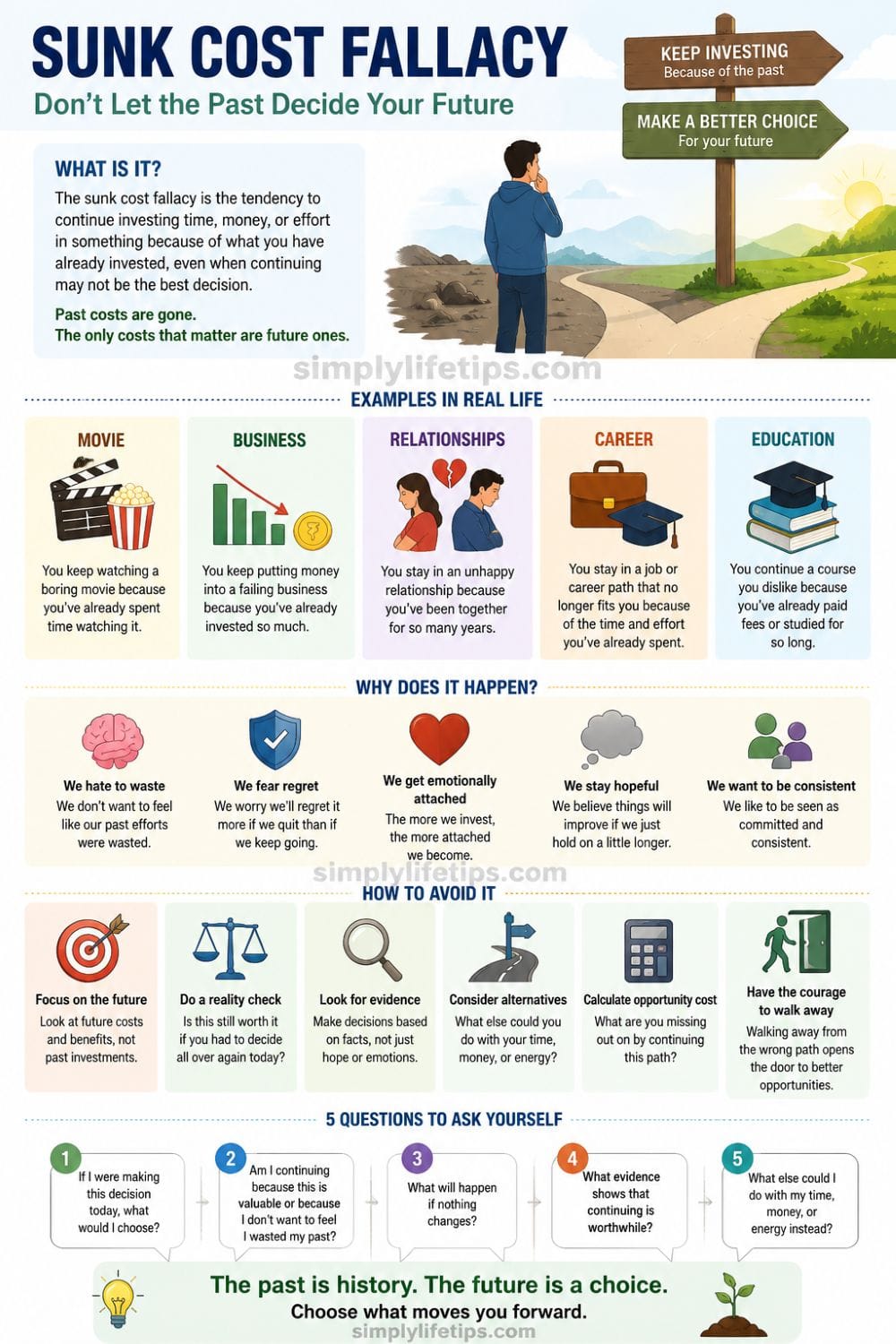
Remember: what you have already invested cannot be recovered by continuing automatically. Before making your next decision, consider what is still possible, what the future is likely to bring, and whether continuing is genuinely worthwhile.
Five Questions to Ask Before You Continue
When you suspect that sunk-cost thinking is influencing you, pause and ask:
1. If I were making this decision today, what would I choose?
This removes some of the emotional weight of the past.
2. Am I continuing because this is valuable or because I do not want my previous investment to feel wasted?
This question can reveal the real reason behind your decision.
3. What will happen if nothing changes?
Imagine the same situation one, three, or five years from now.
Would you still be satisfied with your decision?
4. What evidence suggests that continuing is worthwhile?
Look for actual evidence rather than relying entirely on hope.
5. What could I do with my time, money, or energy instead?
Sometimes the cost of continuing becomes clearer when you consider the alternatives.
When Walking Away May Be the Better Decision
Sometimes the healthiest decision is to stop.
That could mean leaving a failing business, changing careers, abandoning an unproductive project, or creating distance from a consistently unhealthy relationship.
But the decision should be based on the current reality and likely future—not simply on frustration in a single moment.
In relationships especially, important decisions can involve children, finances, housing, family responsibilities, and personal safety. Where there is abuse, coercion, intimidation, or danger, safety should take priority, and appropriate professional support should be sought.
The sunk cost fallacy is a decision-making concept, not a rule telling someone whether to stay or leave.
Conclusion
The sunk cost fallacy can quietly shape decisions about relationships, marriage, friendship, business, careers, and everyday choices.
“I have already invested so much” can be a powerful thought.
But the past investment cannot be recovered by continuing automatically.
Instead, ask a different question:
“What is the best decision from this point forward?”
That question does not disrespect your past.
It simply gives your future a voice.
Frequently Asked Questions
What is the sunk cost fallacy?
The sunk cost fallacy is the tendency to continue investing time, money, effort, or other resources in something because of what has already been invested, even when the future benefits of continuing may not justify the additional investment.
What is a simple example of the sunk cost fallacy?
Continuing to watch a movie you dislike simply because you have already watched most of it is a simple example. The time already spent cannot be recovered by watching the rest. The better question is whether watching the remaining part is worthwhile.
How does the sunk cost fallacy affect relationships?
The sunk cost fallacy can influence relationships when someone focuses mainly on the years, emotions, effort, or sacrifices already invested rather than evaluating the relationship’s current condition and prospects. Research has specifically examined sunk-cost effects in interpersonal decisions.
How can you avoid the sunk cost fallacy?
Ask what you would choose if you were making the decision today, consider future costs and benefits, examine the available alternatives, and look for evidence that continuing is worthwhile. Try not to make a future decision solely to justify a past investment.
Is sunk cost really a fallacy?
The term refers to a decision-making error that occurs when irrecoverable past costs improperly influence a current decision. However, research also shows that sunk-cost effects can vary depending on the situation and decision type. Therefore, the concept should be used thoughtfully rather than treating every decision to continue after an investment as irrational.

Mathukutty P. V. is the founder of Simply Life Tips. He shares practical advice and useful insights on personal growth, health, well-being, technology, and everyday living. His goal is to help readers build positive habits and make informed decisions. He believes in continuous learning and sharing knowledge to help people live healthier, happier, and more meaningful lives.


