

The effects of alcohol addiction can reach far beyond the person who drinks, affecting physical health, mental wellbeing, money, family relationships, children, and everyday life.
It may begin with one drink.
Just one.
After a hard day at work.
With friends.
At a family function.
Or at home because someone says, “I need something to relax.”
Nobody may think much about it in the beginning.
One drink becomes two.
Two become three.
Then drinking becomes part of the evening.
Slowly, something changes.
The person who once said, “I drink only occasionally” starts looking forward to the next drink.
The person who said, “I can stop whenever I want” starts finding reasons why today is not the right day to stop.
Tomorrow, perhaps.
But tomorrow comes.
And the bottle is opened again.
When does drinking stop being a choice and start becoming a need?
That is the question we need to ask.
Understanding the effects of alcohol addiction is important because alcohol can affect far more than a person’s physical health.
What Is Alcohol Addiction?
Alcohol addiction is not simply about drinking alcohol regularly. It is when a person gradually loses control over drinking and finds it difficult to stop, even when alcohol is causing problems in health, work, money, or family life.
In the beginning, drinking may feel like a personal choice.
“I will have one drink.”
“I had a difficult day, so I deserve a drink.”
“I can stop whenever I want.”
But over time, the situation can change.
The person may start drinking more than planned. They may need more alcohol to feel the same effect. They may think about drinking frequently or feel a strong urge to drink. Even after seeing problems at home or noticing changes in their health, they may continue.
That is when alcohol is no longer simply a social habit.
Once drinking becomes difficult to control, the effects of alcohol addiction can begin to appear in everyday life.
It may have become an addiction.
Alcohol addiction is a medical condition, and understanding Alcohol Use Disorder can help explain why some people find it difficult to control their drinking even when it is causing problems.
And this is where the effects of alcohol addiction can begin to reach almost every part of life—not only the person drinking, but also the people who love and depend on them.
Alcohol addiction is a medical condition, and seeking professional help is not a sign of weakness. Treatment and recovery are possible.
Effects of Alcohol Addiction
Alcohol addiction does not affect only the liver or the brain. Its effects can slowly spread into almost every part of life. Physical health may suffer, mental wellbeing can change, relationships can become difficult, children can be affected, and money that should support the family may disappear into drinking.
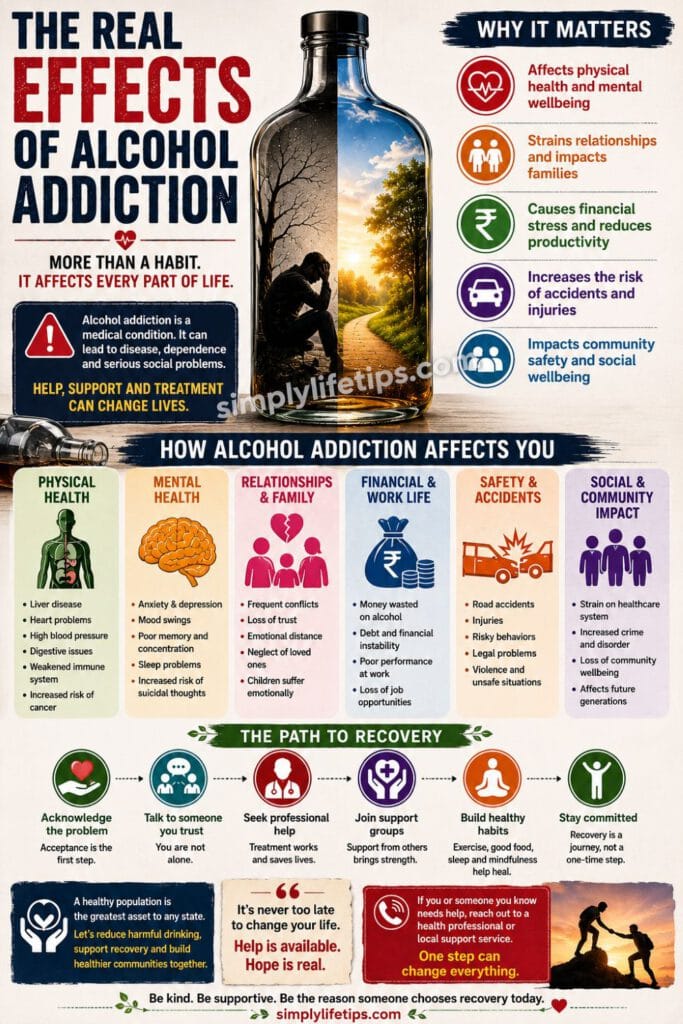
Alcohol is not just a drink
Alcohol is legal and socially accepted in many places. People drink at celebrations, with friends, after work, or simply because they believe it helps them relax.
But alcohol is not harmless.
The World Health Organization describes alcohol as a psychoactive and toxic substance that can cause dependence. Alcohol consumption is causally linked to more than 200 diseases, injuries and other health conditions.
This does not mean every person who drinks will become addicted.
It does mean we should think seriously about how alcohol is used.
The problem becomes much more serious when a person finds it difficult to control how much or how often they drink.
And when that happens, the effects can spread far beyond the drinker.
The person may not notice the problem first
This is one of the difficult things about alcohol addiction.
The person may still go to work.
They may still earn money.
They may still attend family functions.
They may still meet friends and appear completely normal to people outside the home.
So they may think:
“What is the problem? I am managing everything.”
But family members may notice changes much earlier.
“He is drinking more often.”
“She is becoming angry over small things.”
“He forgets conversations.”
“She promised to stop again.”
“Money is disappearing.”
“He is not the same person he used to be.”
These small observations can slowly become a much bigger picture.
Sometimes the people living with the person see the problem before the person drinking is ready to accept it.
Effects on Physical Health
The physical effects of alcohol addiction can develop gradually, sometimes before a person realizes that their health is being affected.
When people hear about alcohol-related disease, they usually think about the liver.
That makes sense.
The liver processes alcohol, and long-term harmful drinking can cause serious liver problems.
But alcohol does not stop with the liver.
It can affect the heart and blood vessels.
It can affect the pancreas.
It can damage the nervous system.
It can affect the immune system.
It can contribute to several types of cancer.
It can also increase the risk of injuries and road crashes.
The worrying part is that some damage may develop before a person feels seriously ill.
Someone can say:
“I feel perfectly healthy.”
But feeling healthy today does not necessarily mean everything inside the body is healthy.
The liver may suffer quietly
Imagine someone who has been drinking heavily for years.
They wake up.
Go to work.
Come home.
Eat dinner.
Have a few drinks.
Go to sleep.
The next morning, the same routine begins.
There may be no dramatic warning.
No sudden pain.
No obvious sign that something is going wrong.
But alcohol-related liver disease can progress over time.
That is why waiting for symptoms before thinking about drinking can be risky.
The body does not always give us an early warning.
The heart and other organs can also be affected
Alcohol-related harm is not limited to one organ.
Long-term harmful drinking can contribute to cardiovascular disease, pancreatitis, and damage to the nervous system. Alcohol is also linked to several cancers.
This is why the question should not simply be:
“Is my liver okay?”
A better question is:
“What is alcohol doing to my whole body?”
Effects on the Brain and Memory
The brain is another major part of the story.
Alcohol can affect judgment, coordination, attention, reaction time, and memory.
After drinking, a person may make decisions they would normally avoid.
They may become more impulsive.
They may say things they later regret.
They may drive when they should not.
They may forget what happened.
Sometimes a person experiences an alcohol blackout.
They may have been awake and talking, but later remember very little about what happened.
That is not simply an ordinary memory lapse.
Alcohol can interfere with the brain’s ability to form new memories.
Repeated excessive alcohol use can also affect brain systems involved in memory, decision-making, impulse control, attention, and stress.
This is one reason alcohol addiction is not simply a matter of “weak willpower.”
The health effects of harmful drinking can extend across many parts of the body, as explained by the World Health Organization’s information on alcohol and health
Some of the most serious effects of alcohol addiction involve the brain, including problems with memory, judgment and coordination.
Effects on Mental Health
“I drink because I am stressed.”
Many people have said something like this.
A difficult day.
Work pressure.
Financial worries.
An argument.
Loneliness.
Poor sleep.
The person reaches for alcohol.
For a while, the mind may feel different.
The person may feel relaxed.
But the problem that caused the stress is still there.
So the next day, the person drinks again.
Slowly, a cycle can develop:
Stress → alcohol → temporary relief → more problems → more stress → alcohol again.
Alcohol becomes the answer to every difficult emotion.
That can be dangerous.
The person may stop learning healthier ways to deal with stress.
Repeated excessive alcohol use can contribute to mental-health and behavioural problems, including anxiety, depression and alcohol use disorder.
Temporary relief is not the same as recovery.
The mental-health effects of alcohol addiction can make recovery more difficult.
Effects on Family Life
This is where alcohol addiction becomes much more than a health problem.
Imagine a child waiting for a parent to come home.
The vehicle arrives.
The door opens.
The child looks at the parent’s face.
Is he sober?
Is she angry?
Will there be an argument tonight?
Children may not understand the medical meaning of addiction.
But they understand tension.
They understand fear.
They understand when the atmosphere at home suddenly changes.
A husband or wife may also start living with uncertainty.
One day there is a promise.
“I will not drink again.”
The family wants to believe it.
Then the same thing happens.
Another argument.
Another apology.
Another promise.
Another drink.
Eventually, the biggest damage may not be the bottle.
It may be the loss of trust.
WHO notes that long-term harmful alcohol use can contribute to family problems, financial problems, problems at work, and unemployment.
The effects of alcohol addiction on family life can be especially painful because the consequences are experienced by people who may not drink at all.
Effects on Children
This is something parents should think about seriously.
Parents often tell their children:
“Stay away from alcohol.”
But children learn from more than words.
They watch.
They observe.
They remember.
If a child repeatedly sees a parent drinking whenever there is stress, sadness or anger, the child may begin to associate alcohol with coping.
That does not mean every child whose parent drinks will become addicted.
The effects of alcohol addiction on children may continue long after a drinking episode has ended.
It does mean parents are important role models.
A child may learn:
Stress → drink.
Sadness → drink.
Celebration → drink.
Anger → drink.
But children can also learn something healthier.
Stress → talk to someone.
Sadness → seek support.
Anger → communicate.
Failure → try again.
Tiredness → rest.
Parents cannot control every decision their children will make.
But they can influence what children see as normal.
If we want children to make healthier choices tomorrow, the example at home matters today.
A parent may say:
“I work hard for my children.”
That may be completely true.
But children do not measure love only by money.
They remember who was there.
Who listened.
Who kept promises.
Who made them feel safe.
Who was calm.
Who came home with time for them.
When alcohol regularly changes a parent’s behaviour, children may lose some of those experiences.
That is one of the most painful effects of alcohol addiction.
Effects on Money and Financial Security
Financial problems are another often-overlooked effect of alcohol addiction.
The daily cost of drinking
There is another cost that families feel every day.
Money.
A person may work for eight or ten hours.
Perhaps in construction.
Perhaps as a driver.
Perhaps in a shop.
Perhaps as a daily-wage worker.
Perhaps in an office.
At the end of the day, the person has earned money through hard work.
Then part of it goes to alcohol.
The person may think:
“It is only a few hundred rupees.”
But that money is spent again tomorrow.
And the day after.
And the day after that.
What could that money have done instead?
A child’s school expenses.
Medicines.
Food.
A house repair.
A loan payment.
Savings.
An emergency fund.
Perhaps a small investment in the child’s future.
The cost of alcohol is not only the price printed on the bottle.
It is also what that money could have achieved.
What about money sent by children?
This is another situation worth thinking about.
Many sons and daughters work away from home.
Some work in another state.
Some work in another city.
Some work in another country.
They may work long hours and send money home because they want their parents to live comfortably.
The money may be intended for food, medicines, household expenses, healthcare, repairs, savings or emergencies.
We should not say that parents generally spend money sent by their children on alcohol.
That would be an unfair generalisation.
But there is a question worth asking:
What if someone struggling with alcohol dependence is using part of that money for drinking?
The son or daughter may be working thousands of kilometres away.
They may believe:
“My parents are using the money I send to live safely.”
They may not know what is happening at home.
This is one of the hidden financial and emotional costs of addiction.
What about welfare and pension money?
Kerala provides social-security support to eligible people.
The purpose of such assistance is to help people meet living needs and maintain some financial security.
We should not make a blanket claim that pension money is being spent on alcohol.
There is no justification for accusing beneficiaries as a group.
But there is a reasonable public-health question:
If a financially vulnerable person is also struggling with alcohol dependence, are we doing enough to help that person overcome the addiction so that limited income can actually support food, medicines and other essential needs?
The answer should not be blame.
It should be support.
Counselling.
Treatment.
Family involvement.
And easier access to rehabilitation when necessary.
“I drink to refresh my body and mind”
This is another common belief.
“I worked hard today. I deserve a drink.”
But what does the body really need after a hard day’s work?
Food.
Water.
Rest.
Sleep.
Recovery.
And what does the mind need?
Peace.
Conversation.
Recreation.
Exercise.
Family time.
Healthy social connection.
Sometimes professional support.
Alcohol may change how a person feels for a short time.
But that is not the same as restoring the body or solving the problem.
Temporary relief is not the same as recovery.
Alcohol can affect work
A person who drinks heavily may begin to have problems at work.
Coming late.
Missing work.
Poor concentration.
Mistakes.
Reduced productivity.
Arguments.
In some cases, job loss.
Then income falls.
Financial pressure increases.
Stress increases.
And the person drinks again.
The cycle becomes harder to break.
The problem that started with a drink after work can eventually affect the person’s ability to work.
One evening can affect another family
Alcohol-related harm does not always take years.
Consider a road accident.
Someone drinks.
They believe they are capable of driving.
They start the vehicle.
A mistake happens.
A passenger is injured.
A pedestrian is hurt.
Another family receives a phone call that changes everything.
The person who drank may not have intended to hurt anyone.
But alcohol can affect judgment, coordination, and reaction time.
WHO notes that alcohol contributes to road traffic injuries and that alcohol-related harm can affect people other than the person drinking.
Alcohol, Unwanted Incidents and Community Safety
Open a newspaper or look at the news on any day, and we often come across incidents involving arguments, fights, road accidents and other unwanted events where alcohol may have played a role.
Not every incident is caused by alcohol.
But alcohol can make a difficult situation worse.
A small disagreement can become a serious argument.
An argument between two people can turn into a fight.
A family problem can become worse when someone comes home drunk.
A person who would normally think twice before doing something may act impulsively after drinking.
Why does this happen?
Alcohol can affect judgment, attention, coordination and self-control. It can also reduce inhibitions. A person may say or do things without thinking about the consequences.
Sometimes the person may not even remember everything clearly the next day.
The consequences, however, do not disappear when the alcohol wears off.
A family may have to deal with the argument.
A person may have to face an injury.
A driver may have to face the consequences of an accident.
Another family may suffer because someone decided to drive after drinking.
This is why the effects of alcohol addiction should not be viewed only as a private health problem.
They can become a family problem, a road-safety problem and a community problem.
The person drinking may think, “I am only having a few drinks.”
But the people around that person may experience the consequences very differently.
One person’s drinking can sometimes become another person’s suffering.
When does drinking become addiction?
Not everyone who drinks has alcohol use disorder.
But there are warning signs that should not be ignored.
A person may drink more than intended.
They may repeatedly try to cut down but fail.
They may need more alcohol to get the same effect.
They may spend a lot of time drinking or recovering from drinking.
They may continue drinking despite health or family problems.
They may miss work or other responsibilities.
They may give up activities they once enjoyed.
They may experience strong cravings.
They may develop withdrawal symptoms when alcohol is stopped.
Alcohol use disorder is a medical condition, and its severity can range from mild to severe. Effective treatment is available.
How can someone stop alcohol addiction?
Understanding the damage is important.
But people also need to know what they can do.
The first step is honesty.
Ask yourself:
Has alcohol started affecting my health?
Has it started affecting my family?
Am I spending more than I can afford?
Have I tried to stop but failed?
Do I need alcohol to relax or sleep?
Do I feel uncomfortable when I cannot drink?
If several answers are yes, talking to a doctor or addiction specialist is a sensible next step.
Treatment is not something to be ashamed of.
Do not suddenly stop heavy drinking without medical advice
This is extremely important.
Someone who has been drinking heavily for a long time should not assume that suddenly stopping at home is always safe.
Withdrawal can cause shaking, sweating, anxiety, nausea, disturbed sleep, and increased heart rate.
Severe withdrawal can cause seizures or delirium tremens and can be life-threatening.
NIAAA notes that people with severe alcohol use disorder may need medical help to manage withdrawal safely.
So the message is not simply:
“Stop drinking today.”
It is:
“If you are dependent on alcohol, get help to stop safely.”
Rehabilitation is not punishment
Some people are afraid of rehabilitation.
They imagine it as a place where a person is isolated because they have failed.
That is not the right way to look at it.
Rehabilitation should help a person understand why they drink and learn how to live without depending on alcohol.
It may involve counselling, behavioural therapy, medical care, family support, healthy routines and relapse-prevention planning.
Some people may benefit from outpatient treatment.
Others may need residential care.
The right approach depends on the person’s needs and the severity of the problem.
Detoxification may be necessary for some people, but detox alone is not the complete recovery process. NIAAA notes that treatment and continuing care can extend far beyond the initial withdrawal period.
Recovery often requires more than simply deciding to stop, and evidence-based alcohol addiction treatment and recovery can provide the medical and behavioural support some people need.
Recovery can give a family another chance
When a person begins recovery, the benefits may reach everyone at home.
The evenings may become calmer.
Money may stay in the household.
Children may feel safer.
The spouse may slowly regain trust.
Work may improve.
Health may improve.
The person may begin thinking about the future again.
Of course, everything does not become normal overnight.
Trust takes time.
Health takes time.
Relationships take time.
But change is possible.
For readers who want to understand the recovery journey in greater detail, see Road to Recovery From Alcohol Addiction.
A real-life recovery story can also provide hope. See Claudia Christian Overcame Alcoholism as an example of one person’s recovery journey.
We should help people, not simply blame them
There is an easy question people ask:
“Why doesn’t he just stop?”
But addiction is not always that simple.
Repeated excessive alcohol use can change brain systems involved in reward, stress and self-control, making it harder for some people to stop without assistance.
So instead of asking only:
“Why can’t you stop?”
perhaps we should ask:
“What help do you need to stop?”
That is a more useful question.
What can families do?
Families often do not know what to do.
They may become angry.
They may plead.
They may threaten.
They may hide the problem from relatives.
They may keep paying debts created by drinking.
They may make excuses for the person.
But protecting someone from every consequence does not necessarily solve addiction.
Family members can encourage professional help.
They can protect children from unsafe situations.
They can set reasonable boundaries.
They can avoid covering up every problem caused by drinking.
And they can seek professional support for themselves.
The family also needs care.
Kerala is fighting drugs. What about alcohol?
Kerala Is Fighting Drugs. What About Alcohol?
Kerala has stepped up its fight against narcotics through Operation Toofan – The Narco Hunt, a campaign aimed at tackling the growing threat of illegal drugs. The initiative focuses on identifying drug traffickers, disrupting distribution networks and reducing the harm caused by narcotics, while also giving importance to awareness and rehabilitation.
This is an important effort because reducing the availability of illegal drugs can make it harder for people to access them.
But it also raises a question that deserves a thoughtful public-health discussion.
If the government is taking strong action to control the availability and spread of illegal narcotics, should we also think more deeply about how to reduce harmful alcohol use?
Alcohol and illegal drugs are not the same.
Alcohol is legal, regulated, and widely used in society. Therefore, the approach to alcohol cannot simply be the same as the approach to illegal narcotics.
But harmful alcohol use can also lead to addiction, health problems, family difficulties, financial hardship, accidents and problems in the wider community.
That is why the question is not whether alcohol should be treated exactly like illegal drugs.
The question is:
What more can we do to prevent alcohol addiction and protect families from its consequences?
Prevention, awareness, early intervention, treatment and rehabilitation all have a role to play.
For readers who want to understand the wider dangers of substance abuse, Dangers of Drug Abuse is also worth reading.
Kerala’s experience with Operation Toofan provides an opportunity to think about addiction from a broader public-health perspective.
If reducing harm from narcotics requires enforcement, awareness and rehabilitation, could stronger prevention, awareness, treatment and rehabilitation also help reduce the harmful effects of alcohol addiction?
That is a question worth discussing—not as a criticism of the government, but as a concern for the health of people, the happiness of families and the wellbeing of the community.
Alcohol policy should not be judged only by how much alcohol is sold or how much revenue it generates. It should also be judged by what happens to people’s health, families and communities.
The World Health Organization recommends evidence-based measures to reduce harmful alcohol use, including regulating the number, density and location of alcohol outlets and controlling the days and hours when alcohol can be sold. WHO recommendations on alcohol availability
Government revenue is important.
It helps fund healthcare, education, infrastructure, welfare and other public services. That is an important part of running a state.
But public health is also a responsibility.
So perhaps we should look at the bigger picture.
How many people are becoming dependent on alcohol?
How many need medical treatment or rehabilitation?
How many families are living with the effects of harmful drinking?
How many accidents and injuries involve alcohol?
How much working time and productivity are lost?
How much does alcohol-related illness cost the healthcare system?
And perhaps the most difficult question of all:
How much suffering is happening quietly inside homes?
These costs are much harder to see than the revenue collected from alcohol.
Revenue can be written in a budget document.
A child’s fear cannot.
A family’s lost peace cannot.
Broken trust cannot be easily measured.
This does not mean that everyone who drinks will develop an addiction or cause problems in their family. Many people who drink do not develop alcohol use disorder.
The concern is harmful alcohol use—the drinking that can lead to disease, dependence, accidents, financial hardship, family conflict, and other social problems.
Therefore, alcohol policy deserves to be looked at from both sides: the revenue it generates and the health and social costs it may create.
The question is not whether government revenue is important.
It is.
The question is whether protecting public health should be given equal importance.
If evidence shows that measures such as controlling alcohol availability, preventing drink-driving, improving awareness and making treatment easier to access can reduce alcohol-related harm, these options deserve serious consideration.
A healthy population is also an asset to a state.
The ultimate goal should not simply be to sell less or collect more.
It should be to reduce harmful drinking, help people recover from addiction, protect families and build healthier communities.
A Respectful Request to Policymakers
This article is not an attack on the Government.
It is a request to think about the larger picture.
If strong action is being taken against illegal drugs, perhaps alcohol-related harm also deserves continued attention.
Not necessarily through one single measure.
But through a combination of better awareness, early intervention, accessible treatment, rehabilitation, family support, mental-health services, road-safety measures and evidence-based alcohol-control policies.
The goal should not simply be to ask:
“How much alcohol can society sell?”
The larger question should be:
“How can society reduce harmful drinking and protect people’s health and family life?”
That is a reasonable question for policymakers, health professionals and the public to discuss.
A Warning We See Everywhere
We have all seen the warning:
“Alcohol is injurious to health.”
It appears in films, television and other media, and health warnings are also associated with alcohol products and their advertising or packaging.
The message is clear: alcohol can harm health.
But there is an interesting question.
If we know that alcohol can cause serious health problems, why is it still so easily available for legal purchase?
There is no simple answer.
Alcohol is a legal product, and governments regulate its sale in different ways. At the same time, public-health authorities also recognise that reducing the availability of alcohol can help reduce harmful drinking.
This is where the discussion becomes important.
A warning tells people about the risk.
But a warning alone may not be enough for someone who is already developing dependence.
A person struggling with alcohol addiction may see the warning every day and still feel unable to stop.
That is why prevention needs to go beyond a message printed on a screen or a label.
Awareness is important.
Early intervention is important.
Treatment is important.
Rehabilitation is important.
And evidence-based policies that reduce harmful alcohol use also deserve attention.
The question is not whether people should be allowed to make their own choices.
The question is whether society is doing enough to help people make healthier choices—and to protect families when drinking becomes harmful.
The real price of a bottle
A bottle of alcohol has a price printed on it.
That is the easiest cost to see.
But for someone who drinks regularly, especially when drinking becomes difficult to control, the real cost can be much higher.
There is the money spent on the bottle.
Then there may be money spent on medicines.
Medical consultations.
Hospital treatment.
Missed days at work.
Repairs after accidents.
Debts.
And sometimes the loss of a job.
But not every cost can be counted in rupees.
What is the cost of a child growing up watching a parent change because of alcohol?
What is the cost of a spouse living with repeated arguments and broken promises?
What is the cost of a family losing trust?
What is the cost of a person losing years of good health?
These are the hidden costs of alcohol addiction.
A person may look at a bottle and think:
“It costs only a few hundred rupees.”
But the family may be paying a much higher price.
The money that goes into alcohol could have been used for food, education, medicines, savings, household needs or something important for the children’s future.
And the emotional cost can be even greater.
A bottle can be replaced.
Money can sometimes be earned again.
But lost health, lost trust and lost family moments may not be so easy to recover.
That is why the real price of alcohol should not be measured only by the amount paid at the shop.
The real price is what alcohol slowly takes away from life.
What could that money have done?
This is not about judging someone for spending money on alcohol.
It is about asking a different question.
If a person spends a significant amount on alcohol every month, what could that money have done for the family?
Perhaps school expenses.
Perhaps better food.
Perhaps medicines.
Perhaps savings.
Perhaps a small emergency fund.
Perhaps a house repair.
Perhaps something that could improve the family’s future.
Money spent on alcohol is gone.
Money saved can create choices.
Parents have another responsibility
There is one more reason parents need to think seriously about alcohol.
Their children are watching.
They are watching how parents deal with stress.
How they deal with anger.
How they deal with disappointment.
How they celebrate.
How they respond when life becomes difficult.
A parent may tell a child:
“Never use alcohol to solve your problems.”
But the example at home can be stronger than the words.
Children do not need perfect parents.
They need healthy examples.
If parents are struggling with alcohol addiction, seeking treatment can therefore be more than a personal decision.
It can also be a decision for the next generation.
A better way to relax after work
A hard day’s work deserves rest.
But alcohol does not have to be the answer.
A person can try a good meal, enough water, a shower, a walk, exercise, music, reading, time with family, talking with a friend, a hobby or simply getting proper sleep.
These things may sound ordinary.
But healthy routines often begin with ordinary choices.
And if the real problem is anxiety, depression, loneliness or overwhelming stress, professional help is much more useful than repeatedly using alcohol as self-treatment.
The goal is not simply to stop drinking
The real goal is to rebuild life.
Better health.
Better sleep.
Better relationships.
Better financial control.
More time with children.
More confidence.
More stability.
More peace.
That is what recovery should mean.
Not simply living without alcohol, but learning to live well without needing it.
Conclusion
The effects of alcohol addiction are not limited to the person who drinks.
They can reach the liver.
The heart.
The brain.
Mental health.
Work.
Money.
Marriage.
Children.
Parents.
And the wider community.
Alcohol addiction may begin quietly.
One drink.
Then another.
Then a habit.
Then a need.
But that does not mean the story has to end there.
A person can ask for help.
A family can offer support.
A doctor can provide treatment.
A rehabilitation programme can help rebuild daily life.
And recovery is possible. Evidence-based treatment can help people with alcohol use disorder, and some alcohol-related brain changes can improve with prolonged abstinence.
Kerala’s efforts against illegal drugs are important. The wider problem of addiction also deserves thoughtful public-health attention.
This is not about blaming every person who drinks.
It is not about saying every drinker will become addicted.
And it is not about attacking the government.
It is about asking whether we can do more to protect people’s health and family life.
Government revenue matters.
But people’s health matters too.
Family happiness matters.
Children’s future matters.
The hard-earned money of working people matters.
Perhaps the real measure of a healthy society is not only how much revenue it collects.
Perhaps it is also how many families can live with health, dignity, security and peace.
So before opening the next bottle, ask yourself:
“What am I really spending—not just today, but on my health, my family and my future?”
And if alcohol has already become difficult to control, asking for help is not weakness.
It may be one of the most important decisions you make for yourself and the people who love you.
The effects of alcohol addiction are not limited to the person who drinks; they can affect health, family, finances and the wider community.
Frequently Asked Questions
What are the main effects of alcohol addiction?
The effects can include physical health problems, changes in brain function, mental-health difficulties, financial problems, relationship problems and disruption to work and family life. Harmful alcohol use is associated with more than 200 diseases, injuries and health conditions.
Can alcohol addiction affect children?
Yes. A parent’s alcohol problems can affect the family environment and may influence children’s experiences and attitudes toward alcohol. However, having a parent with an alcohol problem does not mean a child will inevitably develop addiction.
How can someone stop alcohol addiction?
A person struggling with alcohol should consider speaking with a doctor or addiction specialist. Treatment can include behavioural therapies, counselling, medication when appropriate, and medically supervised withdrawal.
Is it safe to suddenly stop drinking?
Not always. Someone who has been drinking heavily for a long time may develop serious withdrawal symptoms after suddenly stopping. Severe withdrawal can include seizures or delirium tremens. Medical advice is important for people who may be dependent on alcohol.
Can a person recover from alcohol addiction?
Yes. Alcohol use disorder is treatable, and many people recover with appropriate treatment and continuing support. Some alcohol-related brain changes may improve with prolonged abstinence.
Medical Disclaimer
This article is intended for general health education and awareness. It is not a substitute for individual medical diagnosis or treatment. Anyone who has been drinking heavily for a prolonged period should speak with a qualified healthcare professional before stopping alcohol suddenly. Severe withdrawal symptoms, seizures, loss of consciousness, severe confusion, or breathing problems require urgent medical attention.

Mathukutty P. V. is the founder of Simply Life Tips. He shares practical advice and useful insights on personal growth, health, well-being, technology, and everyday living. His goal is to help readers build positive habits and make informed decisions. He believes in continuous learning and sharing knowledge to help people live healthier, happier, and more meaningful lives.