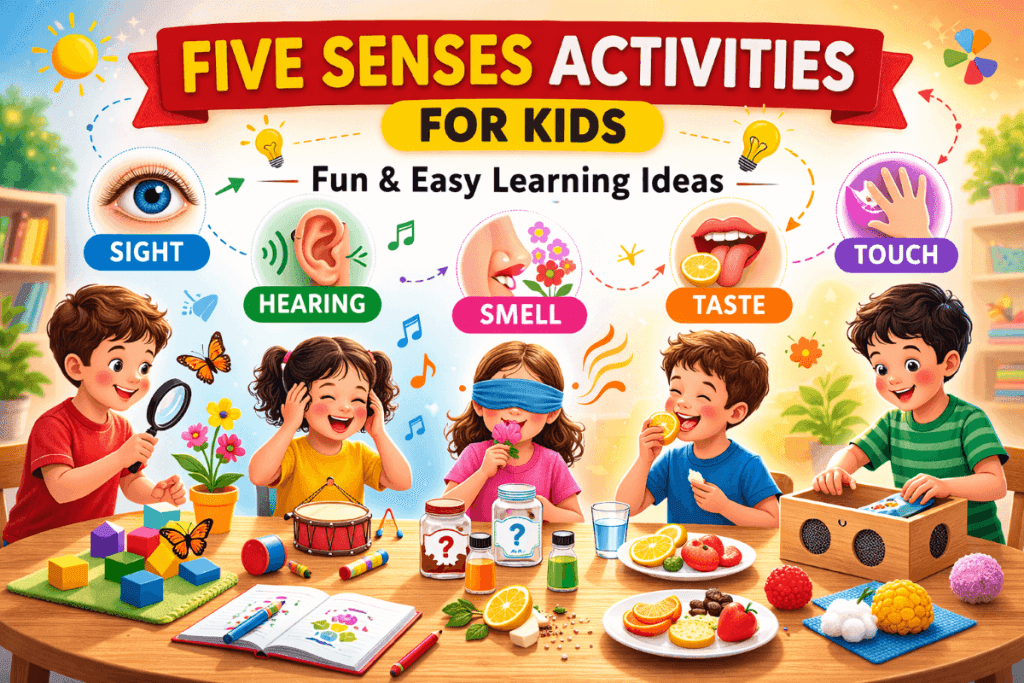
Five senses activities for kids help children understand sight, hearing, smell, taste, and touch through simple hands-on experiences. Interactive learning makes it easier for kids to remember how their senses work in daily life. These activities can be done at home or in the classroom. Before trying these activities, children can first understand how each sense organ works by reading our guide on human sense organs.
Five Senses Activities for Kids
Sight Activities
Color Hunt
Give children a colour and ask them to find objects of that colour around the room. This improves observation skills.
I Spy Game
Play “I Spy” using visual clues. Children look carefully and guess the object being described.
Shadow Play
Use a flashlight to create shadows and observe how shapes change when objects move.
Hearing Activities
Sound Guessing Game
Make different sounds like clapping, tapping, or ringing a bell. Children guess the sound without looking.
Nature Listening Walk
Ask children to stay quiet for a minute and list all the sounds they hear.
Music Freeze Game
Play music and let children dance. When the music stops, they must freeze immediately.
Smell Activities
Mystery Smell Test
Place safe items like lemon, coffee, or flowers in covered containers. Children guess each scent.
Smell and Memory
Ask children if a scent reminds them of something, such as cookies or rain.
Taste Activities
Flavor Sorting
Provide small samples of sweet, salty, sour, and bitter foods. Ask children to group them by taste.
Blind Taste Test
Children close their eyes and guess what they are tasting.
Touch Activities
Texture Box
Fill a box with objects like cotton, sponge, sandpaper, or smooth stones. Children describe how each feels.
Guess the Object
Place an object in a bag. Children feel it without looking and try to guess what it is.
How Five Senses Activities for Kids Help Learning?
Using multiple senses improves memory and understanding. When children see, hear, touch, smell, and taste during activities, they remember information more clearly. Sensory learning also improves vocabulary and communication skills. To learn more about the importance and functions of our senses in daily life, explore our detailed article on human senses.
Why Sensory Activities Are Important for Brain Development?
Sensory activities help children strengthen connections in the brain. When kids see, hear, touch, smell, and taste during learning, their brain processes information more effectively. Using multiple senses at the same time improves memory and understanding.
For example, when a child sees a lemon, touches it, smells it, and tastes it, the brain connects all those experiences together. This makes learning stronger and longer-lasting.
Five Senses Activities for Preschool and Kindergarten
Preschool and kindergarten children learn best through play. Simple activities help them build early science skills.
For younger children, focus on:
• Matching sounds with pictures
• Sorting objects by texture
• Identifying sweet or sour tastes
• Smelling safe household items
• Describing colours and shapes
Short, simple, and supervised activities are most effective at this age.
Easy Materials You Can Use at Home
You do not need expensive materials for sensory learning. Many everyday items can be used:
Sight: colored paper, flashlights, picture books
Hearing: bells, music, clapping games
Smell: fruits, spices, flowers
Taste: small food samples
Touch: cotton, sand, sponge, rice, smooth stones
Using simple materials makes activities easy to repeat and enjoyable for children.
Safety Tips for Sense Activities
• Always supervise tasting activities.
• Use safe, allergy-free materials.
• Avoid hot or sharp objects.
• Keep strong scents mild.
Conclusion
Five senses activities for kids make learning interactive and enjoyable. By exploring sight, hearing, smell, taste, and touch through simple games, children strengthen their observation skills and develop a better understanding of how their senses work in everyday life.
If this resonated with you, share it with someone who needs it.
PVM

Mathukutty P V is a Blogger, YouTuber, and Content Writer and the founder of Simply Life Tips. After taking voluntary retirement in 2017, he embraced a free lifestyle focused on learning, personal growth, and sharing practical wisdom to help others live with more purpose and positivity.