
Outdoor Play for Children is not a luxury, an optional activity, or a break from learning; it is one of the most essential foundations of healthy childhood development. As modern life becomes increasingly indoor-oriented, many children spend their days sitting, watching, tapping, and scrolling rather than running, climbing, and exploring. While technology and structured learning have benefits, they cannot replace the deep neurological, emotional, and physical development that occurs through outdoor play. Children are biologically designed to learn through movement and experience, and when these needs are unmet, the effects quietly appear in reduced focus, delayed learning skills, emotional dysregulation, and lower confidence. Outdoor play supports the whole child by strengthening the brain, body, and sense of self in ways no indoor environment can fully replicate.
Importance of Outdoor Play for Children

Outdoor play for children is important because the developing brain relies on physical movement and sensory experiences to build neural connections. Early childhood learning does not begin with books and screens but with the body interacting with space, texture, balance, and challenge. When children play outdoors, they engage multiple brain systems simultaneously, including motor control, sensory processing, emotional regulation, and executive functioning. These systems form the foundation for later academic skills such as reading, writing, problem-solving, and sustained attention. Outdoor play also allows children to experience healthy levels of risk, uncertainty, and independence, which teaches adaptability and resilience. Without these experiences, children may appear well-behaved indoors but struggle with focus, confidence, and emotional control as they grow.
Outdoor Play and Brain Development
The brain develops from the bottom up, meaning that physical movement and sensory input shape higher-order thinking skills. Outdoor play for children activates the vestibular system, proprioceptive system, and sensory integration processes that are critical for attention and learning. Activities like running improve blood flow to the brain, climbing strengthens planning and coordination, and balancing refines communication between brain hemispheres. These experiences directly support memory formation, language processing, and self-regulation. Children who regularly engage in outdoor play often show stronger concentration and better emotional balance because their brains have learned how to shift between activity and calm naturally.
Emotional Development in Children: How Safety, Presence, and Care Shape the Growing Mind
Benefits of Outdoor Play for Children
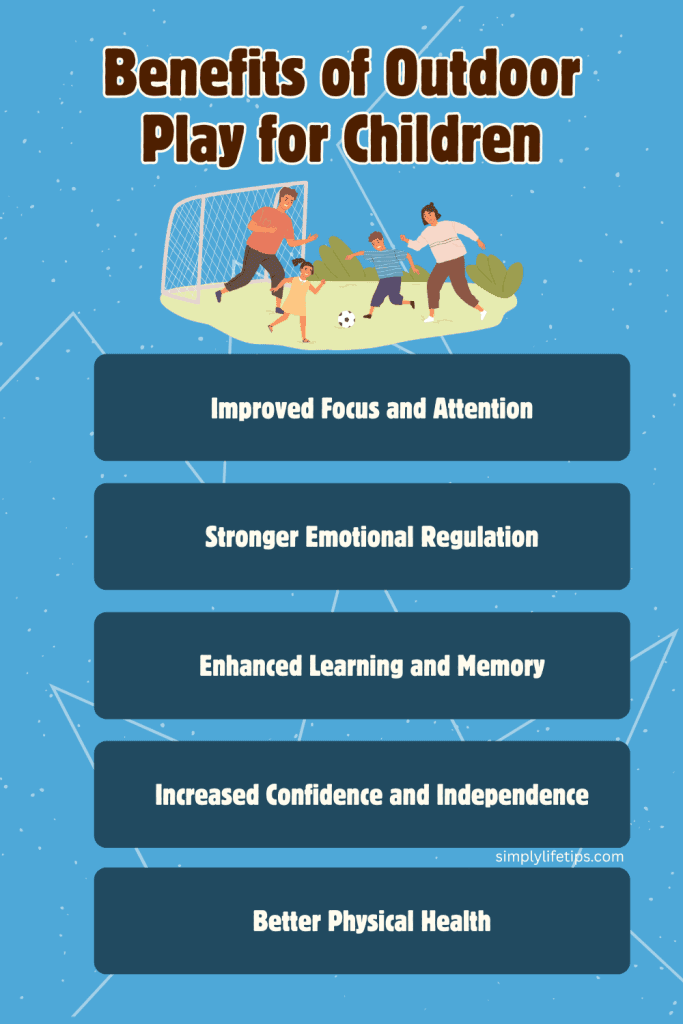
Improved Focus and Attention
Outdoor play helps children develop the ability to concentrate by allowing their nervous system to release excess energy in healthy ways. When children move freely outdoors, they learn to regulate arousal levels, which later supports longer attention spans in structured settings. This natural regulation cannot be forced through discipline but develops organically through active play.
Stronger Emotional Regulation
Outdoor play provides emotional release and teaches children how to manage frustration, excitement, and disappointment. Falling, trying again, negotiating play rules, and handling small failures all build emotional resilience. These experiences help children develop patience, self-control, and coping skills that carry into adolescence and adulthood.
Enhanced Learning and Memory
Learning becomes more effective when it is connected to physical experience. Outdoor play strengthens memory by engaging multiple senses at once, making learning more meaningful and lasting. Children who play outdoors often show better comprehension and recall because their brains associate learning with real-world experience rather than passive intake.
Increased Confidence and Independence
Outdoor play for children encourages independent thinking and decision-making. Choosing how to climb, where to explore, or how to solve a play challenge builds confidence and self-trust. These experiences send a powerful internal message that the child is capable, competent, and resilient.
Better Physical Health
Regular outdoor play strengthens muscles, bones, coordination, and cardiovascular health. Sunlight exposure supports vitamin D production, which is important for bone growth and immune function. Physical activity also reduces stress hormones, supporting both physical and mental well-being.
The Importance Of Playtime: Benefits For Child Development
What Outdoor Play Teaches Children?
Outdoor play teaches children independence by allowing them to test their abilities and make choices. It builds resilience by showing them that setbacks are part of growth. Curiosity is nurtured through open-ended exploration, where there are no instructions or outcomes imposed. Confidence develops as children experience mastery over their bodies and environment. These lessons cannot be taught through instruction alone; they are learned through experience.
Best Outdoor Play Activities for Children
Free Unstructured Play
Unstructured outdoor play allows children to invent games, explore nature, and follow their interests. This type of play supports creativity, problem-solving, and emotional freedom.
Climbing and Balancing Activities
Climbing trees, playground structures, and balancing on beams or rocks strengthens coordination, spatial awareness, and risk assessment skills.
Nature Exploration
Exploring parks, gardens, or natural spaces encourages curiosity, observation, and early scientific thinking. Nature play also has calming effects on the nervous system.
Running and Physical Games
Games that involve running, jumping, and chasing improve cardiovascular health and help children release pent-up energy, supporting better focus later.
Imaginative Outdoor Play
Using outdoor spaces for imaginative play supports language development, creativity, and emotional expression.
Advice for Parents
Outdoor play for children should be treated as a daily priority rather than an occasional activity. Even 20 to 60 minutes of outdoor time makes a meaningful difference. Parents can choose fresh air over screens whenever possible and allow children to get messy, climb, and explore without excessive restrictions. A perfectly safe childhood may feel reassuring, but a balanced childhood builds strength, confidence, and resilience.
Conclusion
Outdoor Play for Children builds more than strong bodies; it builds strong brains, emotional resilience, and belief in oneself. Childhood does not need perfection, expensive activities, or constant supervision to thrive. It needs time, space, and opportunity to explore the world freely. When children are given regular access to outdoor play, they are not just entertained; they are prepared for learning, relationships, and life. Childhood happens only once. Let it happen outside.
FAQs – Outdoor Play for Children
Why is outdoor play for children important?
Outdoor play is important because it supports brain development, emotional regulation, physical health, and learning readiness. Movement and sensory experiences strengthen neural pathways needed for focus and comprehension. Without outdoor play, children may struggle with attention and confidence.
How much outdoor play do children need daily?
Children benefit from at least 20 to 60 minutes of outdoor play each day. More time outdoors provides greater developmental benefits, but consistency matters more than duration. Even short daily exposure makes a difference.
Can outdoor play improve learning skills?
Yes, outdoor play improves learning by strengthening attention, memory, and problem-solving skills. Physical movement enhances brain function, making academic learning easier and more effective.
Is outdoor play better than indoor play?
Both have value, but outdoor play offers sensory and movement experiences that indoor play cannot fully provide. Outdoor environments naturally challenge the brain and body together.
How can parents encourage outdoor play for children?
Parents can schedule outdoor time daily, limit screen use, provide safe outdoor spaces, and allow free, unstructured play. Modelling enjoyment of outdoor activities also encourages children to participate.
Thank you for taking the time to explore this post. I sincerely hope you found the insights valuable and actionable. If this content resonated with you, please consider sharing it. Your support enables me to share knowledge and inspiration with others in our community.
PVM

Mathukutty P V is a Blogger, YouTuber, and Content Writer and the founder of Simply Life Tips. After taking voluntary retirement in 2017, he embraced a free lifestyle focused on learning, personal growth, and sharing practical wisdom to help others live with more purpose and positivity.