
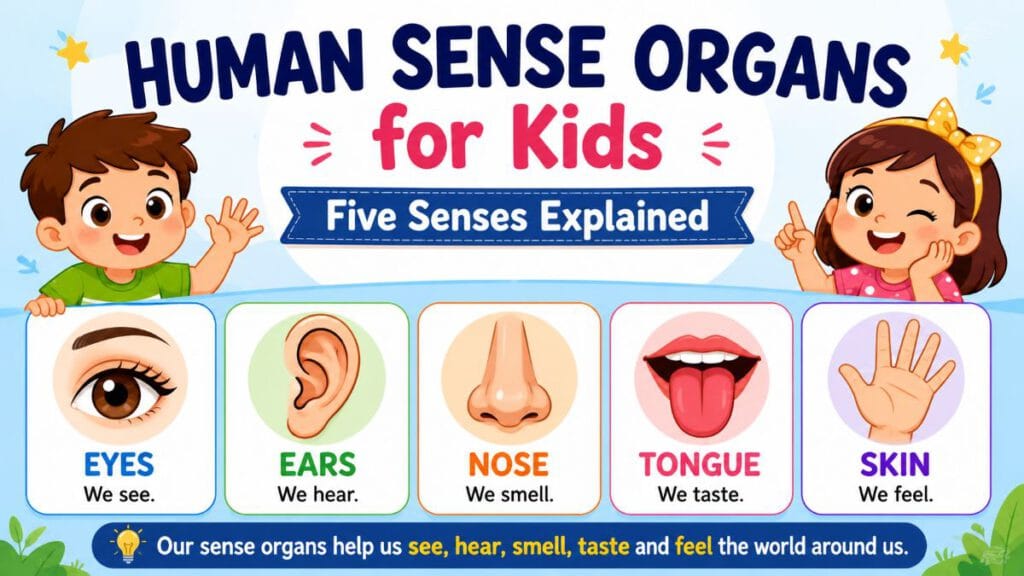
Human sense organs help us understand and interact with the world around us. Our eyes help us see, our ears help us hear, our nose helps us smell, our tongue helps us taste, and our skin helps us feel touch.
Learning about sense organs for kids is an important part of understanding the human body. These organs collect information from our surroundings and work with the nervous system and brain to help us recognize and respond to our experiences.
From seeing a colourful rainbow and hearing music to smelling a flower, tasting food, or feeling something soft, our senses are working throughout the day. In this guide, children will learn about the five human sense organs, their functions, simple examples, and fun ways to explore the five senses.
The Five Sense Organs at a Glance
This simple diagram shows the five main human sense organs and the senses they help us use every day.
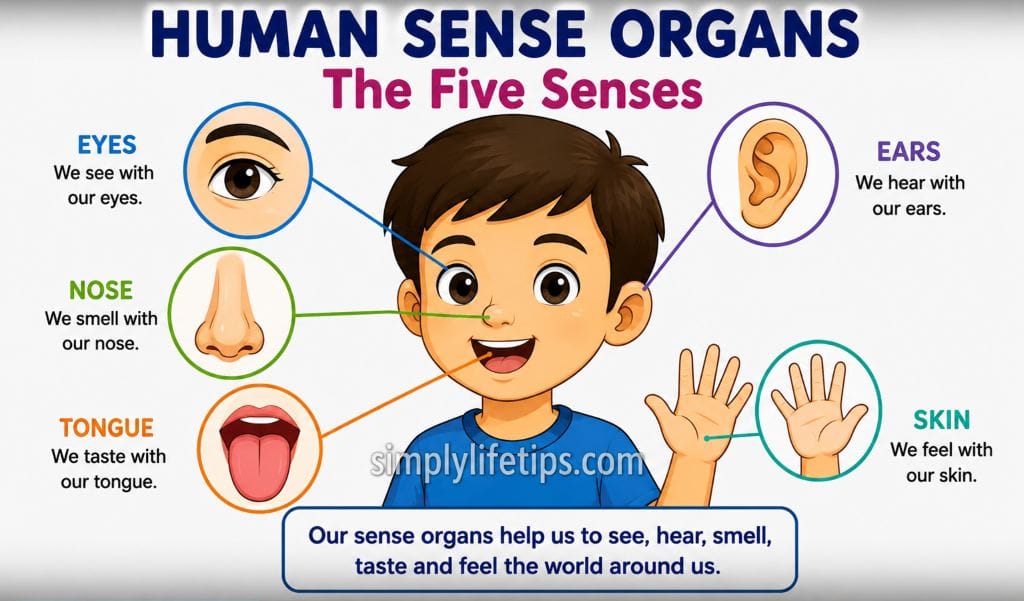
The five main sense organs are the eyes, ears, nose, tongue, and skin. Each one collects different information from our surroundings and works with the brain and nervous system to help us understand what we see, hear, smell, taste, and feel.
Sense Organs for Kids Explained
Eyes – Sense Organ of Sight
The eyes are the sense organs responsible for sight. They help us see colours, shapes, people, animals, objects, and movement around us. When light enters the eyes, it is detected by special cells in the retina, and signals are carried to the brain through the optic nerve. The brain then processes this information so we can understand what we are seeing.
Example: When you look at a colourful rainbow, your eyes detect the different colours and your brain helps you recognize the rainbow.
Ears – Sense Organ of Hearing
The ears are the sense organs responsible for hearing. They help us hear voices, music, birds singing, traffic, and many other sounds around us. Sound waves enter the ear and cause tiny structures inside the ear to vibrate. These vibrations are converted into nerve signals and sent to the brain, where they are interpreted as sounds.
Example: When you hear a bird singing, your ears detect the sound and your brain helps you recognize what you are hearing.
Nose – Sense Organ of Smell
The nose is the sense organ responsible for smell. It helps us detect and identify different scents in our surroundings, such as the fragrance of flowers, the smell of food, or the scent of rain. When we breathe in, tiny molecules from the air reach special smell receptors inside the nose. These receptors send signals to the brain, which helps us recognize and identify different smells.
Example: When you smell a rose, receptors inside your nose detect its scent, and your brain helps you recognize the familiar floral smell.
You can also learn more about the different parts of the head in our detailed guide on parts of the human head for kids.
Tongue – Sense Organ of Taste
The tongue is the main sense organ involved in taste. It helps us detect different flavours in the foods and drinks we consume. Taste receptors, mainly located in taste buds on the tongue, detect substances in food and send information to the brain. This allows us to recognize tastes such as sweet, salty, sour, bitter, and umami.
Example: When you eat a ripe mango, your taste receptors detect its sweet and tangy flavour, while your brain helps you recognize the taste.
Skin – Sense Organ of Touch
The skin is the largest organ of the human body and contains many sensory receptors that help us detect touch, pressure, temperature, and pain. These receptors collect information from the environment and send signals through nerves to the brain, allowing us to understand what our body is feeling.
The skin is the body’s largest organ and contains sensory receptors that help us detect different sensations. Cleveland Clinic – Skin
Example: When you touch a soft pillow, your skin detects its texture. If you touch something very hot, sensory receptors quickly send a warning signal to your brain so you can move your hand away.
Watch: Human Sense Organs and the Five Senses
This short video helps children review the five main sense organs and understand how they help us see, hear, smell, taste, and feel.
After watching the video, children can use the diagram above and the examples in this article to review each sense organ and its function.
How do the Five Senses Work Together?
Our five senses do not work separately. They work together with the brain to help us understand what is happening around us. Each sense provides different information, and the brain combines this information to help us recognize people, objects, sounds, smells, tastes, and textures.
The nervous system carries sensory information between the body and brain, helping us process and respond to what we see, hear, smell, taste, and feel. Cleveland Clinic – Nervous System
For example, when you eat an apple, you use your eyes to see its colour and shape, your nose to smell its aroma, your skin to feel its texture, your ears to hear the crunch when you bite it, and your tongue to taste its flavour. Your brain brings all these pieces of information together so you can understand the experience.
Another example is crossing a road. You use your eyes to look for vehicles, your ears to listen for approaching sounds, and your sense of touch and balance to stay aware of your body and surroundings. Your brain processes the information and helps you respond safely.
This teamwork between the senses and brain helps us learn, communicate, move around, enjoy food, recognize our surroundings, and respond to the world around us.
For a deeper explanation of how sight, hearing, smell, taste, and touch help us experience the world, explore our guide to 5 human senses and their functions.
For Kindergarten and Preschool
Young children can learn about human sense organs more easily through simple, safe, hands-on experiences. Instead of only memorizing the names of the five organs, children can explore how each sense helps them understand the world.
Try these simple activities:
- Sight: Show children colourful pictures, toys, or objects and ask them to describe what they can see.
- Hearing: Play familiar sounds such as birds singing, rain, clapping, or music and ask children to identify them.
- Smell: Let children smell safe items such as flowers, fruits, or mild spices and describe what they notice.
- Taste: With appropriate supervision, let children taste small amounts of familiar foods and describe whether they are sweet, salty, sour, or bitter.
- Touch: Provide safe objects with different textures, such as cotton, a smooth stone, or a soft toy, and ask children to describe how each feels.
These simple experiences make learning about sense organs for kids more interactive and memorable. They also encourage children to observe their surroundings and use their senses in everyday situations.
Fun Activity Ideas to Teach the Five Senses
Hands-on activities can help children understand the five senses through direct experience. These simple activities can be done at home or in a classroom with safe, age-appropriate materials.
- Sight Activity: Place several colourful objects in front of children and ask them to describe their colours, shapes, sizes, and patterns.
- Hearing Activity: Play different familiar sounds and ask children to guess what they are hearing. You can use sounds such as birds, rain, clapping, or musical instruments.
- Smell Activity: Use safe items such as flowers, fruits, or mild spices. Let children smell each item and describe whether the scent is strong, mild, sweet, fresh, or familiar.
- Taste Activity: With appropriate adult supervision, offer small amounts of familiar foods with different tastes. Ask children whether each food tastes sweet, salty, sour, or bitter.
- Touch Activity: Give children safe objects with different textures, such as cotton, a soft toy, a smooth stone, or a piece of sandpaper. Ask them to describe how each object feels.
These activities make learning about the five senses interactive and memorable. They also encourage children to observe, compare, describe, and ask questions about the world around them.
Looking for more hands-on ideas? Explore these five senses activities for kids for additional ways to make learning fun at home or in the classroom.
Simple Real-Life Examples of Using Our Senses
Children use their five senses throughout the day, often without thinking about it. These everyday examples can make the idea of sense organs easier to understand.
- Eating an apple: You use your eyes to see its colour and shape, your nose to smell it, your skin to feel its surface, your ears to hear the crunch, and your tongue to taste its flavour.
- Playing in the park: You see trees and playground equipment, hear birds and other sounds, feel the breeze on your skin, and smell flowers or grass.
- Listening to music: You use your ears to hear the music, your eyes to watch people move or dance, and your skin may detect vibrations from nearby speakers.
- Walking outside: Your eyes help you notice objects around you, your ears help you hear sounds, and your skin helps you feel the temperature and breeze.
- Eating a favourite meal: Your eyes notice how the food looks, your nose detects its aroma, your tongue experiences its taste, and your skin helps you feel the food’s temperature when appropriate.
These examples show how the five senses work together to help children explore their surroundings, learn from experience, and respond to what is happening around them.
Conclusion
Human sense organs help children explore, learn, and interact with the world around them every day. The eyes, ears, nose, tongue, and skin each provide different types of information, while the brain helps us understand and respond to what we experience.
Learning about the five sense organs can be simple and enjoyable when children connect science with everyday experiences. Seeing a rainbow, hearing a bird, smelling a flower, tasting a favourite food, or feeling a soft toy can all become opportunities to learn.
By exploring sense organs for kids through simple explanations, real-life examples, and hands-on activities, children can develop curiosity and a better understanding of their amazing bodies. Human sense organs help children explore, learn, and interact with the world around them every day. The eyes, ears, nose, tongue, and skin each provide different types of information, while the brain helps us understand and respond to what we experience.
Frequently Asked Questions
What are human sense organs?
Human sense organs are specialized body parts that help us gather information about our surroundings. The five main sense organs are the eyes, ears, nose, tongue, and skin, which help us see, hear, smell, taste, and feel.
How many main sense organs are there?
There are five main human sense organs: the eyes for sight, ears for hearing, nose for smell, tongue for taste, and skin for touch. These are the five sense organs commonly introduced to children when learning about the human body.
Why are sense organs important?
Sense organs help us understand and respond to the world around us. They allow children to see objects, hear sounds, recognize smells, taste food, and feel sensations such as touch, temperature, pressure, and pain.
How do sense organs send messages to the brain?
Sense organs detect information from the environment and convert it into signals that travel through nerves to the brain. The brain processes these signals and helps us understand what we are seeing, hearing, smelling, tasting, or feeling.
Are sense organs part of the human body?
Yes. The eyes, ears, nose, tongue, and skin are important parts of the human body that help us gather information about our surroundings. They work with the nervous system and brain to help us learn, move, communicate, and respond to different situations.
Why are the five senses important for kids?
The five senses help children explore their surroundings and learn through everyday experiences. Understanding the senses can also help children become more aware of their bodies and the world around them.
Can children learn about sense organs through activities?
Yes. Simple activities involving safe objects, sounds, smells, tastes, and textures can make learning about sense organs for kids more interactive. Parents and teachers should choose age-appropriate activities and supervise children, particularly during tasting and smelling activities.

Mathukutty P V is a Blogger, YouTuber, and Content Writer and the founder of Simply Life Tips. After taking voluntary retirement in 2017, he embraced a free lifestyle focused on learning, personal growth, and sharing practical wisdom to help others live with more purpose and positivity.



