
Can human nature change, or does a person remain the same throughout life? It is a question we often ask after experiencing disappointment, betrayal, or conflict in our relationships.
Someone loses their temper over a small disagreement. Another person repeatedly tells lies. Someone we trust breaks a promise and later says, “I will never do it again.” We want to believe those words, but our past experiences make us hesitate.
Can an angry person learn to control their temper? Can someone who has been selfish become more considerate? Can a person who has betrayed someone else’s trust genuinely change?
Modern neuroscience and psychology offer a hopeful but realistic answer. People can change their behavior and aspects of their personality, but change is neither automatic nor guaranteed.
Our genes, childhood experiences, relationships, environment, and brain function all influence who we become. Some characteristics remain relatively stable, while others can change as we learn, mature, and respond to new experiences.
Understanding how this process works can help us make better decisions about ourselves and the people we trust.
1. What Determines Human Nature and Personality?
Nobody is born with a fully developed adult personality. From infancy onward, our temperament and behavior develop through a combination of biological influences and life experiences.
Several factors contribute to the development of human nature and personality.
- Genetics: Inherited characteristics can influence temperament, emotional sensitivity, and tendencies toward particular behaviors.
- Brain development: The development and functioning of brain networks influence emotional responses, decision-making, and impulse control.
- Family environment: Parenting, family relationships, and the behavior children observe can shape how they interact with others.
- Childhood experiences: Supportive relationships can promote emotional security, while repeated adversity can influence stress responses and relationships.
- Social environment: Friends, colleagues, cultural expectations, and community experiences can influence behavior.
- Life experiences: Marriage, parenthood, professional responsibilities, loss, and personal challenges can contribute to changes in how people think and act.
Consider two children who grow up in very different households. One may learn to resolve disagreements through discussion because adults model respectful communication. The other may learn to respond to conflict with shouting because aggression is common at home.
These experiences can influence their later behavior, although they do not determine their future completely.
Genetics and environment are not competing explanations. They interact throughout life, influencing how personality develops.
Research published in Psychological Bulletin has examined personality stability and change across the lifespan. The evidence suggests that personality traits can be relatively stable while still changing over time.
Read the research on personality stability and change to learn more about what long-term studies reveal.
The important point is that our inherited tendencies influence us, but they do not dictate every decision we make.
2. Are Anger, Jealousy, and Cruelty Controlled by the Brain?
The brain plays a central role in our emotions, motivations, decisions, and social behavior. However, no single brain region is responsible for a complex characteristic such as cruelty, jealousy, or dishonesty.
Different brain networks work together to influence how we feel and respond.
The amygdala and emotional responses
The amygdala is a group of structures involved in processing emotionally significant information, including potential threats. It helps the brain respond to situations that may require attention or protective action.
Imagine someone making an insulting comment about you in front of others. You may immediately feel angry, embarrassed, or threatened.
Your emotional response may arise before you have fully considered the situation.
The prefrontal cortex and self-control
The prefrontal cortex, located toward the front of the brain, contributes to planning, decision-making, and the regulation of behavior and emotions.
Although emotional regulation depends on several interacting brain networks, the prefrontal cortex helps us consider consequences instead of reacting impulsively.
For example, after being insulted, you might feel like shouting back. However, you may pause, consider the consequences, and respond calmly.
Understanding our emotional responses can help us recognise why we sometimes react before thinking. Read more about anger and the brain to learn what happens during intense anger and how to respond more thoughtfully.
This ability to create a pause between an emotion and an action is an important part of emotional regulation.
For a deeper scientific explanation, read this review of the neural basis of emotion regulation.
Does the brain make us cruel?
Cruelty cannot be explained by one brain structure or a single biological mechanism. Harmful behavior may be influenced by a combination of personal tendencies, learned patterns, social circumstances, emotional processes, and, in some cases, neurological or psychiatric conditions.
Understanding these influences can help explain behavior. It does not automatically excuse the harm caused to others.
Feeling angry is not the same as choosing to hurt someone. We may not always control our first emotional reaction, but we can often learn healthier ways to respond.
3. Can Childhood Experiences Change Our Personality?
Childhood experiences can influence emotional development, expectations, and relationships well into adulthood.
A child who repeatedly experiences humiliation, neglect, or fear may learn to expect rejection or danger in relationships. As an adult, that person might struggle to trust others, become unusually sensitive to criticism, or worry excessively about being abandoned.
For example, someone who was frequently criticized as a child may interpret a partner’s ordinary suggestion as a personal attack.
Another person who experienced unpredictable caregiving may find it difficult to feel secure even in a supportive relationship.
Understanding another person’s behavior requires patience and attention to patterns over time. Our guide on how to understand people better explores how actions, communication, and consistency can help us understand others more clearly.
Research indicates that adverse childhood experiences can affect stress responses and emotional development. However, people respond differently to similar experiences. Childhood adversity does not inevitably produce harmful behavior, and a difficult childhood does not determine a person’s entire future.
Supportive relationships, healthy coping strategies, psychological treatment when appropriate, and positive experiences can help people develop new ways of responding.
Imagine someone who learned to shout whenever a disagreement arose. Through practice, that person may learn to recognize early signs of anger, take a break, listen carefully, and explain concerns without aggression.
The old reaction may not disappear immediately. However, repeated practice can help establish a healthier response.
Our past can influence who we become, but it does not have to dictate every part of our future.
4. Can Brain Diseases Change a Person’s Behavior?
Yes. Certain neurological conditions and brain injuries can cause significant changes in personality, judgment, emotional regulation, or social behavior.
For example, damage to frontal brain networks may affect impulse control, planning, decision-making, and awareness of social consequences.
Some forms of dementia and other neurological disorders can also produce changes in behavior and personality.
A person who was previously patient may become unusually irritable. Someone who was once socially considerate may begin behaving in ways that seem insensitive or out of character.
These changes should not automatically be interpreted as deliberate misconduct or a personality defect.
A sudden, marked, or unexplained change in personality, particularly in middle age or later life, deserves medical assessment. It may have a neurological, psychiatric, medication-related, or other medical explanation.
If a behavior change appears suddenly alongside confusion, difficulty speaking, weakness, or other possible stroke symptoms, seek emergency medical care.
It is important to distinguish between a gradual pattern of behavior and a new change that may signal a health problem.
5. Will Someone Who Betrays You Always Betray You Again?
This is one of the most difficult questions in relationships.
A person lies to you. Someone breaks a promise. A partner betrays your trust. Later, the person apologizes and promises never to repeat the mistake.
Should you believe them?
Science cannot predict with certainty whether a particular person will betray someone again. Past behavior can provide useful information about future risk, but it is not an infallible prediction.
People can learn from mistakes and develop more honest patterns of behavior. However, repeated dishonesty, manipulation, or betrayal should not be dismissed simply because someone promises to change.
Before deciding whether someone has genuinely changed, consider their behavior across different situations rather than relying on a single incident. Learn how to understand people’s behavior by observing whether their actions consistently match their words.
An apology is not proof of change
Consider two people who have both broken a promise.
The first apologizes, blames stress, and expects immediate forgiveness. A few weeks later, the same behavior happens again.
The second acknowledges the harm without making excuses, takes responsibility, respects the other person’s boundaries, and consistently behaves differently over time.
The difference is not simply what they say. It is what they do afterward.
Genuine change may involve:
- Accepting responsibility without blaming the victim.
- Being honest even when the truth is uncomfortable.
- Understanding the harm caused by previous behavior.
- Making practical changes to avoid repeating the same mistake.
- Respecting the other person’s boundaries and need for time.
- Demonstrating consistent behavior over an extended period.
Even these signs cannot guarantee that the person will never repeat the behavior. They provide more meaningful evidence than an apology alone.
Does forgiving someone mean trusting them again?
No. Forgiveness, reconciliation, and trust are different things.
You may choose to forgive someone without restoring the relationship to its previous state. Trust may need to be rebuilt gradually, and in some circumstances, maintaining distance is the healthier option.
You are not responsible for changing another person’s character. Nor must you endure repeated deception or abuse while waiting for someone to improve.
People can change, but you should judge the change by sustained behavior rather than promises.
6. Can Human Nature Change Through Neuroplasticity?
Neuroplasticity is the brain’s capacity to change its structure and functioning in response to learning, experience, and other influences.
The brain is not a completely fixed system. Learning new skills, practising different responses, and adapting to new situations can involve changes in neural connections and brain activity.
However, neuroplasticity does not mean that anyone can instantly transform every aspect of their personality. Brain plasticity is one part of a much larger process involving motivation, habits, environment, relationships, and sustained effort.
The brain’s ability to adapt makes learning and healthy habits important throughout life. Explore these proven ways to keep your brain healthy for practical suggestions to support brain health.
How can neuroplasticity help change behavior?
Imagine a person who becomes angry whenever someone disagrees with them.
Initially, the usual pattern might be:
- Someone disagrees.
- The person interprets the disagreement as an insult.
- Anger rises quickly.
- The person shouts or reacts aggressively.
- The argument becomes worse.
With practice, the person can work on a different pattern:
- Recognize the first signs of anger.
- Pause before responding.
- Consider whether the disagreement is actually a personal attack.
- Listen to the other person’s perspective.
- Respond without insults or threats.
The new response may feel unnatural at first. Repeated practice can make it easier to use, although progress is not always linear and stressful situations may trigger old habits.
Psychological interventions can also help people change certain aspects of personality and emotional functioning.
A systematic review published in Psychological Bulletin in 2017 examined 207 studies and found that interventions were associated with measurable changes in personality-trait scores over an average period of approximately 24 weeks. The authors also reported evidence that some changes persisted during follow-up.
Read the full systematic review of personality trait change through intervention.
A later systematic review of intentional personality change identified 30 longitudinal studies involving 7,719 participants. It found promising evidence that interventions can support desired personality changes, while emphasizing that more research is needed to establish how widely these findings apply.
You can explore the research on intentional personality change for further details.
These findings support the possibility of change, not unlimited control over personality.
The brain can learn new patterns, but lasting change usually requires more than simply wishing to become a different person.
For practical ways to support brain health, explore these proven ways to keep your brain healthy.
The brain’s ability to adapt offers an important insight into human nature: our behavior is not always fixed. Genetics, life experiences, emotional responses, and learned habits all influence who we become. The infographic below highlights seven key facts about human nature, personality, and the brain’s ability to change.
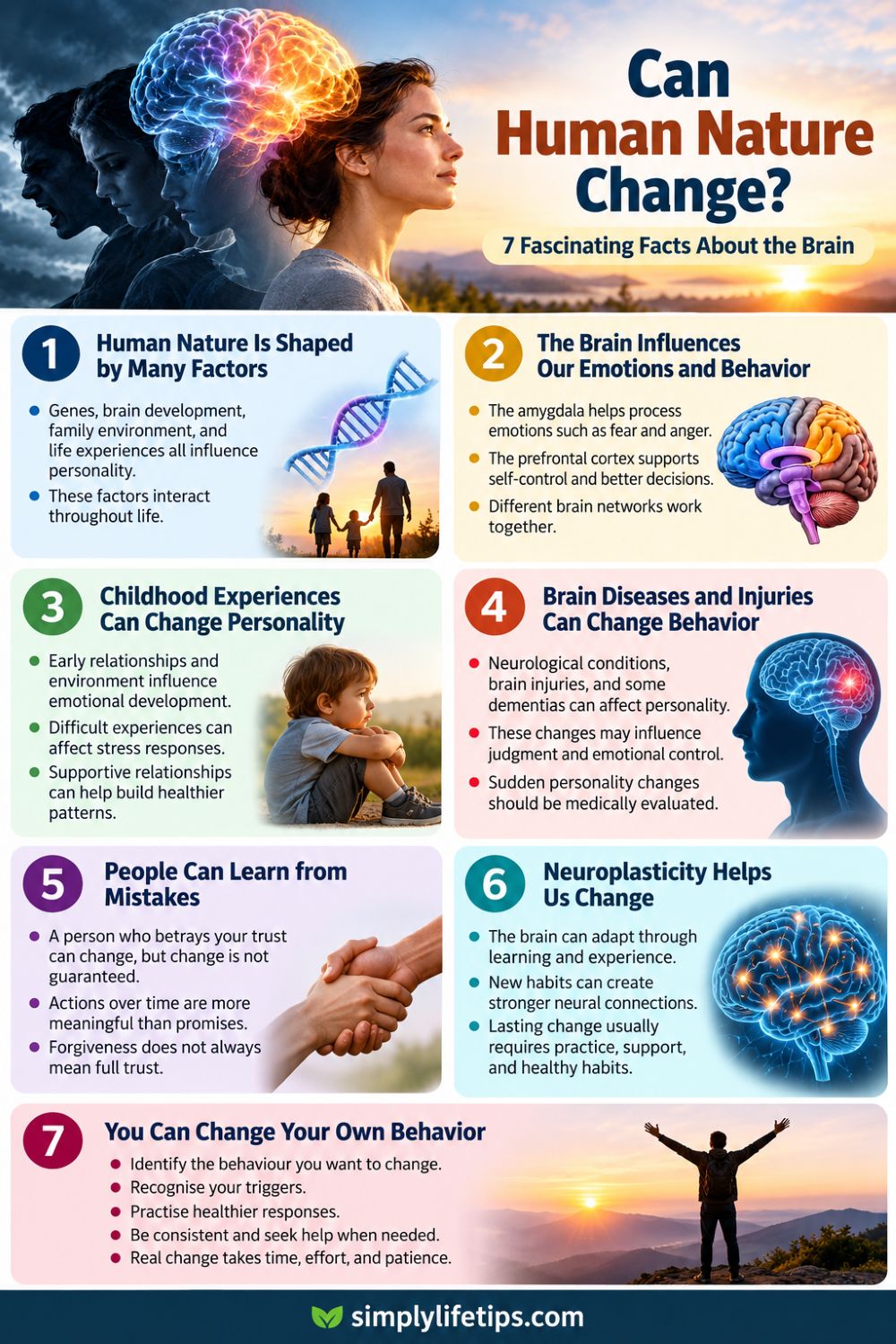
As the infographic explains, meaningful change takes time, practice, and consistent effort. Understanding our emotional triggers, developing healthier habits, and taking responsibility for our actions can help us respond differently. However, change is a personal process, and progress will vary from one individual to another.
So, rather than judging change by promises alone, look for consistent actions over time.
7. How Can You Change Your Own Behavior?
Recognizing an undesirable habit is a useful first step. Turning that awareness into lasting change requires a practical plan.
Step 1: Identify the behavior you want to change
Avoid vague goals such as “I want to become a better person.”
Choose a specific behavior instead.
For example, instead of saying, “I want to stop being angry,” try, “I will avoid shouting when I disagree with someone.”
Instead of saying, “I want to become less selfish,” try, “I will listen carefully before dismissing another person’s concerns.”
Specific goals make progress easier to observe.
Step 2: Recognize your triggers
Notice the situations that repeatedly produce an unwanted response.
Do you become angry when you feel ignored? Do you become defensive when someone criticizes your work? Do you lie because you fear the consequences of telling the truth?
Understanding a trigger does not excuse the behavior. It helps you identify where a different response can begin.
Sometimes, our assumptions influence how we interpret other people’s actions. Read how your brain tricks you to explore how perception, expectations, and thinking patterns can affect our judgments.
Step 3: Practise a replacement behavior
Simply deciding to stop an unwanted habit may not be enough. It helps to choose an alternative.
If you tend to interrupt people, practise waiting until they finish speaking. If you react aggressively during arguments, take a break when emotions become overwhelming, provided you can do so safely, and return to the discussion appropriately.
If you are tempted to conceal a mistake, practise acknowledging it honestly and explaining how you will correct it.
Step 4: Build consistency
One good decision does not establish a new pattern. Repeated choices provide more opportunities to develop different habits.
You may succeed several times and then slip into an old response. A setback does not automatically mean that change is impossible. Examine what happened, take responsibility, and return to your plan.
However, repeated harmful behavior should not be minimized as an ordinary setback, especially when it continues to hurt other people.
Step 5: Seek help when necessary
Some patterns are difficult to change without support.
A qualified mental health professional can help with persistent anger, anxiety, relationship difficulties, harmful habits, or other concerns that interfere with daily life.
Professional help can provide structured strategies, accountability, and a clearer understanding of the factors maintaining a behavior.
The goal is not necessarily to become a completely different person. It is to develop healthier, more responsible ways of thinking, feeling, and acting.
8. Are We Responsible for Our Actions if the Brain Influences Our Behavior?
If our brains, genes, and experiences influence our behavior, can we blame the brain for everything we do?
No. The brain is not separate from us; it is part of what makes our thoughts, feelings, and actions possible.
Biological factors and life circumstances can affect behavior. Some neurological conditions can also seriously impair judgment or behavioral control. These circumstances deserve appropriate understanding and, when necessary, medical evaluation.
Nevertheless, explaining why a behavior occurred is not the same as justifying the harm it caused.
For example, a person may have learned aggressive communication in childhood. That history may help explain why they react aggressively during conflict. It does not make it acceptable to threaten or hurt other people.
Taking responsibility means recognizing the behavior, acknowledging its consequences, and making a serious effort to prevent further harm.
We cannot rewrite every event in our past. We cannot control every person we meet. But many of us can learn to make different choices, seek support, and take greater responsibility for how we treat others.
Understanding the brain should help us change harmful behavior, not become an excuse for it.
Conclusion
Can human nature change? Modern psychology and neuroscience suggest that the answer is yes, within limits.
Personality is relatively stable, but it is not completely fixed. Genetics, childhood experiences, relationships, learning, and life circumstances influence who we become. Deliberate practice and appropriate psychological support can help people change certain traits and behaviors over time.
However, not everyone changes simply because they regret a mistake. Some people make sustained efforts to improve, while others repeat the same harmful patterns despite promising otherwise.
When evaluating change, look beyond words. Look for accountability, honesty, respect for boundaries, and consistent behavior over time.
Remember that understanding someone’s past can help explain their behavior, but it does not require you to accept mistreatment. You can believe in the possibility of change while protecting your own well-being.
We may not be able to change everything about ourselves, but we can work toward becoming more patient, honest, compassionate, and responsible.
Ultimately, real change is demonstrated not by what we promise today, but by how we behave tomorrow and in the days that follow.
Frequently Asked Questions About Human Nature and Personality
1. Can human nature change completely?
Complete transformation of every aspect of personality is unlikely for most people. However, personality traits and specific behaviors can change over time through experience, deliberate practice, and appropriate psychological support.
2. Can an angry person become calm?
Yes. A person who frequently reacts with anger can learn emotional regulation, identify triggers, pause before responding, and practise healthier communication. Progress takes time, and persistent difficulties may benefit from professional help.
3. Will someone who lies once always be a liar?
Not necessarily. One instance of lying does not establish a permanent personality trait. However, repeated dishonesty is a meaningful warning sign. Look for accountability and sustained honesty rather than relying on promises alone.
4. Does neuroplasticity mean we can change any habit?
No. Neuroplasticity supports learning and adaptation, but it does not guarantee that every habit or personality trait can be changed completely. The degree of change depends on many factors, including the behavior, individual circumstances, and available support.
5. Can childhood experiences determine adult personality?
Childhood experiences can influence adult personality, emotional responses, and relationships, but they do not determine every future outcome. Supportive relationships, new experiences, and psychological treatment can help people develop healthier patterns.
What do you think? Can people genuinely change their nature, or do their actions eventually reveal who they really are? Share your thoughts in the comments.

Mathukutty P. V. is the founder of Simply Life Tips. He shares practical advice and useful insights on personal growth, health, well-being, technology, and everyday living. His goal is to help readers build positive habits and make informed decisions. He believes in continuous learning and sharing knowledge to help people live healthier, happier, and more meaningful lives.