

Starting an intentional morning routine is the most powerful way to reclaim your focus and mental energy in an increasingly distracted world. We have all been there: the alarm blares, and your hand instinctively fumbles for your smartphone. Within seconds, you are scrolling through a feed of stressful news, work emails, and perfectly filtered social media lives that make you feel “behind” before you’ve even brushed your teeth. This is a Reactive Morning, and it’s a recipe for burnout.
But imagine a different path. Imagine waking up and feeling a sense of calm authority. Imagine having a “shield” of peace that protects you from the day’s inevitable stress. In this guide, we are going to break down exactly how to build a morning that serves you, rather than you serving the morning. Whether you have two hours or just ten minutes, you can learn to own your day.
What Exactly is an Intentional Morning Routine?
To understand an intentional morning routine, we must first define the word “intentional.” Intentionality is the act of doing something with a clear purpose.
Most people have a morning routine—it’s just an accidental one. They accidentally check their phones, accidentally rush through their coffee, and accidentally start their day in a state of anxiety. An intentional routine is the opposite. It is a sequence of habits that you have carefully chosen because they make you feel focused, energised, and balanced.
According to clinical psychologist Ellie Hambly, prioritising morning sunlight is a powerful way to manage stress and stabilise your mood. Even as the days shorten, shifting your schedule to catch natural light helps regulate your internal body clock by suppressing melatonin and boosting serotonin. This simple habit not only prepares you for the day ahead but is also proven to improve sleep quality at night.
Beyond the biological benefits, Hambly suggests that a phone-free morning walk can activate the brain’s default mode network. This specific neurological state—engaged when we are introspective or daydreaming—is a catalyst for creative problem-solving and generating new ideas. If a full walk isn’t possible, you can achieve a similar effect by simply enjoying your morning coffee at the door or taking a shower without the distraction of a podcast or music.
The Psychology of Intentionality
In 2026, our attention is our most valuable currency. Everyone wants a piece of it—advertisers, your boss, your friends, and your family. When you start your day intentionally, you are making a statement: “My attention belongs to me first.” This simple shift in mindset reduces cortisol (the stress hormone) and increases your “locus of control,” which is the belief that you are the driver of your own life.
The Benefits of Intentional Morning Routine
Why bother with a routine at all? Can’t we just “wing it”? While some people claim to thrive on chaos, science suggests that a structured start offers massive long-term benefits:
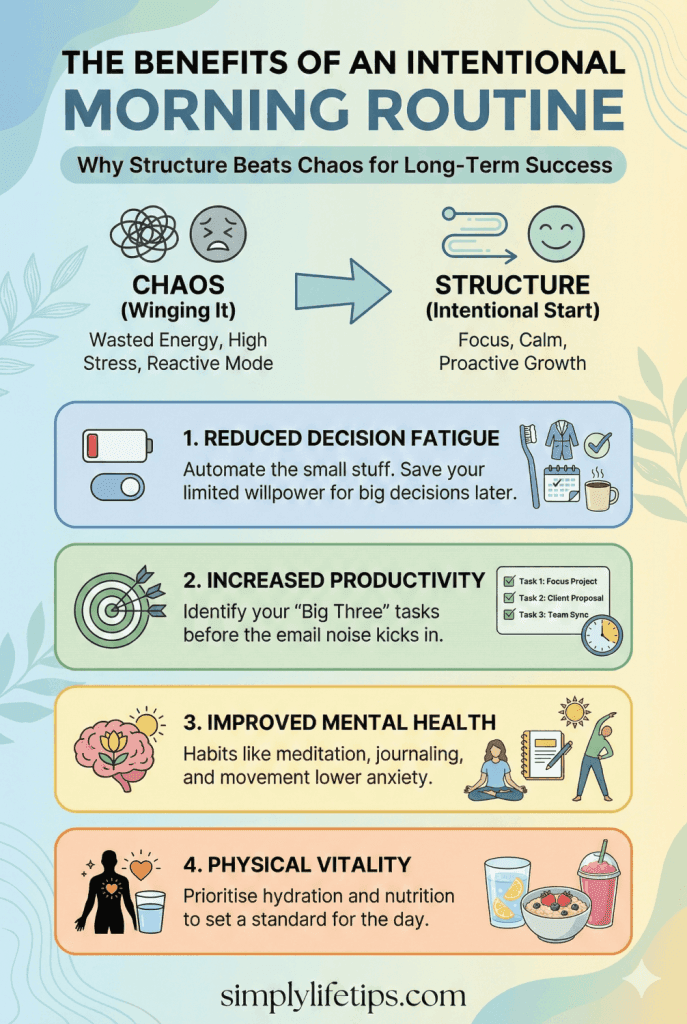
- Reduced Decision Fatigue: We only have a limited amount of willpower each day. If you have to “decide” what to do every morning, you waste brain power. A routine automates the small stuff so you can save your energy for big decisions.
- Increased Productivity: An intentional morning allows you to identify your “Big Three” tasks for the day before the noise of emails kicks in.
- Improved Mental Health: Habits like meditation, journaling, and light movement have been proven to lower symptoms of anxiety and depression.
- Physical Vitality: By prioritising hydration and nutrition early on, you set a standard for your body that lasts until dinner time.
Step 1: Winning the Night Before
You cannot have a successful intentional morning routine if you had a chaotic “accidental” evening. Think of your evening routine as the “pre-game” for your morning.
The “Clean Slate” Method
Before you go to bed, take 10 minutes to “reset” your environment.
- The Kitchen: Wash the dishes and clear the counters. Waking up to a clean kitchen feels like a fresh start.
- The Living Room: Fold the blankets and put away the remotes.
- The Entryway: Lay out your clothes for the next day. If you want to exercise, put your shoes by the door.
Is early morning exercise worth the effort? If you can manage it, the answer is a resounding yes. While the “ideal” workout window often depends on your unique chronotype and specific fitness objectives, such as fat loss (best in the morning). Strength-building sessions are probably slightly better for muscle gain. Consistency allows you to “reprogram” your body to excel at almost any time. Though your natural biological clock plays a role, habitual training helps your body adapt. Ultimately, morning sessions offer a distinct edge, providing unique advantages like accelerated fat burning and deeper, more restorative sleep.
The 3-2-1 Sleep Rule
To ensure you wake up refreshed, follow this rule:
- 3 Hours before bed: No more heavy meals.
- 2 Hours before bed: No more work. Close the laptop and stop checking Slack or emails.
- 1 Hour before bed: No more blue light. Put your phone in another room and pick up a physical book instead.
Step 2: Breaking the Phone Addiction
If there is one thing that ruins an intentional morning faster than anything else, it is the smartphone. When you check your phone first thing in the morning, you are immediately entering “input mode.” You are letting the world’s problems enter your private space before you have even found your own centre.
The Rule: Do not touch your phone for the first 30 minutes of your day. Buy a basic alarm clock so you don’t have to use your phone as your wake-up call. This one change alone will improve your mental health by 50% within a week.
Step 3: Building Your Custom Routine (The Three Pillars)
A great routine doesn’t have to be long, but it should be balanced. At simplylifetips.com, we recommend focusing on three specific pillars: The Body, The Mind, and The Soul.
Pillar 1: Nourish Your Body
Your body has been “fasting” and dehydrating for 8 hours. It needs a jumpstart.
- Hydration First: Drink 16 ounces (500ml) of water before you touch coffee.
- Movement: You don’t need a 60-minute CrossFit session. Five minutes of stretching or a brisk walk around the block is enough to wake up your muscles.
- Natural Light: Try to get sunlight in your eyes within 20 minutes of waking up to regulate your circadian rhythm.
Pillar 2: Focus Your Mind
Before you start “doing,” spend some time “thinking.”
- Journaling: Use the “Brain Dump” method. Write down everything you are worried about to clear your mental cache.
- Gratitude: Write down three specific things you are thankful for.
- The Top One: Identify the one task that, if you finish it today, will make the day a success.
Pillar 3: Quiet Your Soul
In a world that is always shouting, silence is a superpower.
- Meditation: Use a simple 4-7-8 breathing technique (inhale for 4, hold for 7, exhale for 8) to calm the vagus nerve.
- Prayer or Affirmation: Spend two minutes connecting with your higher purpose. State your intention for the day: “Today, I will lead with kindness.”
Comparison: The Reactive vs. Intentional Morning
| Feature | The Reactive Morning (Avoid) | The Intentional Morning (Goal) |
| Wake Up | Hits snooze 3 times | Listens to music or educational podcasts |
| First Action | Checks Instagram/Emails | Drinks water/Deep breathing |
| Breakfast | Grab-and-go sugary bar | Mindful tea/Nourishing meal |
| Commute | Listens to stressful news | Listens to music or educational podcast |
| Mood at 9 AM | Anxious and “behind” | Calm, prepared, and focused |
How to Make the Habit Stick (Habit Stacking)?
The reason most people quit their intentional morning routine after three days is that they rely on willpower. Instead, use Habit Stacking. Attach your new routine to an anchor that already exists.
- “After I brush my teeth (old habit), I will meditate for two minutes (new habit).”
- “After the coffee starts brewing (old habit), I will write three things I’m grateful for (new habit).”
Conclusion
Starting an intentional morning routine is not about becoming a perfect person overnight. It is about deciding that you deserve to start your day with respect. When you own your morning, you stop being a victim of your schedule. You start to see that you have the power to change your mood, your productivity, and your life—one small habit at a time. Don’t wait for “next Monday.” Start tonight by putting your phone in another room and laying out your clothes. Tomorrow morning, wake up and drink that glass of water. You are already on your way to a more intentional life.
What is the one small habit you are going to add to your morning tomorrow to make it more intentional?
Ready to commit to your mornings? > I’ve created a Free 7-Day Intentional Morning Habit Tracker to help you stay consistent this week. Download it, print it out, and tick off your progress every morning!
[ Download My Free Tracker Now ]
FAQ: Mastering Your Intentional Morning Routine
Does an intentional morning routine require waking up at 5:00 AM?
Not at all. The best time to wake up is the time that allows you 7-8 hours of sleep and gives you enough time for your routine before your main responsibilities start. Intentionality is about the quality of your time, not the hour on the clock.
What if I miss a day?
Don’t worry about it. Perfection is the enemy of progress. If you miss a day, just start the next morning again. Follow the “Never Miss Twice” rule to stay on track without the guilt.
Can I check the weather or my calendar during my routine?
Checking the weather is fine, but be careful with your calendar. Seeing a long list of meetings can trigger “pre-work anxiety.” It is usually better to save the calendar for the very end of your routine, after you have built your mental strength.
I am a parent with small children. How can I find time?
This is the biggest challenge! If you can’t wake up before them, involve them in a “Micro-Intention.” Practice two minutes of quiet breathing together or have a “gratitude share” over breakfast. It won’t be silent, but it will still be intentional.
How long should my routine be to be effective?
Even a 5-minute routine can change your life if done consistently. While 30-60 minutes is ideal for many, starting with just 10 minutes (3 minutes of water/stretching, 4 minutes of quiet, 3 minutes of planning) is highly effective for beginners.

Mathukutty P V is a Blogger, YouTuber, and Content Writer and the founder of Simply Life Tips. After taking voluntary retirement in 2017, he embraced a free lifestyle focused on learning, personal growth, and sharing practical wisdom to help others live with more purpose and positivity.


