

Emotional intelligence at work is increasingly recognised as an important quality of effective leadership, professional relationships and workplace success. Technical knowledge, experience and professional qualifications matter, but they do not always determine how successfully someone works with others.
Think about a manager who has excellent technical knowledge but struggles to handle criticism, becomes angry when employees make mistakes, or cannot understand the concerns of team members. Despite professional competence, such a manager may find it difficult to build trust and lead a team effectively.
Now consider another manager who listens carefully, understands personal emotions, handles disagreements calmly and recognises the feelings of employees. This manager may create a more supportive and productive working environment.
What makes the difference?
One important factor is emotional intelligence.
Who Introduced the Concept of Emotional Intelligence?
Daniel Goleman didn’t invent emotional intelligence. He made the world pay attention to it.
The concept existed before Goleman brought it into mainstream discussions.
In 1990, psychologists Peter Salovey and John D. Mayer published an influential academic paper titled Emotional Intelligence. They developed a framework explaining how people recognise, understand and regulate emotions in themselves and others.
Their research helped establish emotional intelligence as an important subject in psychological studies.
Then, in 1995, Daniel Goleman published his landmark book, Emotional Intelligence: Why It Can Matter More Than IQ.
The book introduced the concept to a much wider audience. Goleman explained how emotional intelligence could influence personal relationships, professional performance, leadership and everyday life.
His subsequent work connected emotional intelligence more directly with organisational leadership and workplace effectiveness.
In his influential Harvard Business Review article, What Makes a Leader?, Goleman explained why emotional intelligence is an important quality that distinguishes effective leaders.
What Is Emotional Intelligence at Work?
Emotional intelligence at work is the ability to recognise and understand emotions, manage personal reactions, understand other people’s feelings and use this awareness to develop healthy professional relationships.
It does not mean hiding emotions, avoiding disagreements or always agreeing with colleagues.
Instead, it means understanding what you feel, recognising how your behaviour affects others and choosing appropriate responses in different situations.
For example, imagine an employee makes a mistake in an important project.
A manager with poor emotional regulation might immediately become angry, criticise the employee publicly and create unnecessary tension.
An emotionally intelligent manager would first understand what happened, consider the circumstances, discuss the mistake privately and identify ways to prevent it from happening again.
The second approach does not mean ignoring mistakes. It means correcting them without damaging trust and confidence.
This is where emotional intelligence becomes valuable in professional life.
Developing emotional intelligence at work requires understanding both personal emotions and the emotional needs of colleagues.
Daniel Goleman’s Four Domains of Emotional Intelligence
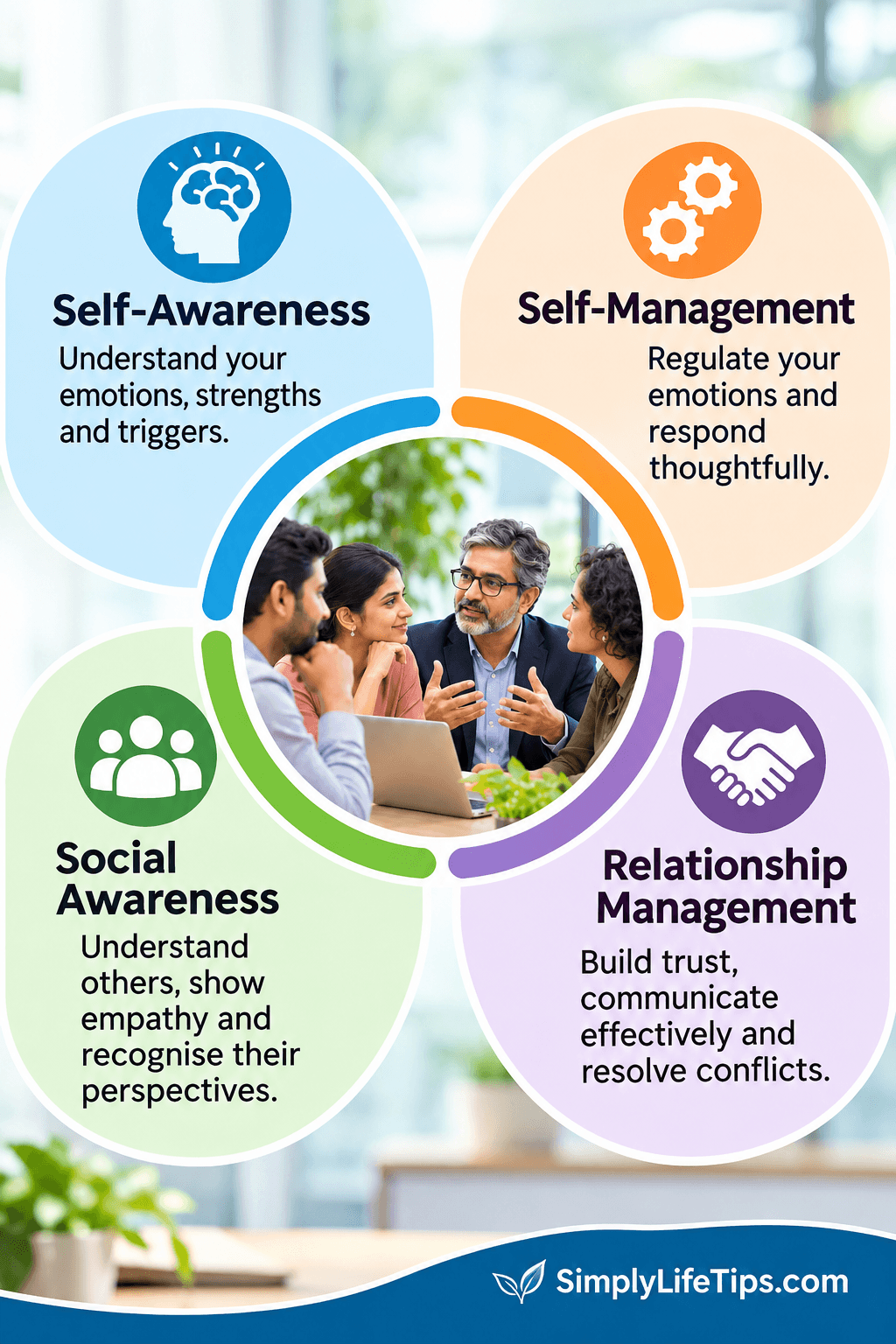
Goleman’s later leadership framework is commonly organised around four interconnected domains.
They are:
- Self-Awareness
- Self-Management
- Social Awareness
- Relationship Management
Each domain contributes to effective leadership and workplace relationships.
These four domains explain how emotional intelligence at work influences individual behaviour, leadership decisions and professional relationships.
Let’s understand how they work in everyday professional situations.
1. Self-Awareness: Understanding Yourself
Self-awareness is the foundation of emotional intelligence.
It involves recognising your emotions, understanding your strengths and weaknesses, and identifying how your feelings influence your decisions and behaviour.
A manager who understands personal emotions is better equipped to recognise situations that trigger frustration, anxiety or impatience.
For example, imagine a manager who becomes irritated whenever an employee questions a decision.
Without self-awareness, the manager may interpret every question as disrespect or opposition.
However, a self-aware manager recognises this emotional reaction and considers whether the employee is genuinely challenging authority or simply seeking clarification.
Instead of reacting defensively, the manager listens and responds constructively.
Why Self-Awareness Matters at Work
Self-awareness helps managers:
- Recognise emotional triggers.
- Understand personal strengths and weaknesses.
- Accept constructive criticism.
- Make thoughtful decisions.
- Recognise how their behaviour affects colleagues.
- Avoid unnecessary conflicts.
Practical example:
Suppose you have an important deadline and several employees are asking questions. You begin feeling frustrated because you believe they should already know what to do.
Recognising that the pressure is influencing your reaction helps you pause and communicate more clearly.
Instead of blaming employees, you can review the instructions and identify whether additional guidance is necessary.
Self-awareness helps you understand that your emotions are influencing your response.
Understanding the different signs of emotional intelligence can help you recognise how emotional awareness influences your behaviour and decisions. Read more about the unusual signs of emotional intelligence.
2. Self-Management: Managing Your Emotions and Reactions
Self-management is the ability to regulate your emotions and control impulsive reactions.
It does not mean suppressing feelings or pretending that everything is fine.
It means responding thoughtfully rather than allowing temporary emotions to control your behaviour.
Consider a situation where an employee disagrees with your decision during a team meeting.
An emotionally reactive manager might become defensive, raise their voice or attempt to silence the employee.
A manager with good self-management listens to the disagreement, considers the reasoning and explains the decision calmly.
Even when the manager disagrees, the discussion remains professional.
Why Self-Management Matters at Work
Self-management helps managers:
- Remain calm under pressure.
- Handle criticism constructively.
- Control impulsive reactions.
- Adapt to unexpected changes.
- Manage workplace stress.
- Maintain professional behaviour during disagreements.
Practical example:
Imagine receiving an unexpected complaint from a customer about your team’s performance.
Your immediate reaction might be frustration or anger.
Instead of sending an angry message to the employee responsible, take time to understand the complaint, verify the facts and discuss the issue privately.
A thoughtful response is usually more productive than an emotional reaction.
Learning to regulate your emotions is essential for handling workplace pressure and difficult situations. Explore these practical strategies for mastering emotions at work.
3. Social Awareness: Understanding Other People
Social awareness involves recognising and understanding other people’s emotions, concerns and perspectives.
Empathy is an important part of this domain.
In a workplace, employees have different personalities, responsibilities, challenges and personal circumstances. An effective manager understands that people do not always respond to situations in the same way.
For example, an employee who has recently become unusually quiet may be experiencing professional pressure, personal difficulties or uncertainty about their responsibilities.
A manager without social awareness might immediately assume that the employee has lost interest in work.
An empathetic manager takes time to understand the situation.
A simple question such as, “Is everything going well? Is there anything I can help you with?” can open the door to a meaningful conversation.
Why Social Awareness Matters at Work
Social awareness helps managers:
- Understand employee concerns.
- Recognise different perspectives.
- Develop empathy.
- Identify workplace tension.
- Understand team dynamics.
- Create a supportive working environment.
Practical example:
Suppose a normally active employee stops contributing during team discussions.
Instead of criticising the employee for a lack of participation, a socially aware manager tries to understand the reason.
Perhaps the employee feels that their ideas are not being considered, or they are uncomfortable speaking in front of senior colleagues.
Understanding the underlying concern can help the manager create a more inclusive environment.
Social awareness is not about assuming what others feel. It involves listening, observing and asking appropriate questions.
4. Relationship Management: Building Strong Workplace Relationships
Relationship management brings the other three domains together.
It involves using emotional awareness, self-management and empathy to develop positive relationships, communicate effectively, resolve conflicts and encourage cooperation.
A manager may understand personal emotions and recognise the feelings of employees. However, these abilities become useful only when they translate into constructive behaviour.
For example, imagine two employees disagree about how to complete an important project.
A manager with poor relationship management might take sides immediately, criticise both employees or allow the disagreement to continue.
A manager with strong relationship management listens to both perspectives, identifies common goals and helps them find a practical solution.
The objective is not simply to end the disagreement but to restore cooperation.
Why Relationship Management Matters at Work
Relationship management helps managers:
- Communicate clearly and respectfully.
- Resolve workplace conflicts.
- Build trust among employees.
- Encourage teamwork.
- Provide constructive feedback.
- Motivate and support team members.
- Manage difficult conversations.
Practical example:
Suppose an employee repeatedly misses deadlines, affecting the entire team.
Instead of publicly embarrassing the employee, the manager discusses the issue privately, explains its impact and listens to the employee’s concerns.
Together, they agree on realistic deadlines and ways to improve performance.
This approach combines accountability with understanding.
Good relationship management does not mean avoiding difficult conversations. It means handling them constructively.
Trust is an essential part of healthy professional relationships. Discover how building trust with emotional intelligence can strengthen communication and workplace relationships.
How the Four Domains Work Together
The four domains of emotional intelligence are interconnected. They are not separate abilities that operate independently.
Consider a manager who receives an unexpected complaint from an employee.
The four domains can work together in the following way:
Self-Awareness: The manager recognises an initial feeling of irritation.
Self-Management: Instead of reacting defensively, the manager pauses and remains calm.
Social Awareness: The manager listens carefully and tries to understand the employee’s concerns.
Relationship Management: The manager discusses possible solutions and agrees on practical next steps.
This example demonstrates why emotional intelligence is important in leadership.
You cannot manage your reactions effectively if you do not recognise your emotions.
You cannot understand employees if you never consider their perspectives.
And you cannot build strong professional relationships without using emotional awareness in your everyday interactions.
Why Is Emotional Intelligence Important in the Workplace?
Emotional intelligence contributes to a healthier working environment in several ways. This is where emotional intelligence at work becomes valuable.
Practising emotional intelligence at work can help employees communicate better, manage disagreements and contribute positively to team performance.
Better Communication
Emotionally intelligent employees and managers are more likely to listen carefully, express concerns respectfully and avoid unnecessary misunderstandings.
Stronger Teamwork
Understanding different personalities and perspectives makes cooperation easier. Employees feel more comfortable sharing ideas and working towards common goals.
Effective Conflict Resolution
Disagreements are inevitable in professional life. Emotional intelligence helps people address differences without allowing temporary frustration to damage long-term relationships.
Better Leadership
Leaders who understand their emotions and the concerns of their employees are better positioned to make thoughtful decisions and build trust.
A Supportive Work Environment
When people feel heard, respected and valued, they are more likely to participate positively in workplace activities.
However, emotional intelligence alone cannot solve every organisational problem. Fair policies, clear responsibilities, adequate resources and competent management are equally important.
Can Emotional Intelligence at Work Be Developed?
Yes. Emotional intelligence is not simply an inborn quality that some people possess, and others lack.
It involves abilities and behaviours that can be strengthened through awareness, practice and feedback.
Managers can strengthen emotional intelligence at work through regular self-reflection, active listening and constructive feedback.
Here are a few practical ways to begin:
- Observe your emotions: Notice how you react when someone disagrees with you or criticises your work.
- Pause before responding: Give yourself time to think before reacting to difficult situations.
- Practise active listening: Listen to understand rather than simply preparing your response.
- Consider different perspectives: Try to understand why another person may see a situation differently.
- Accept feedback: Be willing to recognise how your behaviour affects colleagues.
- Improve communication: Express your thoughts clearly without unnecessary criticism or blame.
- Reflect on difficult situations: Consider what went well and what you could handle differently next time.
Small changes in everyday behaviour can gradually improve emotional awareness and professional relationships.
Developing emotional intelligence requires consistent effort, self-reflection and practice. Read our guide on steps to develop emotional intelligence for additional practical ideas.
Conclusion
Emotional intelligence at work is not about being agreeable all the time or avoiding difficult situations. It is about understanding emotions and using that understanding to make better decisions, communicate effectively and build stronger relationships.
Daniel Goleman helped bring emotional intelligence into mainstream discussions about leadership and professional success. His four-domain framework provides a useful way to understand how personal awareness and interpersonal skills contribute to effective management.
Self-awareness helps you understand yourself. Self-management helps you regulate your reactions. Social awareness helps you understand others. Relationship management helps you build meaningful connections.
Together, these four domains offer a practical foundation for developing emotionally intelligent leadership.
Over the next four articles, we will explore each domain in greater detail, using practical workplace situations that managers encounter every day.
Which of these four areas do you think is the most challenging for managers today?
Frequently Asked Questions
1. What is emotional intelligence at work?
Emotional intelligence at work is the ability to recognise and manage your emotions, understand other people’s feelings and use this awareness to communicate effectively and maintain healthy professional relationships.
2. Who introduced the concept of emotional intelligence?
Psychologists Peter Salovey and John D. Mayer published an influential academic framework for emotional intelligence in 1990. Daniel Goleman popularised the concept through his 1995 book, Emotional Intelligence: Why It Can Matter More Than IQ.
3. What are the four domains of emotional intelligence?
The four domains in Goleman’s later leadership framework are self-awareness, self-management, social awareness and relationship management.
4. Why is emotional intelligence important for managers?
Emotional intelligence helps managers understand their reactions, communicate effectively, resolve conflicts, recognise employee concerns and develop stronger professional relationships.
5. Can emotional intelligence be improved?
Yes. People can develop emotional intelligence through self-reflection, active listening, emotional regulation, constructive feedback and regular practice in everyday interactions.
References
- Salovey, P., & Mayer, J. D. (1990). Emotional Intelligence. Imagination, Cognition and Personality.
- Goleman, D. (1998). What Makes a Leader?. Harvard Business Review.
- The Measurement of Emotional Intelligence: A Critical Review of the Literature and Recommendations for Researchers and Practitioners. Frontiers in Psychology (2019).

Mathukutty P. V. is the founder of Simply Life Tips. He shares practical advice and useful insights on personal growth, health, well-being, technology, and everyday living. His goal is to help readers build positive habits and make informed decisions. He believes in continuous learning and sharing knowledge to help people live healthier, happier, and more meaningful lives.