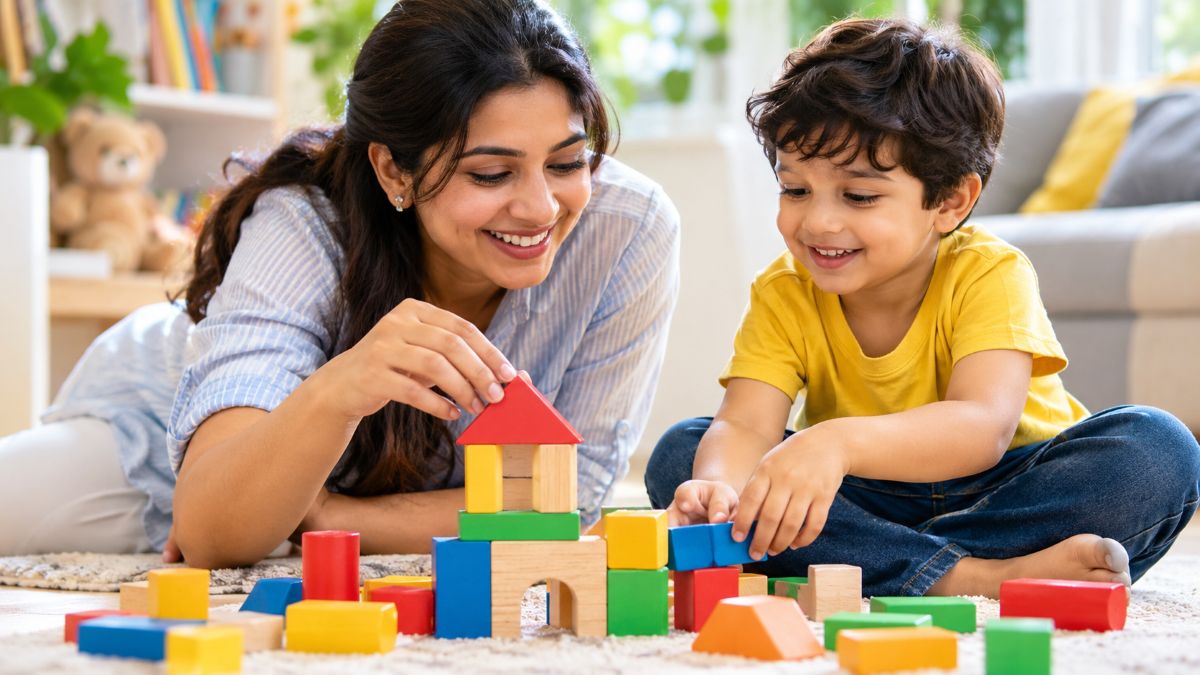
The importance of play in child development lies in helping children learn, explore, grow and thrive through enjoyable everyday experiences. For children, play is much more than entertainment. It is a natural way to understand the world, develop essential life skills, express emotions and build relationships.
From stacking building blocks and drawing pictures to playing outdoor games and pretending to run a shop, every playful experience offers learning opportunities. Through these activities, children gradually develop physical coordination, language abilities, creativity, problem-solving skills and emotional confidence.
In today’s busy world, children often have structured schedules filled with schoolwork, tuition classes and screen-based entertainment. Although these activities can have their place, children also need sufficient time for free, enjoyable and meaningful play.
Let’s explore why play is essential for children’s growth, the different types of play, its developmental benefits and how parents can encourage learning through everyday activities.
What Is Play in Child Development?
Play in child development refers to enjoyable activities that help children explore, learn, express themselves and develop essential skills through everyday experiences.
Unlike formal classroom learning, play usually allows children to explore at their own pace. They can experiment, make mistakes, discover new possibilities and develop their abilities without feeling pressured to achieve a particular result.
For example, when a child builds a tower using blocks, they are not simply arranging toys. They are exploring balance, shapes, sizes, gravity and spatial relationships. When the tower falls, they may try again using a different arrangement. This simple activity encourages experimentation, persistence and problem-solving.
Similarly, when children pretend to be teachers, doctors, shopkeepers or parents, they practise communication, imagination and social interaction.
Play can be child-led, adult-guided or organised as part of a group activity. Each form offers valuable developmental opportunities.
Importance of Play in Child Development
The importance of play in child development is evident in how it strengthens children’s bodies, thinking abilities, emotional understanding, communication and relationships.
Here are ten important ways play contributes to children’s overall development.
1. Supports Physical Development
Physical play helps children develop strength, balance, flexibility, coordination and motor skills. Activities involving movement allow children to understand how their bodies work while improving their physical abilities.
Running, jumping, climbing, dancing, cycling and playing ball games are examples of activities that encourage gross motor development. These movements strengthen large muscle groups and improve balance and coordination.
Fine motor development also benefits from play. Activities such as drawing, colouring, cutting paper with child-safe scissors, threading large beads and building with blocks help children develop control over the muscles in their hands and fingers.
Example: Give a child building blocks, modelling clay or age-appropriate beads. Encourage them to create simple shapes, animals or structures. These activities strengthen hand-eye coordination and fine motor control.
2. Improves Cognitive Development and Problem-Solving Skills
Cognitive development involves learning, thinking, remembering, reasoning and understanding information. Play provides children with opportunities to practise these abilities through enjoyable experiences.
Puzzles, memory games, construction toys, sorting activities and simple board games encourage children to observe patterns, recognise relationships and solve problems.
For example, when a child tries to complete a jigsaw puzzle, they must examine different shapes, identify matching pictures and decide where each piece belongs. If a piece does not fit, they learn to try another possibility.
Building blocks also encourage mathematical thinking. Through hands-on exploration, children begin to understand concepts such as height, size, quantity, symmetry, balance, and measurement.
Example: Ask your child to build the tallest tower possible using ten blocks. If it falls, encourage them to think about why it happened and how they could make the structure more stable.
3. Encourages Creativity and Imagination
Creativity is an essential part of childhood learning. Through imaginative play, children develop the ability to think independently, explore possibilities and express original ideas.
Pretend play allows children to create imaginary situations and take on different roles. They may pretend to operate a restaurant, run a school, care for a doll or travel to another planet.
These experiences encourage storytelling, creative thinking and imaginative expression.
Artistic activities also provide valuable opportunities for creativity. Drawing, painting, music, dancing, crafts and building with recyclable materials allow children to communicate ideas in different ways.
Example: Provide cardboard boxes, crayons, paper, safe craft materials and other reusable household items. Invite your child to create a toy house, vehicle or imaginary animal. Let them decide what to make rather than giving detailed instructions.
When children have the freedom to experiment, they learn that there are several ways to approach a problem or express an idea.
4. Develops Social Skills and Cooperation
Playing with other children helps develop essential social skills. Children learn how to communicate, share resources, cooperate, take turns and respect other people’s ideas.
Group games provide opportunities to understand rules and work towards shared goals. Children also learn that other people may have different opinions, preferences and expectations.
For example, when children play a team game, they must communicate with teammates, follow agreed rules and cooperate to achieve a common objective.
Sometimes disagreements occur during play. Two children may want to use the same toy or disagree about the rules of a game. With appropriate guidance, they can learn to listen, negotiate and find solutions.
Example: Organise a simple building activity where two or three children work together to construct a bridge using blocks. Encourage them to discuss their ideas and decide how to complete the structure.
5. Strengthens Emotional Development and Self-Regulation
Children experience many emotions, including happiness, excitement, frustration, disappointment and fear. Play provides a comfortable environment in which they can explore and express these feelings.
Through pretend play, children may act out situations they have experienced in everyday life. For example, a child who has recently visited a hospital may pretend to examine a doll or treat a stuffed animal.
Such activities can provide opportunities to express feelings, explore familiar experiences and develop emotional understanding.
Games also teach children how to manage disappointment and frustration. Losing a board game, waiting for a turn or rebuilding a fallen tower can help children practise patience and emotional regulation.
Example: When a child becomes upset because a block structure collapses, acknowledge their feelings instead of immediately rebuilding it for them. You might say, “I can see you are disappointed. Would you like to try building it again?”
Parents can also explore positive approaches to emotional guidance through discipline with gentle parenting.
6. Improves Language and Communication Skills
Play creates natural opportunities for children to practise speaking, listening, asking questions and expressing their thoughts.
During pretend play, children often use new words and create conversations based on imaginary situations. When playing shop, for instance, they may practise greeting customers, asking about prices, counting money and describing products.
Storytelling and role-playing also encourage vocabulary development and sentence formation.
Playing with other children provides opportunities to listen to different viewpoints, explain ideas and communicate needs.
Example: Set up a pretend grocery shop at home using empty food containers, toy money and a shopping basket. Encourage your child to become the shopkeeper while you act as the customer.
Ask questions such as, “How much does this apple cost?” or “What would you recommend today?” Such conversations make language learning enjoyable and practical.
7. Builds Confidence and Independence
Play allows children to make choices, experiment with new activities and experience the satisfaction of completing tasks independently.
When children successfully solve a puzzle, learn to ride a bicycle or complete a creative project, they develop a sense of achievement.
Even when they make mistakes, they have opportunities to try again and discover different solutions.
Allowing children to choose their activities also supports independence and decision-making.
Example: Offer your child two or three age-appropriate activities, such as drawing, building blocks or a simple puzzle. Allow them to choose what they would like to do and give them enough time to complete it.
Avoid correcting every small mistake or taking over the activity. Support and encouragement help children develop confidence in their own abilities.
8. Develops Sensory Awareness and Exploration
Sensory play involves activities that stimulate children’s senses of touch, sight, hearing, smell and, where appropriate, taste.
These experiences help children explore different materials, textures, sounds, shapes and properties of objects.
Activities such as playing with water, exploring sand, finger painting, sorting natural objects and listening to different sounds provide opportunities for sensory exploration.
For example, when children play with sand, they discover how it feels when dry or wet, how it changes shape and how different objects leave marks on its surface.
Example: Prepare a supervised sensory tray containing large, age-appropriate natural objects such as leaves, smooth stones and pinecones. Encourage children to describe their textures, shapes and colours.
Sensory activities can encourage curiosity, observation, vocabulary development and hands-on learning.
Always choose materials appropriate for the child’s age and supervise activities carefully, particularly when small objects or materials that could be swallowed are involved.
9. Encourages Curiosity and a Love of Learning
Children are naturally curious. They often learn by asking questions, investigating objects and experimenting with their surroundings.
Play encourages this curiosity by giving children opportunities to discover how things work.
Simple science activities, nature exploration, gardening, water play and construction games can introduce basic scientific and mathematical concepts.
For example, children may wonder why some objects float while others sink. A supervised water experiment with safe household objects can help them explore the difference.
Gardening also provides meaningful learning opportunities. Children can plant seeds, water them, observe growth and learn about the needs of living things.
Example: Plant a few fast-growing seeds in small pots with your child. Ask them to observe changes every few days and describe what they notice.
These experiences encourage observation, questioning, experimentation and an interest in lifelong learning.
10. Strengthens Parent-Child Relationships
Playing together provides valuable opportunities for parents and children to connect. Shared activities create enjoyable experiences, encourage communication and strengthen emotional bonds.
Children often feel valued when parents give them their attention and show genuine interest in their activities.
Parents do not need expensive toys or elaborate arrangements to make play meaningful. Simple activities such as storytelling, drawing, building blocks, cooking together and playing outdoor games can create memorable experiences.
Example: Set aside 15–20 minutes of uninterrupted time each day for an activity chosen by your child. Put away distractions, listen to their ideas and participate with enthusiasm.
This shared time can help children feel supported, understood and emotionally secure.
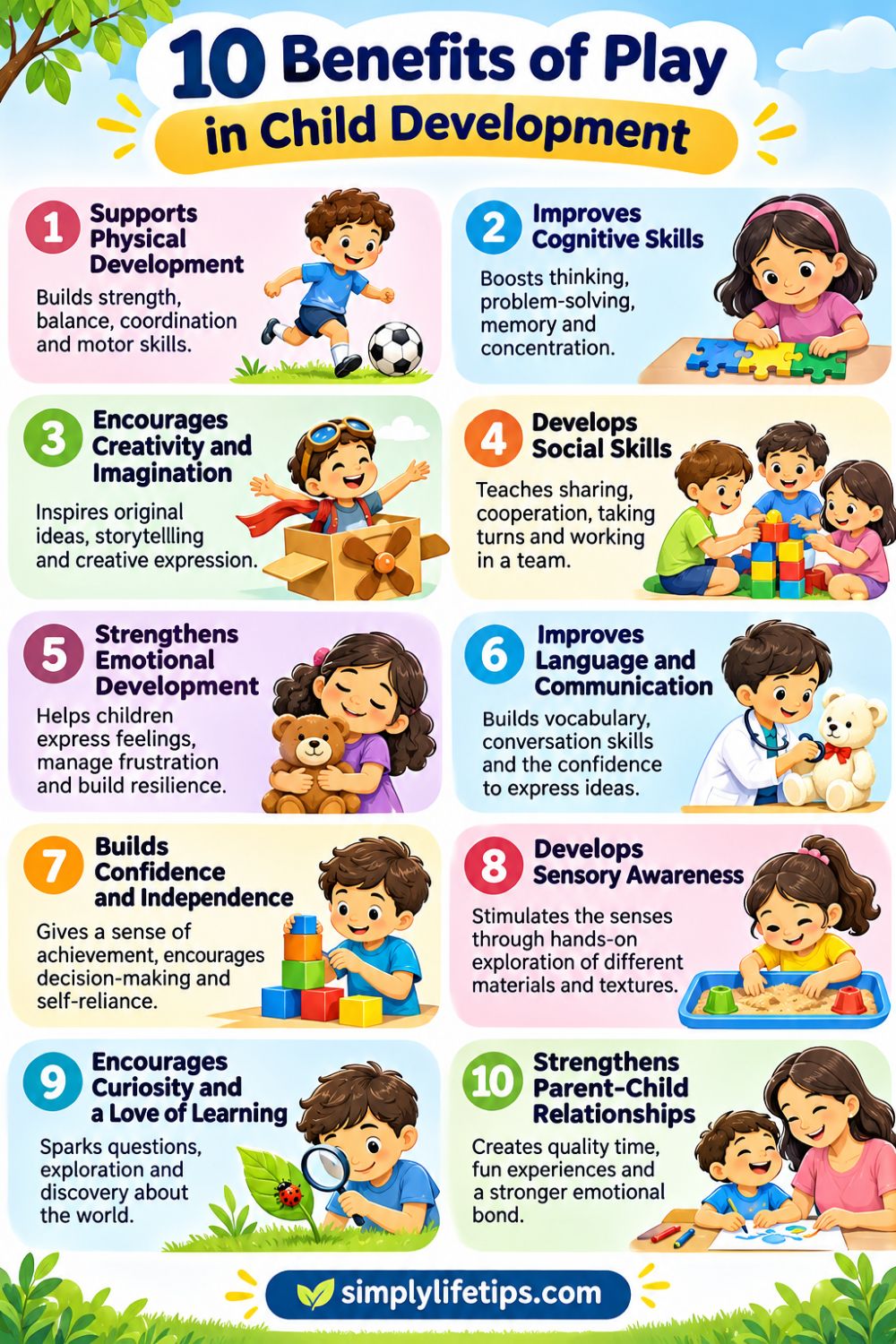
The following infographic summarises ten important benefits of play and shows how everyday playful experiences contribute to children’s overall development.
Different Types of Play in Child Development
Understanding different types of play highlights the importance of play in child development and shows how children’s learning experiences change as they grow.
1. Unoccupied Play
Unoccupied play involves movements and activities that may appear random or unstructured. Young babies may move their arms and legs, observe their surroundings or explore objects within reach.
These early experiences help children become familiar with their bodies and environment.
2. Solitary Play
Solitary play occurs when a child plays independently without actively interacting with other children.
For example, a toddler may spend time stacking blocks, looking at picture books or playing with toy animals.
Independent play encourages concentration, creativity and self-directed exploration.
3. Onlooker Play
During onlooker play, a child watches other children playing without immediately joining them.
For example, a toddler may observe a group of children building a sandcastle. They may watch their actions, listen to their conversations and gradually become interested in participating.
4. Parallel Play
Parallel play occurs when children play alongside one another using similar toys or materials without directly cooperating.
For example, two toddlers may sit next to each other, each building a separate tower with blocks.
Although they are not yet playing together in an organised way, they may observe and imitate one another.
5. Associative Play
In associative play, children interact, communicate and share materials, but their activities may not have a common goal.
For example, several children may play with toy cars together, exchange toys and discuss what they are doing without organising a shared game.
6. Cooperative Play
Cooperative play involves children working together towards a shared objective. They may organise roles, agree on rules and participate in a common activity.
For example, children may work together to build a large block structure or organise a pretend restaurant.
Cooperative play helps develop teamwork, communication, negotiation and problem-solving skills.
7. Pretend or Imaginative Play
Pretend play involves using imagination to create situations, characters and experiences.
Children may pretend to be doctors, teachers, shopkeepers, superheroes or family members.
This type of play encourages creativity, language development, emotional expression and social understanding.
8. Constructive Play
Constructive play involves creating or building something using materials such as blocks, clay, cardboard, sand or construction toys.
For example, children may build a house using blocks or create shapes using modelling clay.
These activities support creativity, spatial awareness, planning and problem-solving.
9. Physical Play
Physical play involves activities that require body movement and coordination.
Examples include running, jumping, climbing, dancing, cycling and playing ball games.
Such activities support physical fitness, gross motor development and coordination.
10. Exploratory Play
Exploratory play involves investigating objects, materials and surroundings to discover how things work.
For example, children may explore the properties of water, examine leaves, observe insects or experiment with different building materials.
This encourages curiosity, observation and early scientific thinking.
These types of play can overlap, and children do not necessarily experience them in a fixed sequence.
How Parents Can Encourage Play in Child Development
Parents support child development through play by creating opportunities for meaningful activities without organising every game or turning play into a lesson.
Provide Age-Appropriate Toys and Materials
Choose toys that encourage creativity, exploration and problem-solving rather than relying only on electronic or battery-operated toys.
Building blocks, puzzles, picture books, art supplies, dolls, balls and simple construction materials can provide many learning opportunities.
Allow Time for Free Play
Children need time to choose their own activities without constant adult direction.
Avoid filling every part of the day with structured lessons, tuition and organised activities. Allow children to explore their interests and create their own games.
Encourage Outdoor Activities
Whenever possible, provide opportunities for outdoor play in safe environments.
Parks, gardens and playgrounds offer space for running, climbing, exploring nature and interacting with other children.
Participate Without Taking Control
Parents can join children’s activities, ask questions and offer encouragement without controlling every decision.
For example, when a child is drawing a picture, instead of telling them what to draw, ask them to describe their creation.
Encourage Play with Other Children
Arrange opportunities for children to interact with siblings, cousins and friends.
Group activities help children practise sharing, cooperation, communication and conflict resolution. Parents can also reinforce positive behaviour through consistent, age-appropriate guidance. For additional ideas, read Teaching Children Discipline: Best Practices.
Reduce Unnecessary Screen Time
Digital devices can offer educational and entertainment opportunities, but they should not replace active, creative and social play.
Encourage a healthy balance between screen-based activities, outdoor movement, reading, imaginative play and family interaction.
Age-Appropriate Play Activities for Children
Children’s interests and abilities change as they grow. Parents can choose activities that match their developmental stage while allowing for individual differences.
Babies: Birth to 12 Months
- Gentle peekaboo games.
- Supervised tummy time when awake.
- Talking and singing.
- Exploring safe, age-appropriate textured toys.
- Looking at colourful picture books.
These activities encourage sensory exploration, early communication and physical development.
Toddlers: 1–3 Years
- Stacking large building blocks.
- Simple sorting games.
- Pretend cooking.
- Scribbling with suitable crayons.
- Dancing to music.
- Playing with balls.
These activities encourage coordination, language development, imagination and early problem-solving.
Preschoolers: 3–5 Years
- Role-playing as doctors or teachers.
- Building structures with blocks.
- Drawing and painting.
- Simple puzzles.
- Storytelling.
- Supervised gardening.
These activities encourage creativity, communication, cooperation and independent thinking.
School-Age Children: 6–12 Years
- Team sports.
- Board games.
- Science experiments with adult supervision.
- Craft projects.
- Gardening.
- Treasure hunts.
- Group construction activities.
These activities support strategic thinking, teamwork, problem-solving, physical fitness and social development.
Children develop at different rates, so these age ranges are general suggestions rather than strict developmental deadlines.
Indoor Play vs Outdoor Play: Why Children Need Both
Both indoor and outdoor play offer valuable developmental opportunities. Rather than choosing one over the other, parents should provide a healthy balance.
Indoor play can encourage concentration, creativity, language development and problem-solving.
Examples include puzzles, drawing, reading, building blocks, pretend play and board games.
Outdoor play offers opportunities for physical movement, exploration, social interaction and contact with nature.
Examples include running, cycling, climbing, gardening, ball games and nature walks.
For example, a child who builds a toy house indoors may develop construction and planning skills. The same child playing outside with friends may practise cooperation, physical coordination and communication.
A balanced combination of indoor and outdoor activities supports different aspects of children’s development.
The Role of Unstructured Play in Childhood
Unstructured play is child-led activity without a fixed outcome or detailed instructions from adults.
For example, when children receive a collection of blocks and decide independently what to build, they are engaging in unstructured play.
This form of play is valuable because it allows children to make decisions, explore their interests, solve problems and use their imagination.
Not every activity needs to produce a finished project or demonstrate a particular learning outcome.
A child may spend an entire afternoon creating imaginary stories with toy animals. Although the activity may appear simple, it can encourage creativity, language development and emotional expression.
Parents should provide safe opportunities for unstructured play alongside organised activities and adult-guided learning.
What Happens When Children Don’t Get Enough Opportunities to Play?
Play is an important part of a balanced childhood. When children have limited play opportunities, they may miss valuable experiences that support their overall development.
Insufficient opportunities for active play may reduce chances to practise physical coordination and movement skills.
Limited social play may reduce opportunities to practise sharing, cooperation and conflict resolution.
Similarly, when children rarely engage in imaginative or creative activities, they have fewer opportunities to experiment with ideas and express themselves through play.
However, it is important not to assume that every developmental difficulty is caused by a lack of play. Children’s development is influenced by many factors, including relationships, health, education, environment and individual needs.
Parents can support healthy development by providing regular opportunities for varied, enjoyable and age-appropriate play.
Common Mistakes Parents Should Avoid During Play
Although parents want the best for their children, certain approaches can unintentionally reduce the benefits of play.
1. Making every activity a lesson: Children need opportunities to play for enjoyment without constant instruction or testing.
2. Over-scheduling children’s time: Too many structured activities can leave little room for independent exploration and relaxation.
3. Comparing children: Every child has different interests, abilities and developmental patterns. Avoid comparing their play skills with those of siblings or friends.
4. Choosing only expensive toys: Children can learn through simple, safe and creative materials. Expensive toys are not necessary for meaningful play.
5. Ignoring outdoor play: Spending too much time indoors can limit opportunities for physical activity and nature exploration.
6. Interrupting independent play unnecessarily: When children are safely engaged in an activity, allow them time to concentrate and explore.
7. Focusing only on winning: Competitive games can be enjoyable, but children also need opportunities to learn cooperation, sportsmanship and participation.
Conclusion
The importance of play in child development goes far beyond entertainment, supporting children’s physical abilities, thinking skills, emotional expression, communication and confidence.
From simple activities such as drawing and stacking blocks to outdoor adventures and imaginative group games, every playful experience can contribute to children’s growth and learning.
Parents should remember that children do not need every moment of their day to be structured or educational. They need time, freedom, encouragement and a safe environment to explore the world through play.
By making play a regular part of family life, parents can support healthier development and create joyful childhood memories that last a lifetime.
Are you giving your child enough time and freedom to learn, explore and grow through play?
Frequently Asked Questions About the Importance of Play in Child Development
1. Why is play important in child development?
Play is important because it supports physical, cognitive, emotional, social and language development. It allows children to explore their surroundings, practise new skills, solve problems, express feelings and build relationships.
2. What are the 10 benefits of play for children?
The ten major benefits include improved physical development, cognitive skills, creativity, social interaction, emotional regulation, language development, confidence, sensory awareness, curiosity and stronger parent-child relationships.
3. What are the different types of play in child development?
Common types include unoccupied play, solitary play, onlooker play, parallel play, associative play, cooperative play, pretend play, constructive play, physical play and exploratory play.
4. How does play improve a child’s social skills?
Play gives children opportunities to communicate, share, cooperate, take turns, follow rules and resolve disagreements. Group games and pretend activities help children understand other people’s feelings and perspectives.
5. How can parents encourage learning through play?
Parents can provide age-appropriate toys, allow free play, encourage outdoor activities, read stories, participate in imaginative games and give children opportunities to explore independently. A safe and supportive environment is more important than expensive toys or elaborate activities.
References and Further Reading
- The Power of Play: A Pediatric Role in Enhancing Development in Young Children – American Academy of Pediatrics. A clinical report explaining the role of play in children’s cognitive, social-emotional and language development.
- Principles of Child Development and Learning – National Association for the Education of Young Children (NAEYC). Research-informed guidance on play-based learning and developmentally appropriate practice.
- Early Childhood Development – UNICEF. Information about early childhood development, learning and nurturing care.

Mathukutty P. V. is the founder of Simply Life Tips. He shares practical advice and useful insights on personal growth, health, well-being, technology, and everyday living. His goal is to help readers build positive habits and make informed decisions. He believes in continuous learning and sharing knowledge to help people live healthier, happier, and more meaningful lives.