
Neuroplasticity exercises can help us understand how the brain adapts to learning, experience, and repeated practice throughout life. Have you ever thought that you are too old to learn something new, that your habits can never change, or that your past determines your future? The science of neuroplasticity offers a more hopeful perspective: our brains retain the ability to adapt, although the extent and pace of change vary from person to person.
Yesterday’s experiences may have shaped who you are today, but they do not necessarily determine who you will become tomorrow. Small, consistent steps can help you develop skills, practise healthier habits, and approach life’s challenges differently.
Neuroplasticity exercises offer practical ways to challenge your brain, learn new skills, develop healthier habits, and remain mentally engaged throughout life. With consistent practice, these activities can support lifelong learning and help you approach everyday challenges with greater confidence.
This article is inspired by ideas shared by Dr Arun Oommen, a neurosurgeon, and explores 15 practical ways to apply the concept of neuroplasticity in everyday life.
Neuroplasticity is not just a scientific concept; it also helps us understand how learning, repeated practice, and everyday experiences can shape the way we think and act. The following infographic highlights 15 practical activities and habits that can support learning, encourage personal growth, and promote brain health throughout life.
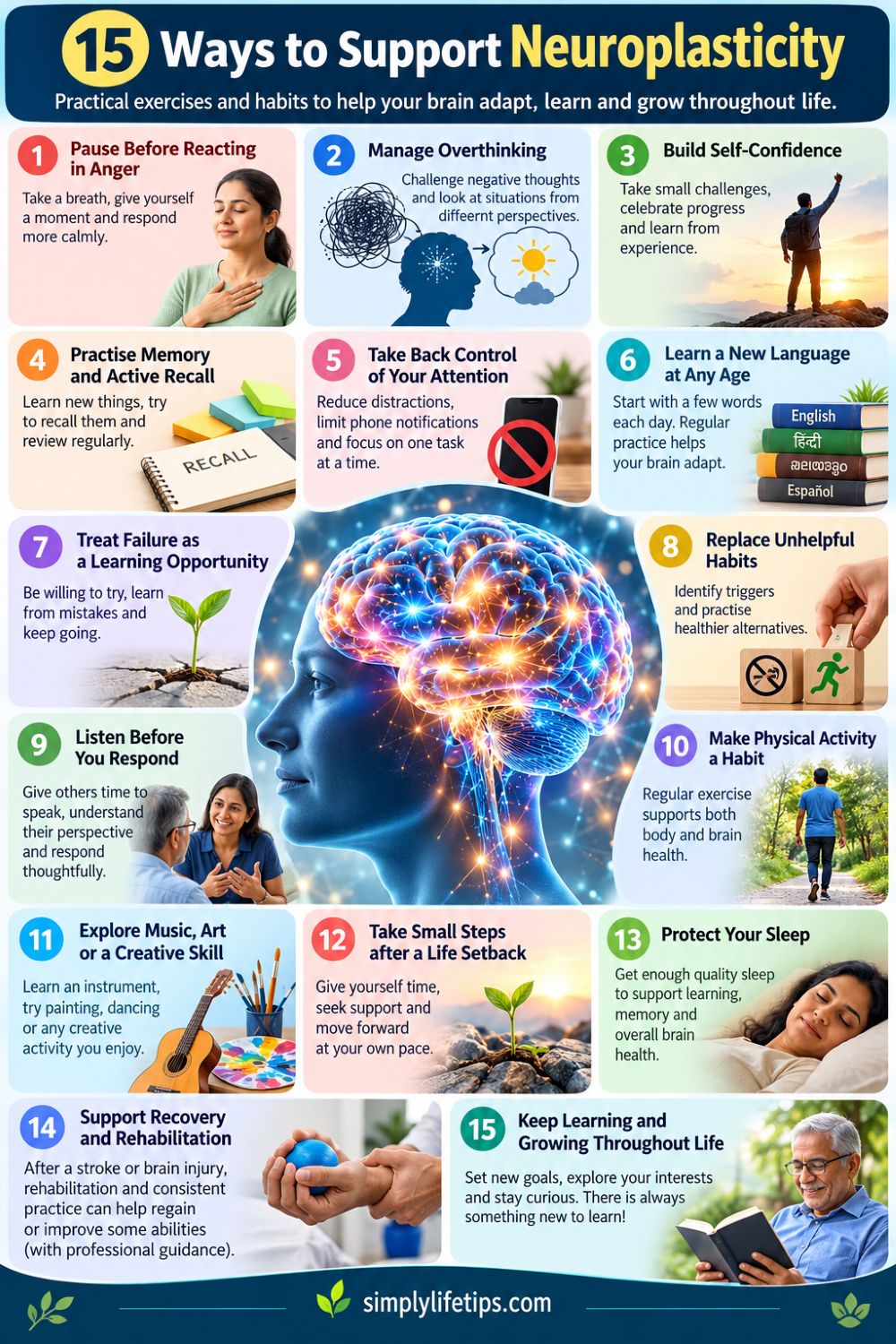
These activities are not guaranteed ways to change the brain or overcome every difficulty. Their benefits depend on factors such as consistency, individual circumstances, and overall health. Choose one or two practices that suit your daily routine and build on them gradually. Let’s explore each of these 15 ideas in more detail.
What Is Neuroplasticity?
Neuroplasticity is the brain’s ability to change its structure, connections, and patterns of activity in response to learning, experience, and changes in our environment.
Our brains contain billions of nerve cells called neurons. These cells communicate through complex networks of connections. When we learn a new skill, practise a task, or encounter new experiences, some of these connections and patterns of activity can change.
Neuroplasticity helps explain how learning and experience can influence the way we think and behave. However, changing habits and aspects of personality takes time and is not guaranteed. Read our article on whether human nature can change to explore the relationship between brain function, personality, and personal growth.
Repeated practice can make particular skills more familiar and efficient. Meanwhile, connections that receive less use may change over time. These processes are part of how the brain learns, adapts, and sometimes compensates for injury. However, brain changes are complex, and not every change necessarily improves performance. Cleveland Clinic explains neuroplasticity and how it supports learning and adaptation.
The encouraging message is that learning does not have to end when formal education finishes. People can continue acquiring knowledge and developing skills throughout adulthood and older age, even though learning speed and the type of changes that occur can vary.
Many popular beliefs about the human brain are misleading, particularly those concerning memory, learning, and ageing. Explore our guide to 12 common brain myths debunked by science to discover what scientific evidence tells us about the brain and its capabilities.
15 Neuroplasticity Exercises and Everyday Practices
The following activities offer practical ways to challenge your brain, practise new responses, and support healthy learning. Some involve direct mental practice, while others are lifestyle habits that support overall brain health. None guarantees a particular result.
1. Pause Before Reacting in Anger
Do you sometimes react angrily before thinking about the consequences?
When you feel anger rising, try pausing before responding. Take a few slow breaths, give yourself time to think, and consider whether your response will improve the situation.
For example, if a family member says something upsetting, you could ask for a moment rather than immediately raising your voice.
Practising a calmer response may help you develop more constructive ways of handling difficult situations. It will not eliminate anger, but it can help you respond more deliberately over time.
2. Learn to Respond Differently to Overthinking
Do you repeatedly revisit the same worry until it affects your peace of mind?
When an upsetting thought returns, try writing it down and asking yourself three questions: What evidence supports this thought? What evidence might challenge it? What practical step can I take now?
For example, instead of repeatedly thinking, “I will certainly fail,” consider, “What can I prepare or practise to improve my chances?”
Thoughts are not always facts. Learning to examine them from different perspectives may help you approach worries more constructively. Persistent or overwhelming anxiety may require support from a qualified mental health professional.
3. Replace “I Cannot Do It” With Small Challenges
Do you often tell yourself, “I am not capable of doing this”?
Instead of expecting yourself to master a difficult task immediately, divide it into smaller steps.
If you want to learn to use a new computer program, start with one basic feature. Practise it, build confidence through experience, and gradually move to more challenging tasks.
Every completed step gives you information about what works and what needs improvement. Confidence can grow through preparation, practice, and experience rather than relying on positive thinking alone.
4. Practise Memory and Active Recall
Do you feel that your memory is not as sharp as it used to be?
Try learning something new and then recalling it without immediately looking at the answer. After reading an article, for example, close the page and write down three important points. Review them later and see what you remember.
Spaced repetition, in which you revisit information at increasing intervals, can also support long-term learning.
Memory can be influenced by sleep, stress, attention, health conditions, and age. Brain exercises may help with practising particular skills, but they cannot guarantee improved memory in every situation. If you notice persistent or worsening memory problems that interfere with daily life, seek medical advice.
5. Take Back Control of Your Attention
Does your smartphone interrupt your work or conversations throughout the day?
Try putting your phone away for a short period and focusing on one task at a time. Turn off unnecessary notifications and check messages at planned intervals instead of responding to every alert.
For example, when reading a book, keep your phone in another room for 20 minutes. Gradually adjust the duration as you become more comfortable concentrating without interruptions.
This practice can help you develop a more deliberate approach to attention. It is not about rejecting technology; it is about using it in ways that support your goals.
6. Learn a New Language at Any Age
Have you ever wanted to learn another language but felt that you were too old to begin?
Start with a few useful words or phrases each day. Listen to short conversations, practise pronunciation, and try using what you learn in everyday situations.
For instance, you could learn five Malayalam, English, Hindi, or other language phrases and practise them in sentences.
You do not need to become fluent immediately. Regular practice, exposure, and opportunities to use the language can help you build your skills. Age may influence how quickly you learn, but it does not mean that learning must stop.
7. Treat Failure as an Opportunity to Learn
Does fear of failure prevent you from trying something new?
Instead of treating every mistake as proof that you lack ability, examine what happened and what you can do differently next time.
Suppose you publish a blog post that attracts fewer readers than expected. You could review its title, search intent, content quality, and promotion strategy before deciding what to improve in your next article.
Failure does not automatically lead to growth. Progress comes from reflecting on the experience, adjusting your approach, and practising again.
8. Replace Unhelpful Habits With Better Alternatives
Do you feel trapped in a habit you want to change?
Start by identifying what triggers it. Then choose a realistic alternative that you can practise consistently.
For example, if you automatically reach for your phone whenever you feel bored, try keeping a book nearby or taking a short walk instead.
You may find it easier to change one behaviour at a time than to attempt a complete lifestyle transformation overnight. Repetition and a supportive environment can help new routines become more familiar, although setbacks are normal.
Remember that some habits, particularly those involving addiction or compulsive behaviour, may require professional support.
9. Listen Before You Respond
Do you sometimes prepare your reply before another person has finished speaking?
Practise listening to understand rather than listening only to respond. Allow the other person to finish, ask a clarifying question, and consider their perspective before giving your opinion.
For example, during a disagreement, you could say, “Let me make sure I understand what you mean,” before explaining your own position.
This approach can improve communication and help you respond more thoughtfully. Listening patiently does not mean agreeing with everything another person says; it means giving yourself time to understand before deciding how to respond.
10. Make Physical Activity Part of Your Routine
Do you keep postponing exercise until tomorrow?
Begin with an activity that suits your current fitness and health, such as a short walk, gentle stretching, or another form of movement you enjoy.
For example, take a 10-minute walk after lunch or spend a few minutes moving between periods of prolonged sitting. Gradually increase your activity as appropriate.
Regular physical activity supports general health and is associated with benefits for cognitive function. It is one component of maintaining brain health, alongside sleep, learning, and other healthy habits. Harvard Health discusses exercise and other ways to support cognitive fitness as we age.
Choose activities that are safe for your circumstances, and seek professional advice if you have a condition that affects your ability to exercise.
11. Explore Music, Art, Dance, or Another Creative Skill
Have you postponed learning an instrument, drawing, painting, or dancing because you think you are too old to start?
Choose one creative activity and practise it regularly. You might spend 15 minutes learning a melody, sketching a familiar object, or following a beginner’s dance lesson.
Creative activities combine attention, learning, coordination, and problem-solving in different ways. Progress may be gradual, but the process itself gives you opportunities to acquire new skills.
You do not need to become an accomplished musician or artist. The goal is to explore, practise, and enjoy learning something new.
12. Take Small Steps After a Major Life Setback
Have you experienced a disappointment that has left you feeling discouraged?
Major setbacks can affect confidence, motivation, and emotional well-being. Give yourself time to process what happened, stay connected with supportive people, and identify one manageable step you can take next.
For example, after losing an important opportunity, you might review what you learned, update your skills, and explore another option when you feel ready.
The brain can adapt to new experiences, but emotional recovery is not always quick or straightforward. You do not need to force yourself to feel positive immediately. If distress persists or interferes with everyday life, professional support can be valuable.
Your past matters, but it does not have to define every future decision.
13. Protect Your Sleep
Are you sacrificing sleep because you believe that working longer will always help you achieve more?
Sleep plays an important role in learning, attention, and memory consolidation. When sleep is insufficient, concentrating and retaining new information can become more difficult.
Try maintaining a consistent sleep schedule, creating a relaxing bedtime routine, and reducing activities that keep you awake unnecessarily.
For example, if you want to learn a new skill, practise during the day and allow yourself adequate sleep rather than repeatedly staying up late to study.
Good sleep does not guarantee better performance, but it supports the conditions needed for learning and everyday functioning.
14. Understand Neuroplasticity in Stroke Rehabilitation
A stroke can affect movement, speech, memory, and other abilities. Recovery varies considerably according to the location and severity of the injury, the person’s overall health, and other factors.
Neuroplasticity is one of the processes involved in how the brain adapts after injury. Rehabilitation may help some people regain or improve particular abilities through repeated, goal-directed practice.
For example, a rehabilitation team may help a person practise specific movements or everyday tasks according to their needs and abilities.
However, neuroplasticity does not mean that every lost function will return. Recovery can take time, and some impairments may persist. Stroke rehabilitation should be guided by qualified healthcare professionals, rather than relying on general brain exercises alone. The NCBI Bookshelf overview of neuroplasticity discusses its role in rehabilitation and the limits of assuming that all brain changes lead to recovery.
15. Keep Learning and Growing Throughout Life
Do you sometimes feel that your opportunities for growth have passed?
Consider setting a new goal that interests you, whether it involves reading, writing, technology, gardening, volunteering, or learning a practical skill.
You could read a chapter of a book each week, begin a small creative project, or explore a subject you have always wanted to understand.
Meaningful goals provide opportunities to learn, practise, and connect with others. You may discover interests and abilities that you had never previously explored.
Growing older does not mean that curiosity must disappear. Your goals may change with time, but you can continue to find worthwhile ways to learn and participate in life.
Can You Improve Neuroplasticity as You Age?
Yes, the brain retains the capacity to adapt throughout adulthood and older age. However, this does not mean that every skill becomes easier with practice or that age-related changes can be completely reversed.
Learning new skills is one way to keep your mind engaged, but brain health also depends on other aspects of daily life. Explore our guide to how to improve brain health for practical habits involving physical activity, sleep, social connections, and lifelong learning.
Learning something new, practising meaningful tasks, staying physically active, maintaining social connections, and getting sufficient sleep are reasonable ways to support brain health and lifelong learning.
Choose activities that challenge you without overwhelming you. Consistency, feedback, and opportunities to practise are generally more useful than expecting instant results.
What Should You Remember About Neuroplasticity?
Neuroplasticity is not a magic solution to every personal or health challenge. It describes the brain’s ability to adapt, and that adaptation can be influenced by many factors.
Some changes require sustained practice. Some difficulties need professional guidance. Certain neurological conditions cannot be resolved simply by thinking positively or doing brain exercises.
The practical lesson is to focus on what you can reasonably influence: learn, practise, reflect, seek help when needed, and give yourself time to improve.
Neuroplasticity is one part of maintaining a healthy, adaptable brain throughout life. Alongside learning new skills and practising useful habits, it is important to care for your overall brain health. Read our guide to 10 daily habits to protect your brain for practical advice on physical activity, sleep, managing health conditions, and preventing head injuries.
Conclusion
Neuroplasticity reminds us that learning and adaptation can continue throughout life. Our experiences shape us, but we can also respond to new experiences and make different choices.
You do not have to transform your entire life in one day. Begin with one small step: learn a new skill, listen more patiently, practise recalling what you read, take a walk, or establish a healthier sleep routine.
Progress will not always be immediate, and not every effort will produce the result you expect. What matters is approaching learning with curiosity, realistic expectations, and a willingness to keep practising.
Your past is part of your story, but it does not have to dictate every chapter that follows. Start with one manageable change today, and keep building from there.
This article was inspired by ideas shared by Dr Arun Oommen, Neurosurgeon, in his original Facebook post. This article is an independent educational adaptation, with additional explanations and references. It is not a direct quotation or a medically reviewed article by Dr Arun Oommen. The information is intended for general educational purposes and does not replace professional medical advice.
References
- Cleveland Clinic. What Is Neuroplasticity? — An accessible overview of neuroplasticity and how the brain adapts.
- Harvard Health Publishing. Tips to Leverage Neuroplasticity to Maintain Cognitive Fitness as You Age — Practical information about supporting cognitive health as we age.
- NCBI Bookshelf. Neuroplasticity: StatPearls — A scientific overview of neuroplasticity, including its relevance to rehabilitation.
These resources provide background information for the educational content in this article.
Frequently Asked Questions About Neuroplasticity Exercises
1. What is neuroplasticity in simple words?
Neuroplasticity is the brain’s ability to adapt and change in response to learning, experience, and changes in circumstances. It helps explain how we acquire skills and adjust to new situations.
2. What are some examples of neuroplasticity exercises?
Examples include learning a language, practising memory recall, learning a musical instrument, developing a new skill, and practising a task repeatedly. These activities challenge the brain and create opportunities for learning.
3. Can neuroplasticity continue as you age?
Yes. The brain retains some ability to adapt throughout adulthood and older age, although learning speed and the extent of change vary. Learning new skills, staying physically active, getting sufficient sleep, and remaining mentally engaged can support brain health as you age.
4. Can neuroplasticity exercises help change habits?
Neuroplasticity is relevant to learning and habit development. Repeatedly practising a new response and adjusting your environment may help you establish different routines, but changing a habit can take time and may require additional support.
5. Can neuroplasticity help restore abilities after a stroke?
Neuroplasticity contributes to the brain’s ability to adapt after a stroke. Rehabilitation may help some people regain or improve particular abilities, but outcomes vary and recovery is not guaranteed. Stroke rehabilitation should be guided by qualified healthcare professionals.

Mathukutty P. V. is the founder of Simply Life Tips. He shares practical advice and useful insights on personal growth, health, well-being, technology, and everyday living. His goal is to help readers build positive habits and make informed decisions. He believes in continuous learning and sharing knowledge to help people live healthier, happier, and more meaningful lives.