The power of a balanced personality can influence almost every area of your life, from the way you handle challenges and make decisions to the way you build relationships and pursue your goals. A balanced personality does not mean being perfect, calm, or confident all the time. It means learning to manage different aspects of yourself so you can respond to life’s situations with greater awareness, flexibility, and emotional stability.
Every person has strengths and weaknesses. You may be confident but sometimes impatient, caring but occasionally unable to set boundaries, ambitious but prone to neglecting your health, or independent while still needing meaningful connections with others. The goal of developing a balanced personality is not to eliminate these differences but to understand yourself better and learn how to use your qualities wisely.
A balanced personality brings together several important areas of life, including mental well-being, emotional maturity, physical health, relationships, communication, career, financial responsibility, personal growth, and a sense of purpose. When these areas receive appropriate attention, you can become better prepared to deal with both success and adversity.
Developing a balanced personality is not something that happens overnight. It is a continuous process of self-awareness, learning, healthy habits, and personal growth. Small improvements made consistently can gradually change the way you think, feel, communicate, and respond to the world around you.
In this article, we will explore the meaning of a balanced personality, why it matters, and practical ways to develop greater balance in different areas of life. By understanding your strengths, recognizing areas that need improvement, and making thoughtful choices, you can unlock more of your potential and create a healthier, more meaningful life.
What Is a Balanced Personality?
A balanced personality is the ability to maintain harmony between different aspects of your character, emotions, thoughts, behaviour, and daily life. It does not mean that you are always calm, positive, confident, or emotionally strong. Instead, it means you understand yourself well enough to respond appropriately to different situations.
A person with a balanced personality can be confident without becoming arrogant, caring without losing personal boundaries, ambitious without sacrificing health, and independent while still maintaining meaningful relationships.
Balance also involves knowing when to adapt. The qualities that help you succeed in one situation may not be appropriate in another. For example, being assertive can be valuable at work, while patience and empathy may be more important during a disagreement with a family member.
A balanced personality therefore involves flexibility rather than a fixed way of behaving.
Balance Does Not Mean Having Every Trait Equally
People have different personalities, strengths, weaknesses, preferences, and natural tendencies. You do not need to become equally outgoing, disciplined, emotional, sociable, or adventurous to develop a balanced personality.
What matters is learning how your characteristics influence your thoughts and behaviour.
For example, an introverted person does not need to become highly extroverted. Instead, they can develop the communication and social skills necessary to build healthy relationships while still respecting their need for personal space.
Similarly, an ambitious person does not need to give up ambition. They may simply need to learn how to balance professional goals with physical health, family, relationships, rest, and personal interests.
The Different Parts of a Balanced Personality
A well-rounded personality develops through several interconnected areas of life, including:
- Mental well-being – keeping your mind active, healthy, and open to learning.
- Emotional intelligence – understanding and managing your emotions while recognizing the feelings of others.
- Emotional maturity – responding to difficult situations thoughtfully rather than impulsively.
- Self-regulation – controlling harmful impulses and choosing appropriate responses.
- Physical well-being – taking care of your body through healthy habits, movement, nutrition, and adequate rest.
- Social skills – communicating effectively and building respectful relationships.
- Healthy relationships – maintaining connections based on trust, respect, and understanding.
- Career and goals – developing meaningful goals while maintaining balance in other areas of life.
- Financial responsibility – making sensible decisions about money and future needs.
- Personal meaning – developing values, purpose, gratitude, reflection, or spirituality according to your beliefs.
These areas do not exist separately. They influence one another.
For example, poor sleep can affect your mood and concentration. Emotional stress can affect your relationships and work. Financial worries can affect mental well-being. Strong relationships, on the other hand, can provide emotional support during difficult periods.
This is why developing a balanced personality requires looking at the whole person rather than focusing on one characteristic.
Why Self-Awareness Matters
Self-awareness is one of the foundations of a balanced personality.
You need to understand your strengths, weaknesses, emotional triggers, habits, values, and patterns of behaviour before you can make meaningful changes.
Ask yourself questions such as:
- How do I react when I am under pressure?
- Do I listen to others or immediately defend myself?
- Do I allow my emotions to control my decisions?
- Am I giving enough attention to my health?
- Are my relationships supportive and respectful?
- Am I pursuing goals that genuinely matter to me?
- Do I make enough time for rest and meaningful activities?
There are no perfect answers to these questions. The purpose is to become more aware of yourself.
Once you understand where you are today, you can identify which areas need attention and gradually work toward greater balance.
The Power Of A Balanced Personality
The power of a balanced personality becomes most visible in the way you respond to everyday situations. Life will always bring success, disappointment, pressure, uncertainty, conflict, and unexpected changes. You cannot control everything that happens, but you can learn to control how you respond.
A balanced personality can help you approach these situations with greater awareness and resilience.
Better Emotional Stability
Emotional stability does not mean avoiding difficult emotions. Everyone experiences anger, sadness, fear, frustration, disappointment, and anxiety at different times.
The difference is how you respond to those emotions.
When you develop greater emotional awareness and self-regulation, you can pause before reacting. Instead of allowing a temporary emotion to determine your behaviour, you can consider the situation and choose a more constructive response.
For example, receiving criticism may initially make you feel angry or disappointed. A balanced response allows you to acknowledge that feeling, consider whether the criticism contains something useful, and decide what to do next.
Stronger Relationships
Healthy relationships require more than affection. They also require communication, empathy, patience, trust, respect, and appropriate boundaries.
A balanced personality can help you understand that relationships involve both giving and receiving.
You can care about another person’s feelings without ignoring your own needs. You can disagree without becoming disrespectful. You can listen without immediately trying to prove that you are right.
These qualities can help create stronger relationships with family members, friends, colleagues, and other people around you.
Better Decision-Making
Emotions, personal experiences, social pressure, and immediate desires can all influence decisions.
A balanced personality encourages you to consider different factors before making important choices.
For example, accepting a new job may provide a higher salary, but you might also need to consider working hours, stress, career development, family responsibilities, health, and personal priorities.
Looking at the bigger picture can help you make decisions that support your overall well-being rather than focusing on only one benefit.
Greater Resilience
Difficult experiences are an unavoidable part of life.
A balanced personality can help you recover from setbacks without allowing one disappointing event to define your entire life.
Resilience does not mean pretending that everything is fine. It means acknowledging difficulties, learning from experience, seeking support when necessary, and finding a way forward.
A failed project, rejected application, broken relationship, or unexpected financial problem may hurt deeply. But with resilience, the experience can become an opportunity to learn and grow rather than a reason to give up completely.
Improved Personal and Professional Life
Balance can also influence your professional life.
Discipline, confidence, communication, emotional intelligence, adaptability, and goal-setting can help you work more effectively with others and handle workplace challenges.
However, professional success should not require you to neglect every other area of life.
A career is important, but so are health, family, relationships, rest, personal interests, and emotional well-being.
Learning to manage these different priorities can help you pursue success without losing sight of what makes life meaningful.
Greater Self-Confidence
A balanced personality can strengthen genuine self-confidence.
Real confidence does not mean believing that you are better than everyone else. It means understanding your abilities while also accepting that you have limitations and areas where you can improve.
When you know your strengths and weaknesses, you do not have to constantly prove yourself to others.
You can accept mistakes, learn new skills, ask for help when necessary, and continue moving forward.
A More Meaningful Life
The ultimate power of a balanced personality is not simply becoming more successful. It is creating a life that feels meaningful and fulfilling.
Success without health may not feel satisfying. Wealth without meaningful relationships may feel empty. Career achievement without time for yourself can lead to exhaustion.
A balanced approach allows you to consider the whole of your life.
When you take care of your mind, body, relationships, career, finances, personal interests, and sense of purpose, you create a stronger foundation for long-term well-being.
Balance is therefore not about doing everything perfectly. It is about giving appropriate attention to the things that genuinely matter.
Why Is a Balanced Personality Important?
A balanced personality is important because life rarely gives us situations that require only one quality. We may need confidence in one moment, patience in another, discipline when working toward a goal, and empathy when dealing with someone we care about.
When different aspects of your personality work together, you may be better prepared to handle these changing demands.
A balanced personality can influence several important areas of life.
It Helps You Handle Challenges
Difficult situations are unavoidable. Problems at work, disagreements with others, financial concerns, unexpected changes, and personal disappointments can test your emotional strength.
A balanced personality can help you face these challenges without immediately becoming overwhelmed.
You may still feel worried or disappointed, but you can learn to step back, understand the situation, and consider what you can do next.
It Improves Relationships
Relationships become healthier when people can communicate openly, listen to one another, respect boundaries, and manage disagreements constructively.
A balanced personality encourages you to consider both your own needs and the feelings of others.
For example, being honest is important, but honesty does not require being harsh. You can express your opinion clearly while still respecting another person’s feelings.
It Supports Better Choices
Good decisions often require more than intelligence or knowledge.
You may need to consider emotions, facts, consequences, responsibilities, and long-term priorities.
A balanced personality can help you avoid making important decisions based entirely on temporary emotions or outside pressure.
Instead, you can pause, consider the available choices, and think about how each decision may affect your future.
It Builds Resilience
Resilience is the ability to recover and adapt after difficult experiences.
A balanced person can recognize that failure and disappointment are part of life without allowing them to become the definition of their identity.
Instead of thinking, “I failed, so I am a failure,” you can think, “This did not work. What can I learn from it?”
That change in perspective can make it easier to keep moving forward.
It Supports Personal Growth
A balanced personality encourages continuous self-improvement.
You become more willing to recognize your weaknesses without feeling ashamed of them. At the same time, you can appreciate your strengths without becoming overconfident.
This creates a healthier attitude toward personal development.
You do not need to become perfect. You simply need to become more aware of who you are and continue improving where improvement is possible.
It Creates Greater Life Satisfaction
A fulfilling life usually involves more than career achievement or financial success.
Health, family, friendships, personal interests, emotional well-being, meaningful work, and a sense of purpose can all contribute to life satisfaction.
A balanced personality helps you recognize the importance of these different areas rather than allowing one area to consume your entire life.
For example, working hard toward a career goal can be positive, but constantly sacrificing sleep, health, relationships, and personal time may eventually create a different kind of problem.
Balance helps you pursue success while remembering that your overall well-being matters too.
Balance Helps You Adapt to Change
Life does not remain the same.
Your responsibilities, relationships, career, financial circumstances, priorities, and interests can change over time.
A balanced personality helps you remain flexible when circumstances change.
Instead of insisting that everything must remain exactly as it was, you can recognize the change, evaluate your options, and adapt your approach.
This flexibility is especially valuable because personal growth itself often requires us to change.
Balance Is a Lifelong Process
A balanced personality is not something you achieve once and never have to think about again.
Different stages of life create different challenges.
You may need to focus more on career and independence at one stage, while family responsibilities, health, relationships, or personal meaning may become more important at another.
The goal is therefore not to achieve a permanent state of perfect balance.
The goal is to regularly examine your life, recognize what needs attention, and make adjustments when necessary.
A balanced personality gives you a stronger foundation for dealing with life’s changing circumstances while continuing to grow as a person.
A balanced personality can influence many areas of life, from emotional stability and relationships to productivity, resilience, and overall well-being. The infographic below highlights some of the key benefits of developing a more balanced personality.
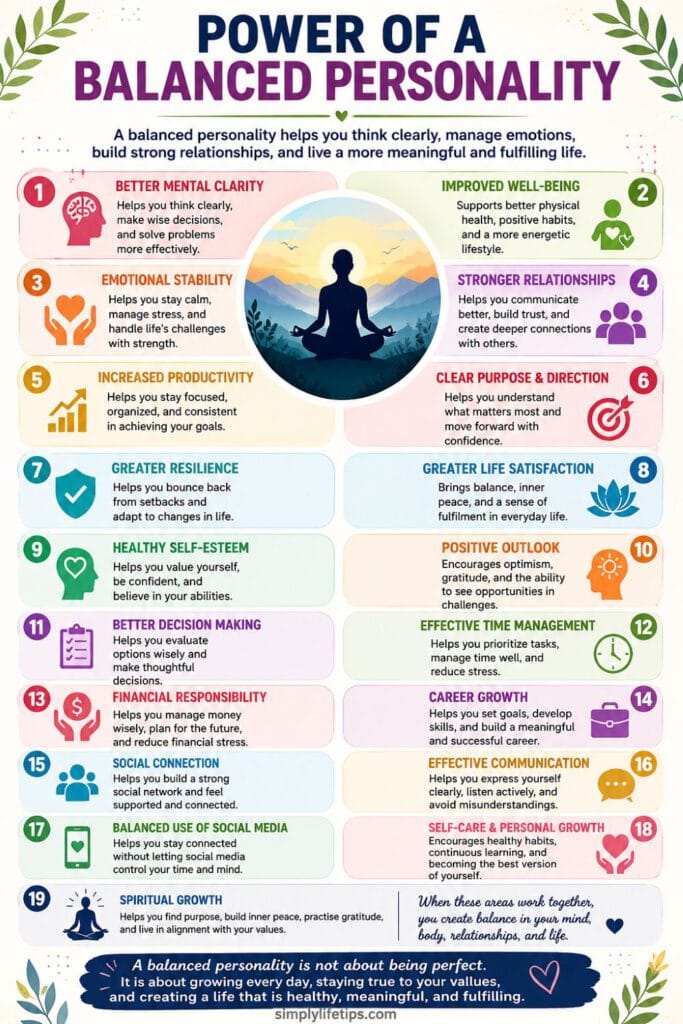
Developing a balanced personality is a gradual process. These benefits are interconnected, so improving one area can often support other areas of your life as well. The next step is to understand why balance matters and how you can develop it through practical daily habits.
How To Achieve A Balanced Personality?
Developing a balanced personality requires attention to different areas of life. Mental health, emotional well-being, physical health, relationships, communication, career, finances, personal interests, and a sense of purpose can all influence how balanced and fulfilled you feel.
You do not have to improve every area at the same time. In fact, trying to change everything at once can become overwhelming. A better approach is to identify the areas that need the most attention and make small, consistent improvements.
The following 19 areas provide a practical framework for developing a more balanced personality.
- Mental Health
- Regular Reading Habit
- Practice Mindfulness
- Emotional Intelligence
- Emotional Maturity
- Self-Regulation
- Self-Compassion
- Social Skills
- Control Emotions
- Set Realistic Goals
- Physical Well-Being
- Engage in Meaningful Activities
- Balanced Diet
- Healthy Relationships
- Effective Communication
- Social Media
- Financial Responsibility
- Career Goals
- Spirituality
Each area contributes something different. Some strengthen your inner life, while others improve your physical health, relationships, responsibilities, and sense of purpose.
You do not need to become perfect in any of these areas. The aim is to create healthier habits and greater awareness so that different parts of your life can support rather than undermine one another.
Mental Health
Mental health is one of the foundations of a balanced personality. When your mind is constantly overwhelmed by stress, worry, negative thinking, or exhaustion, it can become difficult to maintain balance in other areas of life.
Taking care of your mental health does not mean avoiding every problem or trying to remain positive all the time. It means developing healthy ways to deal with pressure, process difficult experiences, solve problems, and maintain a realistic outlook.
Keeping your mind active can also contribute to mental well-being. Reading, learning new things, studying, writing, solving problems, and exploring creative ideas can provide valuable mental stimulation. Even simple activities can become useful exercises for the mind.
Regular physical activity can support your overall well-being too. If you prefer exercising at home, you can explore these best ways to exercise at home.
It is also important to give your mind opportunities to rest. Constant work, excessive screen time, continuous social media use, and a lack of quiet time can leave you mentally drained. Creating periods of rest and disconnecting from unnecessary distractions can help you regain focus.
You can also develop simple habits to keep your mind healthy, such as maintaining meaningful social connections, learning regularly, getting adequate rest, spending time outdoors, and making time for activities you genuinely enjoy.
Make Mental Health Part of Your Daily Routine
You do not need a complicated routine to take better care of your mental health.
Start with small habits that you can maintain consistently. For example, spend a few minutes reading, take a walk, write down your thoughts, practise quiet reflection, or talk to someone you trust when you are struggling.
The goal is not to eliminate stress from your life. Some level of stress and difficulty is unavoidable. The goal is to develop healthier ways of responding to those experiences.
When you take care of your mental health consistently, you create a stronger foundation for emotional stability, healthy relationships, productive work, and personal growth.
Regular Reading Habit
A regular reading habit can help keep your mind active, curious, and open to new ideas. Reading gives you an opportunity to learn from other people’s knowledge and experiences while developing your own understanding of different subjects.
You do not need to read for hours every day to benefit from the habit. Even 15 or 20 minutes of focused reading can become valuable when practised consistently.
Choose books and articles that genuinely interest you. You might read about personal development, history, science, biographies, psychology, literature, technology, or any subject that encourages you to learn.
Reading can also encourage deeper thinking. Instead of simply accepting every idea you encounter, consider asking yourself:
- What can I learn from this?
- Do I agree with the author’s point of view?
- How could this information apply to my life?
- Is there another way to look at the subject?
Keep Your Mind Engaged
Reading is only one way to keep your mind active. Problem-solving activities, puzzles, writing, learning new skills, listening to educational talks, and podcasts can also provide mental stimulation.
The important thing is to remain curious.
A person who continues learning throughout life can develop a broader perspective and become more comfortable with new ideas and changing circumstances.
A regular reading habit can therefore support the development of a balanced personality by encouraging knowledge, reflection, creativity, and lifelong learning.
The purpose is not to read as many books as possible. It is to develop a habit of learning that enriches your thinking and helps you understand yourself and the world around you.
Practice Mindfulness
Mindfulness is the practice of paying attention to the present moment without immediately judging your thoughts, feelings, or experiences. It can help you become more aware of what is happening within you and around you.
This awareness can be valuable when developing a balanced personality because many of our reactions happen automatically. We may become angry, worried, frustrated, or defensive before taking time to understand what we are actually feeling.
Mindfulness creates an opportunity to pause.
For example, imagine that someone says something that upsets you. Your first reaction may be to respond immediately. Instead, you can take a moment to notice your feelings, slow down, and consider what response would be most appropriate.
Simple Ways to Practise Mindfulness
Mindfulness does not have to involve a complicated routine. You can incorporate it into ordinary activities.
Try to:
- Spend a few quiet minutes focusing on your breathing.
- Pay attention to your surroundings when walking.
- Eat without constantly looking at your phone or other screens.
- Notice your thoughts without immediately acting on them.
- Take a short pause when you feel emotionally overwhelmed.
- Spend some time each day without unnecessary digital distractions.
- Reflect on your feelings before making an important decision.
The purpose is not to stop thinking. It is to become more aware of your thoughts and emotions rather than allowing them to automatically control your behaviour.
For a science-based overview of meditation and mindfulness, see the National Center for Complementary and Integrative Health’s guide to meditation and mindfulness
How Mindfulness Supports a Balanced Personality
Regular mindfulness practice can encourage greater self-awareness and help you recognize emotional patterns.
When you understand what triggers certain reactions, you can begin choosing healthier responses.
For example, if you notice that tiredness makes you impatient, you may recognize the need for rest before entering an important conversation. If you notice that criticism immediately makes you defensive, you can practise listening before responding.
Over time, this awareness can support emotional regulation, thoughtful decision-making, healthier communication, and greater resilience.
Mindfulness is therefore not about becoming perfectly calm. It is about becoming more aware of the present moment so you can respond to life with greater intention.
Emotional Intelligence
Emotional intelligence is the ability to recognize, understand, and manage your own emotions while also being aware of the emotions of other people. It is an important part of developing a balanced personality because emotions influence how we think, communicate, make decisions, and respond to difficult situations.
Being emotionally intelligent does not mean hiding your feelings or avoiding emotional situations. It means understanding what you are feeling and learning how to respond appropriately.
For example, if you feel frustrated during a conversation, emotional intelligence can help you recognize that frustration before it turns into an angry response. You can then pause, listen, and choose a more constructive way to communicate.
The Key Elements of Emotional Intelligence
Emotional intelligence can be developed through several related skills.
Self-awareness helps you recognize your emotions, strengths, weaknesses, and emotional triggers.
Self-regulation helps you manage your reactions instead of allowing strong emotions to control your behaviour.
Empathy helps you understand that other people may experience the same situation differently from you.
Social awareness helps you recognize emotions and dynamics within relationships and groups.
Relationship skills help you communicate, resolve disagreements, cooperate with others, and build trust.
How Emotional Intelligence Helps
Developing emotional intelligence can improve the way you interact with people at home, at work, and in social situations.
Consider a disagreement between two colleagues. One person may immediately become defensive and turn the disagreement into an argument. Another may recognize the tension, listen to the other person’s concerns, explain their own perspective calmly, and work toward a solution.
The second response does not mean the person has no emotions. It means they are managing those emotions more effectively.
Emotional intelligence can also help you receive criticism, handle disappointment, understand other people’s perspectives, and communicate your feelings more clearly.
Building Emotional Intelligence
You can gradually strengthen emotional intelligence by paying closer attention to your emotional reactions.
When you experience a strong emotion, ask yourself:
- What am I feeling?
- What caused this feeling?
- How is this emotion affecting my behaviour?
- How might the other person be feeling?
- What response would improve the situation?
These simple questions can create a pause between feeling and reacting.
With practice, greater emotional awareness can support better communication, stronger relationships, thoughtful decision-making, and greater emotional balance.
Emotional intelligence is therefore not just a social skill. It is an important part of becoming a more self-aware, adaptable, and balanced person.
Emotional Maturity
Emotional maturity is an important part of developing a balanced personality. It involves understanding your emotions, accepting responsibility for your behaviour, and learning to respond to difficult situations in a thoughtful and constructive way.
Being emotionally mature does not mean that you never become angry, disappointed, afraid, or upset. Difficult emotions are a normal part of life. Emotional maturity means learning how to deal with those emotions without allowing them to control your actions.
Develop Self-Awareness
Self-awareness is one of the foundations of emotional maturity.
Pay attention to situations that repeatedly trigger strong emotional reactions. You may notice that criticism makes you defensive, unexpected changes make you anxious, or feeling ignored makes you angry.
Understanding these patterns allows you to change how you respond.
Instead of simply asking, “Why did they make me feel this way?” also ask, “Why did I react this way?”
This shift in perspective can encourage greater personal responsibility.
Learn to Pause Before Reacting
Emotional maturity involves creating space between an emotion and an action.
When you are angry, you do not have to respond immediately. When you are disappointed, you do not have to make an important decision at that moment. When you feel offended, you can take time to understand what actually happened before assuming the worst.
A short pause can prevent an emotional reaction from becoming a larger problem.
For example, if you receive a message that sounds rude, you might immediately want to reply angrily. Taking time to reread the message and consider the context may lead to a more constructive response.
Develop Empathy
Empathy means trying to understand another person’s feelings and perspective.
People may react differently to the same situation because of their experiences, expectations, personality, or circumstances.
You do not have to agree with someone to understand their perspective.
Listening carefully and considering what another person may be experiencing can reduce unnecessary conflict and strengthen relationships.
Accept Responsibility
Emotionally mature people understand that they are responsible for their own behaviour.
Other people may influence your emotions, but you still have a choice about how you respond.
If you make a mistake, acknowledge it rather than immediately blaming someone else. A sincere apology and a willingness to correct your behaviour can be signs of emotional maturity.
Taking responsibility does not mean accepting blame for everything. It means recognizing the part that genuinely belongs to you.
Learn From Difficult Experiences
Emotional maturity also involves learning from mistakes and difficult experiences.
Instead of repeatedly thinking about what went wrong, ask:
- What happened?
- How did I respond?
- What could I have done differently?
- What can I learn from this experience?
- What can I do better next time?
This approach turns difficult experiences into opportunities for personal growth.
Emotional Maturity Supports Balance
Emotional maturity helps connect several parts of a balanced personality.
It can improve self-awareness, strengthen relationships, support better communication, and make it easier to handle stress and disagreements.
You will not respond perfectly every time. The goal is to become increasingly aware of your emotional patterns and gradually develop healthier responses.
With practice, emotional maturity can help you become more thoughtful, resilient, empathetic, and balanced in the way you deal with yourself and others.
Self-Regulation
Self-regulation is the ability to manage your thoughts, emotions, impulses, and behaviour healthily and appropriately. It is an important part of a balanced personality because strong emotions can sometimes influence our actions before we have had time to think.
Self-regulation does not mean suppressing your emotions or pretending that you are not angry, worried, disappointed, or frustrated. Instead, it means recognizing what you are feeling and choosing how to respond.
Pause Before You React
One of the simplest ways to practise self-regulation is to create a pause between an emotional reaction and your response.
Imagine that someone criticizes you unexpectedly. Your first instinct may be to defend yourself or respond angrily. Instead, take a moment to breathe, listen carefully, and understand what the person is actually saying.
That short pause can prevent an emotional reaction from turning into an unnecessary argument.
Recognize Your Triggers
Everyone has situations that produce stronger emotional reactions.
You may become impatient when you are tired, frustrated when plans change unexpectedly, or defensive when someone questions your decisions.
Recognizing these triggers can help you prepare for them.
When you understand your patterns, you can take practical steps to manage them. For example, if tiredness makes you more irritable, getting enough rest may help you respond more calmly.
Manage Impulsive Behaviour
Impulsive decisions can sometimes create problems that could have been avoided with a little patience.
Before making an important decision while experiencing a strong emotion, ask yourself:
- Am I reacting or thinking?
- Will this decision still make sense tomorrow?
- Could my emotions be influencing my judgment?
- What are the possible consequences?
- Is there a better response?
These questions can help you slow down and consider the situation more carefully.
Self-Regulation and Relationships
Self-regulation is particularly important in relationships.
Disagreements are normal, but reacting with insults, shouting, threats, or hurtful words can damage trust.
Being able to remain respectful during disagreement does not mean you have to agree with another person. It means you can express your feelings and opinions without allowing anger to control your behaviour.
This can make difficult conversations more productive and help protect important relationships.
Practise Self-Regulation Every Day
Self-regulation becomes stronger with practice.
Simple habits such as mindfulness, regular physical activity, adequate rest, taking a short break during stressful situations, and reflecting on your reactions can help you become more aware of your behaviour.
You will not respond perfectly every time. The goal is to notice when you lose control, understand what happened, and try to respond differently next time.
Developing self-regulation can help you become calmer under pressure, make more thoughtful decisions, communicate more effectively, and handle life’s challenges with greater emotional balance.
Self-Compassion
Self-compassion means treating yourself with kindness, understanding, and patience, especially when you make mistakes or go through difficult experiences. It is an important part of a balanced personality because personal growth becomes difficult when you constantly criticize yourself.
Everyone makes mistakes. You may make a poor decision, fail to reach a goal, disappoint someone, or struggle with something that seemed easy for others. These experiences can be painful, but they do not make you a worthless or incapable person.
Learn to Treat Yourself With Understanding
Many people speak to themselves more harshly than they would ever speak to a friend.
Imagine that a close friend makes a mistake and feels disappointed. You might encourage them to learn from the experience and try again. Self-compassion means offering yourself some of that same understanding.
Instead of saying, “I am a failure,” try asking, “What went wrong, and what can I learn from this?”
This does not mean ignoring mistakes. It means correcting them without unnecessarily damaging your self-esteem.
Self-Compassion Is Not an Excuse
Being compassionate toward yourself does not mean avoiding responsibility.
If you make a mistake, acknowledge it. If you hurt someone, take responsibility and apologize. If a habit is harming your life, work on changing it.
Self-compassion simply allows you to approach these situations constructively instead of becoming trapped in shame and negative self-judgment.
There is an important difference between accepting yourself and refusing to improve.
You can accept that you made a mistake while still deciding to do better next time.
Learn From Failure
Failure can become an important part of personal growth when you use it as a learning experience.
For example, if you fail to achieve an important goal, examine what happened. Perhaps the goal was unrealistic, your preparation was insufficient, or circumstances changed.
Rather than repeatedly criticizing yourself, identify what you can control and decide what you will do differently.
This approach can help you develop resilience and maintain motivation.
Practise Self-Acceptance
Self-acceptance means recognizing yourself as you are while remaining open to growth.
You have strengths and weaknesses. You may be confident in some situations and uncertain in others. You may have habits you are proud of and others you want to change.
You do not have to reject yourself because you have weaknesses.
A balanced personality develops when you can recognize your limitations without allowing them to define your entire identity.
Self-Compassion and Emotional Balance
Self-compassion can support emotional regulation because it reduces the tendency to respond to mistakes with excessive self-criticism.
When you are kind and realistic toward yourself, it can become easier to acknowledge difficult emotions, learn from experiences, and move forward.
Try asking yourself:
- What am I feeling right now?
- Am I judging myself too harshly?
- What would I say to a friend in the same situation?
- What can I learn from this experience?
- What is one small step I can take next?
Developing self-compassion does not make you weaker or less ambitious. It can help you become more resilient, self-aware, and emotionally balanced while continuing to work toward becoming a better version of yourself.
Social Skills
Social skills are the abilities that help you interact with other people in a respectful, comfortable, and effective way. They are an important part of a balanced personality because much of life involves communication, cooperation, relationships, and dealing with people who may think or behave differently from you.
Good social skills do not mean that you have to be highly outgoing or talkative. A quiet person can have excellent social skills. What matters is your ability to listen, communicate, understand others, respect boundaries, and respond appropriately to different situations.
Learn to Listen
Listening is one of the most important social skills.
Many conversations become difficult because people are preparing their response instead of actually listening to what the other person is saying.
When someone is speaking, try to give them your attention. Avoid interrupting unnecessarily and ask questions when you need clarification.
Good listening can help people feel respected and understood.
Develop Empathy
Empathy helps you consider what another person may be feeling or experiencing.
You do not have to agree with someone’s opinion to understand their perspective.
For example, if a friend is upset about something that seems minor to you, dismissing their feelings may damage the relationship. Listening and acknowledging their feelings can create a more supportive conversation.
Empathy can therefore help you respond to people with greater patience and understanding.
Learn to Communicate Respectfully
Good social skills include expressing your own thoughts and feelings clearly while respecting other people.
You can disagree without becoming rude. You can say no without insulting someone. You can express disappointment without attacking another person.
Respectful communication is particularly important during disagreements because emotions can easily become stronger when people feel misunderstood.
Respect Personal Boundaries
Healthy social interaction also requires an understanding of boundaries.
People have different comfort levels regarding personal space, time, communication, privacy, and relationships.
Respecting another person’s boundaries demonstrates consideration. At the same time, learning to communicate your own boundaries can protect your well-being.
A balanced personality involves both respecting others and understanding your own limits.
Handle Social Situations With Flexibility
Not every social situation requires the same behaviour.
You may speak differently with a close friend than you would with a colleague. A family disagreement may require a different approach from a professional disagreement.
Being able to adapt your communication while remaining authentic can help you navigate different environments more effectively.
Practise Forgiveness and Letting Go
Forgiveness can sometimes help you move forward from past conflicts and disappointments.
Forgiving someone does not necessarily mean forgetting what happened, approving harmful behaviour, or allowing someone to hurt you again.
It can mean choosing not to remain trapped in resentment.
Learning to forgive yourself is also important. Mistakes from the past can become opportunities to learn and grow rather than permanent sources of guilt.
Strengthen Your Social Confidence
Social confidence develops through practice.
Start with simple actions such as greeting people, making eye contact when appropriate, asking questions, listening carefully, expressing your opinions respectfully, and participating in conversations.
You do not need to become the most outgoing person in the room.
The goal is to become comfortable enough with yourself to interact with others naturally and respectfully.
Social Skills and a Balanced Personality
Strong social skills can improve relationships, communication, cooperation, and emotional well-being.
They can also help you deal with disagreements without unnecessarily damaging relationships.
Developing these skills is a gradual process. Pay attention to how people respond to your communication, remain open to learning, and be willing to adjust when necessary.
When you combine empathy, listening, communication, boundaries, and respect, you can build healthier relationships and become more balanced in the way you interact with the people around you.
Control Emotions
Learning to manage your emotions is an important part of developing a balanced personality. Emotions are a natural part of being human, and there is nothing wrong with feeling anger, sadness, fear, excitement, disappointment, or frustration.
The important thing is to avoid allowing temporary emotions to control your decisions and behaviour.
Understand Your Emotional Reactions
Before you can manage your emotions, you need to recognize them.
When you experience a strong reaction, try to identify what you are actually feeling.
Are you angry, or are you disappointed? Are you frustrated, or are you feeling ignored? Are you worried about what might happen, or are you reacting to something that has already happened?
Naming an emotion can sometimes make it easier to understand and manage.
Avoid Impulsive Reactions
Strong emotions can encourage impulsive behaviour.
For example, you may send an angry message, make an unnecessary purchase, quit something important, or say something hurtful during a moment of frustration.
Before acting on a strong emotion, give yourself some time.
Take a few deep breaths, step away from the situation, go for a short walk, or simply wait until you feel calmer.
A temporary emotional reaction should not automatically determine a long-term decision.
Look at the Situation From Another Perspective
When emotions are strong, it can be easy to see only one side of a situation.
Try asking yourself:
- Am I making assumptions?
- Could there be another explanation?
- How might the other person see this situation?
- Will this matter as much tomorrow?
- What response would I be proud of later?
These questions can help you move from an immediate emotional reaction toward a more thoughtful response.
Use Healthy Stress-Management Strategies
Stress can make emotional control more difficult. Developing healthy ways to manage stress can therefore support emotional balance.
Depending on your situation, useful approaches may include regular physical activity, adequate rest, mindfulness, quiet reflection, spending time with supportive people, engaging in meaningful activities, or taking a temporary break from a stressful situation.
The most useful strategy is one that you can practise consistently.
Express Emotions in a Healthy Way
Controlling emotions does not mean keeping everything inside.
Suppressing emotions for long periods can make problems more difficult to address. Instead, learn to express your feelings appropriately.
For example, instead of shouting during an argument, you might calmly explain what upset you and what you need.
Instead of pretending that you are not disappointed, you can acknowledge the feeling and decide what constructive action to take.
Healthy emotional expression can improve communication and reduce unnecessary conflict.
Emotional Control Takes Practice
Nobody manages emotions perfectly all the time.
You may occasionally lose your patience, say something you regret, or react more strongly than you intended. What matters is what you do afterward.
Reflect on the situation, take responsibility where necessary, and consider what you could do differently next time.
With practice, better emotional awareness and self-regulation can help you become more resilient and balanced when facing life’s challenges.
Set Realistic Goals
Setting realistic goals can give your life direction, strengthen your sense of purpose, and encourage personal growth. Goals help you decide where you want to go and identify the steps required to get there.
However, goals should challenge you without becoming so unrealistic that they create constant frustration and disappointment.
Start With Clear Goals
A vague goal can be difficult to follow.
Instead of saying, “I want to become healthier,” consider creating a more specific objective such as, “I will walk for 30 minutes on five days each week.”
Instead of saying, “I want to improve my career,” identify a specific skill you want to develop or a course you want to complete.
Clear goals make it easier to measure progress.
Break Large Goals Into Smaller Steps
Large goals can sometimes feel overwhelming.
Breaking them into smaller actions can make them easier to manage.
For example, if you want to write a book, you do not have to think about completing the entire book at once. You can begin by deciding on the subject, creating an outline, writing a small section each day, and gradually building the manuscript.
Small steps can eventually produce significant results.
Set Goals That Match Your Reality
A realistic goal takes your current circumstances into account.
Consider your available time, resources, skills, responsibilities, and energy before deciding what you can reasonably accomplish.
This does not mean setting easy goals. It means setting goals that are challenging while still achievable with consistent effort.
Unrealistic expectations can create unnecessary stress. Realistic goals can help you maintain motivation and confidence.
Learn From Setbacks
Progress is rarely completely smooth.
You may miss a deadline, lose motivation, experience an unexpected problem, or fail to achieve a target.
A setback does not mean that the entire goal has failed.
Review what happened and ask yourself:
- What went wrong?
- Was the goal realistic?
- What can I change?
- Do I need more time?
- What can I learn from this experience?
Adjusting your plan when circumstances change is not giving up. It is part of effective goal-setting.
Build Confidence Through Progress
Achieving small goals can gradually strengthen your confidence.
If you want to build confidence, start by choosing achievable actions and following through consistently.
As you make progress, you can gradually take on more challenging objectives.
You can also explore these powerful tips to boost self-confidence as part of your personal development journey.
Balance Goals With Other Areas of Life
Goals should improve your life rather than consume it completely.
For example, pursuing a career goal is valuable, but consistently sacrificing sleep, health, family, and meaningful relationships may create an unhealthy imbalance.
A balanced personality recognizes that success has several dimensions.
Your goals should therefore consider your overall well-being.
Focus on Consistency
Motivation can change from one day to another. Consistency is often more dependable.
You will not always feel motivated to work toward a goal. Developing routines and taking small actions even when motivation is low can help you continue making progress.
The objective is not to achieve everything immediately. It is to keep moving forward while remaining flexible enough to adjust your approach when necessary.
Realistic goal-setting can help you develop discipline, perseverance, confidence, and a stronger sense of purpose—all important qualities of a balanced personality.
Physical Well-Being
Physical well-being is an important part of a balanced personality. Your physical condition can influence your energy, concentration, mood, confidence, and ability to manage everyday responsibilities.
Taking care of your body does not require an extreme fitness routine. The goal is to develop sustainable habits that support your overall health and help you feel capable of dealing with daily life.
Stay Physically Active
Regular physical activity can help you maintain strength, mobility, stamina, and general well-being.
You do not necessarily need to spend hours at a gym. Walking, stretching, cycling, swimming, household activities, or other forms of movement can become part of an active lifestyle.
Choose activities that are realistic for your circumstances and that you can maintain consistently.
Prioritize Quality Sleep
Sleep is another important part of physical and overall well-being.
When you regularly fail to get enough rest, you may notice changes in your energy, concentration, mood, and ability to handle everyday stress.
Developing consistent sleep habits can help you create a healthier routine. Try to maintain a regular sleep schedule, create a comfortable sleeping environment, and reduce unnecessary distractions before bedtime.
If you are working on your sleep routine, you can also explore how to get better quality sleep at night and this ultimate sleep routine for high performance.
Listen to Your Body
Physical well-being also involves paying attention to what your body is telling you.
Persistent tiredness, lack of energy, or discomfort should not simply be ignored. Give yourself appropriate time to rest and seek professional advice when a health concern requires it.
A balanced lifestyle is not about constantly pushing yourself. Rest and recovery are also important.
Connect Physical and Mental Well-Being
Physical and mental well-being are closely connected.
When you regularly move your body, sleep well, eat sensibly, and make time for recovery, you may find it easier to maintain energy and manage everyday responsibilities.
At the same time, prolonged stress and emotional difficulties can affect physical habits such as sleep, appetite, and activity levels.
This is why physical health should be considered part of your overall approach to developing a balanced personality.
Create Sustainable Habits
Avoid trying to change your entire lifestyle overnight.
Instead, choose small habits that you can maintain. You might begin by taking a daily walk, improving your sleep schedule, drinking enough water, spending more time outdoors, or adding more movement to your normal routine.
Small, consistent actions can become powerful habits over time.
Taking care of your physical well-being gives you a stronger foundation for mental clarity, emotional balance, productive work, healthy relationships, and a more fulfilling life.
Engage in Meaningful Activities
A balanced personality is not developed through work and responsibilities alone. Meaningful activities can bring enjoyment, creativity, connection, and a stronger sense of purpose to your life.
Meaningful activities are different for everyone. What brings fulfilment to one person may not have the same effect on another.
You might enjoy reading, gardening, photography, music, writing, travelling, cooking, sports, volunteering, learning a new skill, or simply spending quality time with people you care about.
Make Time for What Matters
Modern life can become so focused on work, responsibilities, and digital distractions that meaningful activities are easily pushed aside.
Making time for activities that genuinely matter to you can help create a healthier balance.
For example, someone who spends most of the day working at a computer might benefit from spending time outdoors, exercising, gardening, meeting friends, or pursuing a creative hobby.
These activities may not directly contribute to career success, but they can contribute to overall well-being.
Spend Quality Time With Loved Ones
Relationships can become stronger when you make time for the people who matter to you.
Instead of simply being physically present while everyone is using their phones, try to create opportunities for genuine conversation and shared experiences.
A family meal, a walk with a friend, helping someone with a task, or having an uninterrupted conversation can become meaningful parts of everyday life.
Help Others
Helping others can provide a sense of connection and purpose.
This might involve volunteering, supporting a neighbour, helping a colleague, sharing your knowledge, or simply being available when someone needs encouragement.
Helping does not always require money or a major commitment. Small acts of kindness can also make a meaningful difference.
Make Room for Creativity
Creative activities can provide an opportunity to express yourself and explore new ideas.
Writing, drawing, painting, photography, music, crafts, cooking, or other creative pursuits can help you step away from routine responsibilities and engage your mind in a different way.
You do not have to be professionally talented to enjoy creative activities. The value often comes from the process rather than the final result.
Discover What Gives You Purpose
Meaningful activities can also help you understand what matters to you.
Ask yourself:
- What activities make me lose track of time?
- What do I enjoy learning about?
- What activities leave me feeling satisfied?
- Who do I enjoy spending time with?
- What would I continue doing even without recognition?
- How can I contribute something useful to others?
Your answers may reveal interests and values that deserve more attention.
Balance Productivity With Fulfilment
Not everything you do needs to be productive in the traditional sense.
Resting, enjoying a hobby, talking with a friend, listening to music, or spending time in nature may not produce a measurable result, but these experiences can still contribute to a healthy and fulfilling life.
A balanced personality recognizes that life is about more than constant achievement.
Making room for meaningful activities can reduce the risk of allowing work and responsibilities to consume your entire life. It can help you maintain a stronger sense of identity, purpose, happiness, and connection.
Balanced Diet
A balanced diet is an important part of maintaining physical well-being and supporting a balanced lifestyle. Your body needs a variety of nutrients to function properly, and the foods you choose can become an important part of your everyday health habits.
A healthy approach to eating does not require following complicated diets or completely avoiding foods you enjoy. The focus should be on developing sensible and sustainable eating habits.
Choose a Variety of Nutritious Foods
Try to include a variety of foods in your regular meals. Fruits, vegetables, whole grains, legumes, nuts, seeds, and appropriate sources of protein can all contribute to a varied diet.
Different foods provide different nutrients, so variety is important.
Instead of relying heavily on one type of food, aim for meals that contain a reasonable combination of nutritious ingredients.
Develop Healthy Eating Habits
Your eating habits are influenced by your daily routine.
Eating regular meals, paying attention to portion sizes, staying adequately hydrated, and limiting excessive consumption of highly processed foods can support healthier choices.
You do not have to make every meal perfect. What matters more is the overall pattern of your eating habits.
Avoid Extreme Approaches
Extreme diets and unrealistic food restrictions can be difficult to maintain and may create unnecessary stress around eating.
A balanced approach allows room for flexibility while encouraging nutritious choices most of the time.
If you have specific dietary requirements or health concerns, seek advice from a qualified healthcare professional or registered dietitian rather than relying solely on general advice.
Connect Food With Overall Well-Being
Food is only one part of physical well-being.
A balanced lifestyle also includes regular physical activity, adequate sleep, stress management, and healthy relationships.
When these areas work together, they can provide a stronger foundation for overall well-being.
You can explore ideas about foods for optimal health as part of your efforts to develop healthier everyday habits.
Make Healthy Choices Sustainable
The best eating habits are those you can maintain over the long term.
Rather than trying to change everything overnight, make gradual improvements. Add more nutritious foods to your meals, become more aware of your eating habits, and reduce choices that you know are not supporting your well-being.
A balanced diet is not about perfection. It is about making sensible choices consistently and developing a healthier relationship with food.
When combined with good sleep, physical activity, mental well-being, and other healthy habits, nutritious eating can support the physical foundation of a balanced personality.
Healthy Relationships
Healthy relationships are an important part of a balanced personality. The people around us can influence our emotional well-being, confidence, outlook, and ability to deal with difficult situations.
Family members, friends, colleagues, and other meaningful connections can provide companionship, encouragement, understanding, and support. At the same time, healthy relationships require effort from both sides.
Build Relationships on Trust and Respect
Trust and respect are among the foundations of a healthy relationship.
Trust develops when people are honest, reliable, and consistent in their behaviour. Respect means recognizing that another person has their own feelings, opinions, boundaries, and needs.
You may disagree with someone without disrespecting them.
For example, two friends can have completely different opinions about an important subject and still maintain a strong friendship when they listen to each other and respect their differences.
Communicate Openly
Good relationships require communication.
If you never express your thoughts, concerns, or expectations, misunderstandings can easily develop.
Try to communicate honestly while remaining respectful. If something is bothering you, discuss it rather than allowing resentment to build.
Improving your communication skills can help you express yourself more clearly and understand others more effectively.
Spend Quality Time Together
Simply being around people does not necessarily create strong relationships.
Quality time involves giving people your attention and being genuinely present.
A conversation without constant phone distractions, a shared meal, a walk, a family activity, or helping someone with an important task can strengthen a relationship.
Small moments of genuine connection can become more valuable than occasional grand gestures.
Learn to Give and Receive Support
Healthy relationships involve both giving and receiving.
There may be times when someone you care about needs your support. At other times, you may need support yourself.
Do not assume that asking for help is a sign of weakness. Recognizing when you need support can be a sign of self-awareness.
At the same time, supporting someone does not mean taking responsibility for every problem in their life.
Maintain Healthy Boundaries
Healthy relationships also require boundaries.
You can care about someone while still saying no when necessary. You can be supportive without allowing another person’s demands to control your entire life.
Boundaries help protect time, energy, privacy, and emotional well-being.
A balanced personality understands that maintaining healthy relationships does not require sacrificing your own well-being.
Choose Quality Over Quantity
You do not need hundreds of friends to have a fulfilling social life.
A small number of trustworthy and supportive relationships can be more meaningful than a large number of superficial connections.
Focus on relationships where there is mutual respect, honesty, support, and genuine interest in each other’s well-being.
At the same time, remain open to meeting new people and learning from different perspectives.
Handle Conflict Constructively
Disagreements are a normal part of relationships.
The goal is not to avoid every disagreement but to learn how to handle conflict without unnecessarily damaging the relationship.
Listen to the other person’s perspective, explain your own feelings clearly, avoid personal attacks, and look for a practical way forward.
Sometimes a disagreement can even strengthen a relationship when both people learn something from the experience.
Healthy Relationships and a Balanced Personality
Healthy relationships can provide emotional support and help you develop empathy, patience, communication skills, and emotional maturity.
They can also remind you that personal growth does not happen in isolation.
A balanced personality allows you to care about others while also caring for yourself. By building relationships based on trust, respect, communication, empathy, and healthy boundaries, you can create a stronger social and emotional foundation for a fulfilling life.
Effective Communication
Effective communication is one of the most important skills for developing a balanced personality. The ability to express your thoughts, feelings, needs, and opinions clearly can improve both personal and professional relationships.
Communication is not simply about speaking. It also involves listening, understanding, observing, asking questions, and responding appropriately.
Learn to Listen Before Responding
Good communication begins with listening.
When someone is speaking, give them your attention instead of immediately preparing your response. Try to understand what they mean before deciding how you will answer.
Sometimes people do not need immediate advice. They may simply want to feel heard and understood.
Active listening can reduce misunderstandings and help build trust.
Express Yourself Clearly
When communicating, try to say what you actually mean.
Avoid expecting other people to guess your thoughts or feelings.
For example, instead of saying, “You never help me,” you might explain the specific problem: “I felt overwhelmed because I had to handle this task alone. Could we divide it between us next time?”
Clear communication makes it easier for another person to understand your concern and respond appropriately.
Communicate With Respect
Being honest does not require being rude.
You can disagree with someone while remaining respectful. You can express disappointment without insulting another person. You can defend your boundaries without deliberately hurting someone.
Respectful communication becomes especially important during disagreements because strong emotions can easily turn a small problem into a much larger conflict.
Pay Attention to Nonverbal Communication
Communication also includes body language, facial expressions, tone of voice, and other nonverbal signals.
Your words may say one thing while your tone or body language communicates something different.
Being aware of these signals can help you communicate more consistently and understand how your message may be received.
You can also learn more about body language and communication skills to improve your awareness of nonverbal communication.
Ask Instead of Assuming
Assumptions can create unnecessary misunderstandings.
If you are unsure what someone means, ask for clarification instead of immediately deciding what they intended.
For example, if a friend does not respond to your message, you may assume they are ignoring you. There could be many other explanations.
Giving people an opportunity to explain themselves can prevent unnecessary conflict.
Handle Difficult Conversations
Some conversations are uncomfortable but necessary.
If you need to discuss a problem, choose an appropriate time and place. Focus on the issue rather than attacking the person’s character.
Try using statements that describe your experience rather than accusations.
Instead of saying, “You always make everything difficult,” you could say, “I found it difficult when the plan changed without discussing it with me.”
This approach can make difficult conversations more productive.
Communication and Personal Growth
Effective communication can help you build stronger relationships, work more effectively with others, resolve conflicts, and express your needs with greater confidence.
It also encourages self-awareness because communicating clearly requires you to understand what you actually think and feel.
A balanced personality does not mean avoiding disagreement or trying to please everyone. It means learning to communicate honestly and respectfully while remaining willing to listen and understand other perspectives.
By developing better listening, speaking, empathy, and conflict-resolution skills, you can strengthen both your relationships and your personal and professional life.
Social Media
Social media has become an important part of modern life. It can help us stay connected with family and friends, discover useful information, learn new things, and share our experiences.
However, using social media without boundaries can also affect your attention, relationships, emotional well-being, and daily routine. Developing a balanced personality therefore includes learning how to use social media wisely rather than allowing it to control your time and attention.
Be Aware of How Social Media Affects You
People respond differently to social media.
For some, it is a useful way to communicate and learn. For others, constant scrolling, comparison, arguments, or the pressure to keep up with other people’s lives can become stressful.
Pay attention to how you feel after using social media.
Ask yourself:
- Am I using it intentionally or automatically?
- How much time am I spending on it?
- Does it improve or reduce my mood?
- Am I comparing my life with other people’s posts?
- Is it interfering with sleep, work, study, or relationships?
- Am I checking my phone even when there is no real reason to?
These questions can help you recognize unhealthy patterns.
Avoid Constant Comparison
Social media often presents carefully selected versions of people’s lives.
You may see someone’s achievements, holidays, celebrations, new possessions, or professional success without seeing the difficulties behind those moments.
Comparing your everyday life with someone else’s carefully selected highlights can create unrealistic expectations.
Remember that online content rarely represents the complete picture of another person’s life.
Protect Your Time and Attention
Constant notifications and endless scrolling can make it difficult to concentrate on important tasks.
Consider turning off unnecessary notifications and setting specific times to check social media instead of checking it continuously throughout the day.
Creating periods without social media can also help you focus on work, study, hobbies, exercise, rest, and relationships.
Prioritize Real-Life Relationships
Social media can help maintain relationships, but online interaction should not completely replace meaningful face-to-face connection.
Make time to talk with family members, meet friends, share meals, and participate in activities without constantly checking your phone.
If social media is beginning to interfere with your real-life relationships, it may be time to reconsider your habits.
You can also learn more about how social media addiction can affect health and life.
Create Healthy Boundaries
You do not necessarily have to stop using social media to create a healthier relationship with it.
Instead, establish boundaries that work for you.
For example, you might avoid social media during meals, while working, before going to bed, or when spending quality time with family.
Remember that social media should never take priority over family.
Use Social Media With Purpose
Before opening a social media app, ask yourself why you are doing it.
Are you communicating with someone, looking for specific information, sharing something meaningful, or simply opening the app out of habit?
Intentional use can help reduce unnecessary scrolling.
Social media itself is neither completely good nor completely bad. Its value depends largely on how you use it.
Social Media and a Balanced Personality
A balanced personality includes the ability to use technology without becoming controlled by it.
When you set reasonable boundaries, protect your attention, prioritize real-world relationships, and use social media intentionally, you can enjoy its benefits while reducing its potential negative effects.
The goal is not to disconnect from the digital world completely. It is to make sure that social media remains a useful part of your life rather than becoming the centre of it.
Financial Responsibility
Financial responsibility is another important part of a balanced personality. Money affects many practical aspects of life, including housing, food, education, healthcare, career choices, savings, and plans.
Developing a healthy relationship with money can reduce unnecessary financial stress and help you make more thoughtful decisions.
Understand Your Financial Situation
The first step toward financial responsibility is understanding where your money comes from and where it goes.
Keep track of your income, regular expenses, debts, savings, and other financial commitments.
You do not need a complicated system. Even a simple record of your monthly income and expenses can help you identify unnecessary spending and understand your priorities.
Distinguish Needs From Wants
Not every purchase has the same importance.
Learning to distinguish between essential needs and optional wants can help you make more deliberate spending decisions.
For example, paying for essential household expenses is different from making an impulse purchase simply because something looks attractive at the moment.
This does not mean that you should never spend money on things you enjoy. It means understanding the difference between enjoying your money and allowing unnecessary spending to control your finances.
Plan for the Future
Financial responsibility also involves thinking beyond the present.
Depending on your circumstances, you may need to consider emergency savings, future education, major purchases, retirement, insurance, or other long-term needs.
Having a basic financial plan can provide greater clarity and help you prepare for unexpected situations.
Avoid Unnecessary Financial Stress
Financial problems can affect emotional well-being and relationships.
Overspending, unmanaged debt, or constantly comparing your financial situation with others can create unnecessary pressure.
Try to make financial decisions based on your own circumstances and priorities rather than trying to match someone else’s lifestyle.
Money Is Only One Part of Life
Financial stability is important, but money is not the only measure of success.
A person may have a successful career and strong finances while neglecting health, relationships, personal interests, or emotional well-being.
Remember that money cannot buy everything required in life.
A balanced personality recognizes the importance of financial responsibility while also understanding that meaningful relationships, good health, personal growth, and a sense of purpose contribute greatly to a fulfilling life.
Make Financial Decisions Thoughtfully
Before making a significant financial decision, take time to consider the consequences.
Ask yourself:
- Can I afford this?
- Is this purchase necessary?
- Does it support my priorities?
- Will it create financial stress later?
- Have I considered other options?
- Does this decision fit into my longer-term plans?
Taking time to think before making financial decisions can reduce impulsive choices.
Financial Responsibility and a Balanced Personality
Financial responsibility is not about becoming wealthy or focusing on money all the time.
It is about understanding your financial situation, spending thoughtfully, planning for the future, and making choices that support your overall well-being.
When financial responsibility is combined with healthy relationships, physical and mental well-being, meaningful goals, and personal values, it becomes one part of a more balanced and fulfilling life.
Career Goals
Career goals can provide direction, motivation, and a sense of purpose. For many people, work occupies a significant part of life, so choosing a career path that fits your interests, abilities, values, and circumstances can contribute to a more balanced and fulfilling life.
Career success, however, should not be measured only by salary, job title, or professional recognition. A career should ideally support the kind of life you want to build.
Understand Your Strengths
Before setting career goals, take time to understand your abilities.
Consider the subjects, activities, and tasks you naturally enjoy. Think about the skills you have already developed and the areas where you need improvement.
Ask yourself:
- What am I good at?
- What do I enjoy doing?
- What skills do I want to develop?
- What type of work suits my personality?
- What kind of working environment suits me?
- What are my long-term priorities?
Understanding your strengths and limitations can help you make more informed career decisions.
Set Clear Career Goals
A career goal should provide a direction rather than simply being a vague ambition.
Instead of saying, “I want to be successful,” identify what success means to you.
You might want to develop a particular skill, earn a professional qualification, move into a specific field, start a business, take on greater responsibility, or find work that provides a better balance between career and personal life.
Clear goals make it easier to identify the steps required to move forward.
Develop the Right Skills
Achieving a career goal often requires education, training, experience, and continuous learning.
Identify the skills required for your chosen field and create a realistic plan for developing them.
These may include technical knowledge, communication, problem-solving, leadership, digital skills, creativity, or other abilities relevant to your career.
You can also explore these important life skills you may not have learned in school as part of your broader personal development.
Use Goals to Guide Your Progress
Having a career goal can help you decide where to invest your time and energy.
For example, if you want to move into a new profession, you may need to complete a course, gain practical experience, build a portfolio, or develop professional connections.
Break the larger goal into smaller steps and review your progress regularly.
Your career plan does not have to remain unchanged. As you gain experience, your interests and priorities may also change.
Do Not Sacrifice Your Entire Life for Career Success
Career development is important, but it is only one part of a balanced personality.
Working constantly while neglecting sleep, physical health, relationships, hobbies, and personal interests can eventually create an unhealthy imbalance.
Professional success becomes more meaningful when it exists alongside a healthy and fulfilling personal life.
Ask yourself not only, “What career do I want?” but also, “What kind of life do I want my career to support?”
Adapt When Circumstances Change
Career paths rarely develop exactly according to the original plan.
Opportunities may appear unexpectedly. Industries can change. Personal responsibilities may change. You may discover that a career you once wanted no longer suits your priorities.
Being willing to reassess your goals does not mean that you have failed.
It means you are paying attention to your circumstances and making informed decisions.
Career Goals and a Balanced Personality
A meaningful career can provide financial stability, personal growth, achievement, learning opportunities, and a sense of purpose.
At the same time, a balanced personality recognizes that professional achievement is only one part of a fulfilling life.
When you choose career goals that align with your abilities and values while also protecting your health, relationships, and personal well-being, your professional life can become a positive part of a broader and more balanced life.
Spirituality
Spirituality can be another meaningful part of a balanced personality. It does not necessarily require following a particular religion or adopting a specific set of beliefs. For some people, spirituality is connected with faith and prayer. For others, it may involve meditation, reflection, nature, gratitude, or a deeper understanding of life’s purpose.
The important point is to develop a sense of meaning that helps you understand what truly matters to you.
Reflect on the Meaning of Life
Modern life can become so busy that we rarely stop to think about our values, priorities, and purpose.
Taking a little time for quiet reflection can help you consider questions such as:
- What gives my life meaning?
- What values are important to me?
- What kind of person do I want to become?
- What do I want to contribute to the lives of others?
- What am I grateful for?
There are no universal answers to these questions. Your understanding of purpose may change as you gain new experiences.
Spend Time in Nature
Nature can provide an opportunity to slow down and step away from constant distractions.
A walk through a park, sitting quietly outdoors, watching a sunrise, gardening, or simply spending time away from screens can create space for reflection.
You do not have to turn every moment into a formal spiritual practice. Sometimes simply being present and appreciating your surroundings can provide a sense of peace and perspective.
Practise Meditation or Prayer
Meditation and prayer can provide opportunities for quiet reflection.
For people who practise a particular faith, prayer may be an important part of spiritual life. Others may prefer meditation, breathing exercises, quiet contemplation, or simply spending time alone with their thoughts.
Choose an approach that is meaningful and appropriate for your personal beliefs.
Develop Gratitude
Gratitude can help shift attention toward the positive aspects of life.
This does not mean ignoring problems or pretending that everything is perfect. Difficulties are still real.
Instead, gratitude encourages you to notice the people, experiences, opportunities, and simple moments that add value to your life.
You might take a few moments each day to think about something you appreciate.
Live According to Your Values
Spirituality can also involve living according to values that matter to you.
If you value kindness, try to practise kindness. If you value honesty, make honesty part of your decisions. If you value compassion, look for opportunities to help others.
When your actions are consistent with your values, you may develop a stronger sense of authenticity and purpose.
Spirituality and a Balanced Personality
A sense of purpose can provide perspective during both good and difficult periods.
Success, money, career achievements, and possessions can all have value, but they are not the only things that can make life meaningful.
Spirituality, in whatever form is appropriate for you, can encourage reflection, gratitude, compassion, connection, and a deeper understanding of what matters.
When combined with mental well-being, emotional maturity, physical health, healthy relationships, meaningful goals, and responsible choices, spirituality can become another part of a well-rounded and balanced personality.
Conclusion
The power of a balanced personality lies in learning how to give appropriate attention to the different areas of your life. Mental well-being, emotional maturity, physical health, relationships, communication, career, finances, personal interests, and personal values can all contribute to a healthier and more fulfilling life.
Developing a balanced personality does not mean becoming perfect or eliminating every weakness. It means understanding yourself, recognizing what needs improvement, and making thoughtful choices that support your overall well-being.
You may not be able to control everything that happens in life, but you can gradually improve the way you think, respond, communicate, and make decisions. Small changes, repeated consistently, can eventually create meaningful personal growth.
Remember that balance can change as your circumstances change. What requires your attention today may not be the same tomorrow. A successful career may be important at one stage of life, while health, family, relationships, or personal purpose may become more important at another.
The goal is to keep evaluating your priorities and making adjustments when necessary.
A balanced personality can help you face challenges with greater resilience, build healthier relationships, make wiser decisions, and pursue meaningful goals without losing sight of your overall well-being.
It is a lifelong journey of self-awareness and growth—not a destination you reach once and never revisit.
Start with one area that needs your attention, make one positive change, and build from there.
What is the first area of your life you would like to bring into better balance?
Frequently Asked Questions
What is a balanced personality?
A balanced personality is a healthy combination of mental, emotional, physical, social, professional, and personal qualities. It helps you respond to different situations with greater awareness, flexibility, and emotional stability.
Why is a balanced personality important?
A balanced personality can help you handle challenges, build healthier relationships, communicate effectively, make thoughtful decisions, develop resilience, and maintain greater overall well-being.
How can I develop a balanced personality?
You can develop a balanced personality by improving self-awareness, practising mindfulness, developing emotional intelligence, managing your emotions, taking care of your physical health, maintaining healthy relationships, setting realistic goals, and pursuing meaningful activities.
Does having a balanced personality mean being perfect?
No. A balanced personality does not mean being perfect or calm all the time. Everyone experiences difficult emotions, makes mistakes, and faces setbacks. Balance means learning from these experiences and developing healthier ways to respond.
How long does it take to develop a balanced personality?
Developing a balanced personality is a lifelong process. You can begin with small, consistent changes in one area of your life and gradually work on other areas as your needs and circumstances change.

Mathukutty P V is a Blogger, YouTuber, and Content Writer and the founder of Simply Life Tips. After taking voluntary retirement in 2017, he embraced a free lifestyle focused on learning, personal growth, and sharing practical wisdom to help others live with more purpose and positivity.